AI can make or break a company
AI can make or break a company
Artificial Intelligence (AI) is one of the most transformative forces in modern business. It has the potential to drive unprecedented growth, efficiency, and innovation, but it also carries the risk of missteps that can cripple even well-established organizations. The outcome depends less on the technology itself and more on how it is understood, implemented, and managed. A company’s success or failure with AI hinges on its strategic vision, operational discipline, and ethical foresight.
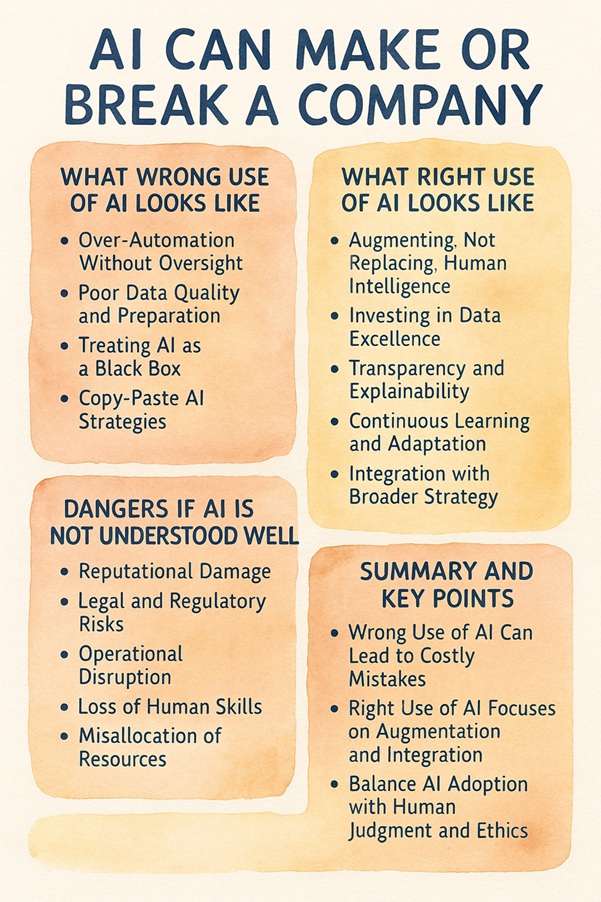
- What wrong use of AI looks like
Misusing AI often stems from rushing into adoption without a clear plan or realistic understanding of what the technology can and cannot do.
Over-automation without oversight:
Some companies see AI as a magic wand to cut costs and remove human involvement wherever possible. They automate complex decision-making without adequate supervision, leading to serious mistakes—such as misclassifying customers, rejecting valid transactions, or making biased hiring decisions. These errors can damage trust and brand reputation far more than the savings they promise.
Poor data quality and preparation:
AI is only as good as the data it learns from. Feeding it incomplete, outdated, or biased data leads to flawed predictions and decisions. For example, a retail AI trained on old customer data might recommend products irrelevant to current market trends, frustrating customers and wasting marketing spend.
Treating AI as a black box:
When companies deploy AI systems without understanding how they work, they lose the ability to explain outcomes. This lack of transparency is dangerous in regulated industries such as healthcare, finance, and law, where decisions must be justifiable. A “black box” approach can also hinder internal trust—employees may resist or bypass tools they don’t understand.
Copy-paste AI strategies:
Blindly copying what competitors are doing without tailoring AI to the company’s own goals and processes can lead to wasted investments. A generic chatbot might work for a rival with high-volume support needs but fail in a business where personal relationships drive customer loyalty.
- What right use of AI looks like
Successful companies treat AI as a strategic partner, not a quick-fix tool. They align AI initiatives with clear objectives, robust governance, and human oversight.
Augmenting, not replacing, human intelligence:
The most effective AI deployments enhance human decision-making rather than replacing it. For example, in healthcare, AI can flag anomalies in medical images so radiologists can focus on the most critical cases. This combination of machine speed and human judgment produces more accurate outcomes.
Investing in data excellence:
Top-performing companies treat data as a strategic asset. They clean, structure, and enrich it to ensure AI has the most accurate and relevant inputs. In retail, AI powered by fresh, high-quality data can personalize offers in real time, improving conversion rates and customer satisfaction.
Transparency and explainability:
Right use of AI involves choosing systems whose decisions can be explained and audited. This is particularly important in areas like credit scoring or insurance underwriting, where regulators and customers demand fairness and clarity.
Continuous learning and adaptation:
Markets evolve, and so must AI. Leading companies continuously monitor AI performance, retrain models with new data, and adjust algorithms to reflect changing conditions. This prevents drift and ensures that AI remains aligned with business goals.
Integration with broader strategy:
Instead of adopting AI piecemeal, successful companies weave it into their long-term strategy. This means considering how AI will impact operations, customer experience, supply chains, and employee roles—and ensuring each part supports the others.
- Dangers If AI not understood well
Failing to truly understand AI creates risks that can undermine both short-term performance and long-term viability.
Reputational damage:
If AI makes a high-profile mistake—such as denying loans unfairly, recommending harmful products, or producing offensive marketing content—the backlash can be swift and severe. In today’s social media-driven world, a single misstep can trend globally within hours.
Legal and regulatory risks:
Misusing AI can lead to violations of privacy laws, anti-discrimination rules, or industry-specific regulations. Without proper governance, a company could face lawsuits, fines, and costly remediation efforts.
Operational disruption:
AI systems are not infallible. If they are tightly integrated without proper contingency plans, failures can cascade through the organization—causing delays, halting production, or disrupting customer service.
Loss of human skills:
Over-reliance on AI can erode institutional knowledge. If employees come to depend entirely on algorithms, they may lose the ability to make independent decisions or think critically about unusual cases—leaving the company vulnerable if the AI system fails.
Misallocation of resources:
When AI projects are poorly understood, companies may invest heavily in initiatives that deliver little value. This wastes budgets, distracts leadership, and can slow investment in areas with higher potential.
- Summary and key points
AI is a double-edged sword in business—it can propel a company to new heights or accelerate its decline. The difference lies in understanding and execution.
Key takeaways:
- Wrong use of AI—including blind automation, poor data management, and lack of transparency—can lead to costly mistakes, lost trust, and wasted investments.
- Right use of AI focuses on augmentation, data excellence, explainability, and integration into the broader business strategy.
- Dangers of misunderstanding AI include reputational harm, regulatory breaches, operational breakdowns, loss of human expertise, and misallocation of resources.
- The best outcomes come from balanced adoption—combining AI’s speed and analytical power with human judgment, creativity, and ethical responsibility.
AI will not automatically make or break a company—it’s leadership’s understanding, planning, and governance that will decide which outcome prevails. Those who embrace AI thoughtfully, adapt continuously, and keep human values at the center will thrive. Those who rush in blindly risk becoming cautionary tales in the AI era.
RELATED POSTS


Nothing Found