AI vs human intelligence: A comparison
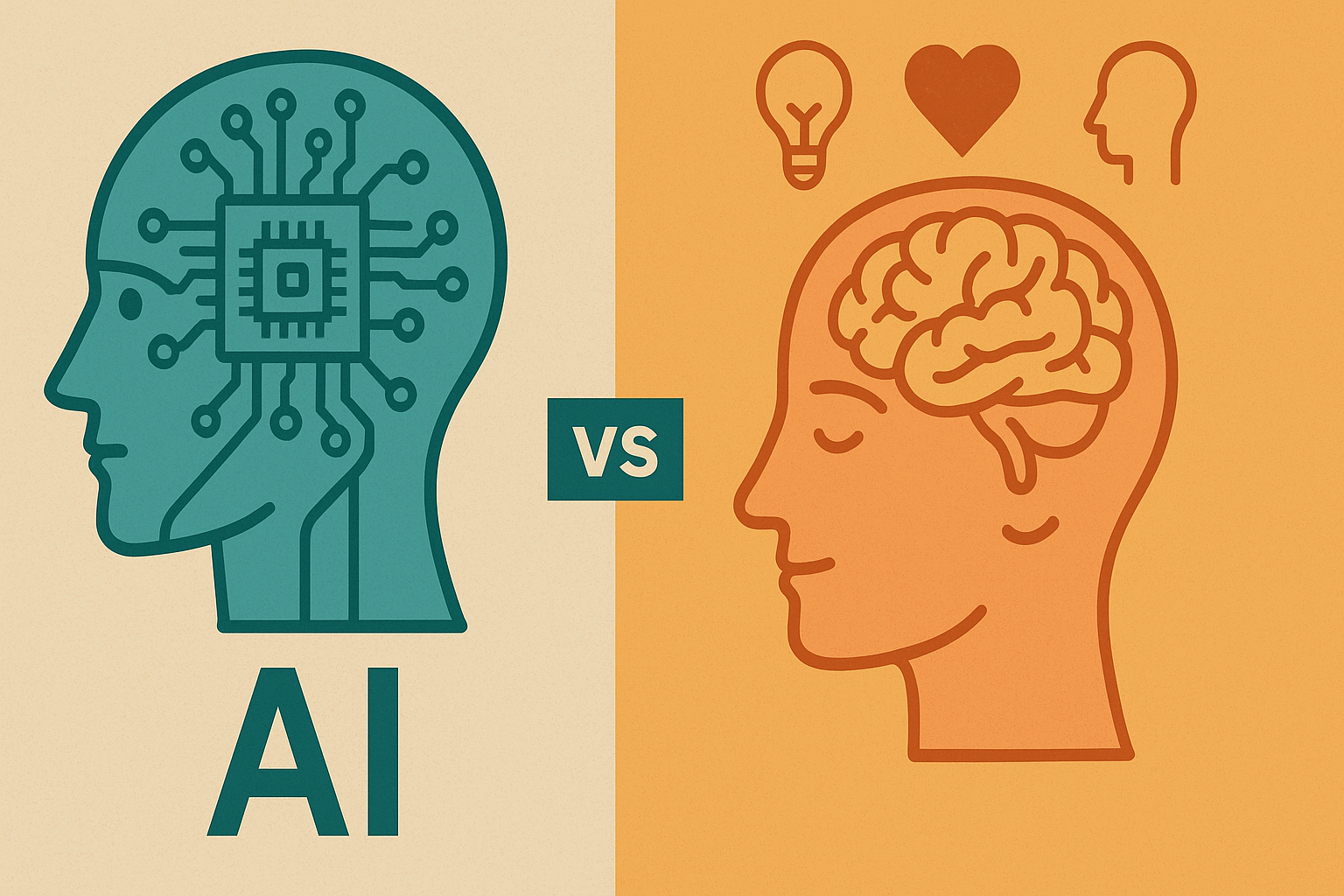
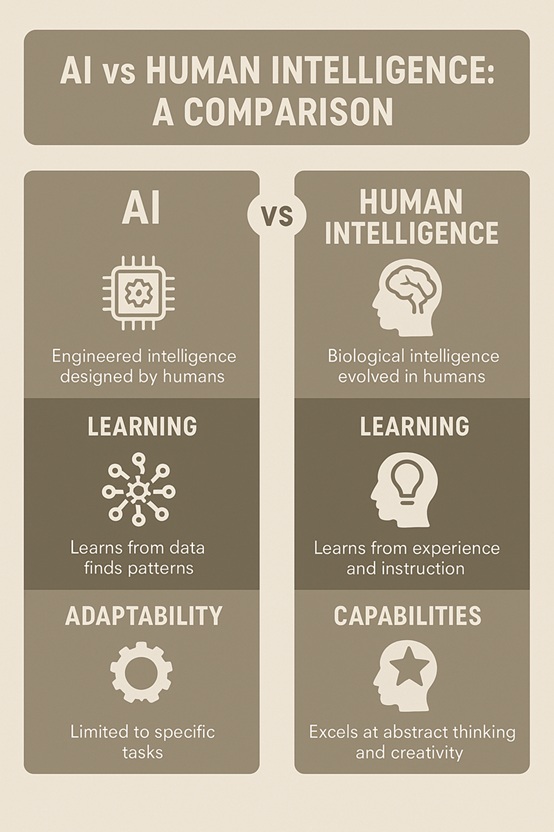
Artificial Intelligence (AI) and human intelligence are often compared, but they fundamentally differ in structure, capability, adaptability, and origin. Understanding their distinctions is crucial to framing expectations about what AI can—and cannot—achieve.
At its core, human intelligence is a product of biological evolution, characterized by consciousness, emotions, creativity, self-awareness, and a flexible, generalized ability to learn across diverse domains. Humans possess intuition, moral reasoning, and an understanding of abstract concepts beyond direct sensory input. Emotional and social intelligence are deeply ingrained, enabling collaboration, empathy, and cultural development.
Artificial Intelligence, by contrast, is engineered intelligence—algorithmically designed to perform specific tasks by processing vast amounts of data. While modern AI systems can surpass humans in narrow domains—such as chess, image recognition, or language translation—they do not possess self-awareness, emotional understanding, or true creativity. AI lacks the ability to generalize knowledge outside its trained data sets unless explicitly programmed or retrained for new tasks.
One of the key differences lies in learning mechanisms. Humans learn through a combination of experience, social interaction, abstraction, and emotion. AI systems learn statistically, identifying patterns within datasets to optimize outcomes according to predefined objectives. They are excellent at finding correlations but struggle with causal reasoning unless specifically modeled.
Adaptability is another dividing line. Humans can seamlessly shift between radically different tasks with minimal instruction. In contrast, AI is brittle; it performs remarkably well within its trained parameters but often fails when faced with scenarios outside its programmed scope (a phenomenon called “out-of-distribution failure”).
Speed and scale also differentiate the two. AI can process massive datasets and perform calculations at speeds impossible for the human brain. However, humans excel at low-data, high-context reasoning—drawing conclusions from limited information based on prior knowledge and judgment.
In summary, AI is a powerful augmentation tool but not a replacement for human intelligence. It excels at specialized, repetitive, and high-volume tasks, while human intelligence remains superior in creativity, emotional understanding, ethical reasoning, and complex problem-solving across varied contexts. Recognizing and respecting these differences is key to designing systems where AI complements rather than competes with human capabilities.