Key fields within artificial intelligence
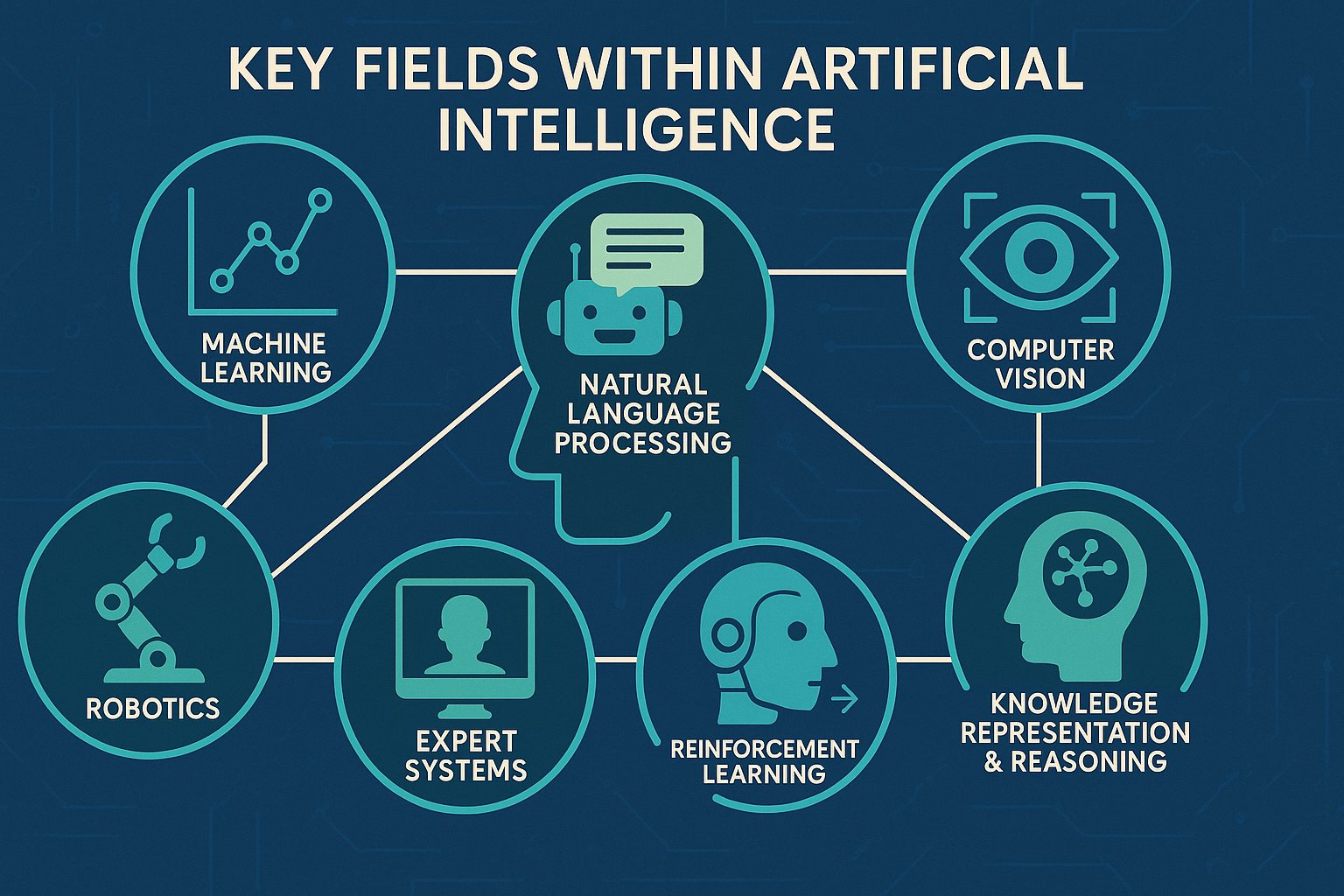
Artificial Intelligence (AI) is not a single technology but an umbrella term that encompasses a range of specialized fields, each contributing to the creation of intelligent systems. Understanding these core areas is essential for grasping the true depth and complexity of AI.
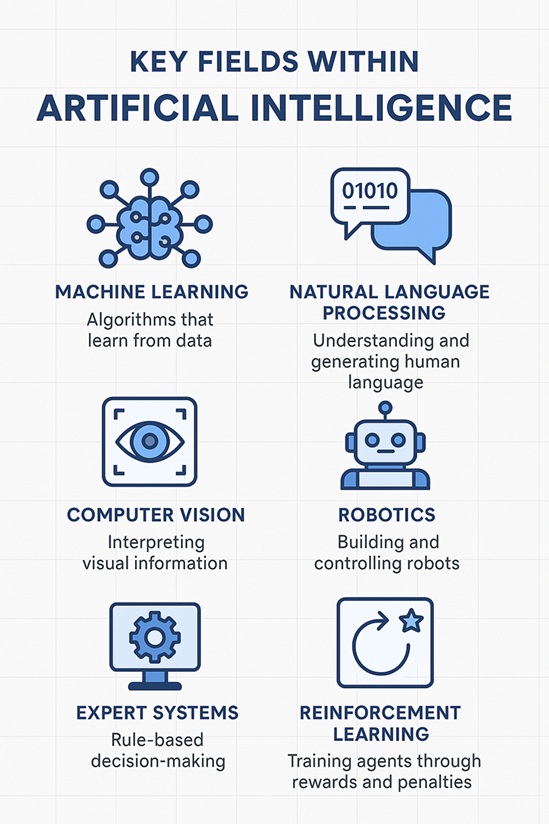
Machine Learning (ML) is perhaps the most prominent field within AI today. It focuses on developing algorithms that allow machines to learn from and make predictions based on data without explicit programming. ML itself branches into subfields like supervised learning, unsupervised learning, and reinforcement learning, each addressing different types of tasks and data environments.
Natural Language Processing (NLP) enables machines to understand, interpret, and generate human language. This field powers applications like chatbots, language translators, and voice assistants. NLP combines computational linguistics, machine learning, and deep learning to bridge the gap between human communication and machine understanding.
Computer Vision deals with teaching machines to interpret and make decisions based on visual inputs such as images and videos. Key applications include facial recognition, medical imaging diagnostics, autonomous vehicles, and object detection systems. Advances in convolutional neural networks (CNNs) have significantly accelerated progress in this domain.
Robotics integrates AI with mechanical systems to design and operate autonomous or semi-autonomous machines. Robots equipped with AI can navigate environments, make real-time decisions, and perform complex tasks ranging from industrial automation to surgical procedures.
Expert Systems are AI programs that simulate the decision-making abilities of a human expert. These systems use rule-based logic to analyze information and solve specific problems within domains such as medical diagnosis, engineering, and finance.
Reinforcement Learning (RL), though a subset of machine learning, stands as a distinctive field. In RL, agents learn optimal behavior through trial and error, receiving rewards or penalties. It is crucial for developing decision-making systems in dynamic environments like gaming, robotics, and financial modeling.
Knowledge Representation and Reasoning (KRR) deals with how information about the world can be structured and used by AI to solve complex problems, infer new information, and make logical decisions.
Collectively, these fields form the backbone of AI innovation, each pushing the frontier of what machines can perceive, understand, and achieve.