Key milestones in AI development
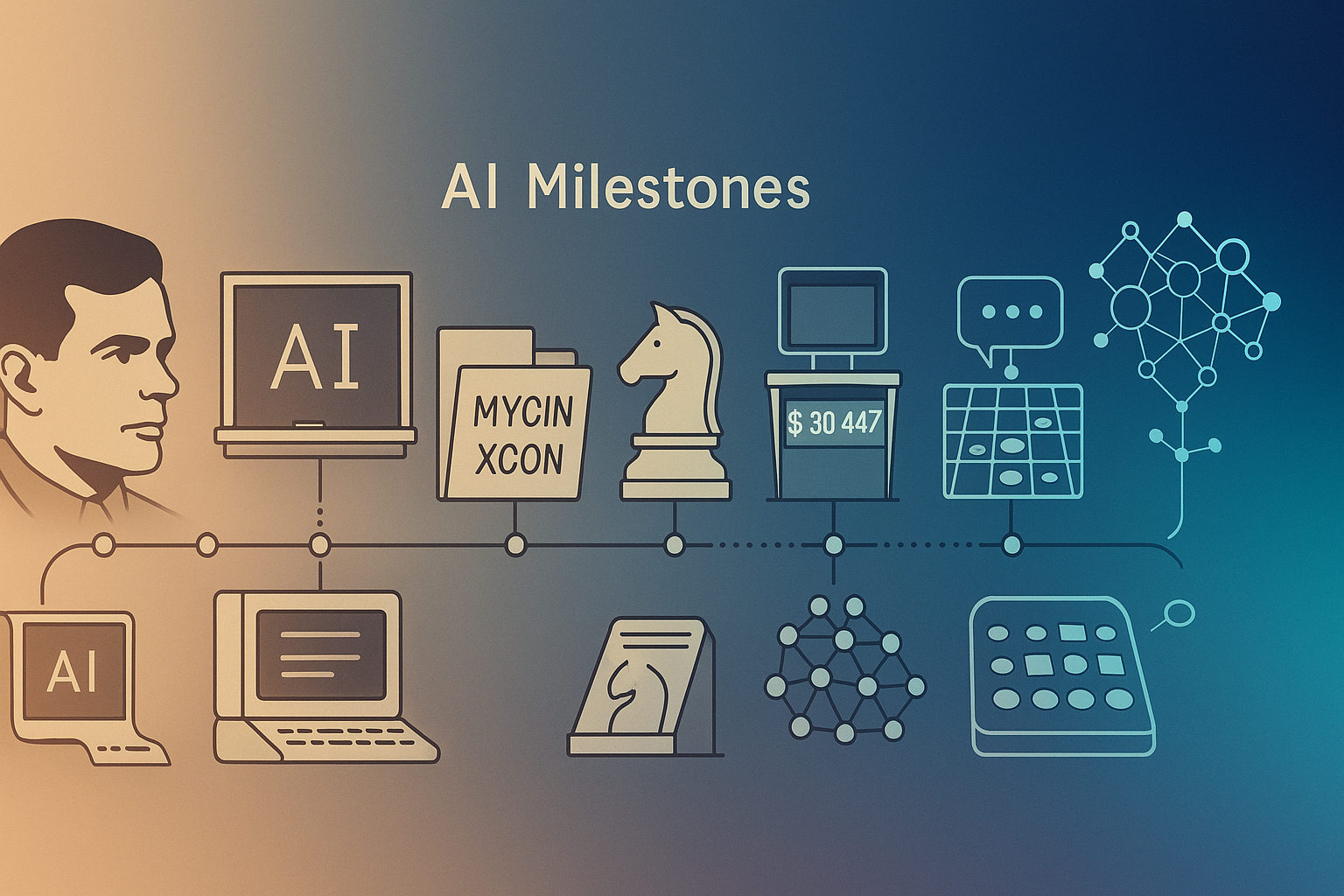
The development of Artificial Intelligence (AI) has been punctuated by a series of pivotal milestones—each marking a leap in how machines replicate, support, or extend human cognition. These breakthroughs have not only expanded the frontiers of computer science but have also redefined what machines are capable of in practical, commercial, and societal contexts.
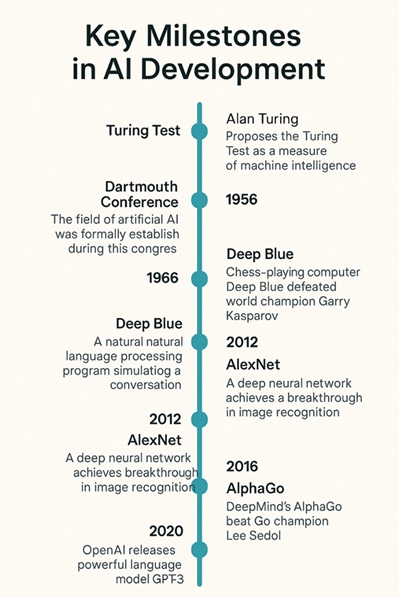
The journey began with Alan Turing’s foundational work in the 1940s and his 1950 paper “Computing Machinery and Intelligence”, where he introduced the Turing Test, a thought experiment still referenced in modern AI discourse. This laid the philosophical and mathematical groundwork for artificial reasoning.
The Dartmouth Conference of 1956, often considered AI’s birth event, gathered pioneers like John McCarthy, Marvin Minsky, and Claude Shannon. It was here that the term “Artificial Intelligence” was officially coined, catalyzing formal research into machine reasoning, learning, and symbolic manipulation.
One of the first operational AI programs was ELIZA (1966), an early natural language processor that simulated a psychotherapist. Though rudimentary, ELIZA illustrated AI’s potential for human-machine interaction. In the 1980s, expert systems like MYCIN and XCON demonstrated AI’s utility in decision support—especially in medicine and business rule systems.
A seismic shift occurred in 1997, when IBM’s Deep Blue defeated world chess champion Garry Kasparov, marking the first time a machine outperformed a human in a complex intellectual domain. This was followed by IBM Watson’s victory on Jeopardy! (2011), showcasing the integration of natural language understanding with reasoning at scale.
Perhaps the most transformative milestone came in 2012, when a deep convolutional neural network—AlexNet—won the ImageNet challenge by a significant margin, sparking the deep learning revolution. This led to the rapid advancement of computer vision, NLP, and speech recognition capabilities.
In 2016, DeepMind’s AlphaGo defeated Go champion Lee Sedol, a feat previously thought to be decades away. The rise of large language models (LLMs) like GPT-3 and GPT-4, and generative AI like DALL·E and ChatGPT, has since brought AI to mainstream awareness.
These milestones represent not just technical victories, but a steady march toward general-purpose, adaptable intelligence—shaping industries, governance, and human-computer collaboration in profound ways.