Narrow AI vs General AI vs Super AI
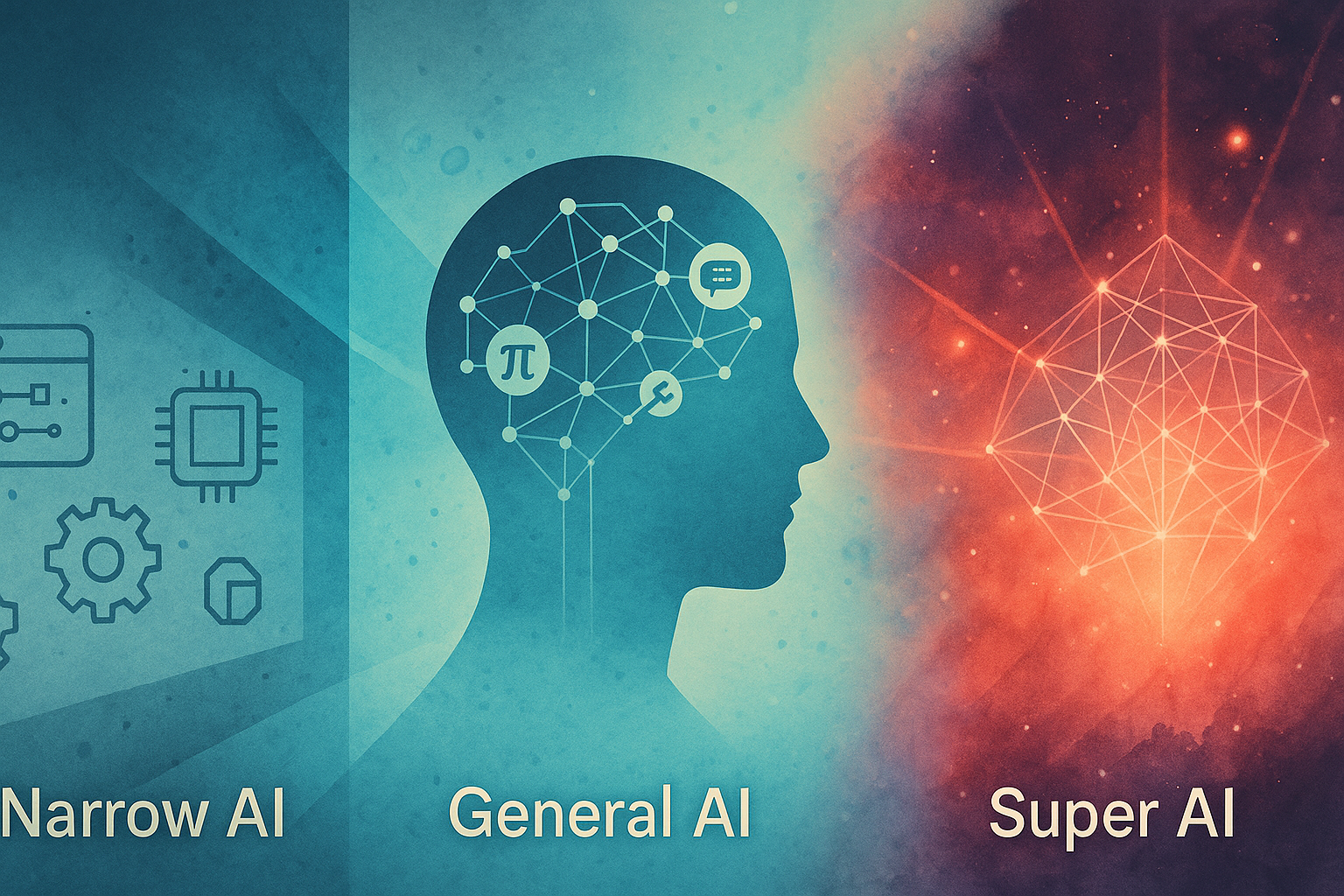
Artificial Intelligence (AI) is a broad field, but its evolution can be categorized into three distinct stages: Narrow AI, General AI, and Super AI — each representing a major leap in capabilities, complexity, and risks.
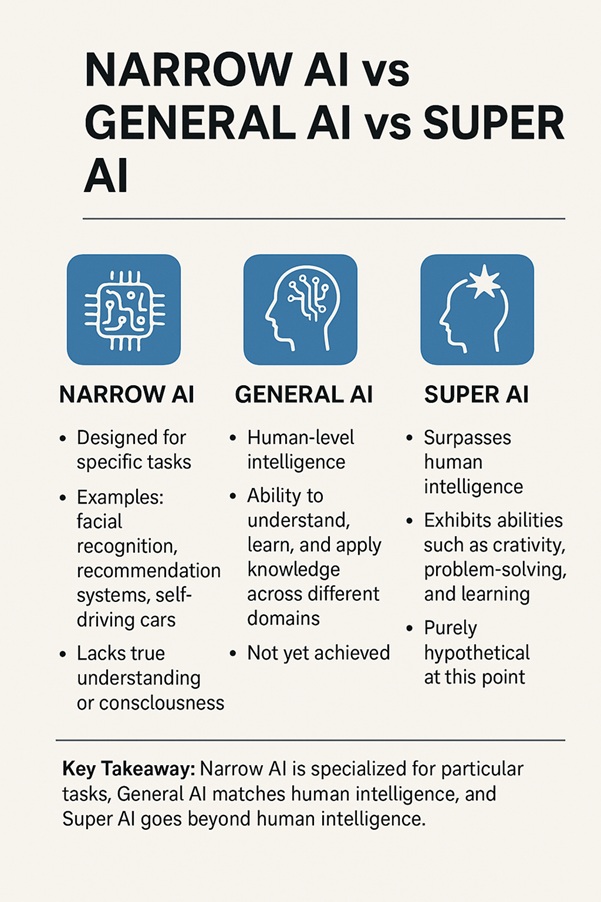
Narrow AI, also called Weak AI, refers to systems designed and trained for a specific task. Today’s AI ecosystem is almost entirely dominated by Narrow AI. Examples include facial recognition software, recommendation algorithms, autonomous vehicles, and language models like GPT. These systems operate within a predefined range and cannot function beyond their programming or learn context outside of it. Despite their impressive performance in specialized domains, Narrow AI lacks true understanding, consciousness, or self-awareness.
General AI (AGI – Artificial General Intelligence) is the theoretical next stage. An AGI would possess the ability to understand, learn, and apply knowledge across a wide variety of tasks, matching human cognitive abilities. Unlike Narrow AI, an AGI could reason, plan, solve unfamiliar problems, and adapt flexibly to new situations without requiring task-specific training. Building AGI remains one of the greatest unsolved challenges in computer science, cognitive science, and philosophy. Experts disagree on when — or if — true AGI will be achieved, and debate continues around its ethical, economic, and existential implications.
Super AI represents a hypothetical intelligence far surpassing human intellect across all domains, including creativity, decision-making, emotional intelligence, and problem-solving. Super AI would not only perform tasks better than humans but could also innovate in ways humans cannot even conceptualize. If realized, Super AI could revolutionize civilization but also pose profound risks, including potential loss of human control over critical systems. Researchers in AI safety stress the need for robust alignment strategies to ensure that the goals of Super AI remain beneficial to humanity.
In summary, today’s world is firmly rooted in Narrow AI, with General and Super AI still in the realm of research and speculation. Understanding these categories is crucial, as the transition from one stage to another will redefine technology, society, and the future of human existence.