The history of AI: From Turing to today
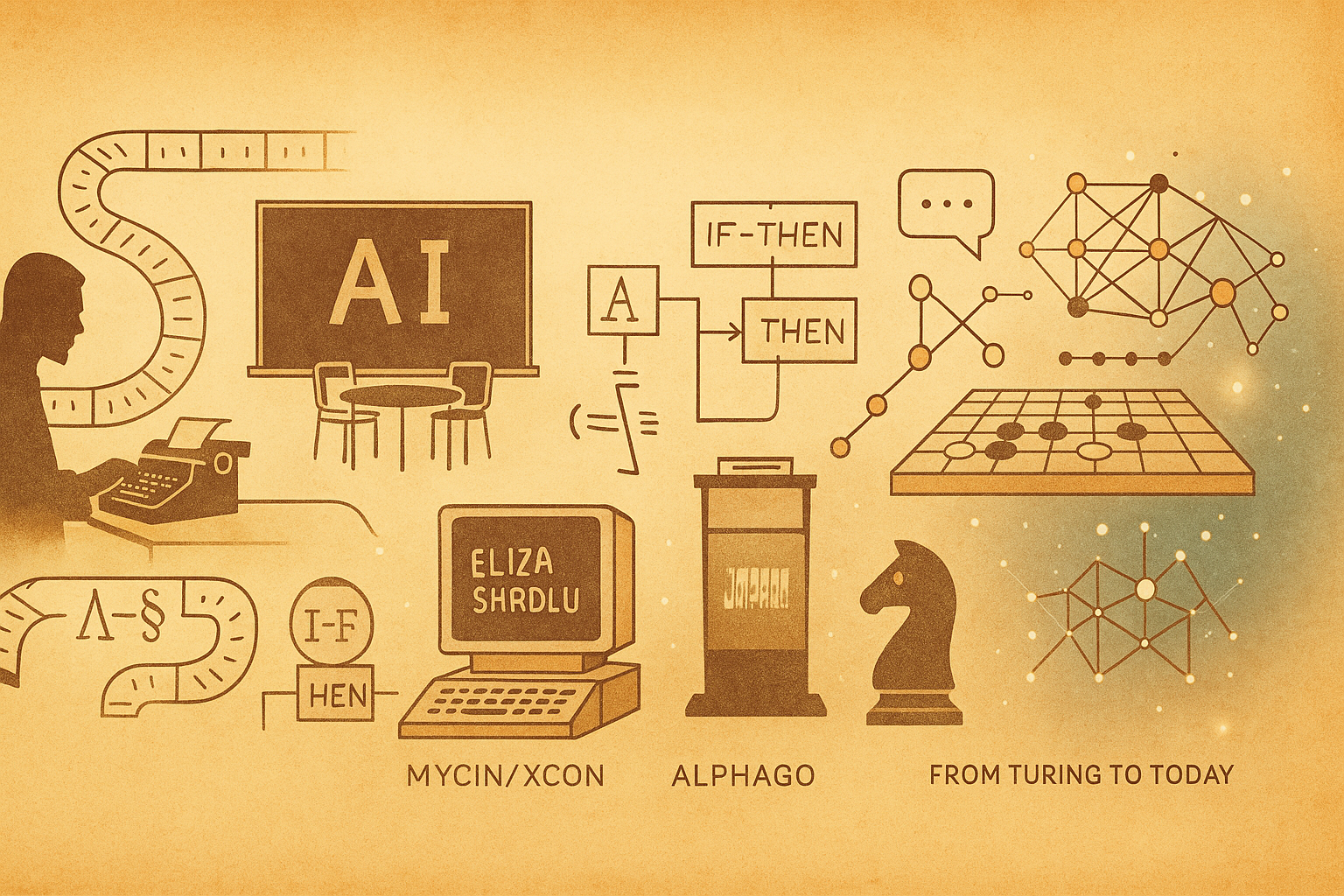
The history of Artificial Intelligence (AI) is a story of ambition, breakthroughs, setbacks, and persistent innovation — beginning long before the term “AI” was coined. The intellectual roots of AI stretch back to classical philosophers who dreamed of mechanizing reasoning, but its formal foundation was laid in the 20th century.
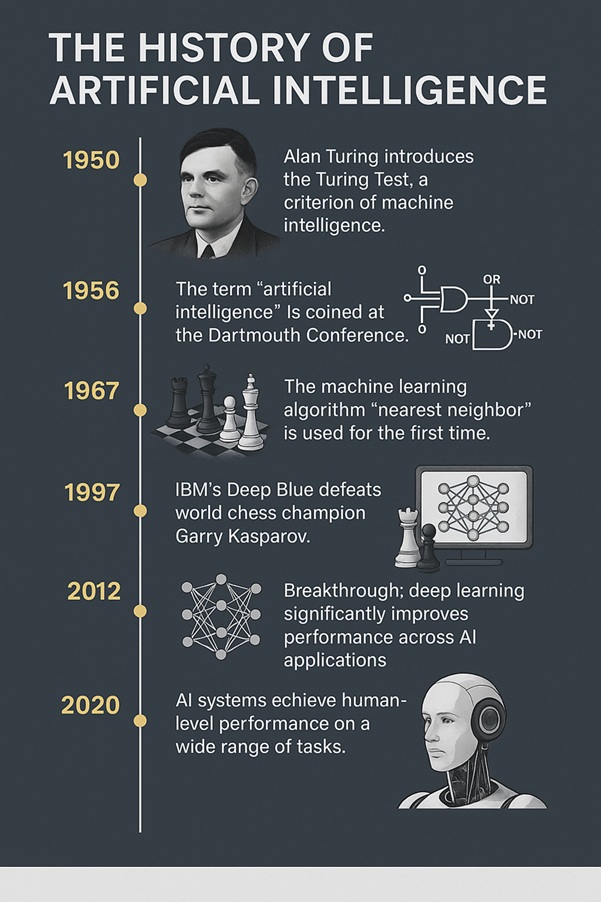
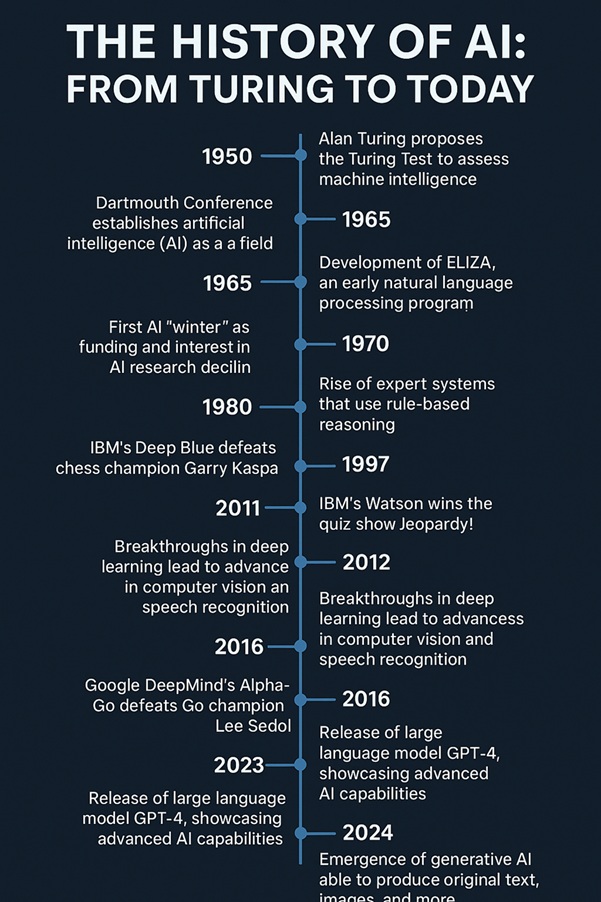
The modern AI narrative arguably begins with Alan Turing, who, in his seminal 1950 paper “Computing Machinery and Intelligence”, posed the question, “Can machines think?”. He introduced the Turing Test as a benchmark for machine intelligence — a criterion that still provokes debate.
The Dartmouth Conference of 1956, led by John McCarthy, Marvin Minsky, Claude Shannon, and others, formally launched AI as a field. McCarthy coined the term “Artificial Intelligence,” envisioning machines that could simulate every aspect of learning and intelligence. This era was marked by symbolic AI, or “Good Old-Fashioned AI” (GOFAI), which relied on explicit rules and logic.
The 1960s and 70s saw enthusiasm but also limits — early systems like ELIZA and SHRDLU could simulate intelligence in narrow domains but failed to generalize. By the mid-1970s, the first AI winter set in due to unmet expectations and limited computing power.
In the 1980s, expert systems revived interest. Programs like MYCIN and XCON showcased rule-based reasoning in medicine and business. But their brittleness led to another slowdown — the second AI winter — in the early 1990s.
The turning point came with machine learning and, later, deep learning. Fueled by large datasets, powerful GPUs, and algorithms like backpropagation, deep neural networks began outperforming traditional approaches. Milestones like IBM’s Deep Blue (1997), Watson (2011), and Google DeepMind’s AlphaGo (2016) demonstrated AI’s increasing power.
Today, with large language models, computer vision, reinforcement learning, and generative AI, we are in the midst of a renaissance — not just advancing AI technology, but redefining how society interfaces with intelligence itself.
From Turing’s thought experiments to GPT-4, AI has evolved from theory to pervasive reality — and its history is far from over.