GENERATIVE AI basics
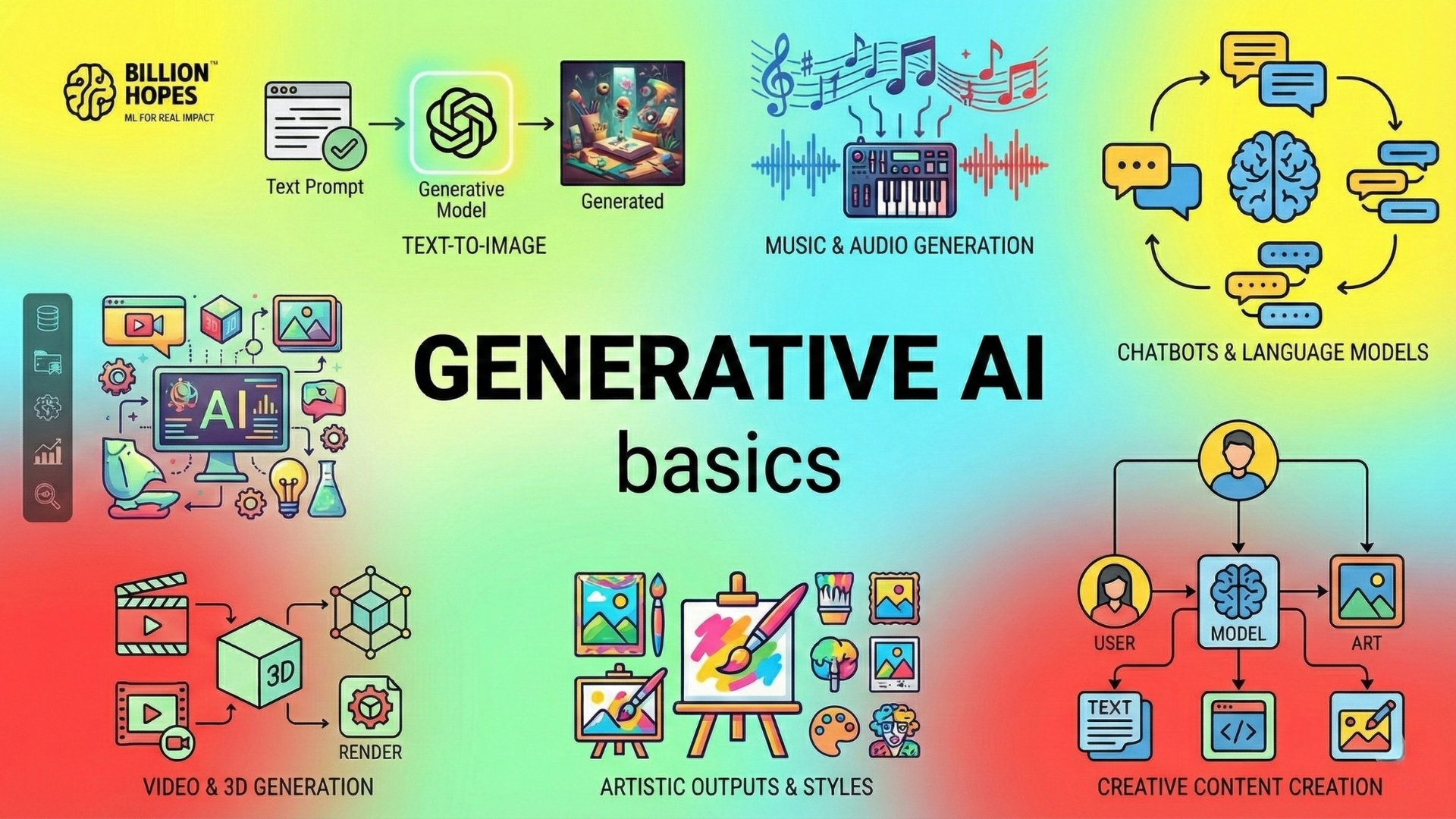
1. What is Generative AI – and why is it different
Generative AI refers to a class of artificial intelligence (AI) systems that can create new content rather than merely analyze or classify existing data. This content can include text, images, audio, video, code, 3D designs, simulations, and synthetic data. Unlike earlier AI systems that focused on prediction (“Is this spam?”) or classification (“Is this a cat or a dog?”), generative models answer a fundamentally different question: “What could exist next?” This is a totally new paradigm.
At its core, Generative AI learns the underlying patterns, structures, and distributions of data and then samples from those patterns to produce new outputs that resemble – but are not copies of – the training data. When a large language model writes an essay, it is not retrieving stored text; it is generating each word probabilistically based on context, grammar, semantics, and learned world knowledge.
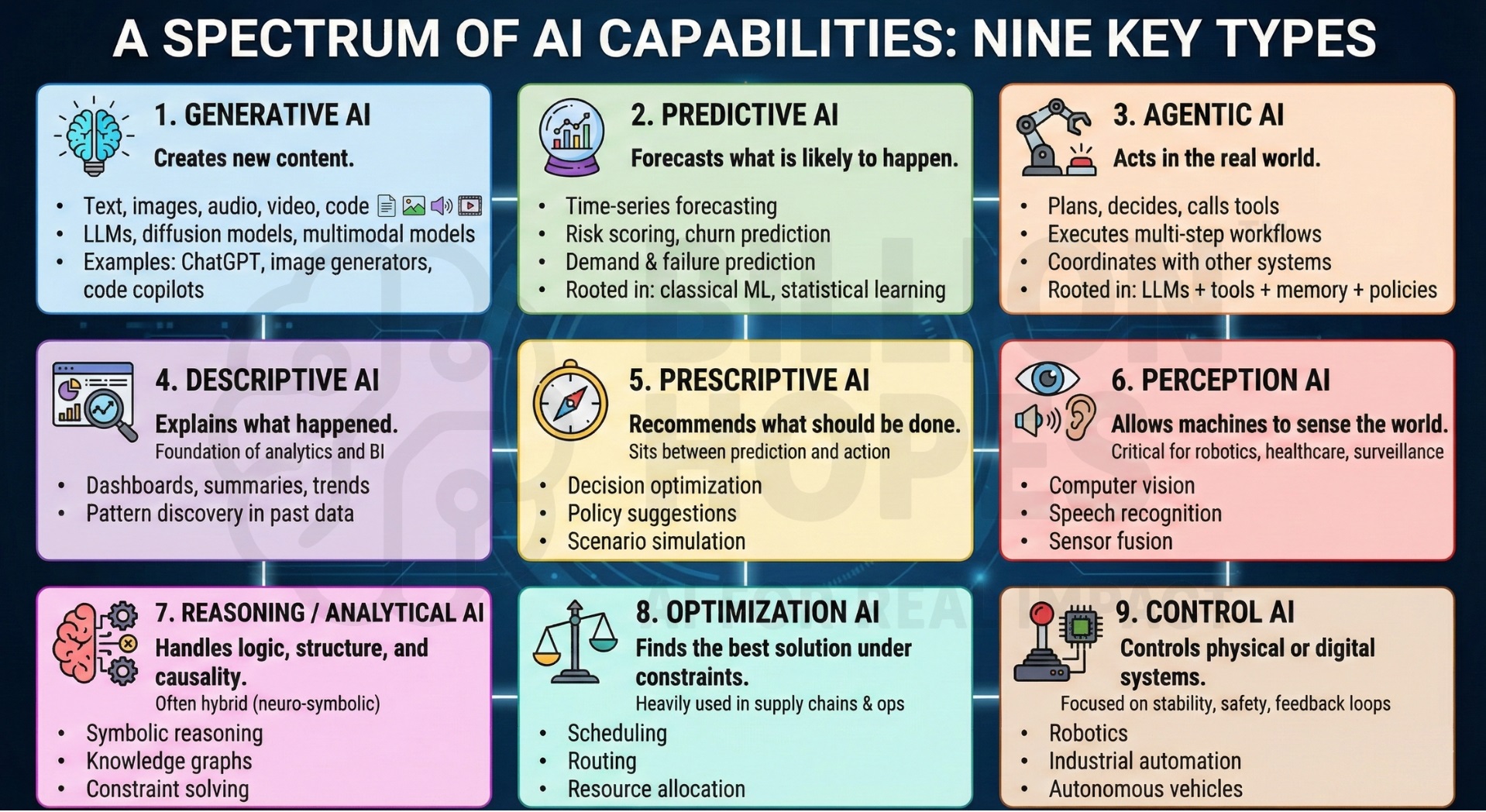
This shift – from recognizing patterns to producing them – is what makes Generative AI transformative. It turns AI from a passive tool into an active collaborator in thinking, design, creativity, and problem-solving. That said, AI has no true understanding of the human world, nor any sentience or consciousness. A full spectrum of AI Capabilities can be seen now across 9 key types.
Our wonderful course on GenAI can be a good starting point for learners of any age!
2. A brief history: From rules to generators
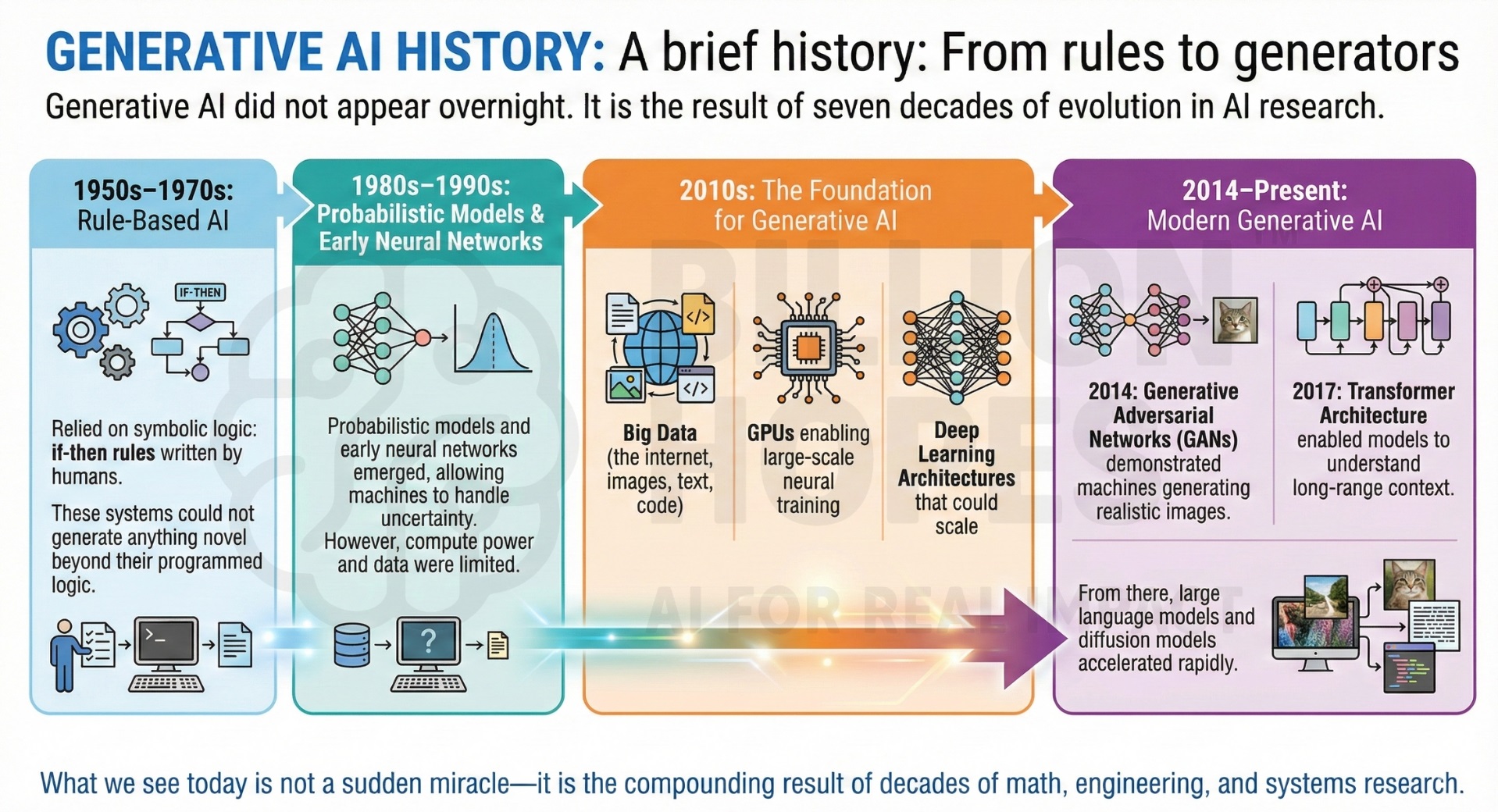
Generative AI did not appear overnight. It is the result of seven decades of evolution in AI research.
In the 1950s–1970s, AI systems were rule-based. They relied on symbolic logic: if-then rules written by humans. These systems could not generate anything novel beyond their programmed logic.
In the 1980s–1990s, probabilistic models and early neural networks emerged, allowing machines to handle uncertainty. However, compute power and data were limited.
The real foundation for Generative AI was laid in the 2010s with three key breakthroughs:
- Big data (the internet, images, text, code)
- GPUs enabling large-scale neural training
- Deep learning architectures that could scale
In 2014, Generative Adversarial Networks (GANs) demonstrated machines generating realistic images. In 2017, the Transformer architecture enabled models to understand long-range context. From there, large language models and diffusion models accelerated rapidly.
What we see today is not a sudden miracle—it is the compounding result of decades of math, engineering, and systems research. An excellent collection of learning videos awaits you on our Youtube channel.
3. Core types of Generative AI models
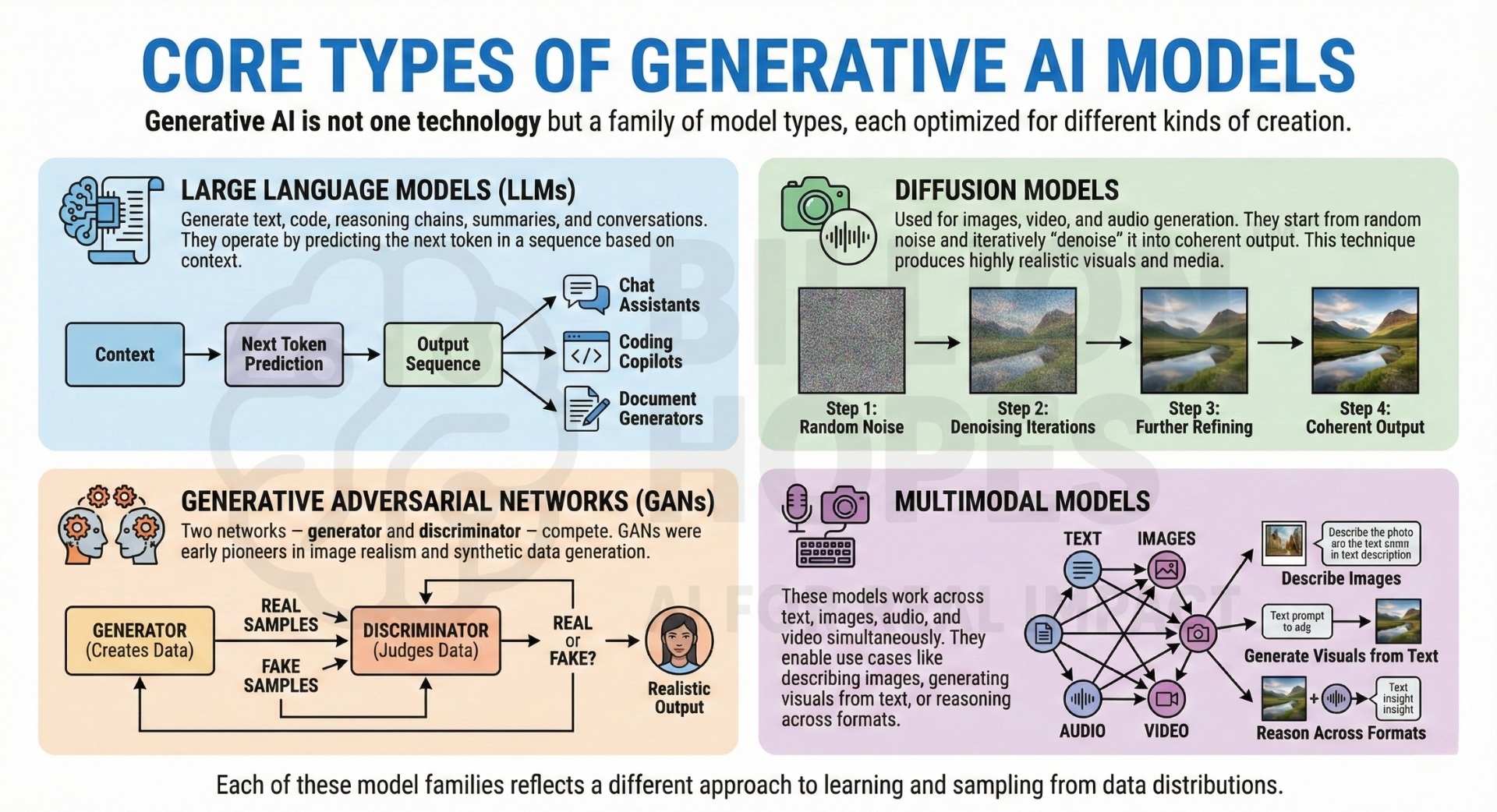
Generative AI is not one technology but a family of model types, each optimized for different kinds of creation.
Large Language Models (LLMs)
These generate text, code, reasoning chains, summaries, and conversations. They operate by predicting the next token in a sequence based on context. LLMs power chat assistants, coding copilots, and document generators.
Diffusion Models
Used for images, video, and audio generation. They start from random noise and iteratively “denoise” it into coherent output. This technique produces highly realistic visuals and media.
Generative Adversarial Networks (GANs)
Two networks – generator and discriminator – compete. GANs were early pioneers in image realism and synthetic data generation.
Multimodal Models
These models work across text, images, audio, and video simultaneously. They enable use cases like describing images, generating visuals from text, or reasoning across formats.
Each of these model families reflects a different approach to learning and sampling from data distributions.
4. How Generative AI works (conceptual architecture)
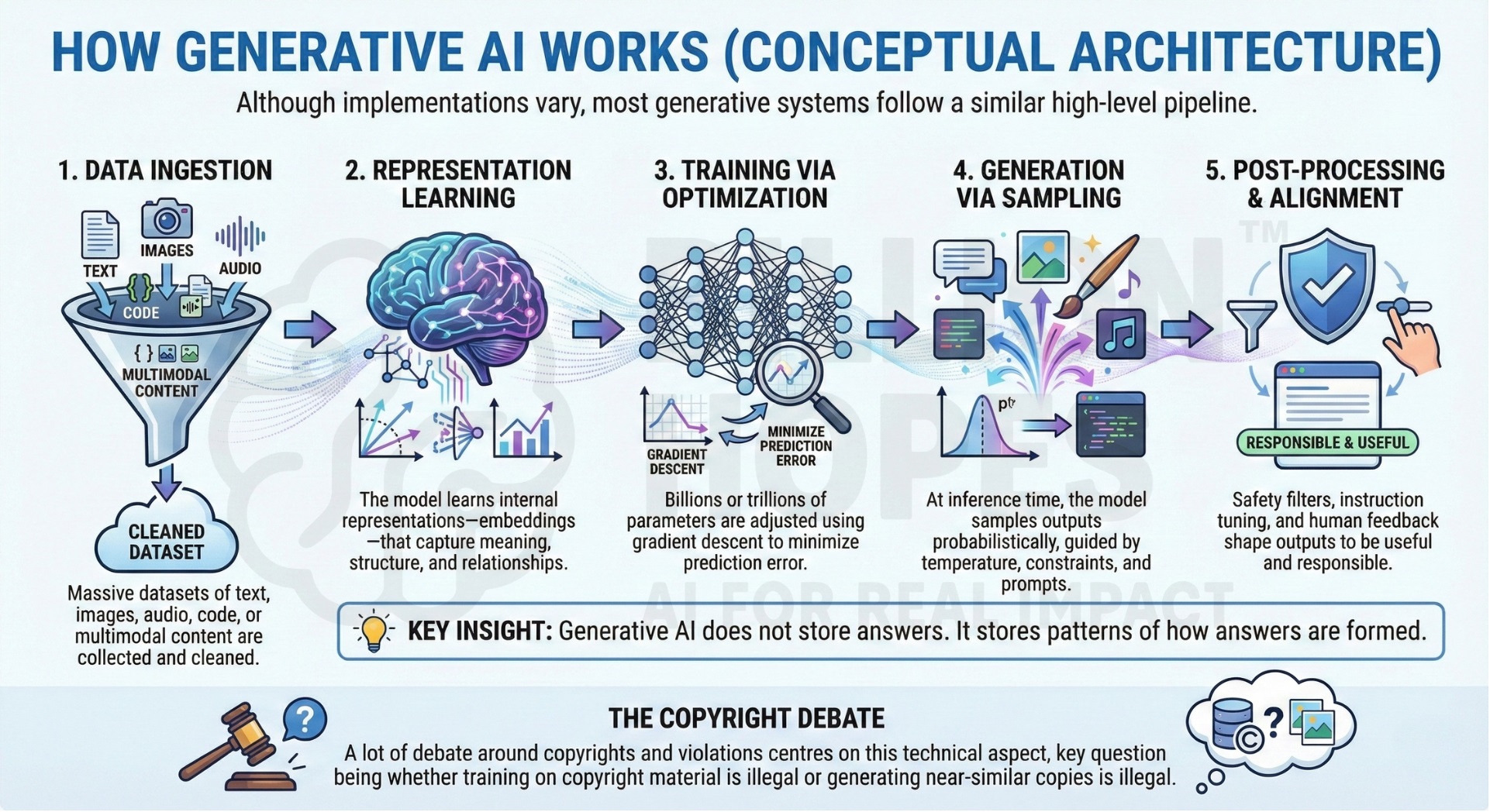
Although implementations vary, most generative systems follow a similar high-level pipeline:
- Data ingestion
Massive datasets of text, images, audio, code, or multimodal content are collected and cleaned. - Representation learning
The model learns internal representations—embeddings—that capture meaning, structure, and relationships. - Training via optimization
Billions or trillions of parameters are adjusted using gradient descent to minimize prediction error. - Generation via sampling
At inference time, the model samples outputs probabilistically, guided by temperature, constraints, and prompts. - Post-processing & alignment
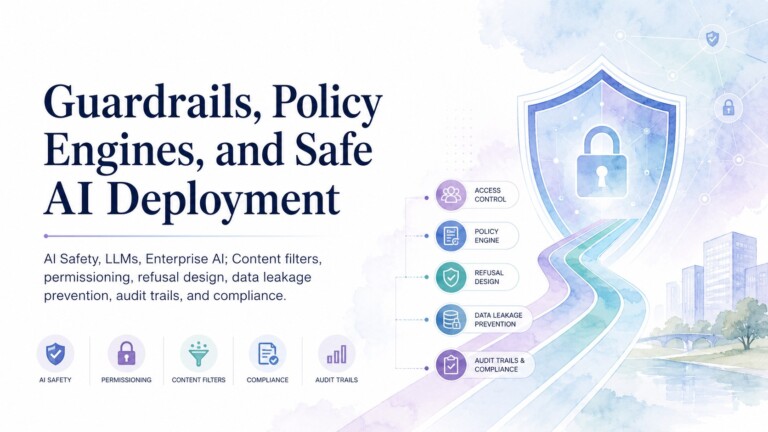
Safety filters, instruction tuning, and human feedback shape outputs to be useful and responsible.
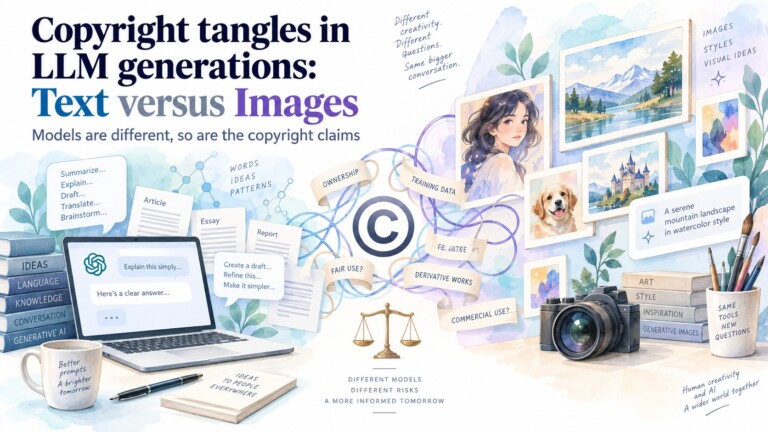
The key insight is this: Generative AI does not store answers. It stores patterns of how answers are formed. A lot of debate around copyrights and violations centres on this technical aspect, key question being whether training on copyright material is illegal or generating near-similar copies is illegal. A constantly updated Whatsapp channel awaits your participation.
5. Why Generative AI feels intelligent
Generative AI often appears intelligent because it operates at the level where humans experience intelligence: language, images, ideas, and creativity.
Three factors amplify this perception:
- Fluency: Outputs are grammatically and stylistically coherent.
- Context awareness: Models track long conversations and constraints.
- Generalization: Models combine knowledge across domains.
However, it is critical to understand that generative models do not possess understanding, intent, or consciousness. They do not “know” facts; they model statistical relationships between symbols.
This distinction matters. Generative AI is powerful, but it is not a thinking being. It is a reasoning simulator, not a mind. In fact, none of AI has a mind of its own, but it is the human weakness of anthropomorphizing that leads to such erroneous conclusions.
6. Major Industry use cases
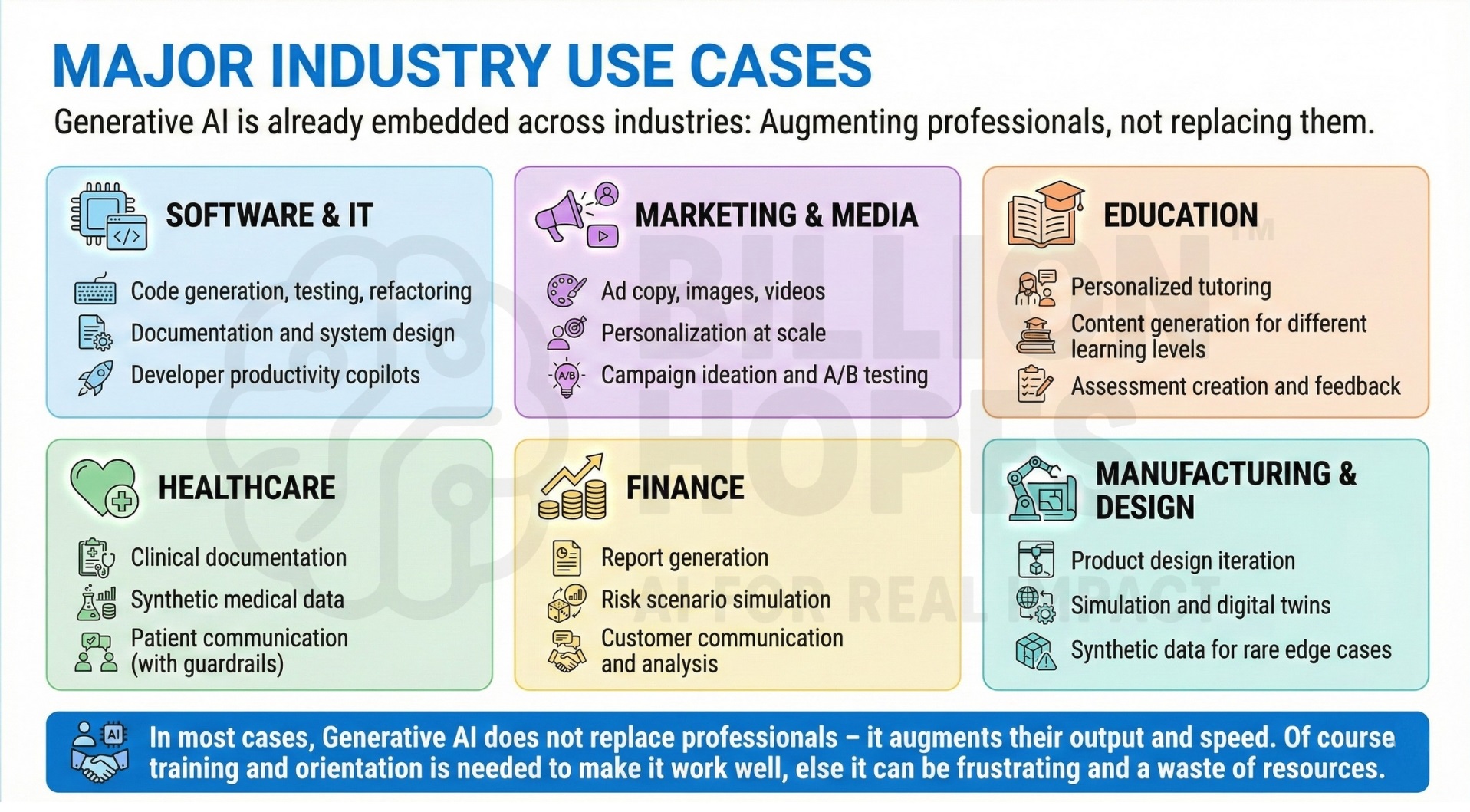
Generative AI is already embedded across industries:
Software & IT
- Code generation, testing, refactoring
- Documentation and system design
- Developer productivity copilots
Marketing & Media
- Ad copy, images, videos
- Personalization at scale
- Campaign ideation and A/B testing
Education
- Personalized tutoring
- Content generation for different learning levels
- Assessment creation and feedback
Healthcare
- Clinical documentation
- Synthetic medical data
- Patient communication (with guardrails)
Finance
- Report generation
- Risk scenario simulation
- Customer communication and analysis
Manufacturing & Design
- Product design iteration
- Simulation and digital twins
- Synthetic data for rare edge cases
In most cases, Generative AI does not replace professionals – it augments their output and speed. Of course, training and orientation is needed to make it work well, else it can be frustrating and a waste of resources. Excellent individualised mentoring programmes available.
7. Generative AI as a productivity force multiplier
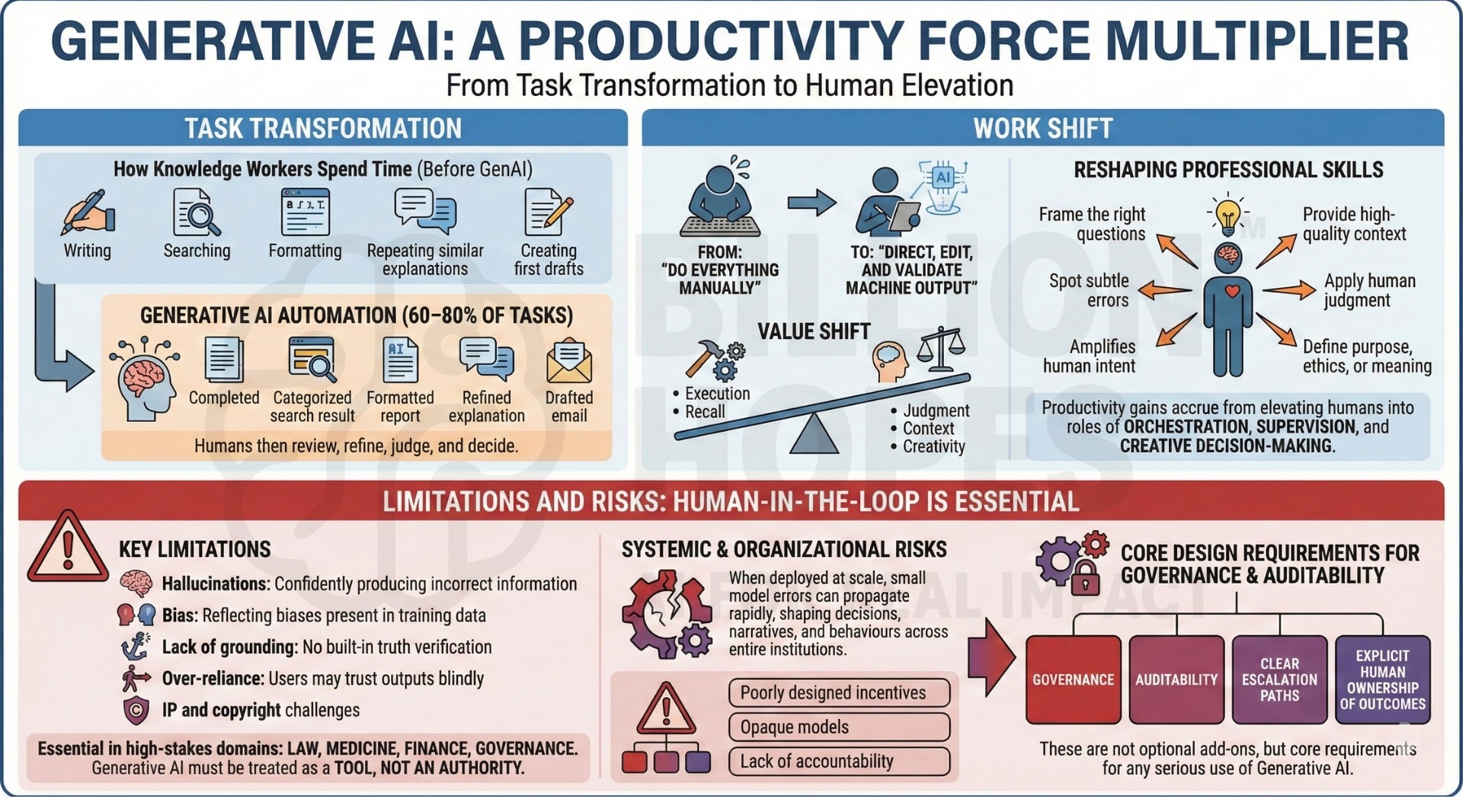
The most immediate impact of Generative AI is not job replacement but task transformation.
Knowledge workers spend a large portion of their time:
- Writing
- Searching
- Formatting
- Repeating similar explanations
- Creating first drafts
Generative AI automates the first 60–80% of these tasks. Humans then review, refine, judge, and decide.
This changes work from:
“Do everything manually”
to
“Direct, edit, and validate machine output”
The value shifts from execution to judgment, context, and creativity.
Over time, this rebalancing fundamentally reshapes professional skills. The most valuable workers are no longer those who type fastest or recall the most information, but those who can frame the right questions, provide high-quality context, spot subtle errors, and apply human judgment where machines cannot. Generative AI amplifies human intent, but it cannot define purpose, ethics, or meaning. As a result, productivity gains accrue not from replacing humans, but from elevating them into roles of orchestration, supervision, and creative decision-making.
8. Limitations and Risks
Despite its power, Generative AI has serious limitations:
- Hallucinations: Confidently producing incorrect information
- Bias: Reflecting biases present in training data
- Lack of grounding: No built-in truth verification
- Over-reliance: Users may trust outputs blindly
- IP and copyright challenges
These limitations make human-in-the-loop systems essential, especially in high-stakes domains like law, medicine, finance, and governance.
Generative AI must be treated as a tool, not an authority.
Beyond technical flaws, Generative AI also introduces systemic and organizational risks. When deployed at scale, small model errors can propagate rapidly, shaping decisions, narratives, and behaviours across entire institutions.
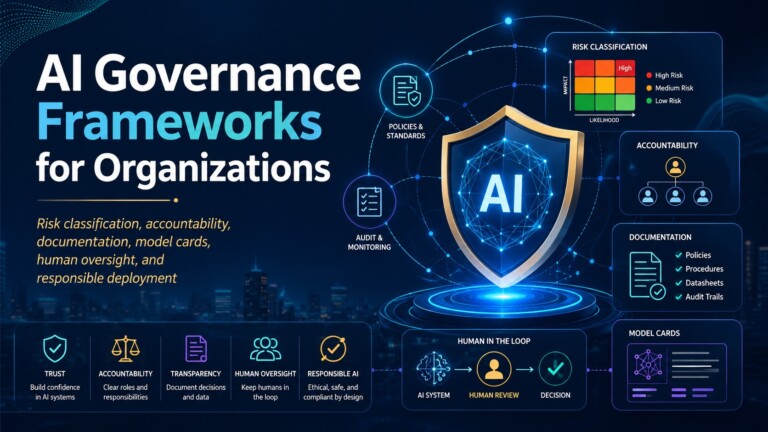
Poorly designed incentives may encourage automation without accountability, while opaque models make it difficult to trace responsibility when things go wrong. This is why governance, auditability, clear escalation paths, and explicit human ownership of outcomes are not optional add-ons, but core design requirements for any serious use of Generative AI. Subscribe to our free AI newsletter now.
9. Governance, ethics, and responsible use
As Generative AI becomes more capable, governance becomes unavoidable.
Key principles include:
- Transparency about AI-generated content
- Accountability for decisions made using AI
- Clear boundaries in sensitive domains
- Ongoing monitoring and evaluation
- Alignment with societal values
Organizations are increasingly adopting AI governance frameworks, model audits, and usage policies to ensure safe deployment.
Responsible AI is not about slowing innovation – it is about making innovation sustainable.
In practice, responsible governance requires embedding these principles directly into workflows, not treating them as compliance checklists. This includes documenting model assumptions, defining acceptable use cases, logging AI-assisted decisions, and ensuring humans retain final authority in high-impact outcomes.
As AI systems evolve continuously, governance must also be adaptive – reviewed, tested, and updated as models, data, and societal expectations change. Strong governance builds trust, and trust is what ultimately allows Generative AI to scale responsibly across organizations and societies.
Our wonderful course on GenAI can be a good starting point for learners of any age!
10. The future of Generative AI
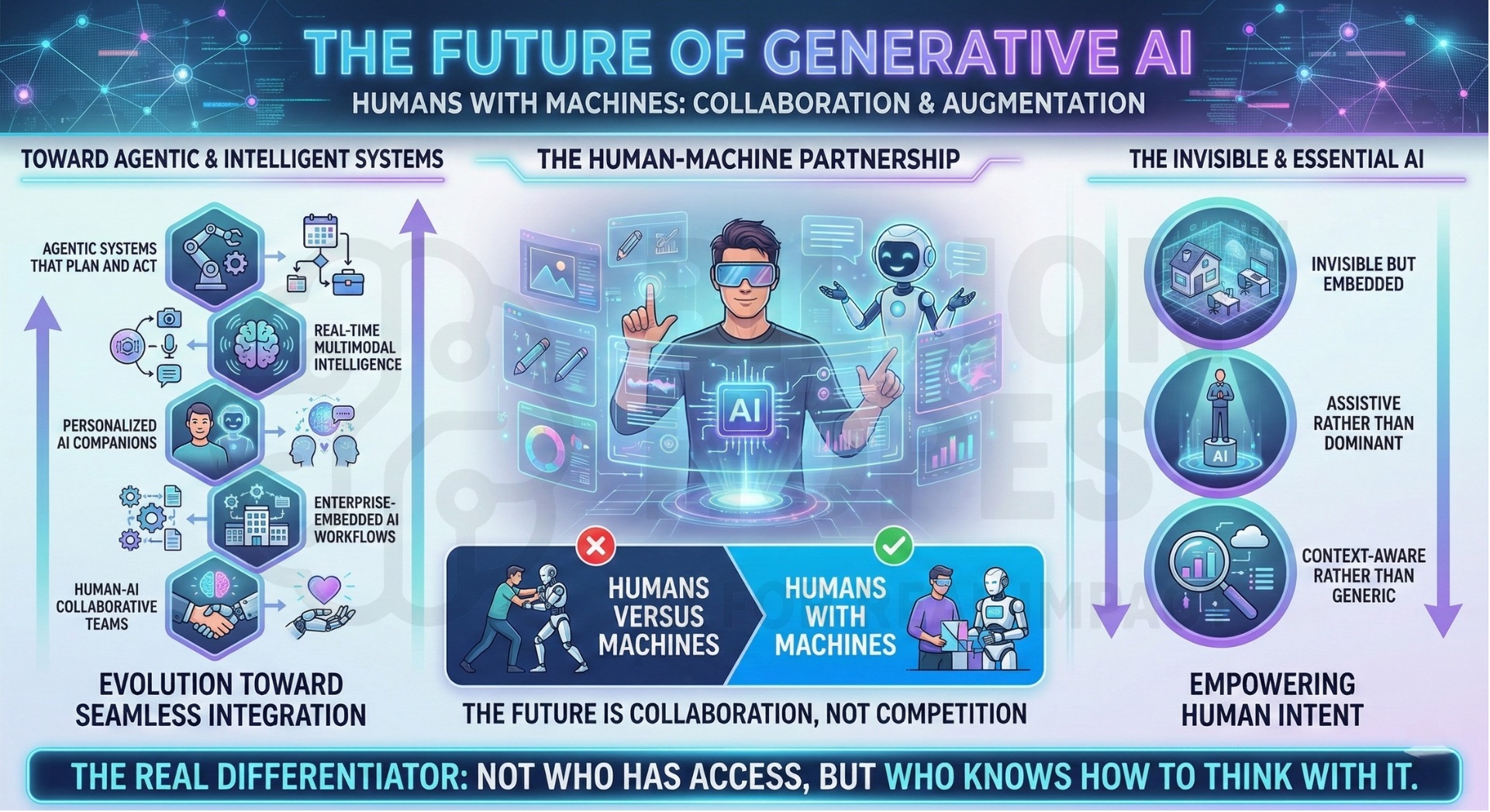
Generative AI is moving toward:
- Agentic systems that plan and act
- Real-time multimodal intelligence
- Personalized AI companions
- Enterprise-embedded AI workflows
- Human-AI collaborative teams
The future is not humans versus machines. It is humans with machines.
Generative AI will increasingly become:
- Invisible but embedded
- Assistive rather than dominant
- Context-aware rather than generic
The real differentiator will not be who has access to AI – but who knows how to think with it.
Summary
Generative AI is one of the most profound technological shifts since the internet. It reshapes how ideas are created, how work is done, and how humans interact with machines. But its true power lies not in replacing human intelligence – it lies in amplifying it.
Used wisely, Generative AI can make us more productive, more creative, and more capable. Used blindly, it can mislead and distort. The responsibility, ultimately, remains human.
AI can generate. Humans must decide. Upgrade your AI-readiness with our masterclass.