AI in 2025 – Top 30 developments
1. Foundational AI models become default infrastructure, not products
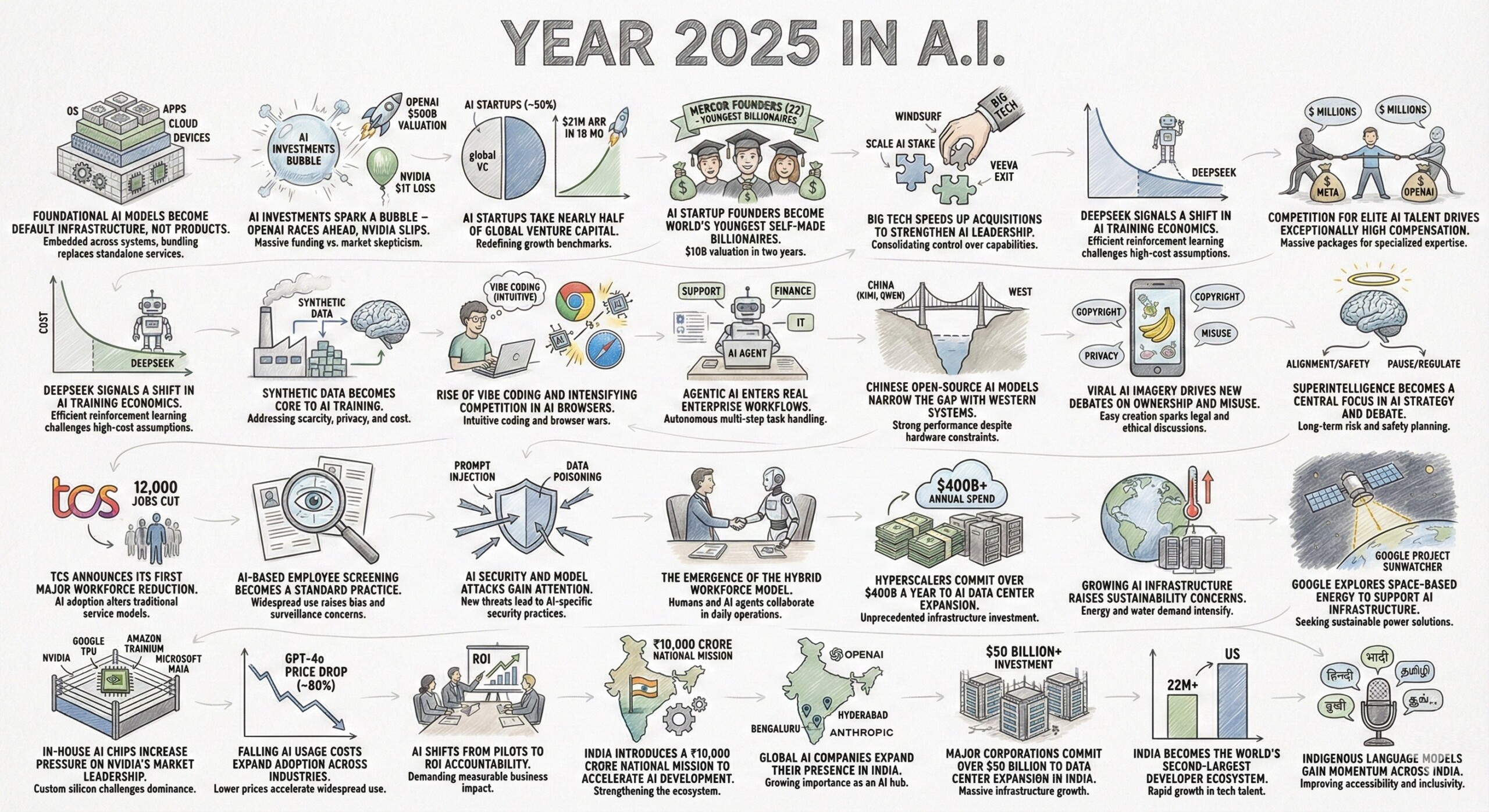
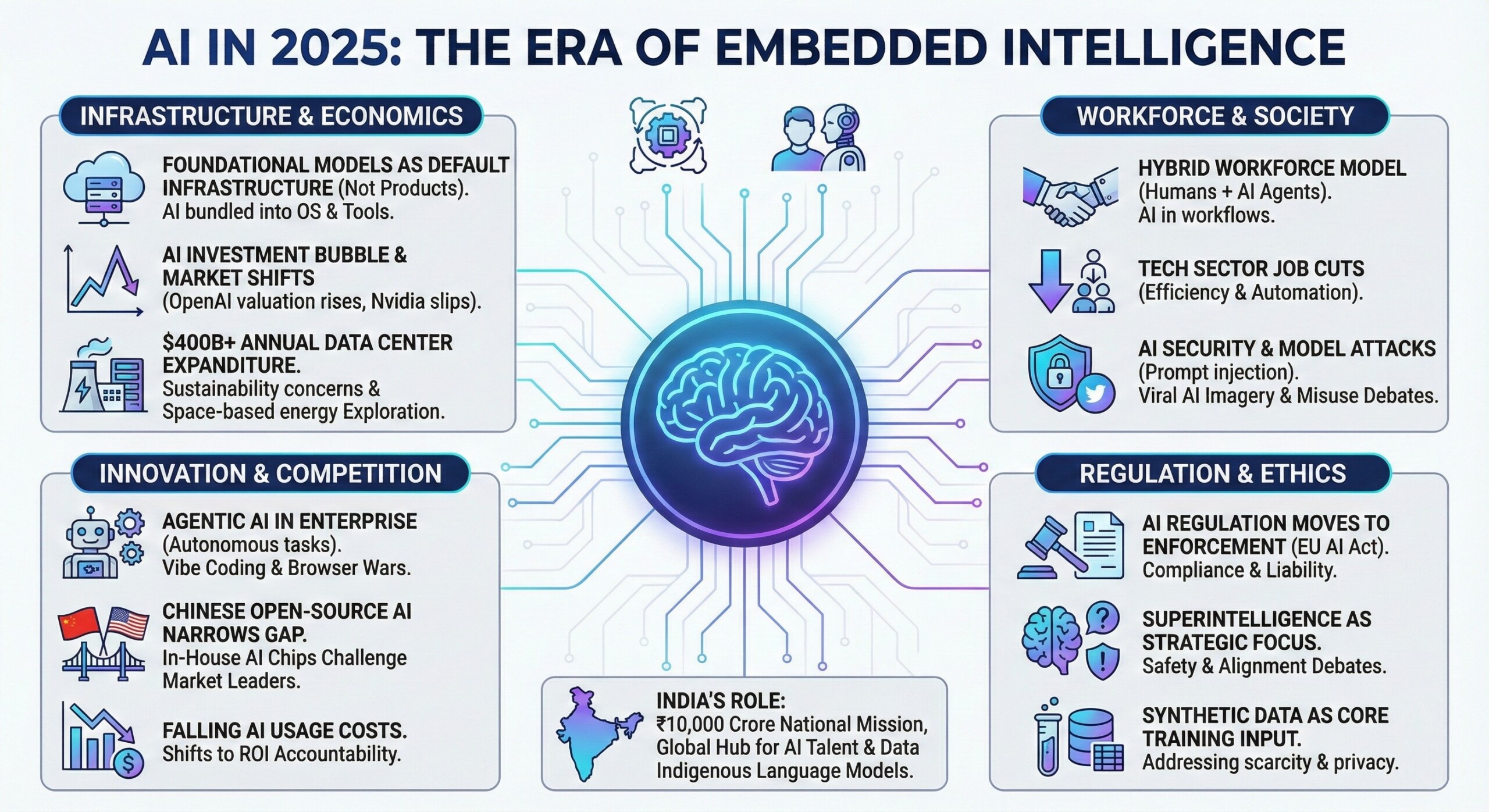
At the start of January 2025, artificial intelligence crossed a structural threshold as large language models began to function less as standalone products and more as invisible infrastructure embedded across software, devices, and enterprise systems. AI capabilities were increasingly bundled into operating systems, productivity tools, cloud platforms, and developer stacks by default, rather than offered as separate services. This shift marked the beginning of AI as a baseline layer of the digital economy, similar to cloud computing or databases, fundamentally changing how value is captured, priced, and competed for in the technology industry.
2. AI investments spark a Bubble – OpenAI races ahead, Nvidia slips
Sam Altman’s OpenAI crossed a historic milestone by achieving a $500 billion valuation, becoming the most valuable private AI company following a series of massive funding rounds. The organization also transitioned into a for-profit model, signaling a strategic shift in how it scales and competes. Reports suggest growing distance from Microsoft as OpenAI pursues greater autonomy, reshaping the balance of power within the AI ecosystem and opening doors to diversified partnerships. A potential $1 trillion IPO is now on the horizon. A tightly woven web of cross-investments took shape across the AI industry in the US, with players such as Nvidia, Microsoft, Oracle, AMD, SoftBank, and OpenAI backing one another. OpenAI alone committed to agreements worth nearly $1.4 trillion over an eight-year period. As capital spending on data centres surged – often funded through heavy borrowing – Wall Street began questioning whether demand was being overstated. Nvidia’s market value fell by more than $1 trillion, reviving comparisons to previous technology bubbles.
3. AI Startups take nearly half of global venture capital
In 2025, companies focused on artificial intelligence attracted close to 50% of all venture capital invested worldwide, marking the highest proportion ever seen. Before the rise of AI-led businesses, a strong benchmark for enterprise startups was reaching $1 million in annual recurring revenue within two years. By contrast, many AI startups now reach around $21 million in annual recurring revenue within just 18 months. Firms such as Scale AI and OpenAI have significantly shifted investor expectations and redefined growth benchmarks across the venture capital ecosystem.
4. AI Startup Founders become the world’s youngest self-made billionaires
In 2025, the three co-founders of AI startup Mercor, Adarsh Hiremath, Brendan Foody, and Surya Midha, were recognised as the world’s youngest self-made billionaires at the age of 22. This milestone surpassed a record previously held by Mark Zuckerberg for nearly two decades. All three founders are college dropouts and alumni of the Thiel Fellowship program. They started Mercor as a technology-driven talent sourcing and workforce intelligence platform. Within just two years, the company scaled rapidly and reached a valuation of approximately $10 billion, highlighting how AI-enabled businesses can accelerate wealth creation at unprecedented speed.
5. Big Tech speeds up acquisitions to strengthen AI leadership
In 2025, major technology companies significantly increased mergers, acquisitions, and strategic investments to consolidate their positions in artificial intelligence. OpenAI expanded its capabilities by acquiring the video generation platform Windsurf, while Meta reorganised its AI efforts around a long-term focus on superintelligence research. Microsoft deepened its involvement in the AI data ecosystem by investing $14.3 billion in Scale AI, securing a 49 percent stake. Salesforce founder Marc Benioff exited the data company Veeva, signalling a strategic realignment. Uber also invested in Scale AI to support its AI-driven operations. At the same time, Nvidia and Amazon carried out targeted acquisitions to strengthen their AI infrastructure and supply chains, reflecting an industry-wide push to control critical AI capabilities end to end. An excellent collection of learning videos awaits you on our Youtube channel.
6. DeepSeek signals a shift in AI training economics
The release of DeepSeek in 2025 represented a notable turning point in artificial intelligence development. The Chinese-built model relied heavily on reinforcement learning techniques that emphasized efficiency and optimization, allowing it to be trained at significantly lower cost than many large Western language models. By demonstrating competitive performance without extreme spending on compute infrastructure, DeepSeek challenged the widely held assumption that large language model development must rely on vast capital investment and massive hardware resources. Its success prompted technology companies and researchers outside China to reassess prevailing cost structures and training strategies used in advanced AI systems.
7. Synthetic Data becomes core to AI training
Synthetic data emerged as a critical input for training and fine-tuning AI models in 2025. Companies increasingly generated artificial datasets to supplement scarce, expensive, or regulated real-world data. This approach helped reduce costs, address privacy concerns, and improve model robustness, especially in healthcare, finance, and autonomous systems. Synthetic data became a strategic asset rather than a research niche.
8. Rise of Vibe Coding and intensifying competition in AI browsers
During 2025, advances in reasoning and agentic artificial intelligence became central to model development strategies across the industry. A new approach often referred to as vibe coding gained traction, emphasizing more intuitive and context-aware coding assistance rather than strict syntax-driven outputs. Many leading AI models placed increased emphasis on software development tasks, including code generation, debugging, and multi-step problem solving. At the same time, competition expanded beyond models into distribution and user interfaces. AI-driven commerce and browsing experiences became a new battleground as OpenAI and Google introduced shopping-focused and browser-integrated AI capabilities, intensifying what came to be described as emerging browser wars.
9. Agentic AI enters real enterprise workflows
In 2025, agentic AI systems moved from experimental demos into live enterprise deployments. AI agents began handling multi-step tasks such as customer support resolution, IT operations, finance reconciliation, and internal reporting with limited human intervention. This marked a transition from AI as an assistant to AI as an active operational participant, raising new questions around oversight, accountability, and failure modes.
10. Chinese Open-Source AI models narrow the gap with Western systems
In 2025, several Chinese open-source artificial intelligence models demonstrated performance levels that were comparable to leading systems developed in the United States and Europe. Models such as Kimi, developed by Moonshot AI, and Qwen from Alibaba showed strong capabilities across language understanding and reasoning tasks, even as Chinese firms faced restrictions on access to advanced Nvidia chips due to United States export controls. These developments indicated that Chinese AI research and engineering were able to progress despite hardware constraints. As a result, the perceived technological gap between China and the United States narrowed considerably, reshaping global discussions about competition, resilience, and leadership in artificial intelligence. A constantly updated Whatsapp channel awaits your participation.
11. Viral AI imagery drives new debates on ownership and misuse
In 2025, AI-generated images became a major cultural talking point as tools associated with styles such as Chibi and the so-called Nano Bananas aesthetic spread rapidly across social media platforms. Image generation systems, including Nano Bananas and OpenAI’s Sora, made it significantly easier for users to produce highly realistic and visually striking content with minimal effort. While these tools accelerated creativity and experimentation, they also intensified concerns related to copyright ownership, individual privacy, and the potential misuse of synthetic media. Policymakers, creators, and platforms increasingly debated how existing laws should apply to AI-generated visuals.
12. Superintelligence becomes a central focus in AI strategy and debate
In 2025, the concept of superintelligence moved from speculative discussion into mainstream strategic planning among major technology companies. Organizations began revisiting their approaches to AI alignment, safety, and long-term risk management. Microsoft and Meta established dedicated research groups focused on advancing toward artificial general intelligence, with an emphasis on long-horizon capabilities and control mechanisms. OpenAI publicly outlined ambitions to pursue the development of superintelligent systems over the coming decade. At the same time, these announcements intensified public and academic debate, with researchers, policymakers, and civil society groups calling for stronger safeguards and, in some cases, advocating for a temporary pause in the most advanced forms of AI development.
13. AI Regulation moves from drafts to enforcement
In 2025, artificial intelligence regulation moved beyond policy drafts into active enforcement. Governments in the European Union began operationalizing provisions of the EU AI Act, while regulators in the United States, China, and other regions issued clearer guidance on model transparency, data usage, and liability. Companies faced real compliance costs, audits, and penalties for the first time, marking a shift from voluntary AI ethics to legally binding governance.
14. Technology sector records its largest wave of job cuts since the early internet boom
In 2025, workforce reductions across the technology industry reached their highest annual level since the rapid expansion of the internet economy. As companies accelerated the use of artificial intelligence to improve efficiency and streamline operations, large-scale restructuring followed. More than 1.2 million jobs were eliminated across the global tech sector over the course of the year. Major technology firms, including Amazon, Google, Intel, and Meta, announced significant layoffs affecting a wide range of roles. Professional services and consulting firms were also impacted, with companies such as Accenture reducing headcount as AI-driven automation changed delivery models and reduced demand for certain traditional services.
15. Competition for elite AI talent drives exceptionally high compensation
In 2025, the battle for top artificial intelligence researchers intensified sharply, particularly among leading technology companies in Silicon Valley. Firms such as Meta and OpenAI began offering compensation packages that reached into the millions of dollars in an effort to attract and retain highly specialized talent. Meta publicly acknowledged allocating as much as $100 million toward researcher retention and recruitment, underscoring the strategic importance of advanced AI expertise. This escalation in pay occurred even as many other technology companies continued to reduce staff, highlighting a growing divide between general tech roles and a small group of highly valued AI specialists. Excellent individualised mentoring programmes available.
16. TCS announces its first major workforce reduction
In 2025, Tata Consultancy Services publicly confirmed a workforce reduction that marked the first time in its history that the company had carried out large-scale job cuts. Approximately 12,000 employees were let go, representing about 1.2 percent of its total workforce. The decision reflected broader changes underway in the global IT services industry, where increased adoption of artificial intelligence and automation has begun to alter long-established delivery models. The move drew attention to how AI-driven efficiencies are reshaping demand for traditional services and prompting even long-standing technology firms to rethink staffing and operational structures.
17. AI-based employee screening becomes a standard practice
By 2025, the use of artificial intelligence in hiring and workforce management had moved firmly into the mainstream. Organizations increasingly relied on AI-powered tools for tasks such as matching candidate skills to job requirements, analyzing interview responses, and monitoring productivity levels. Surveys indicated that more than 70 percent of companies were using some form of AI in employee screening or recruitment processes. While these tools improved speed and efficiency in hiring, their widespread adoption also raised important concerns related to algorithmic bias, lack of transparency in decision making, and the growing use of digital surveillance in the workplace.
18. AI security and model attacks gain attention
As AI adoption accelerated, security risks targeting models themselves became more visible in 2025. Organizations reported incidents involving prompt injection attacks, model extraction attempts, data poisoning, and misuse of AI agents. This led to the rise of AI-specific security practices, including model monitoring, guardrails, and red-teaming, expanding the traditional definition of cybersecurity.
19. The emergence of the hybrid workforce model
In 2025, the idea of a hybrid workforce gained widespread acceptance as organizations increasingly combined human employees with AI-driven digital workers. Salesforce CEO Marc Benioff remarked that current business leaders may be the last generation to manage workforces made up only of people, as software agents and automated systems become permanent participants in daily operations. This shift changed how companies designed roles, assigned responsibilities, and defined accountability. Workflows were reorganized to allow humans and AI systems to collaborate, with machines handling repetitive or data-intensive tasks while people focused on judgment, creativity, and oversight. The hybrid workforce model began to redefine the structure of modern enterprises across industries.
20. Hyperscalers commit over $400 billion a year to AI data center expansion
In 2025, annual capital spending by the world’s largest cloud and technology companies exceeded $400 billion, driven largely by the rapid growth of artificial intelligence workloads. Companies such as Amazon, Microsoft, Google, and Meta announced unprecedented investments in new data centers to support generative AI services and large-scale GPU infrastructure. As construction accelerated across multiple regions, practical constraints began to surface. Securing sufficient electrical power, advanced cooling systems, and suitable land emerged as critical challenges, influencing both the pace and location of future data center development. Subscribe to our free AI newsletter now.
21. Growing AI infrastructure raises sustainability concerns
As artificial intelligence infrastructure expanded rapidly in 2025, sustainability emerged as a major issue for governments, companies, and regulators. The International Energy Agency projected that electricity consumption by data centers worldwide could double by 2030 if current growth trends continue. Facilities built to support AI workloads required significantly higher levels of power and water than traditional data centers, intensifying pressure on local energy grids and water supplies. These trends sparked broader discussions around carbon neutrality, renewable energy adoption, and the need to improve efficiency in how large-scale computing infrastructure is designed and operated.
22. Google explores space-based energy to support AI infrastructure
In 2025, Google revealed details of Project Sunwatcher, an initiative focused on developing solar-powered satellites designed to operate in space. The project aims to deploy these satellites by 2027, with the goal of collecting solar energy and transmitting it back to Earth. The transmitted power would be used to support energy-intensive AI data centers, which have become a major driver of electricity demand. By exploring space-based solar generation, Google signaled interest in reducing dependence on fossil fuels and easing constraints associated with land-based renewable energy sources, while also addressing long-term sustainability challenges linked to large-scale computing.
23. In-House AI chips increase pressure on Nvidia’s market leadership
In 2025, competition in the AI hardware market intensified as major technology companies expanded the use of custom-designed chips for artificial intelligence workloads. Google continued advancing its Tensor Processing Units (TPUs) with the TPU v6, while Amazon scaled deployments of its Trainium and Inferentia chips across its cloud platforms. Microsoft introduced its Maia accelerator as part of its broader AI infrastructure strategy, and Apple increased reliance on its own silicon for AI processing. These efforts reduced dependence on Nvidia hardware and challenged its long-standing dominance in the sector. In response, Nvidia introduced new chip architectures, including Blackwell and Rubin, aimed at maintaining performance leadership and defending its position in the rapidly evolving AI compute market.
24. Falling AI usage costs expand adoption across industries
In 2025, the cost of using advanced AI models declined significantly, making large-scale deployment more accessible to a wider range of organizations. Pricing for OpenAI’s GPT-4o dropped by close to 80 percent, reflecting broader improvements in how models are served and optimized. Advances in inference efficiency, model distillation techniques, and improvements in underlying hardware all contributed to lower operating costs. As a result, startups were able to build AI-powered products with far less capital, while enterprises expanded AI usage across more business functions, accelerating adoption throughout the economy.
25. AI shifts from pilots to ROI accountability
By 2025, enterprises moved past experimental AI pilots and began demanding measurable returns on investment. Boards and executives increasingly asked for clear productivity gains, revenue impact, or cost reductions tied to AI deployments. This shift forced companies to integrate AI more deeply into core business processes rather than treating it as an innovation showcase. Upgrade your AI-readiness with our masterclass.
26. India introduces a ₹10,000 crore National Mission to accelerate AI development
In 2025, India announced a national artificial intelligence mission with a total allocation of ₹10,000 crore, aimed at strengthening the country’s AI ecosystem. The initiative focused on expanding access to high-performance compute infrastructure, building large and diverse datasets, supporting the development of indigenous AI models, and investing in talent creation and skill development. The government described the program as one of the most cost-efficient AI missions globally, designed to lower entry barriers for startups, researchers, and academic institutions. It also placed strong emphasis on public sector applications, including governance, healthcare, education, and language technologies, with the goal of broad-based and inclusive AI adoption.
27. Global AI companies expand their presence in India
In 2025, several leading international artificial intelligence companies increased their footprint in India as part of broader global expansion strategies. Organizations such as OpenAI and Anthropic, along with a number of other United States based AI startups, established offices in major technology hubs including Bengaluru and Hyderabad. This expansion reflected India’s growing importance as a center for AI research, engineering, and operations. The country continued to develop a large and skilled workforce, with estimates placing the number of AI professionals at over 9,00,000. As a result, India strengthened its position as a critical destination for global AI talent and development activities.
28. Major corporations commit over $50 billion to Data Center expansion in India
In 2025, a combination of Indian conglomerates and global cloud providers announced plans to invest more than $50 billion in new data center infrastructure across the country. Companies including Reliance, Microsoft, Amazon, Google, Adani Group, and Tata Consultancy Services outlined large-scale capital expenditure programs aimed at supporting growing demand for cloud computing and artificial intelligence services. Proposed facilities were planned across multiple cities such as Mumbai, Chennai, Hyderabad, and Noida. These investments reinforced India’s role as an emerging global hub for data storage, cloud services, and AI-driven digital infrastructure.
29. India becomes the world’s second-largest developer ecosystem
In 2025, India’s developer community crossed 22 million professionals, positioning the country as the second-largest developer ecosystem globally. Data from platforms such as GitHub and Stack Overflow indicated sustained and rapid growth in software development activity across the country. This expansion has been driven by rising adoption of artificial intelligence, cloud computing, and open-source technologies, along with a strong pipeline of engineering talent. Based on current growth trends, these datasets projected that India could overtake the United States to become the world’s largest developer base by 2028, marking a significant shift in the global technology landscape.
30. Indigenous language models gain momentum across India
In 2025, a new wave of artificial intelligence models focused on Indian languages began to gain traction under the IndiaAI Mission. Startups and research institutions across the country released foundational models designed to support a wide range of regional and vernacular languages. These Indic language models improved accessibility for users who primarily communicate in non-English languages and enabled more inclusive digital services. By building domestic capabilities in large language models, India reduced its reliance on systems developed outside the country and strengthened its position in maintaining control over critical digital infrastructure and linguistic data.