AI Policy, Regulation & Public Sector Careers – Government, think tanks, and global bodies
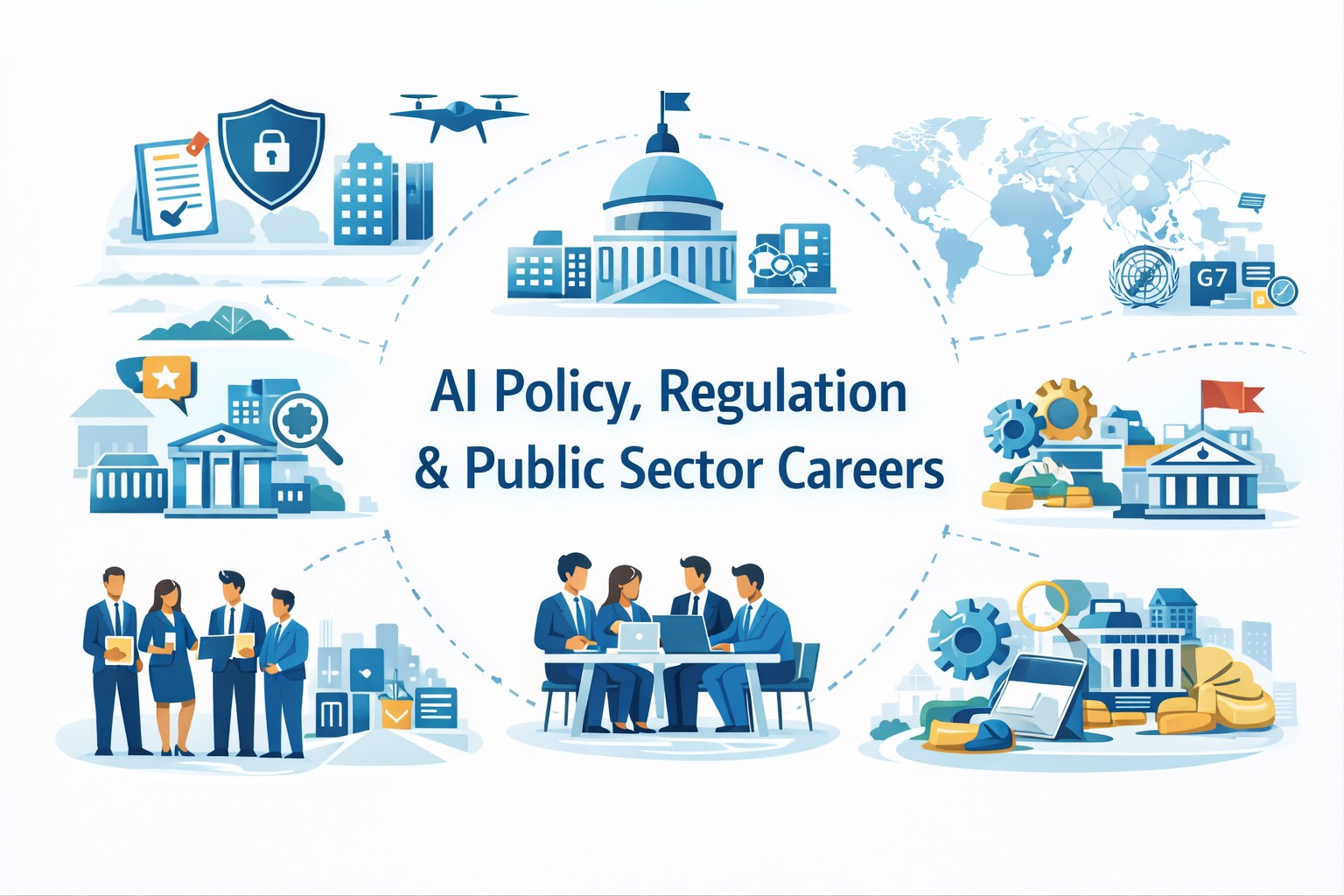
Artificial intelligence is rapidly becoming a matter of public governance rather than private experimentation. It influences national economies, public services, security systems, electoral processes, and the relationship between citizens and the state.
As governments grapple with the scale and speed of AI deployment, a new class of careers has emerged focused on AI policy, regulation, and public interest oversight. These roles are not about building models, but about defining the rules, safeguards, and institutional frameworks that determine how AI is allowed to operate in society. Understanding these careers is essential for shaping AI systems that serve democratic values, protect public trust, and align technological power with collective responsibility.
1. Why AI policy and public sector roles now matter
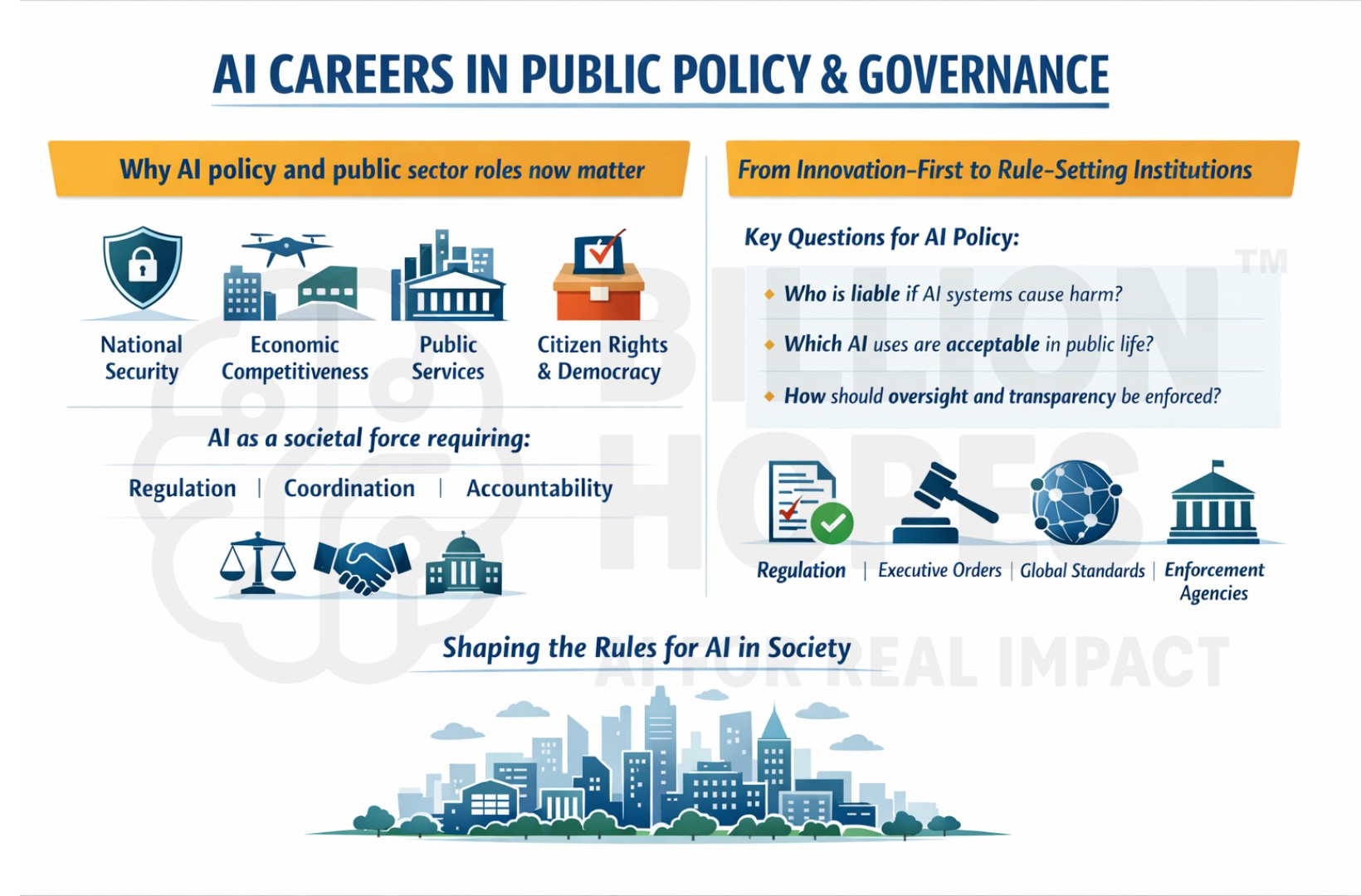
Artificial intelligence is no longer just a commercial or technical concern. It increasingly shapes national security, economic competitiveness, public services, democratic processes, and citizen rights. Governments around the world are being forced to decide not only how AI should be used, but where it must be limited, governed, or prohibited.
This has created a growing demand for professionals who understand AI not as a product, but as a societal force requiring regulation, coordination, and public accountability. AI policy and public sector careers sit at the intersection of technology, law, economics, diplomacy, and governance. Their purpose is not to build AI systems, but to shape the rules under which AI operates.
2. From innovation-first to rule-setting institutions
In the early years of AI adoption, governments largely deferred to industry innovation. Policy lagged behind deployment. That gap is no longer tenable.
Today, states face concrete questions:
Who is liable when AI systems cause harm?
Which uses of AI are unacceptable in public life?
How should transparency, auditability, and human oversight be enforced?
As a result, AI policy has moved from advisory white papers to binding regulation, executive orders, standards bodies, and enforcement agencies. Public sector roles now influence procurement rules, licensing regimes, national AI strategies, and cross-border coordination. An excellent collection of learning videos awaits you on our Youtube channel.
3. AI roles within government institutions
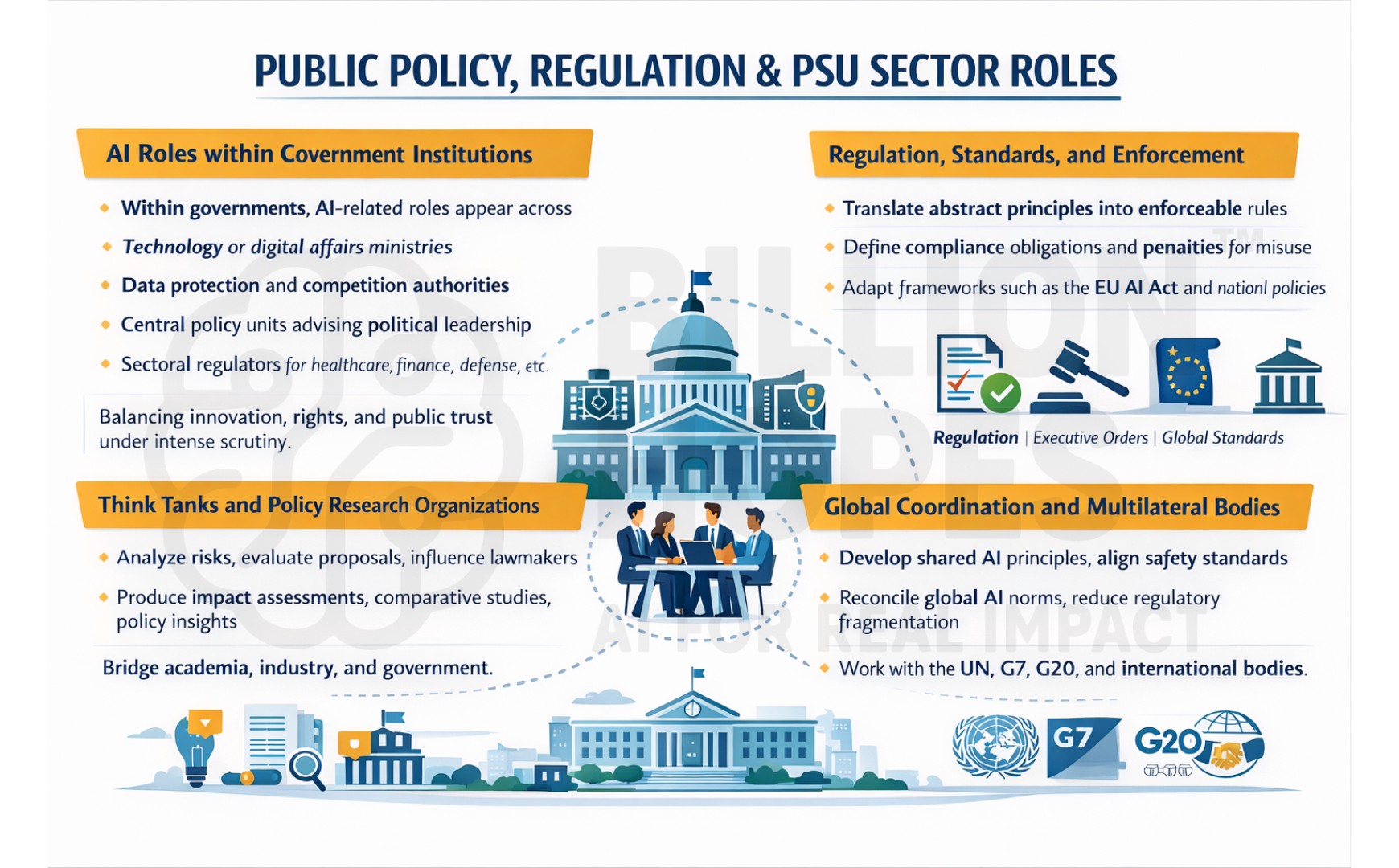
Within governments, AI-related roles appear across ministries, regulators, and public agencies. These professionals assess risks, draft policy, and guide implementation across sectors such as healthcare, finance, policing, welfare, defense, and education.
They may work inside:
- Technology or digital affairs ministries
- Data protection and competition authorities
- Central policy units advising political leadership
- Sectoral regulators adapting AI rules to domain-specific risks
Unlike private-sector AI teams, government professionals must balance innovation, rights, political feasibility, and public trust, often under intense scrutiny.
4. Regulation, standards, and enforcement
A central function of AI policy careers is translating abstract principles into enforceable rules. This includes defining risk categories, compliance obligations, documentation requirements, and penalties for misuse.
AI regulation is increasingly shaped by large frameworks such as the European Union AI Act, national AI strategies, and sector-specific guidance. Public sector professionals work to interpret these rules, adapt them locally, and ensure they can be operationalized rather than remaining symbolic.
Regulation is not static. These roles require continuous revision as AI capabilities evolve faster than legislative cycles.
A constantly updated Whatsapp channel awaits your participation.
5. Think tanks and policy research organizations
Beyond governments, AI policy is shaped by think tanks, research institutes, and civil society organizations. These bodies analyze emerging risks, evaluate policy proposals, and influence lawmakers through research and advocacy.
Professionals in these roles produce impact assessments, scenario analyses, and comparative studies across countries and regions. They often serve as bridges between academia, industry, and government – translating technical developments into policy-relevant insights.
Institutions such as OECD, Brookings Institution, and global policy labs play a disproportionate role in shaping international norms despite lacking formal regulatory power.
6. Global coordination and multilateral bodies
AI governance is inherently global. Models, data, and platforms cross borders even when laws do not. This has elevated the role of multilateral organizations in AI policy.
Professionals working with bodies such as the United Nations, G7, G20, and international standards organizations focus on coordination rather than enforcement. Their work includes developing shared principles, aligning safety standards, and reducing regulatory fragmentation.
These roles require diplomatic skill, cultural sensitivity, and the ability to reconcile competing national interests around AI capability and control. Excellent individualised mentoring programmes available.
7. Skills that define AI policy professionals
AI policy careers demand a distinctive skill mix. Technical depth matters, but it is rarely sufficient on its own.
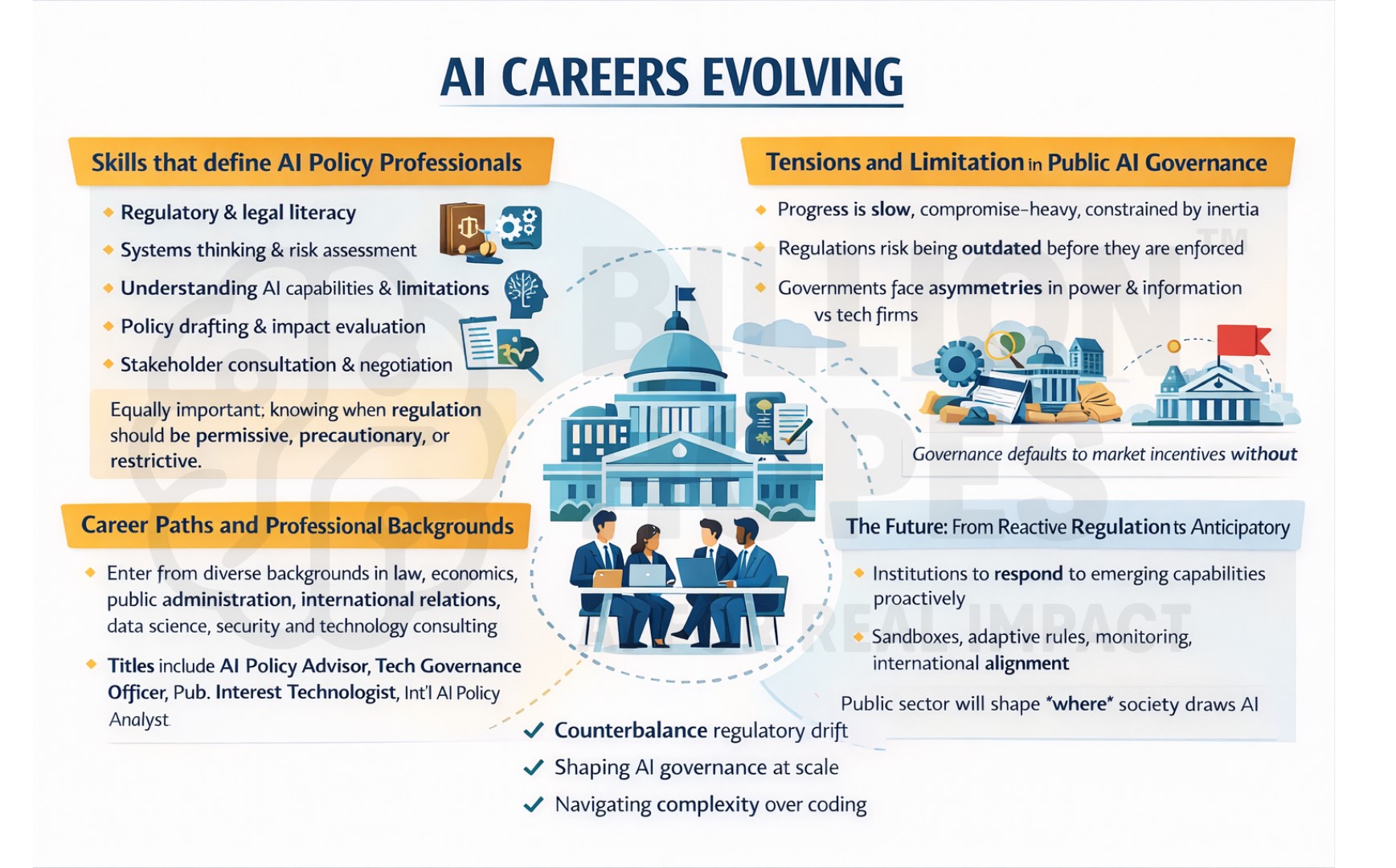
Key capabilities include:
- Regulatory and legal literacy
- Systems thinking and risk assessment
- Understanding AI capabilities and limitations
- Policy drafting and impact evaluation
- Stakeholder consultation and negotiation
Equally important is judgment: knowing when regulation should be permissive, precautionary, or restrictive – often under uncertainty and political pressure.
8. Career paths and professional backgrounds
People enter AI policy and public sector roles from diverse backgrounds: law, economics, public administration, international relations, data science, security, and technology consulting.
Titles vary widely, including AI Policy Advisor, Digital Regulation Specialist, Technology Governance Officer, Public Interest Technologist, or International AI Policy Analyst. Career progression is shaped less by coding skill and more by experience navigating institutional complexity and political trade-offs.
These roles often influence outcomes indirectly – but at scale. Subscribe to our free AI newsletter now.
9. Tensions and limitations in public AI governance
AI policy work is not glamorous. Progress is slow, compromise-heavy, and constrained by institutional inertia. Regulations risk being outdated before they are enforced. Governments also face asymmetries in power and information when dealing with large technology firms.
Yet absence of governance is not neutral. Without policy intervention, AI deployment defaults to market incentives alone, often at the expense of rights, equity, and long-term stability.
Public sector AI careers exist to counterbalance that drift.
10. The future: From reactive regulation to anticipatory governance
The future of AI policy lies in anticipatory governance – building institutions capable of responding to emerging capabilities before harm becomes widespread. This includes regulatory sandboxes, adaptive rules, continuous monitoring, and international alignment.
As AI systems become more powerful and general-purpose, public sector professionals will increasingly shape not just how AI is used, but where society draws its red lines. Upgrade your AI-readiness with our masterclass.
Billion Hopes summary
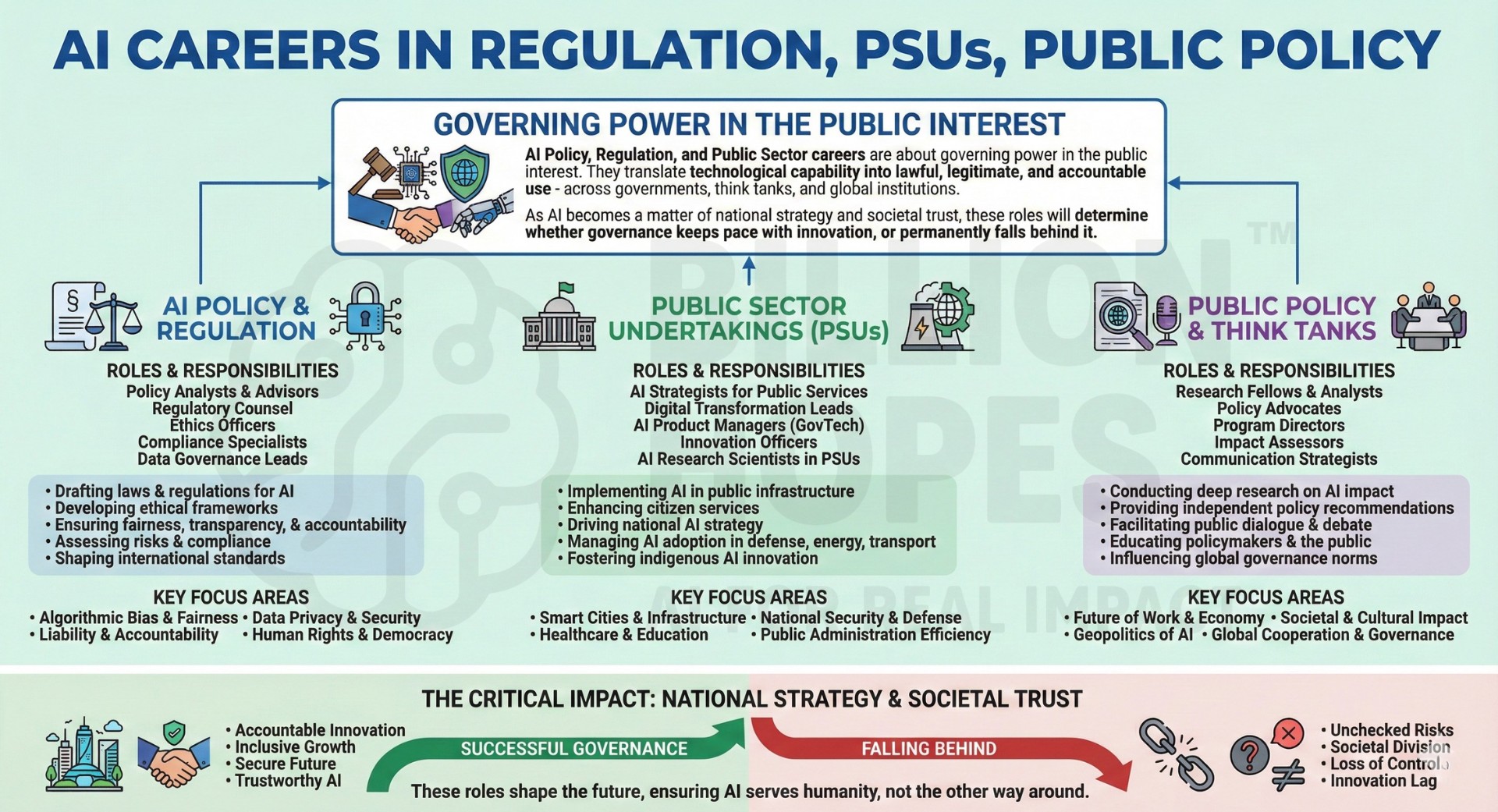
AI Policy, Regulation, and Public Sector careers are about governing power in the public interest. They translate technological capability into lawful, legitimate, and accountable use – across governments, think tanks, and global institutions. As AI becomes a matter of national strategy and societal trust, these roles will determine whether governance keeps pace with innovation, or permanently falls behind it.