AI in Cybersecurity & Risk Management Careers – Threat detection, defense, and resilience
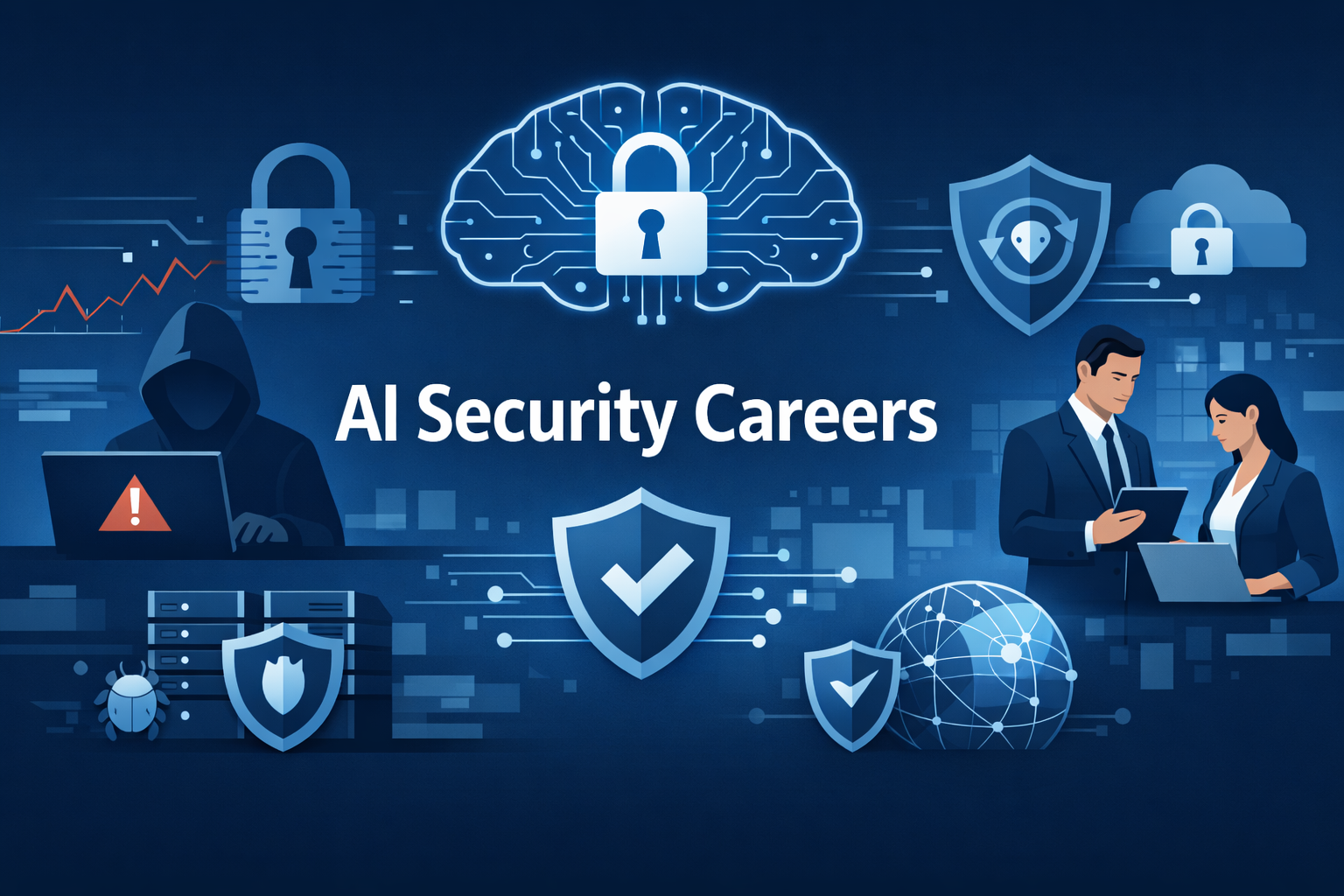
Artificial intelligence is no longer confined to research labs or experimental security tools. It is becoming a core pillar of enterprise cybersecurity strategy, influencing how organizations detect threats, manage risk, and build resilience at scale. As digital systems grow more complex and adversaries more sophisticated, traditional rule-based security approaches are proving insufficient.
Across industries, organizations are under pressure to move from fragmented security tools to AI-driven, adaptive defense systems that can operate in real time. This shift is not just technological – it is reshaping careers. A new class of roles has emerged at the intersection of AI, cybersecurity, and enterprise risk management, focused on embedding intelligence into security operations, governance, and decision-making. Understanding these careers is essential for organizations that want AI to strengthen resilience rather than create new vulnerabilities.
1. Why AI-driven cybersecurity and risk roles now matter
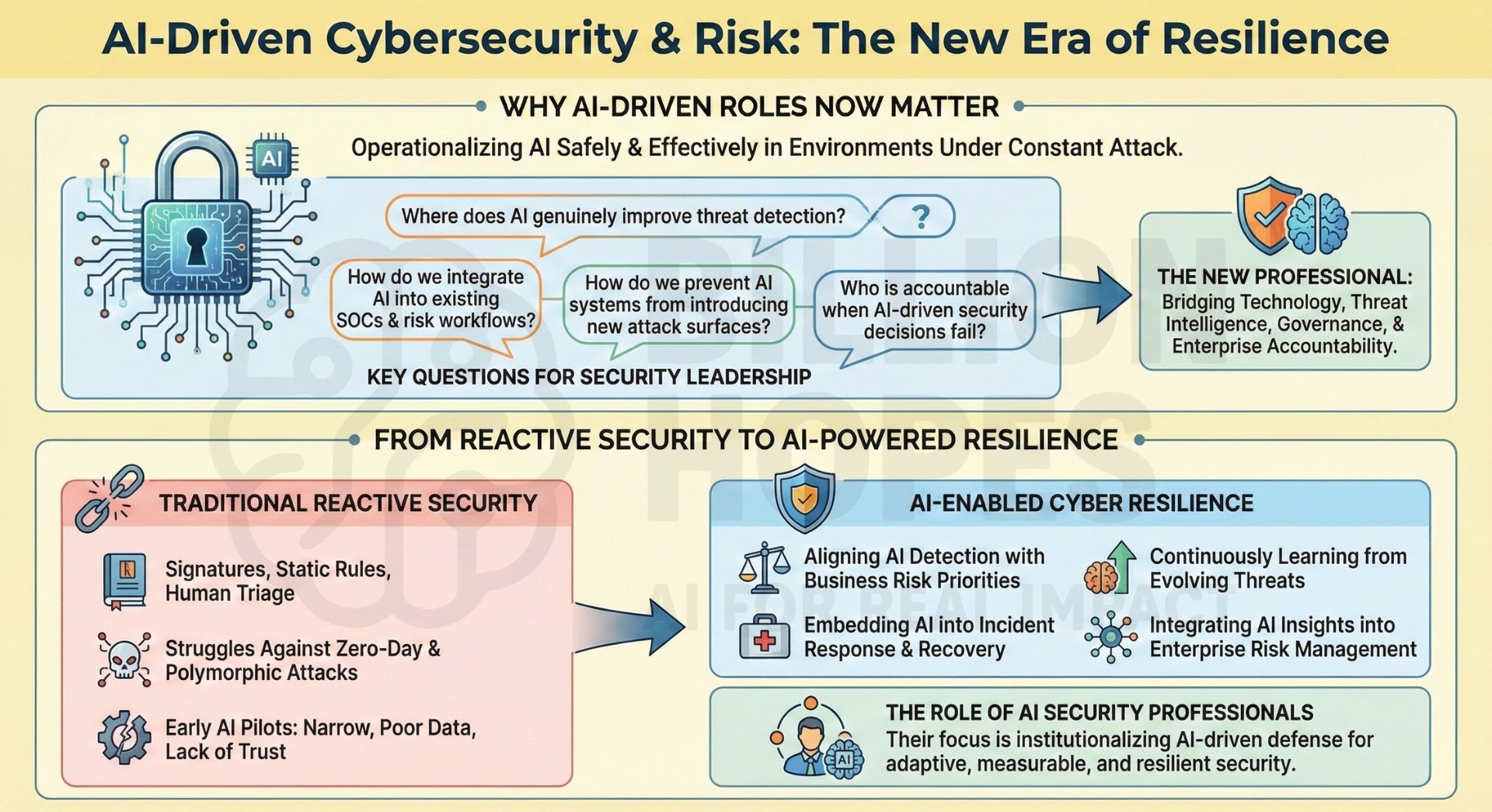
Cybersecurity has entered a new phase. Enterprises are no longer asking whether AI can help security teams; they are grappling with how to operationalize AI safely and effectively in environments under constant attack.
Key questions now dominate security leadership discussions:
Where does AI genuinely improve threat detection?
How do we integrate AI into existing SOCs and risk workflows?
How do we prevent AI systems from introducing new attack surfaces?
Who is accountable when AI-driven security decisions fail?
These challenges have created demand for professionals who understand AI as a security and risk discipline, not merely as a detection tool. Careers in AI-driven cybersecurity exist to bridge technology, threat intelligence, governance, and enterprise accountability.
2. From reactive security to AI-powered resilience
Traditional security models rely on signatures, static rules, and human triage—approaches that struggle against zero-day attacks, polymorphic malware, and automated adversaries. Early AI use in security focused on narrow pilots such as anomaly detection or log analysis, many of which failed to scale due to poor data quality or lack of trust.
Today, organizations are shifting toward AI-enabled cyber resilience, which includes:
Aligning AI detection with business risk priorities,
Embedding AI into incident response and recovery workflows,
Continuously learning from evolving threats,
Integrating AI insights into enterprise risk management.
AI security professionals play a central role in this transition. Their focus is not novelty, but institutionalizing AI-driven defense so security becomes adaptive, measurable, and resilient. An excellent collection of learning videos awaits you on our Youtube channel.
3. Core AI cybersecurity and risk roles within enterprises
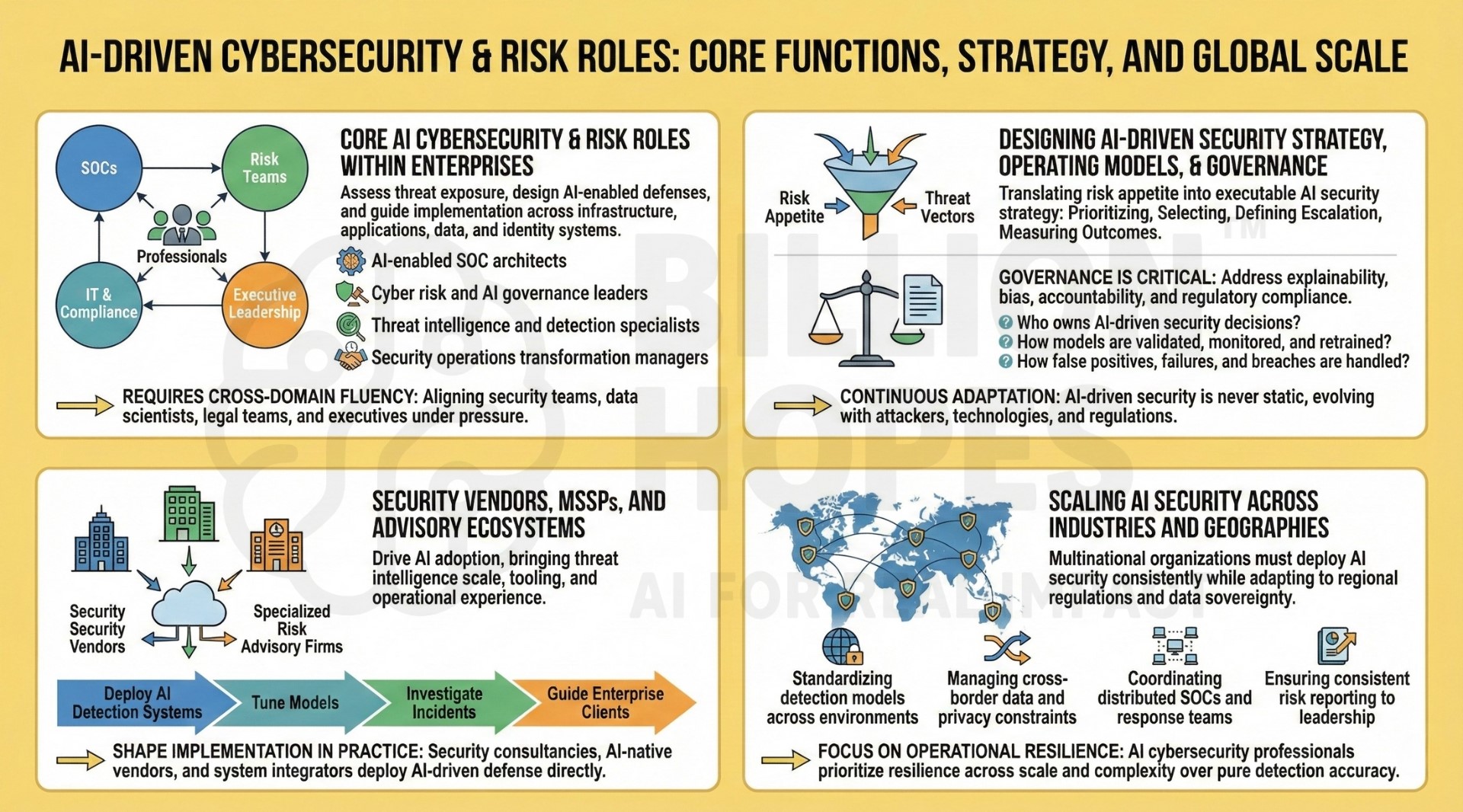
AI-driven security professionals operate across SOCs, risk teams, IT, compliance, and executive leadership. They assess threat exposure, design AI-enabled defenses, and guide implementation across infrastructure, applications, data, and identity systems.
They may work as:
• AI-enabled SOC architects
• Cyber risk and AI governance leaders
• Threat intelligence and detection specialists
• Security operations transformation managers
Unlike pure security engineers, these roles require cross-domain fluency. Success depends on aligning security teams, data scientists, legal teams, and executives—often under incident pressure and regulatory scrutiny.
4. Designing AI-driven security strategy, operating models, and governance
A central responsibility in AI cybersecurity roles is translating risk appetite into executable AI security strategy. This includes prioritizing threat vectors, selecting AI detection approaches, defining escalation thresholds, and measuring security outcomes.
Equally critical is governance. As AI systems influence security decisions—blocking access, flagging insiders, triggering responses—organizations must address explainability, bias, accountability, and regulatory compliance.
Professionals in these roles help define:
• Who owns AI-driven security decisions
• How models are validated, monitored, and retrained
• How false positives, failures, and breaches are handled
AI-driven security is never static. These roles require continuous adaptation as attackers, technologies, and regulations evolve.
A constantly updated Whatsapp channel awaits your participation.
5. Security vendors, MSSPs, and advisory ecosystems
Much of AI adoption in cybersecurity is driven by security vendors, managed security service providers (MSSPs), and specialized risk advisory firms. These organizations bring threat intelligence scale, tooling, and operational experience that many enterprises lack internally.
Professionals in these environments work across industries and threat profiles. They deploy AI detection systems, tune models, investigate incidents, and guide enterprise clients through security transformations.
Security consultancies, AI-native vendors, and system integrators collectively shape how AI-driven defense is implemented in practice – often more directly than academic research or internal innovation teams.
6. Scaling AI security across industries and geographies
Cyber threats are global, and so is AI-driven defense. Multinational organizations must deploy AI security systems consistently while adapting to regional regulations, data sovereignty requirements, and threat landscapes.
At scale, challenges include:
• Standardizing detection models across environments
• Managing cross-border data and privacy constraints
• Coordinating distributed SOCs and response teams
• Ensuring consistent risk reporting to leadership
AI cybersecurity professionals operating at this level focus less on detection accuracy alone and more on operational resilience across scale and complexity. Excellent individualised mentoring programmes available.
7. Skills that define AI cybersecurity and risk professionals
Careers in AI-driven cybersecurity require a hybrid skill set. Deep coding expertise is helpful but not sufficient.
Key capabilities include:
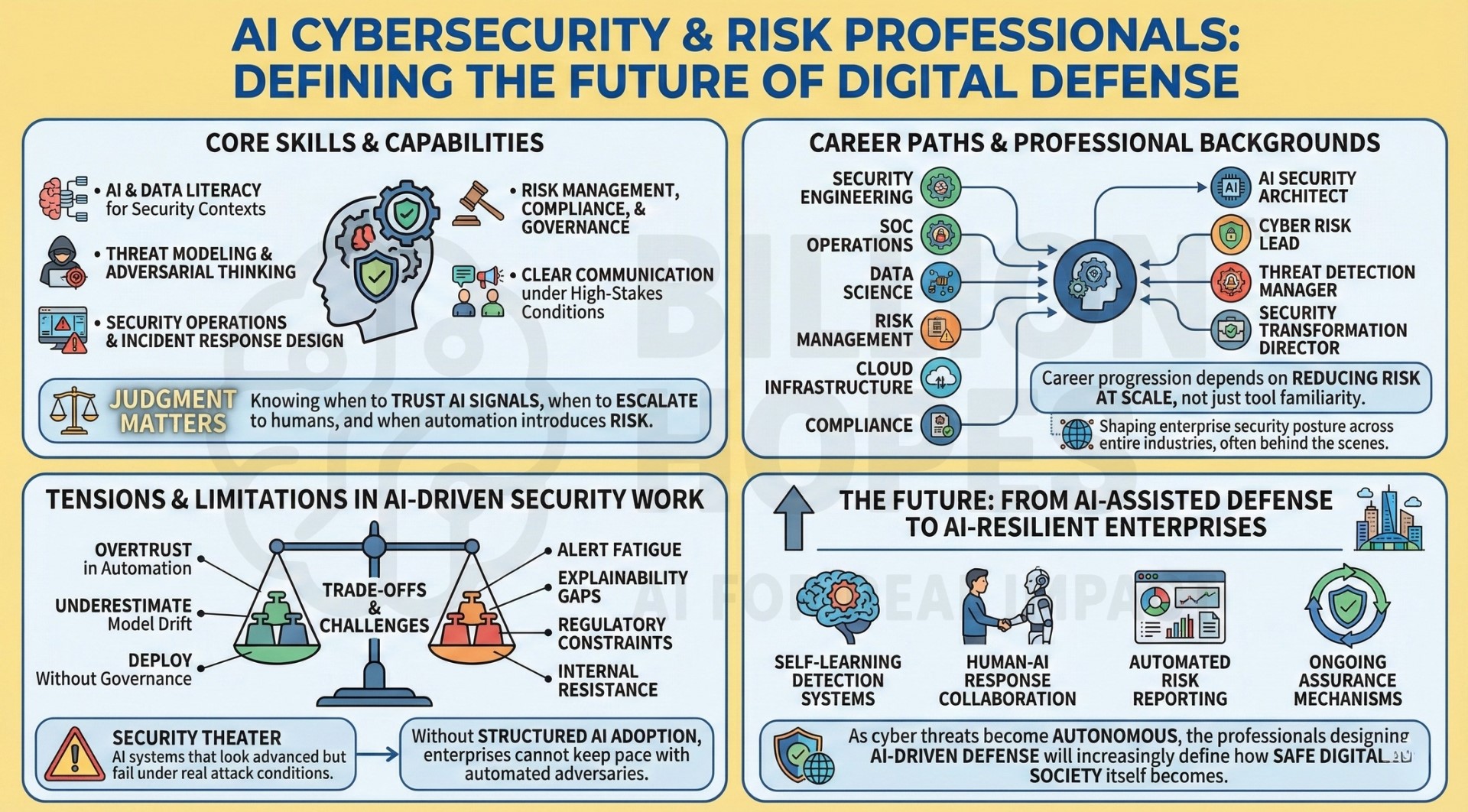
• AI and data literacy for security contexts
• Threat modeling and adversarial thinking
• Security operations and incident response design
• Risk management, compliance, and governance
• Clear communication under high-stakes conditions
Above all, judgment matters—knowing when to trust AI signals, when to escalate to humans, and when automation itself introduces risk.
8. Career paths and professional backgrounds
AI cybersecurity professionals come from security engineering, SOC operations, data science, risk management, cloud infrastructure, and compliance backgrounds.
Common titles include AI Security Architect, Cyber Risk Lead, Threat Detection Manager, or Security Transformation Director. Career progression depends less on tool familiarity and more on reducing risk at scale.
These roles rarely attract public attention—but they shape enterprise security posture across entire industries.
Subscribe to our free AI newsletter now.
9. Tensions and limitations in AI-driven security work
AI in cybersecurity introduces new trade-offs. Organizations may overtrust automated detection, underestimate model drift, or deploy AI without adequate governance.
Professionals must navigate alert fatigue, explainability gaps, regulatory constraints, and internal resistance. There is also the risk of “security theater”—AI systems that look advanced but fail under real attack conditions.
Yet without structured AI adoption, enterprises cannot keep pace with automated adversaries. AI security careers exist to manage this tension between speed, safety, and trust.
10. The future: From AI-assisted defense to AI-resilient enterprises
The future of AI in cybersecurity lies in AI-resilient enterprises, where threat detection, response, recovery, and governance are continuously adaptive.
This includes self-learning detection systems, human–AI response collaboration, automated risk reporting, and ongoing assurance mechanisms. As cyber threats become more autonomous, the professionals designing AI-driven defense will increasingly define how safe digital society itself becomes. Upgrade your AI-readiness with our masterclass.
Billion Hopes summary
AI in Cybersecurity & Risk Management careers are about turning AI into a force for resilience rather than vulnerability. These roles integrate threat intelligence, AI systems, governance, and human judgment to protect organizations at scale. As cyber risk becomes existential to enterprises and nations alike, professionals who can operationalize AI responsibly in security will shape the future of trust, safety, and digital stability.