AI and the future of IT and SaaS
AI and the future of IT and SaaS
How jobs, value, and power will evolve
Introduction
Longstanding industries build their own momentum, ecosystem and manpower pipelines. Their rock-solid inertia is built on multiple dimensions like institutional knowledge, social acceptance, global reach and domain expertise.
And then comes the meteor strike.
February 2026 triggered a sharp dip in IT and SaaS stocks across multiple markets after Anthropic released its new Cowork plugins. Investors panicked that AI was about to replace large parts of traditional IT and SaaS work. But is that fear actually justified?
If we investigate deeper, it gets clear that AI is not killing IT or ending SaaS. Rather, it is restructuring how work, software, pricing power, and enterprise value itself are created. The real disruption is not that AI replaces entire jobs, but how it decomposes jobs into tasks and automates predictable layers of work. This ‘compresses’ software margins, and shifts economic power toward those humans who control data, workflows, and orchestration layers. This is a big transition indeed. And it is already reshaping Indian IT services, global SaaS companies, and the architecture of enterprise technology itself.
If you fear LLMs (large language models), remember that Generative AI has fundamental technical limitations – relying on correlation, not causation – which constrain its commercial usefulness. Our complex world runs deeply on causation, that humans excel at understanding. Towards the end of this assessment, I will come back to this crucial point.
Deeper insights for CXOs, managers and thought-leaders
1. Jobs and tasks are not the same thing
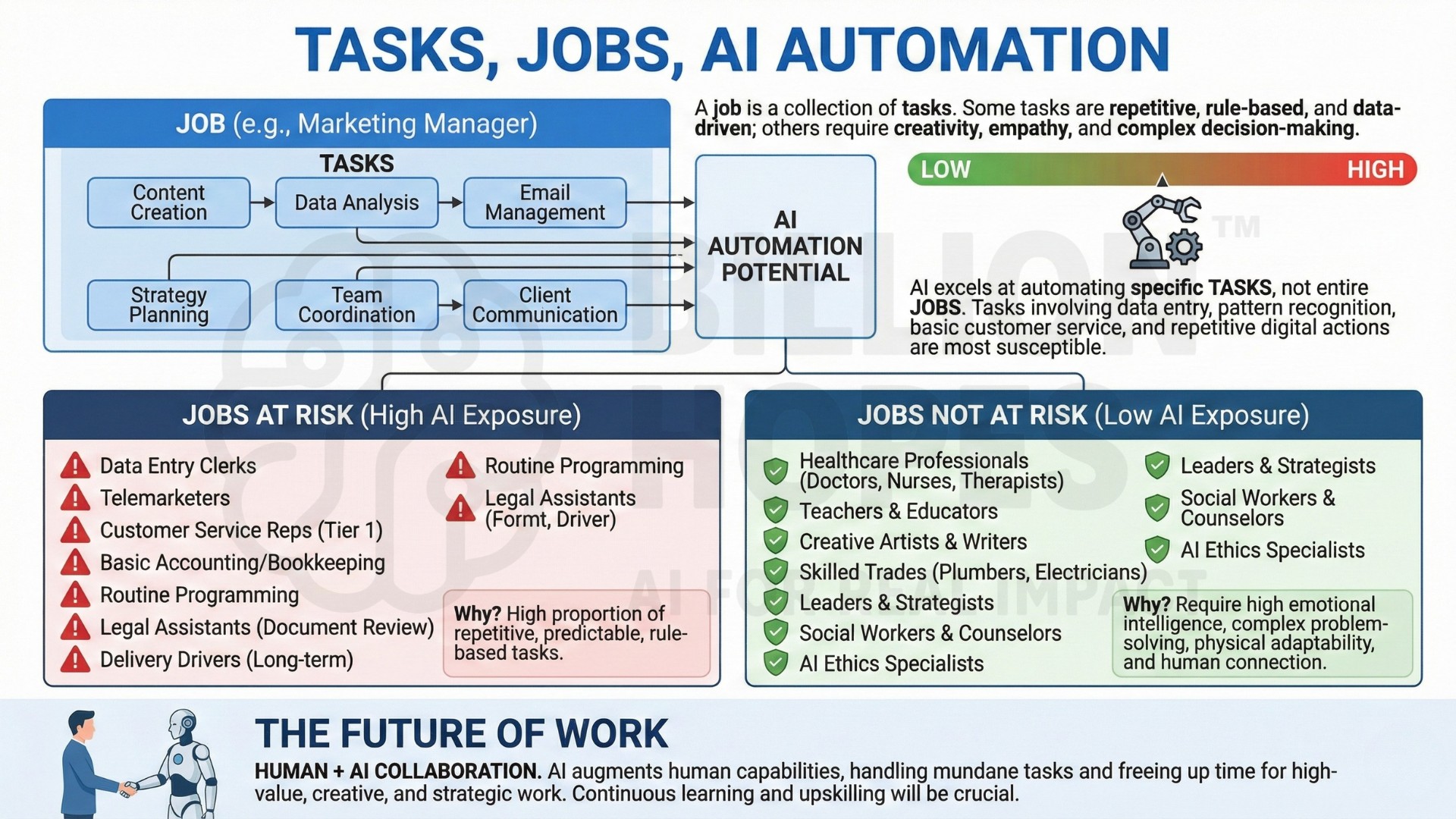
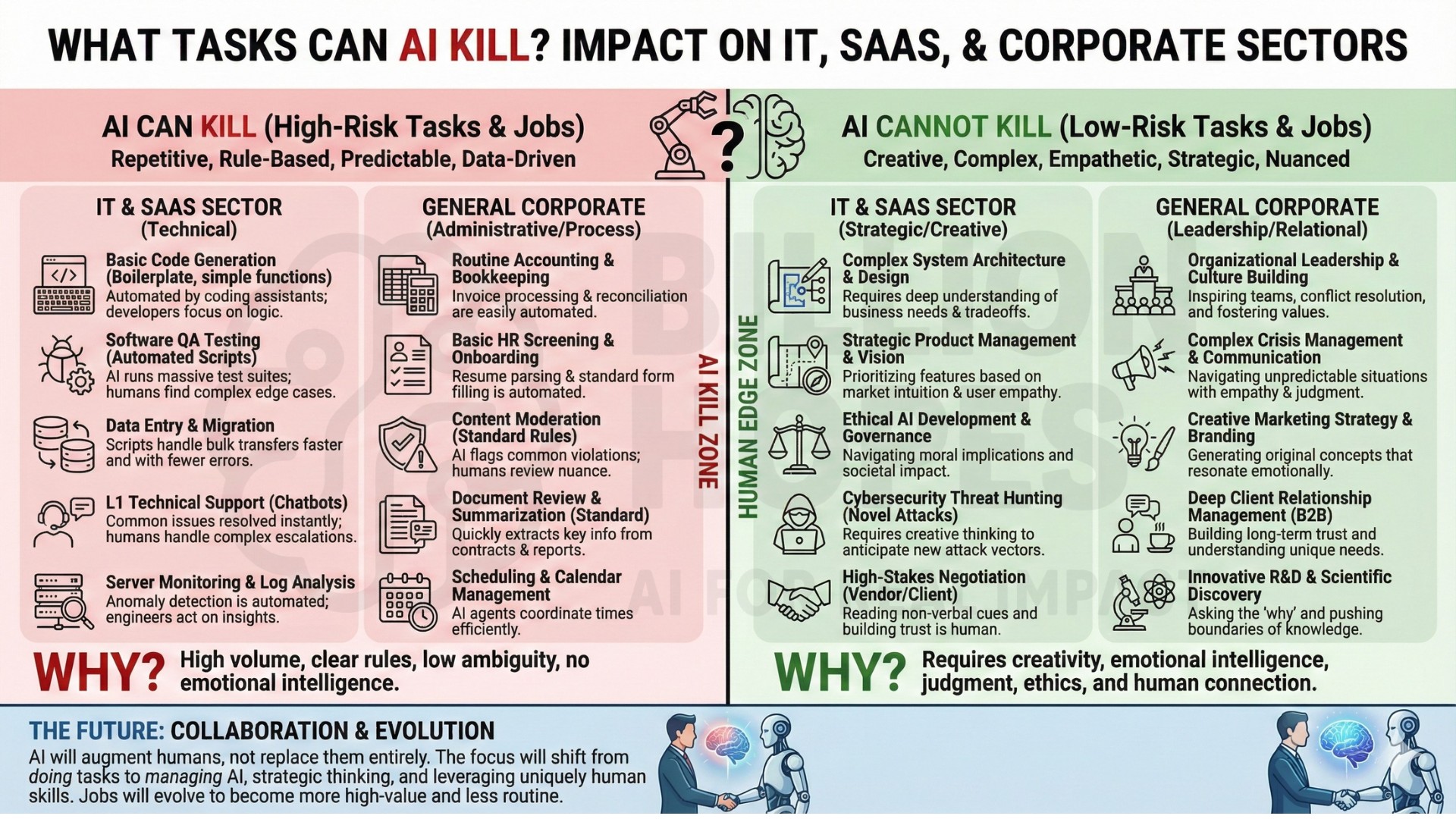
As every manager knows, jobs are collections of a variety of tasks. AI does not replace most jobs directly. It replaces specific categories of tasks inside different jobs. Tasks that are repetitive, rule-based, structured, and data-driven are highly automatable. Tasks requiring judgment, contextual reasoning, ethics, trust, creativity, and relationship building resist automation. The future of work is not job loss. It is task-level reconfiguration. Even if very smart AI arrives via robots (some day), the human edge in higher-level discretionary work will remain unmatched.
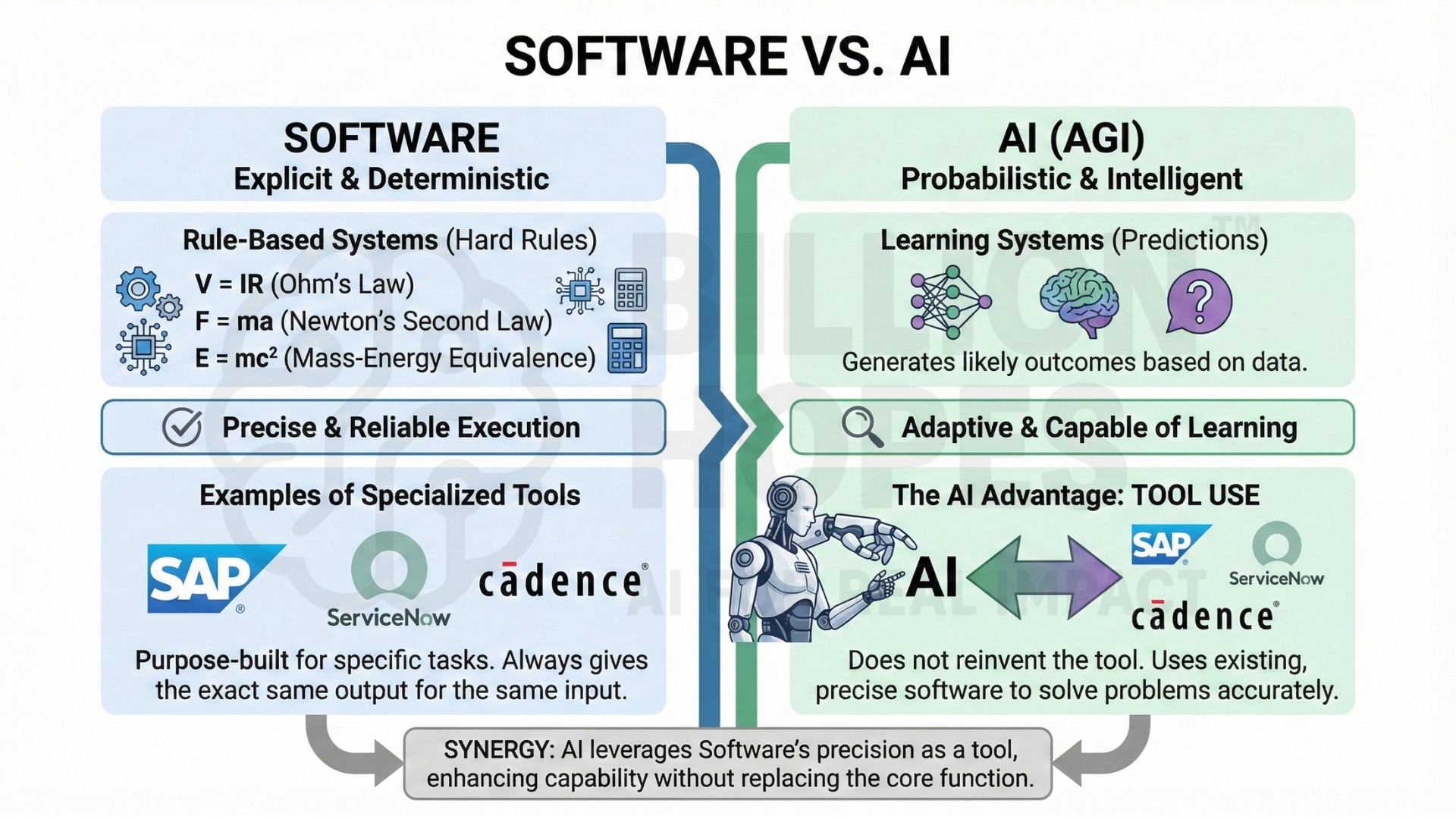
Jensen Huang of Nvidia said in 2026 that super-smart AI (or say, artificial general robotics AGR) will also first want to use existing tools and not invent new tools (he was explaining how existing ERPs and SaaS solutions aren’t dying anytime soon).
2. What AI actually does to jobs and tasks
AI reshapes roles rather than eliminating them. A single role such as developer, marketer, or analyst now splits into three layers: the first contains AI executable tasks such as boilerplate code and basic analysis, the second layer human judgment tasks such as architecture, prioritization, and accountability, and the final & third layer contains orchestration tasks such as managing AI systems, validating outputs, and setting constraints. This creates ‘job shape shifting’ rather than mass job destruction. And remembers, general large language models (LLMs) suffer from many limitations that become evident when you try to use them for commercial-grade work. There’s practically no zero-shotting at all, and independent completion of crucial assignments won’t happen in near future.
3. What SaaS really is and why AI changes it: deterministic versus probabilistic
Traditional SaaS is deterministic software built on rules, workflows, fixed logic, and predictable outputs. For a set of given inputs, we always know what the outputs would be. But AI introduces probabilistic systems with adaptive behaviour, uncertain outputs, and continuous learning. That is just what the nature of AI is. So, SaaS is not replaced by AI, but becomes the execution layer that AI calls into. AI orchestrates workflows across SAP, ServiceNow, Salesforce, Workday, and internal tools instead of replacing them. The product is no longer the interface. The product becomes the outcome delivered across systems. Humans will always be needed to orchestrate these systems. And so companies that employ those humans will always exist.
4. What the Indian IT sector’s moat actually is
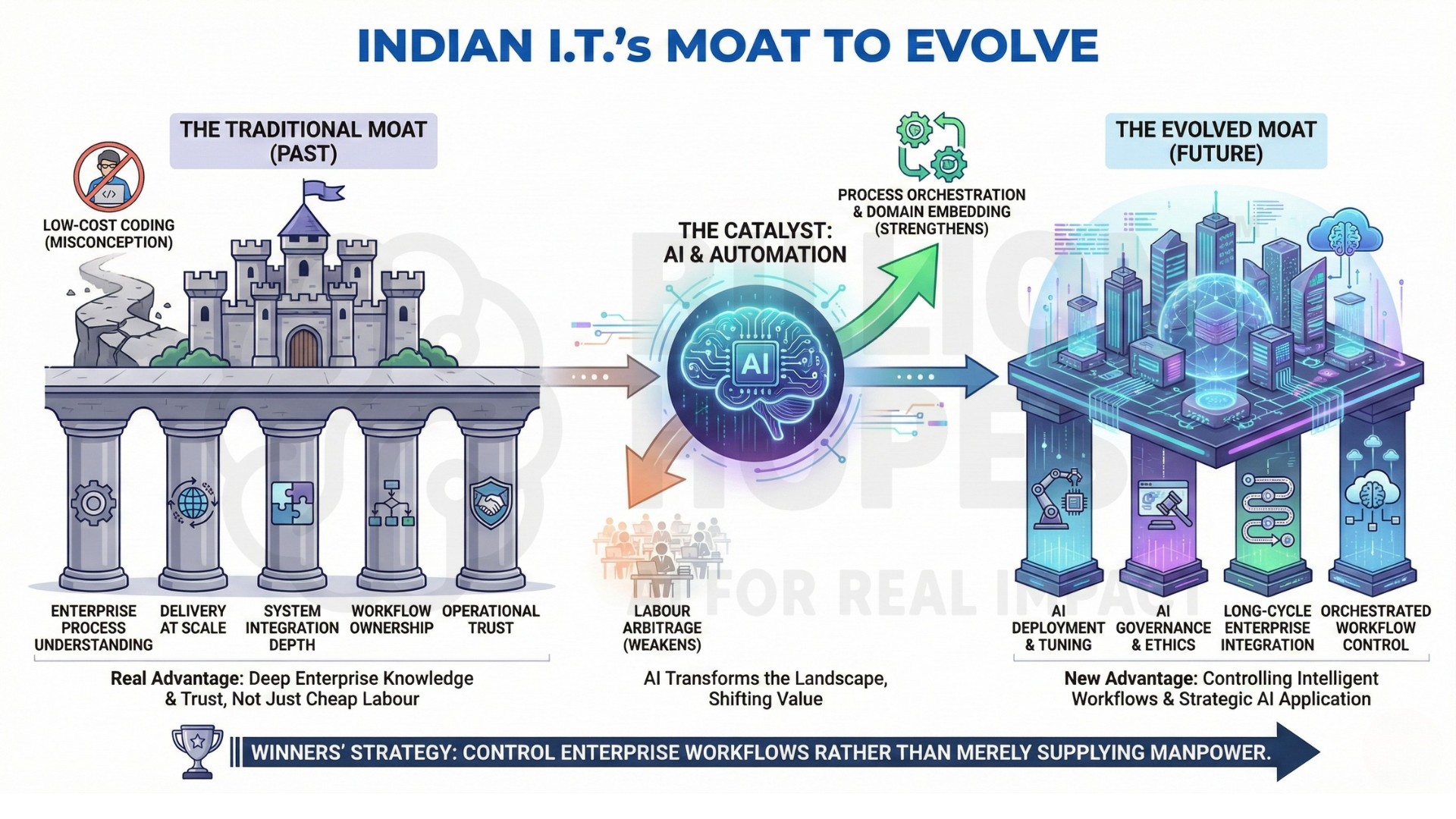
Business survive long-term on moats, unassailable advantages that no one can destroy. Was Indian IT’s real moat actually low-cost coding? Perhaps not. It was enterprise process understanding, delivery at scale, system integration depth, workflow ownership, and operational trust. AI weakens labour arbitrage but strengthens process orchestration and domain embedding. The moat shifts from execution capacity to AI deployment, tuning, governance, and long-cycle enterprise integration. The winners will be firms that control enterprise workflows rather than merely supplying manpower.
5. What the real risks from AI are
The real risks are structural rather than existential. Large IT and SaaS firms run by complacent managers who’ve seen nothing but steady profits all their lives, now face a moment of reinvention. SaaS pricing power compresses as foundation models commoditize features, and IT services margins face pressure as automation reduces billable hours. Platform owners gain leverage by controlling workflows. Eventually, talent polarizes between system designers and routine executors. Data ownership becomes the primary defensible asset (or moat). The risk is not mass unemployment, but rapid value migration away from undifferentiated providers.
6. Claude Cowork plugins and the stock scare of February 2026
The February 2026 market reaction to Claude cowork plugins was not about plugins themselves. It was about perceived disintermediation of SaaS interfaces. Investors reacted to the idea that AI agents could operate SaaS tools directly, weakening user facing software stickiness. This created fear that SaaS would become a commodity execution layer while AI becomes the control plane. The market response reflected anxiety about workflow control, not the replacement of tools.
7. What will happen in the short term
In the short term, AI should augment employees rather than replacing them. SaaS vendors will be seen embedding copilots and agents across products. IT services firms will package AI transformation as consulting engagements, a new experience for them, at lower profit margins initially. Productivity should improve while accountability remains human. Clearly, market narratives move faster than enterprise adoption. But nothing’s a given, and outcomes will vary hugely across companies depending on management understanding of the situation.
Speaking in more concrete terms, expect these: (i) slow hiring or no new hiring, (ii) nature of the job switched from doing it yourself to supervising AI output (post-generation), (iii) increased task volume – decreased hourly rates, (iv) freelancers getting less work. This is the pattern visible with software jobs.
8. What will happen in the mid term
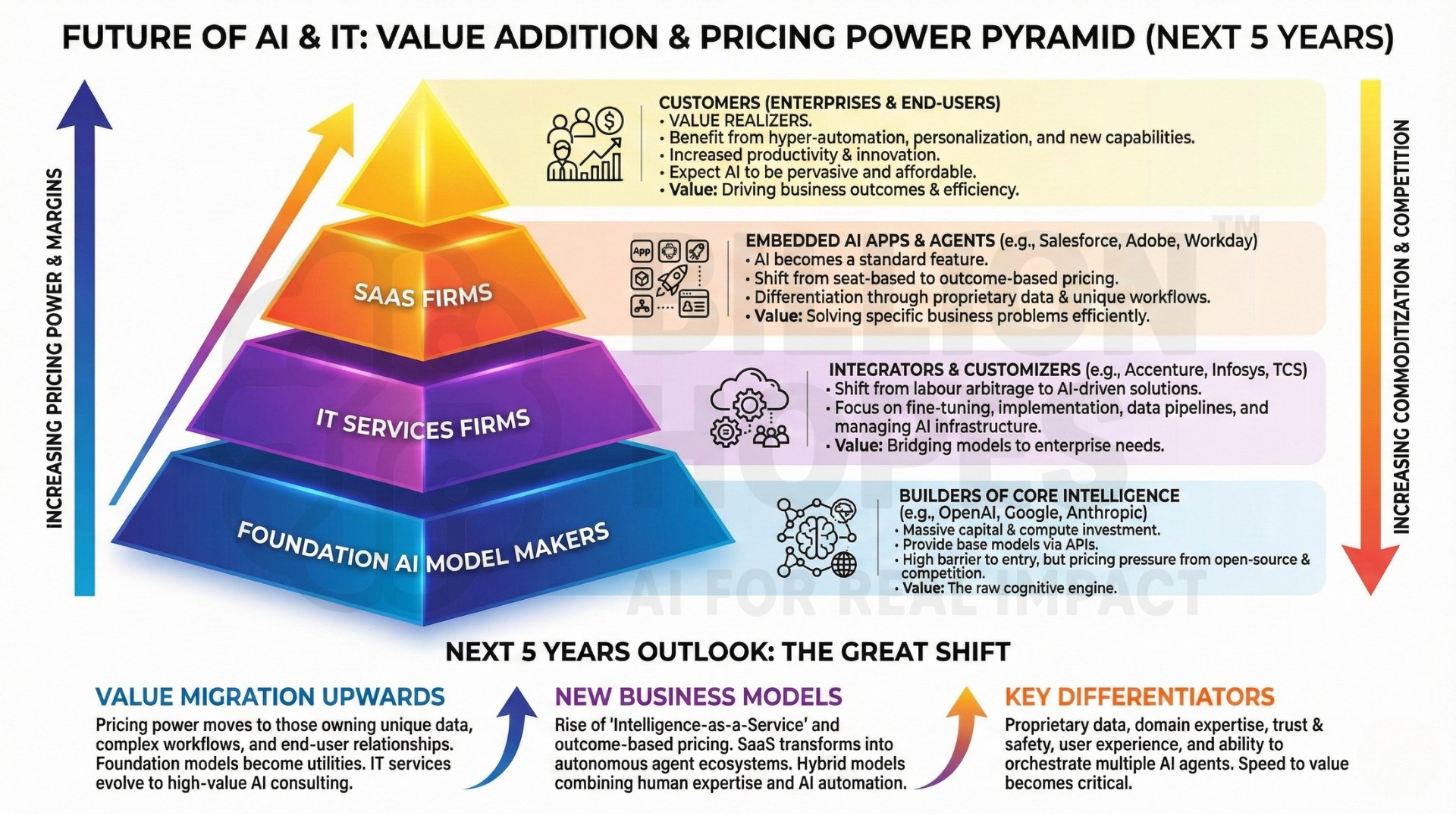
In the mid term, SaaS pricing shifts from seat-based models to outcome-based pricing. AI agents will coordinate workflows across enterprise systems. IT services firms will evolve into AI orchestration and governance providers. Foundation AI models (largely Western and Chinese) will commoditize and differentiation will shift to proprietary data and workflow control. Many operational roles will become partially automated.
9. What will happen in the long term
In the long term, AI will become invisible infrastructure. SaaS won’t die but will become modular capability blocks. Enterprise value will firmly concentrate around data ownership, orchestration layers, and workflow intellectual property. IT services will finally transform into operating system integrators for AI-driven enterprises. Human roles and jobs will concentrate around judgment, ethics, leadership, system design, and accountability. As of now, this is the visible trajectory will 2030.
10. Why AI will not kill SaaS
AI will not kill SaaS, but abstract it. SaaS (built and run by humans) will be the callable infrastructure for intelligent agents. Interfaces will shift from dashboards to intent-driven orchestration. This weakens brand lock-in but increases dependence on SaaS reliability and depth of integration.
11. Why AI will not kill IT services
IT services do not disappear overnight, because the real world and its complexities do not. Value will shift from manual configuration to AI pipeline design, enterprise data engineering, workflow orchestration, model governance, and risk management. Strategic relevance increases while low skill labour margins compress.
12. The new power pyramid
Foundation AI models will become utilities. SaaS firms will compete on workflow control. IT services firms will compete on orchestration and trust. Customers gain leverage as AI lowers switching costs across vendors. Pricing power migrates toward those who control data, workflows, and outcomes.
13. Why human work becomes more valuable
As automation expands, the need for human judgment increases. Remaining fully-human-tasks carry higher leverage, higher consequence, and greater strategic weight. The economic value of decision making, ethics, leadership, negotiation, and system design rises. So invest in yourself: read, stay updated, stay skilled and stay motivated!
The winners will control how work flows, not merely which tools are used.
Recalling the Generative AI argument at the start of this article, Gen AI’s commercial power today comes from scale and pattern learning, not causal understanding. This creates reliability ceilings in high-stakes, dynamic, and safety-critical domains. Until causal reasoning is formally integrated into model architectures and training objectives, generative AI will remain an extremely powerful assistant, but a structurally limited decision-maker. Maybe one day we’ll have hybrid models, but till then, limitations persist.
Summary
AI is not replacing software, SaaS, or IT services. It is restructuring the hierarchy of enterprise technology. Jobs fragment into tasks. Tasks become automated. SaaS becomes execution infrastructure. IT services become orchestration engines. Value migrates upward to those who control data, workflows, and outcomes. The future of IT is not about writing more code. It is about designing intelligent systems of work.
Share this with the world
Related Articles