AI basics
1. Understanding Artificial Intelligence: Definition, Scope, and Evolution
Artificial Intelligence (AI) refers to computer systems capable of performing tasks that traditionally require human intelligence – such as reasoning, perception, planning, decision-making, learning from experience, and interacting in natural language. The concept was formally introduced in 1956 at the Dartmouth Conference by pioneers such as John McCarthy, Marvin Minsky, Herbert Simon, and Allen Newell, who predicted that machines would soon “think” like humans.
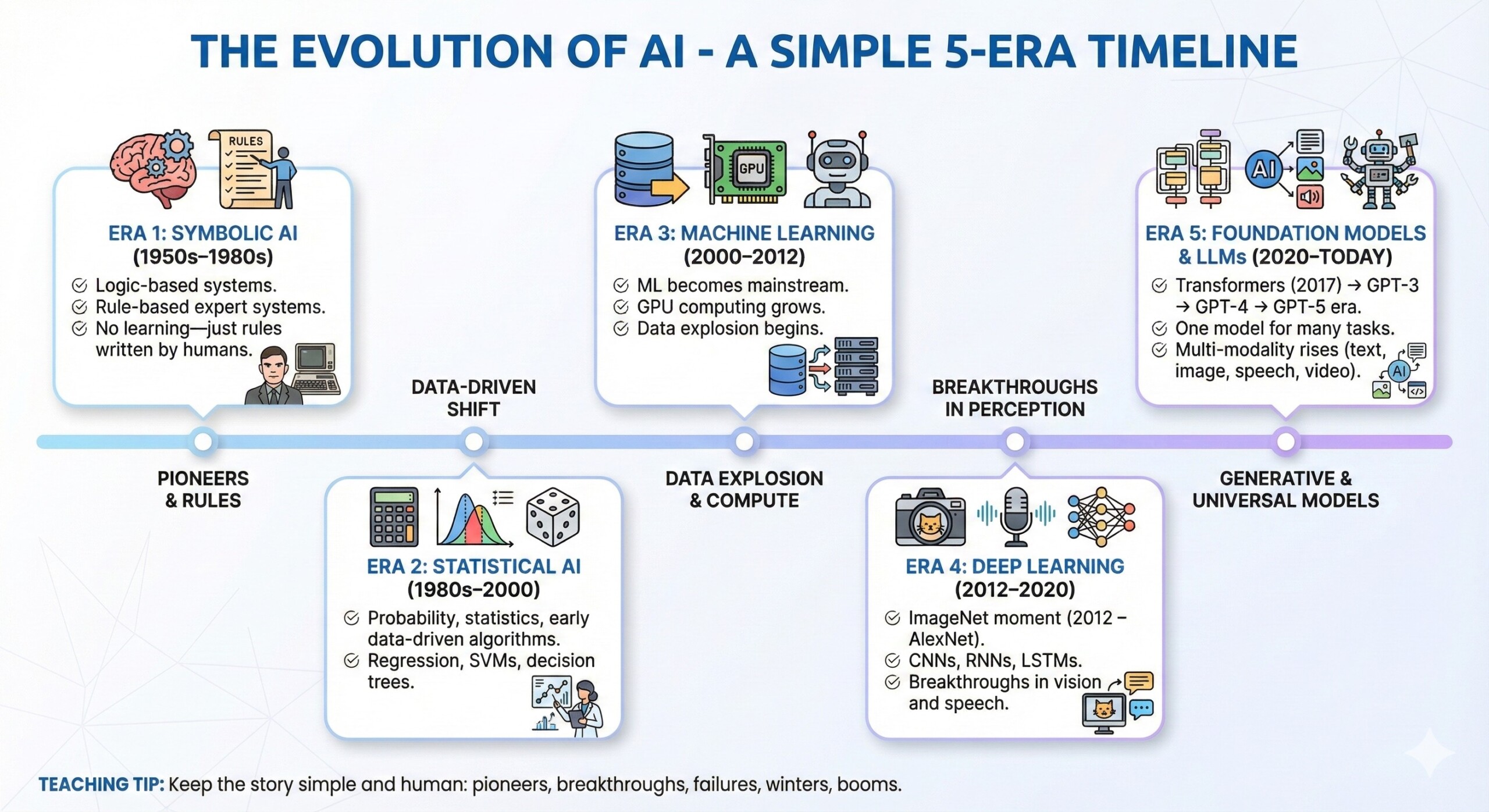
AI has gone through several waves:
- Rule-Based Systems (1950s–1980s): Early symbolic AI such as SHRDLU and DENDRAL relied on manually coded rules.
- Statistical & Machine Learning Era (1990s–2010s): Neural networks, SVMs, and probabilistic models powered speech recognition and computer vision.
- Deep Learning Revolution (2012–present): AlexNet’s success in the ImageNet competition triggered an explosion in neural-network dominance.
- Generative AI & LLMs (2020s–present): Models like GPT-4/5, Claude, Gemini, and Stable Diffusion created human-like text, images, audio, and video.
Today, AI permeates medicine, business analytics, national security, entertainment, finance, and governance. Global investment in AI is projected to exceed USD 500 billion by 2027, with the field expanding faster than any technological domain in history.
2. Foundations of AI: Logic, Rules, Learning, and Representation
AI systems rely on different approaches to represent knowledge and perform intelligent behavior:
- Symbolic or Rule-Based AI
Based on logic and explicit rules. Examples include:
- Expert systems like MYCIN for diagnosing blood infections.
- Chess engines (pre-neural networks), hard-coded with decision trees and heuristics.
Strength: Transparency and explainability.
Weakness: Brittle, cannot learn from data.
- Statistical & Machine Learning Approaches
The system learns patterns from data rather than explicit rules.
Key techniques include:
- Decision trees
- Logistic regression
- Clustering
- Ensemble models (Random Forest, XGBoost)
Example:
- Credit card fraud detection uses anomaly detection models trained on millions of transactions.
- Neural Networks & Deep Learning
Layers of interconnected nodes mimic the brain. Deep learning excels at perception tasks:
- Image classification (ResNet, Inception)
- Voice assistants (Siri, Google Assistant)
- Medical imaging (DeepMind’s retina scan diagnostic models)
- Reinforcement Learning
Learning by trial and error with reward signals.
Examples:
- AlphaGo, beating world champion Lee Sedol.
- Robotic arm control in factories.
Together, these methods form the foundation of modern artificial intelligence. An excellent collection of learning videos awaits you on our Youtube channel
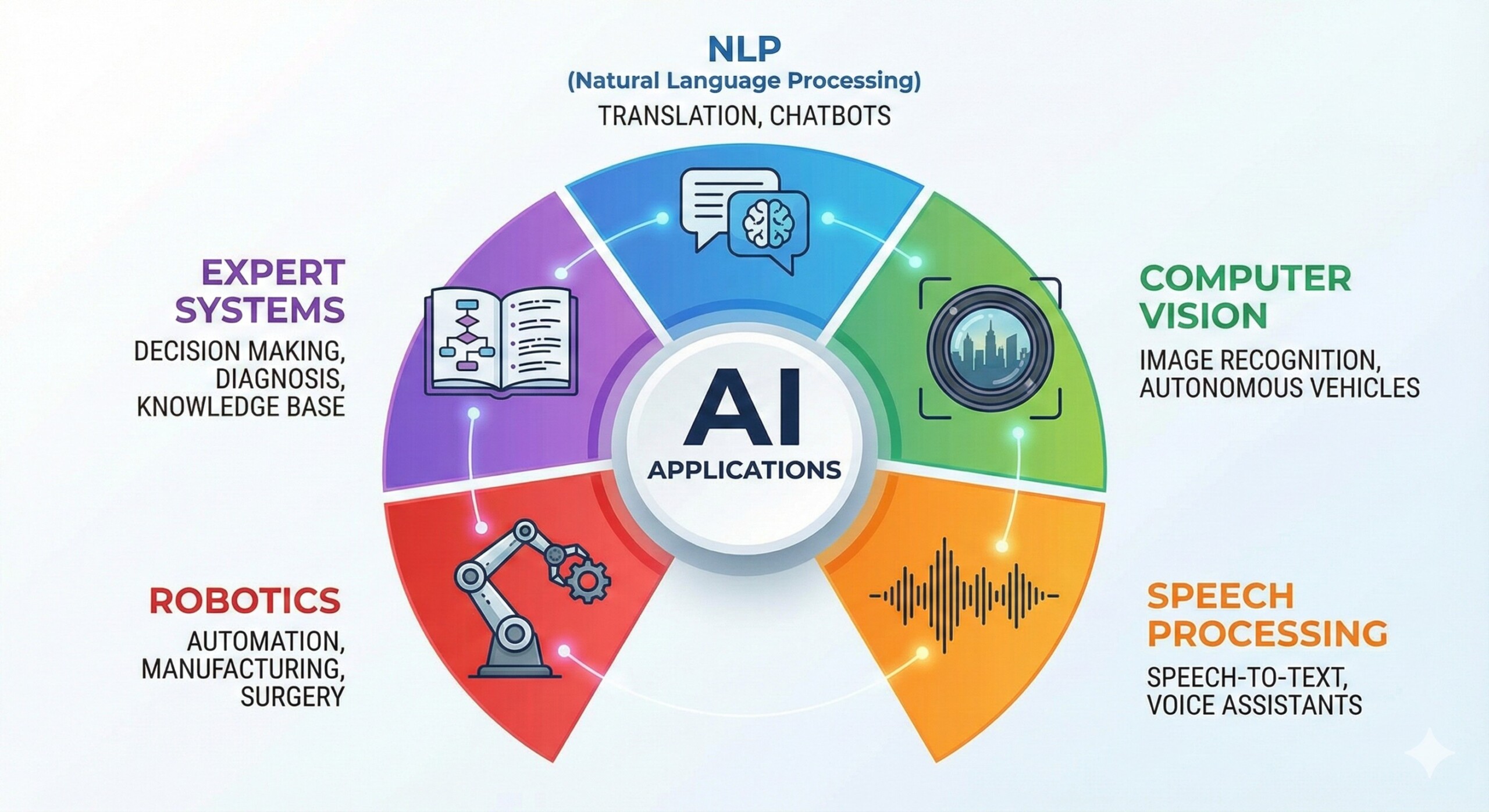
3. Key Subfields of AI: Reasoning, Perception, Language, Action, and Planning
AI is a broad field with specialized branches:
- Natural Language Processing (NLP)
Examples:
- ChatGPT and Gemini for conversation
- Machine translation (Google Translate)
- Sentiment analysis in marketing
- Computer Vision
Systems that “see” and interpret images and videos.
Examples:
- Autonomous vehicle lane detection
- Airport security X-ray analysis
- Facial recognition (Apple Face ID)
- Speech Recognition & Synthesis
Used in:
- Call center automation
- Voice assistants
- Dictation apps
- Robotics & Motion Planning
Examples:
- Boston Dynamics robots navigating rough terrain
- Amazon warehouse robots routing shelves
- Drone delivery path-planning
- Expert Systems & Cognitive Simulation
Examples:
- Legal decision-support systems
- Oil exploration modelling
- Medical diagnostic systems like IBM Watson (early attempts)
Each subfield tackles one aspect of human intelligence and contributes to building holistic AI systems.
4. Intelligent Agents and Environments: How AI Systems Operate
An intelligent agent is an entity that perceives its environment and takes actions to maximize goals.
Components of an AI Agent
- Sensors: Cameras, microphones, text inputs
- Actuators: Motors, text outputs, API calls
- State: Internal memory representing the world
- Policy: Strategy for choosing actions
- Reward function: Used in reinforcement learning
Examples of Intelligent Agents
- Self-driving cars: Perceptual sensors + driving actions.
- Chatbots: Understand queries and respond via language.
- Trading algorithms: Monitor financial markets and place orders.
- Personal assistants: Schedule tasks, set reminders, optimize productivity.
AI agents can be reactive (simple reflexes) or deliberative (plan over time). Modern systems increasingly combine both. A constantly updated Whatsapp channel awaits your participation.
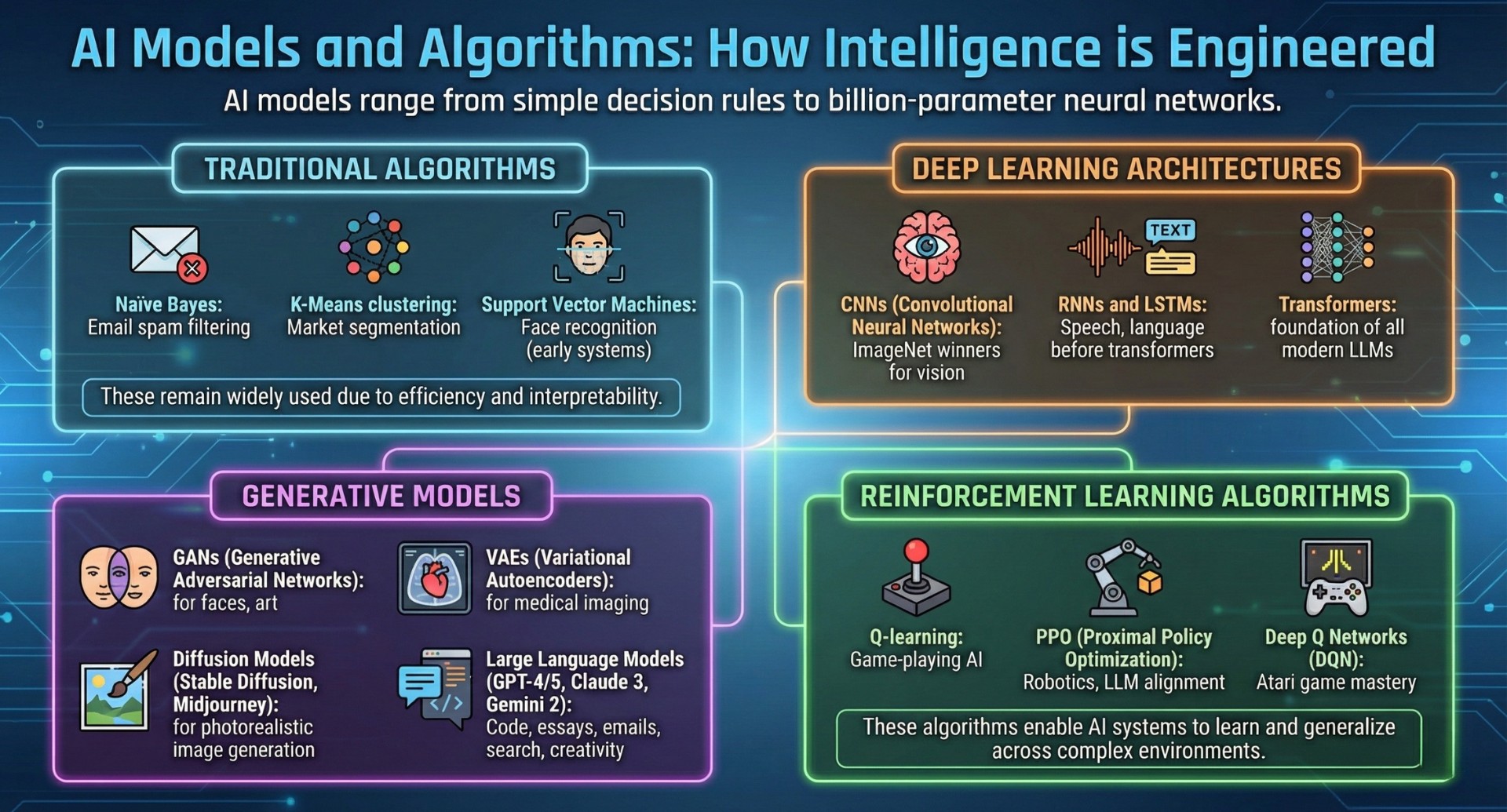
5. AI Models and Algorithms: How Intelligence is Engineered
AI models range from simple decision rules to billion-parameter neural networks.
Traditional Algorithms
- Naïve Bayes: Email spam filtering
- K-Means clustering: Market segmentation
- Support Vector Machines: Face recognition (early systems)
These remain widely used due to efficiency and interpretability.
Deep Learning Architectures
- CNNs (Convolutional Neural Networks): ImageNet winners for vision
- RNNs and LSTMs: Speech, language before transformers
- Transformers: foundation of all modern LLMs
Generative Models
- GANs (Generative Adversarial Networks) for faces, art
- VAEs (Variational Autoencoders) for medical imaging
- Diffusion Models (Stable Diffusion, Midjourney) for photorealistic image generation
- Large Language Models (GPT-4/5, Claude 3, Gemini 2): Code, essays, emails, search, creativity
Reinforcement Learning Algorithms
- Q-learning: Game-playing AI
- PPO (Proximal Policy Optimization): Robotics, LLM alignment
- Deep Q Networks (DQN): Atari game mastery
These algorithms enable AI systems to learn and generalize across complex environments.
6. Data, Training, Evaluation, and Deployment in AI Systems
AI performance depends heavily on data quality, model selection, and evaluation techniques.
Data in AI
- Labeled data: Images with tags
- Unlabeled data: Raw text or video
- Synthetic data: AI-generated datasets for training
- Real-time data: IoT sensors, social media streams
Training Steps
- Data collection
- Preprocessing and augmentation
- Model selection and hyperparameter tuning
- Training on GPUs/TPUs
- Validation using test sets
- Deployment to cloud, edge devices, or APIs
Model Evaluation Metrics
- Accuracy, precision, recall for classification
- BLEU, ROUGE for NLP
- FID for generative images
- Mean Average Precision (mAP) for object detection
Example Deployment Pipelines
- Netflix uses AI to personalize recommendations, improving watch-time by over 70%.
- Tesla deploys new self-driving models via OTA (over-the-air) updates weekly.
- Banks deploy fraud detection models on edge servers to detect anomalies instantly.
AI engineering has become a discipline combining software engineering, data science, and DevOps (called MLOps). Excellent individualised mentoring programmes available.
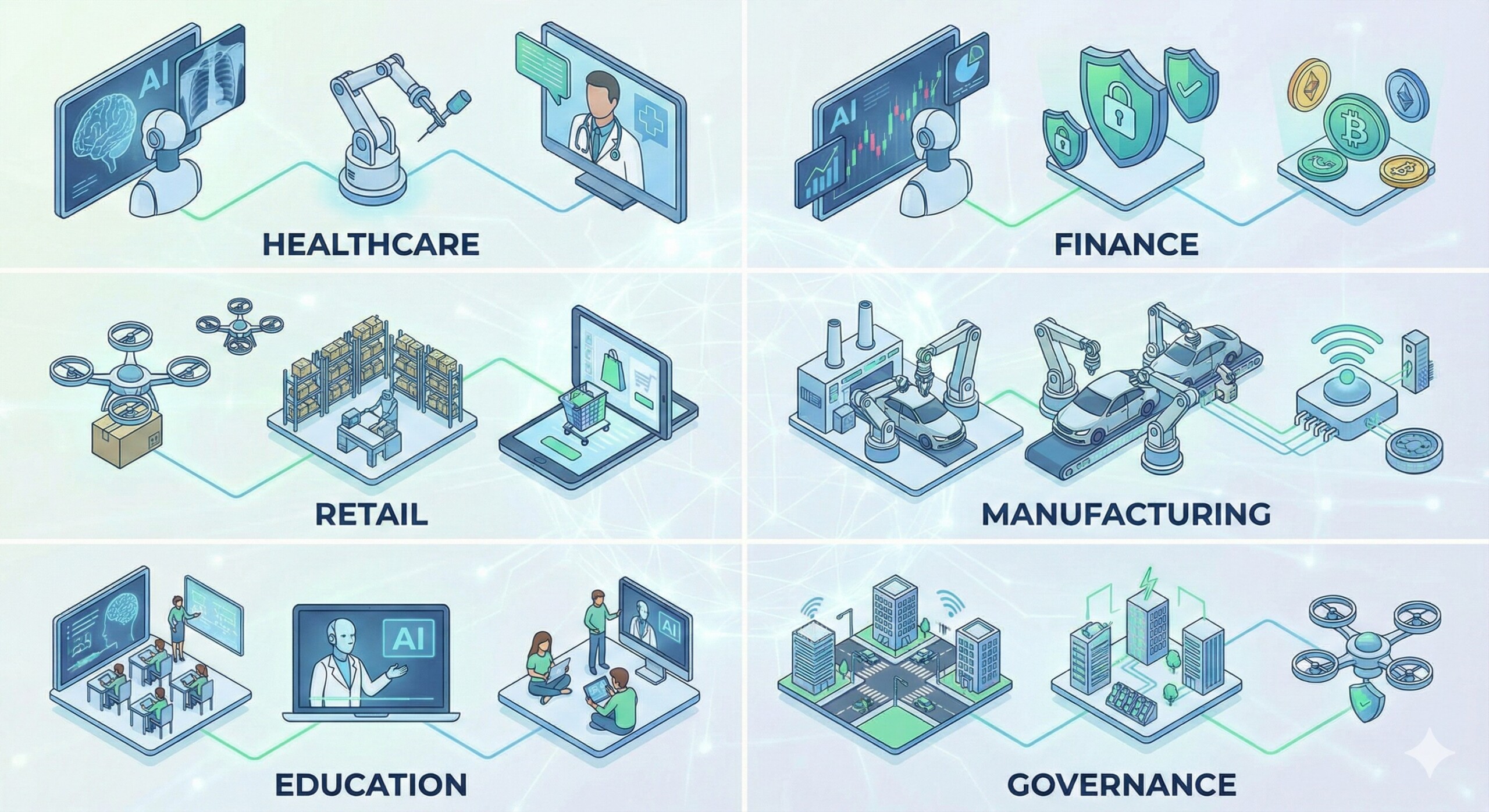
7. Real-World Applications of AI Across Industries
AI’s impact is massive and growing rapidly:
Healthcare
- AI models like DeepMind’s AlphaFold predicted 200M+ protein structures.
- AI-based radiology tools detect cancer with higher-than-human accuracy in some tasks.
- Hospital workflow automation improves patient care efficiency.
Finance
- AI-powered credit scoring (ZestAI, FICO ML models).
- High-frequency trading algorithms.
- Fraud detection systems analyzing billions of transactions.
Retail & E-commerce
- Amazon’s recommendation engine generates ~35% of revenue.
- Dynamic pricing using ML.
- Automated warehousing using Kiva robots.
Manufacturing
- Predictive maintenance using IoT + ML.
- Quality control using computer vision.
- Autonomous assembly lines.
Education
- Personalized learning platforms like Khanmigo (AI tutor).
- Automated grading systems.
- Adaptive learning pathways.
Governance and Public Sector
- Smart-city traffic systems.
- Citizen service chatbots.
- AI policy frameworks and regulatory sandboxes.
AI is already embedded in daily life—often invisible but enormously influential.
8. Ethical, Social, and Governance Challenges in AI
As AI expands, ethical responsibilities intensify.
Key Issues
- Bias & fairness: Face recognition bias examples (MIT Gender Shades study).
- Privacy: Data misuse, surveillance, biometric data collection.
- Explainability: Black-box models in critical decisions.
- Job displacement: Automation threatening routine work.
- AI misuse: Deepfakes, misinformation, automated cyberattacks.
- Regulation: EU AI Act, US White House AI Executive Order (2023), India’s evolving AI policy framework.
Examples of Ethical Failures
- Amazon’s hiring algorithm discriminating against women.
- COMPAS tool biases in judicial sentencing.
- Cambridge Analytica data scandal affecting elections.
Solutions Emerging
- Fairness frameworks (IBM Fairness 360, Google PAIR tools).
- Model interpretability techniques (SHAP, LIME).
- AI auditing and governance bodies.
- Global AI safety focuses from OpenAI, Anthropic, and DeepMind.
AI ethics is now a parallel discipline to AI development itself. Subscribe to our free AI newsletter now.
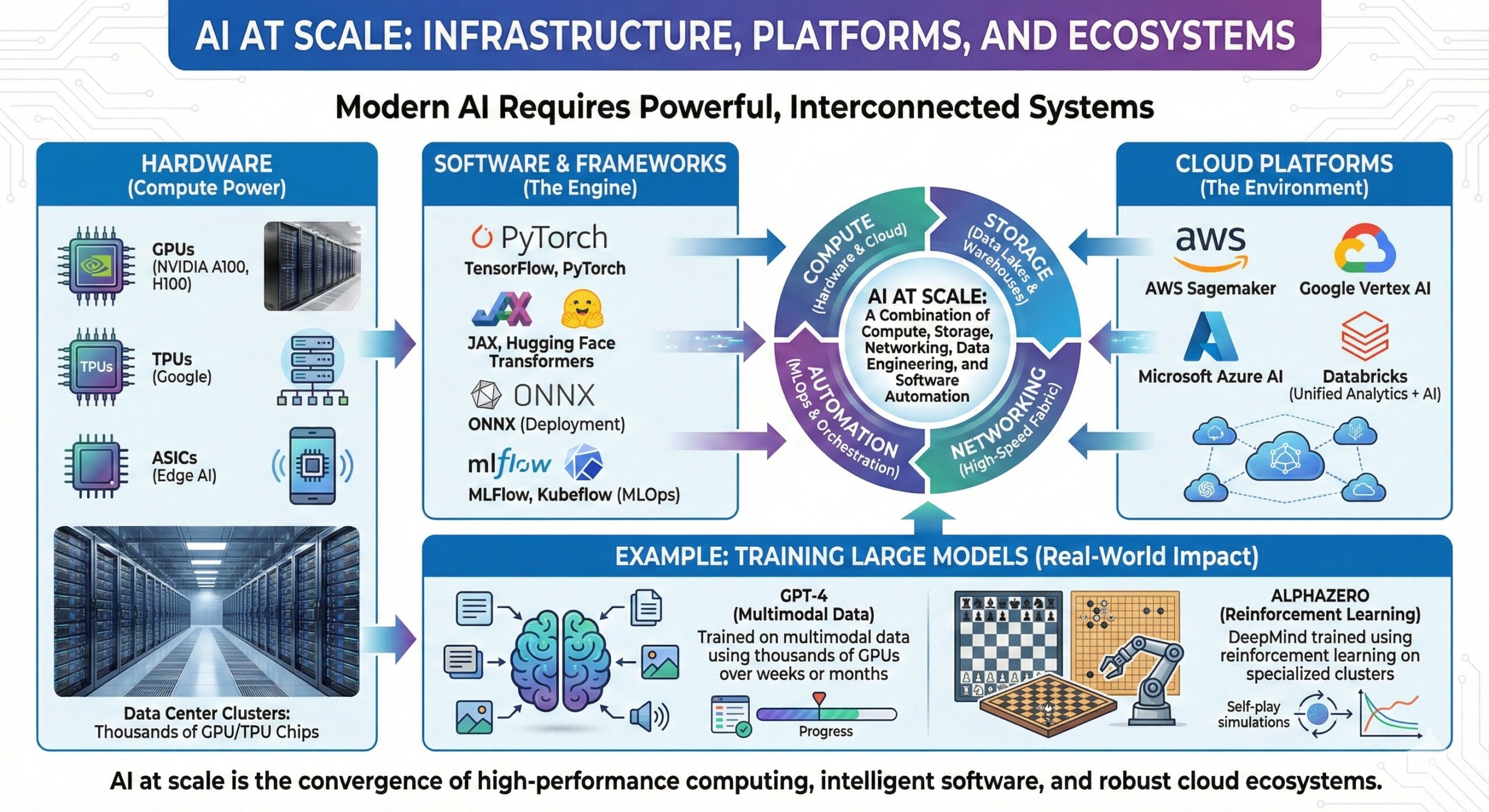
9. AI at Scale: Infrastructure, Platforms, and Ecosystems
Modern AI requires powerful infrastructure:
Hardware
- GPUs (NVIDIA A100, H100)
- TPUs (Google)
- ASICs for edge AI
- Data center clusters with thousands of GPU chips
Software & Frameworks
- TensorFlow, PyTorch
- JAX, Hugging Face Transformers
- ONNX for deployment
- MLFlow, Kubeflow for MLOps
Cloud Platforms
- AWS Sagemaker
- Google Vertex AI
- Microsoft Azure AI
- Databricks for unified analytics + AI
Example: Training Large Models
GPT-4 was trained on multimodal data, using thousands of GPUs over weeks or months.
DeepMind trained AlphaZero using reinforcement learning on specialized clusters.
AI at scale is a combination of compute, storage, networking, data engineering, and software automation.
10. The Impact and Future Trajectory of AI
AI is transforming global society and industry alike.
Emerging Trends
- Generative AI Everywhere: From marketing copy to drug discovery.
- Agentic AI Systems: Autonomous multi-step agents performing workflows.
- Foundation Models for Everything: Biology, chemistry, materials science.
- Edge AI: Smartphones, IoT devices, AR/VR headsets.
- AI Safety Research: Red teams, alignment, interpretability.
Economic and Social Impact
- AI could add $15.7 trillion to global GDP by 2030 (PwC).
- New jobs emerging: prompt engineers, AI ethicists, AI policy advisors, MLOps engineers.
- Shift from “automation” to “augmentation”—AI as a thinking partner.
Long-Term Vision
- Personalized AI assistants with memory and reasoning.
- AI copilots integrated into every profession.
- AI accelerating scientific progress by decades.
- Safe, aligned AI that complements rather than replaces human judgment.
Artificial Intelligence will continue reshaping how societies work, think, create, and govern. Upgrade your AI-readiness with our masterclass.
Share this with the world
Related Articles