AI Career Risks, Myths & Realities
AI Career Risks, Myths & Realities
Job fear, hype cycles, and long-term truth
Introduction
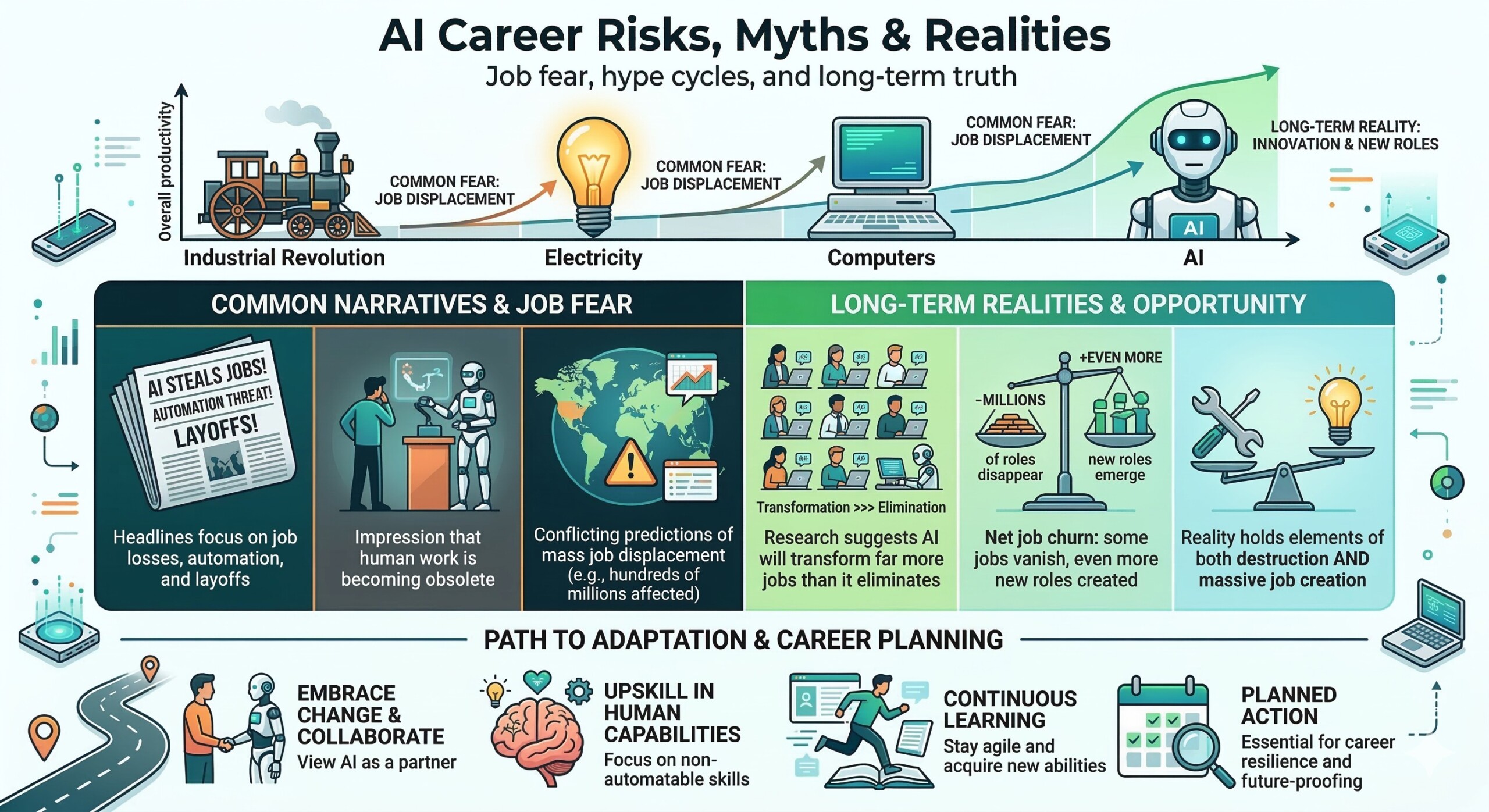
Artificial Intelligence (AI) has triggered one of the biggest debates about careers since the industrial revolution. Every major technological wave – from electricity to computers – sparked fears of mass unemployment. AI is now the latest chapter in that story.
Headlines often focus on job losses, automation, and layoffs, creating the impression that human work is becoming obsolete. Some forecasts claim that hundreds of millions of jobs could be affected globally, while others predict massive job creation. In reality, both narratives contain elements of truth.
Research suggests that AI will transform far more jobs than it eliminates. Estimates show that while millions of roles could disappear, even more new roles may emerge, especially for workers who adapt and acquire new skills.
Understanding the real risks, myths, and long-term realities of AI is therefore essential for professionals planning their careers.
Ten realities about AI Careers
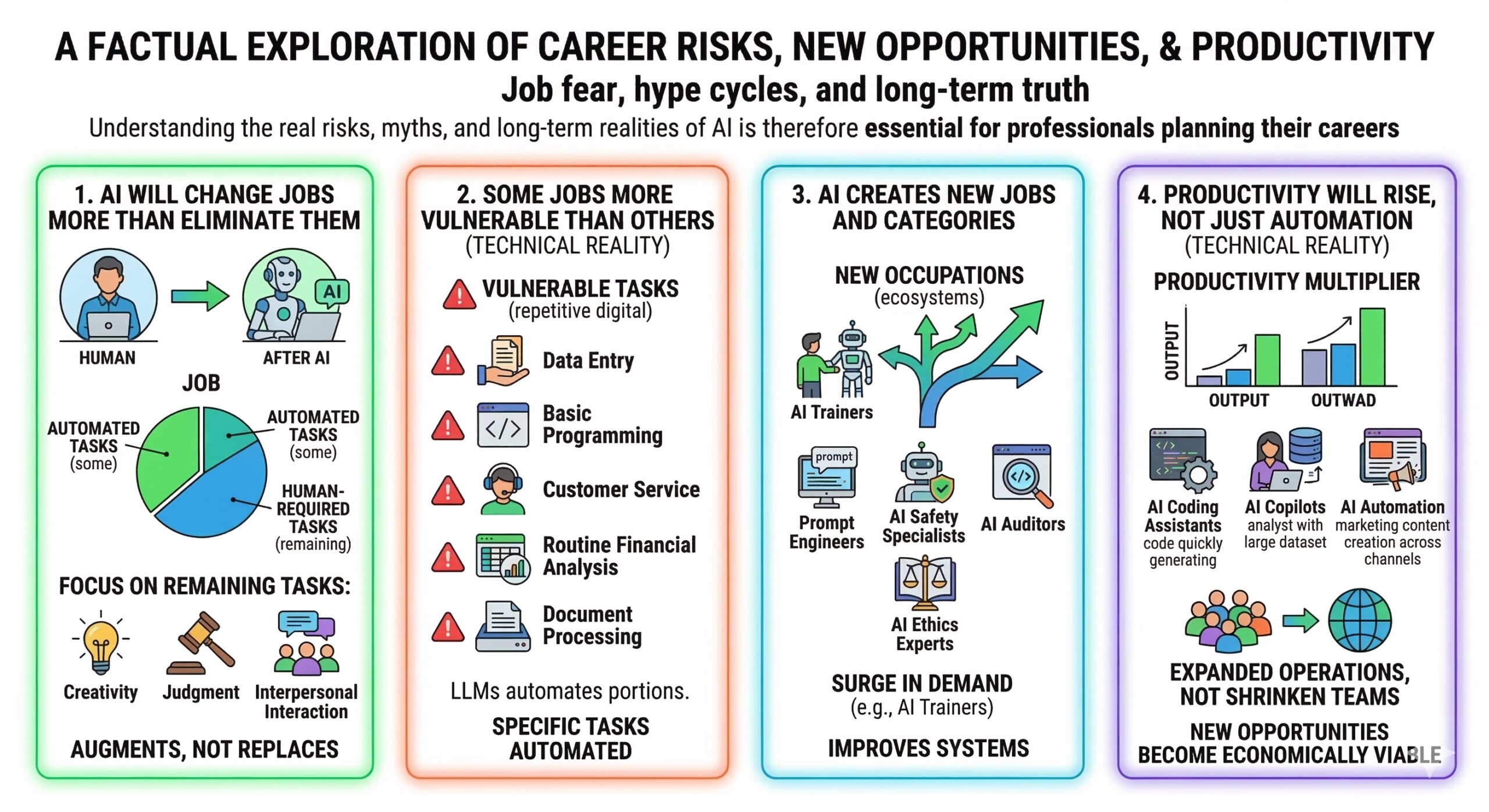
1. AI will change jobs more than eliminate them
One of the biggest myths is that AI will simply replace humans. In practice, most technologies transform job tasks rather than eliminate entire occupations.
Studies show that many jobs consist of multiple tasks, and AI automates only some of them. Workers then focus on the remaining tasks that require judgment, creativity, or interpersonal interaction.
As a result, AI tends to augment human work rather than fully replace it.
2. Some jobs more vulnerable than others (technical reality)
Jobs with structured, repetitive digital tasks are the most vulnerable.
Examples include:
- Data entry
- Basic programming
- Customer service operations
- Routine financial analysis
- Document processing
Large language models already automate significant portions of programming and customer support tasks, which makes these roles particularly exposed to automation.
However, the key insight is that specific tasks are automated – not entire professions. An excellent collection of learning videos awaits you on our Youtube channel.
3. AI creates new jobs and categories
Every technology wave creates new occupations that previously did not exist.
Recent examples include:
- AI trainers
- Prompt engineers
- AI safety specialists
- AI auditors
- AI ethics experts
Demand for roles such as AI trainers has surged dramatically as companies need humans to evaluate and improve AI systems.
The emergence of these roles demonstrates that AI generates new employment ecosystems.
4. Productivity will rise, not just automation (technical reality)
AI is primarily a productivity multiplier.
Instead of replacing workers, AI tools allow one professional to accomplish far more work. For example:
- AI coding assistants accelerate software development
- AI copilots help analysts process large datasets
- AI automation speeds up marketing content creation
Higher productivity often leads companies to expand operations rather than shrink teams, because new opportunities become economically viable. A constantly updated Whatsapp channel awaits your participation.
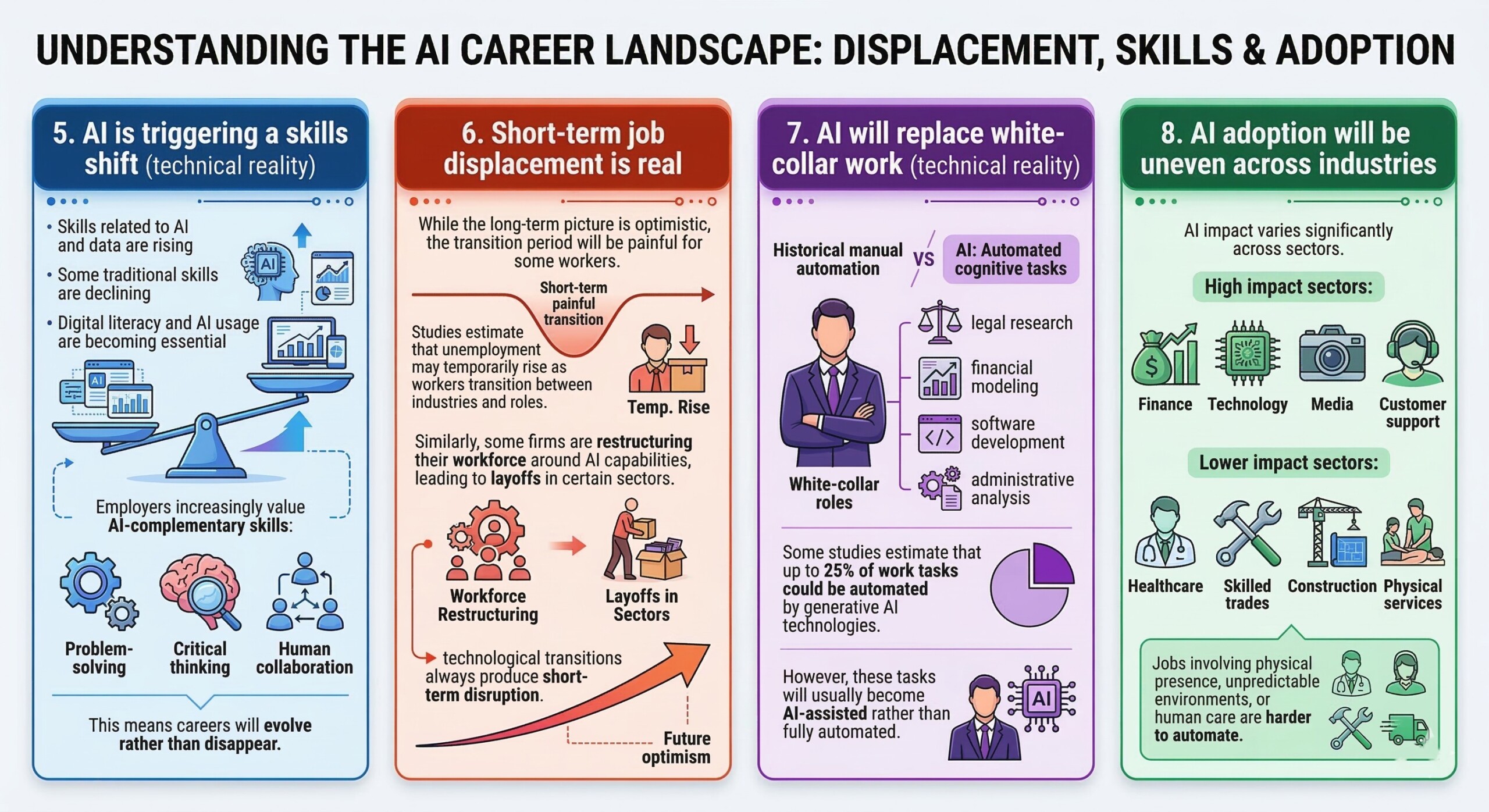
5. AI is triggering a skills shift (technical reality)
Rather than eliminating careers, AI is changing the skills required within them.
Research analyzing millions of job postings shows that:
- Skills related to AI and data are rising
- Some traditional skills are declining
- Digital literacy and AI usage are becoming essential
Employers increasingly value AI-complementary skills, such as problem-solving, critical thinking, and human collaboration.
This means careers will evolve rather than disappear.
6. Short-term job displacement is real
While the long-term picture is optimistic, the transition period will be painful for some workers.
Studies estimate that unemployment may temporarily rise as workers transition between industries and roles.
Similarly, some firms are restructuring their workforce around AI capabilities, leading to layoffs in certain sectors.
The important reality: technological transitions always produce short-term disruption. Excellent individualised mentoring programmes available.
7. AI will replace white-collar work (technical reality)
Historically, automation mainly affected manual labour. AI is different because it can automate cognitive tasks.
This means white-collar roles are increasingly exposed, including:
- legal research
- financial modeling
- software development
- administrative analysis
Some studies estimate that up to 25% of work tasks could be automated by generative AI technologies.
However, these tasks will usually become AI-assisted rather than fully automated.
8. AI adoption will be uneven across industries
AI impact varies significantly across sectors.
High impact sectors:
- Finance
- Technology
- Media
- Customer support
Lower impact sectors:
- Healthcare
- Skilled trades
- Construction
- Physical services
Jobs involving physical presence, unpredictable environments, or human care are harder to automate. Subscribe to our free AI newsletter now.
9. AI driving demand for hybrid professionals (technical reality)
The most valuable professionals in the AI era are not pure technologists.
Instead, companies increasingly need people who combine:
- domain expertise
- data understanding
- AI literacy
Examples include:
- AI-enabled doctors
- AI-assisted lawyers
- data-driven marketers
- AI-literate business managers
This hybrid skill model is becoming the dominant career pattern.
10. Biggest risk isn’t AI – it’s skills stagnation
The real danger for workers is not automation itself but failing to adapt.
Technological change has always rewarded people who learn new tools. Workers who continuously update their skills are far less likely to be displaced.
In fact, projections suggest that AI could create millions of new roles globally, offsetting many of the jobs lost to automation.
The winners will be those who treat AI as a tool rather than a threat. Upgrade your AI-readiness with our masterclass.
Conclusion
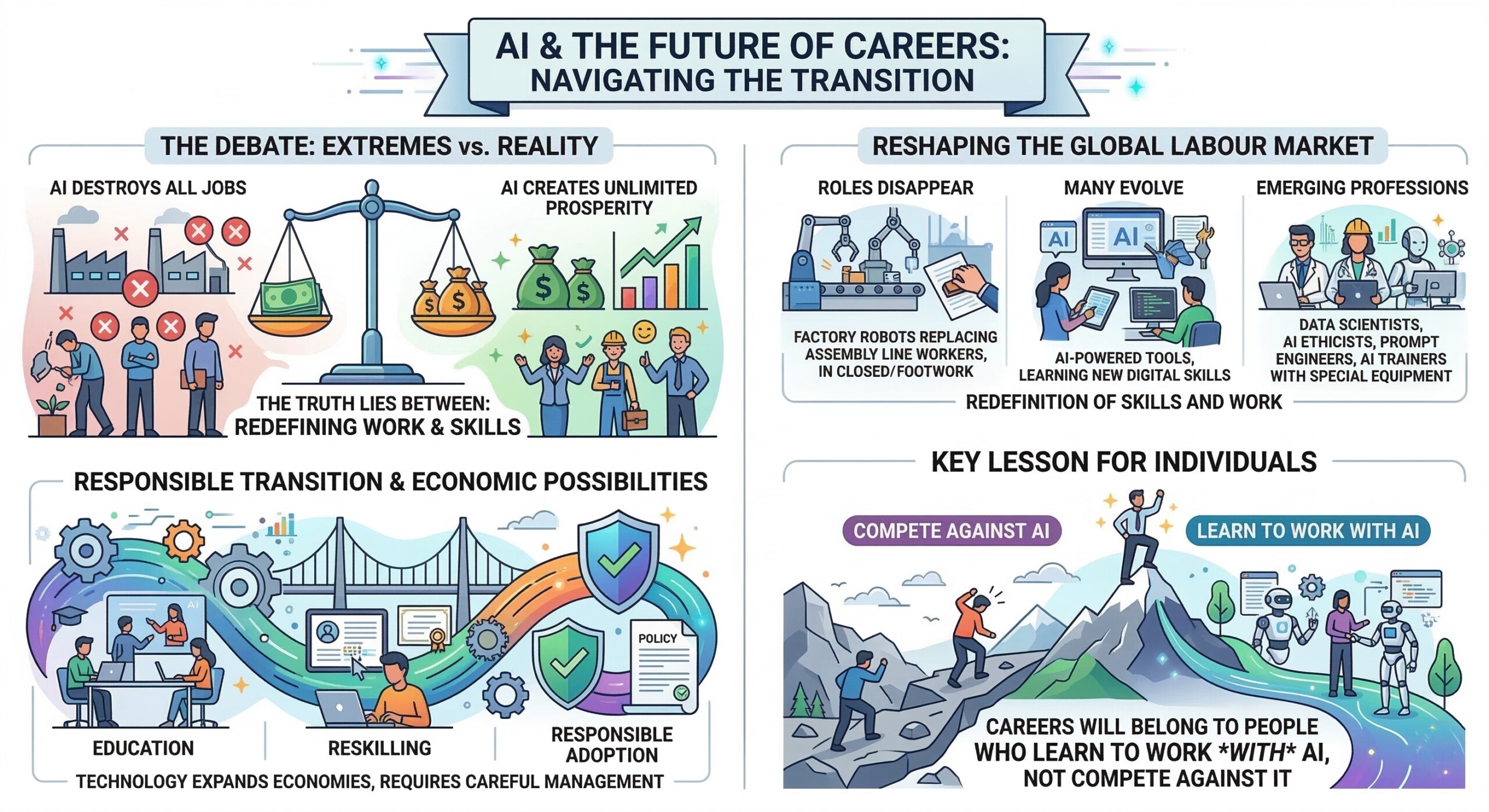
The debate around AI careers is often dominated by extremes: either AI will destroy all jobs or it will create unlimited prosperity. The truth lies between these two narratives.
AI will undoubtedly reshape the global labour market. Some roles will disappear, many will evolve, and entirely new professions will emerge. The most significant change will not be unemployment but a redefinition of skills and work itself.
History suggests that technology ultimately expands economic possibilities. However, societies must manage the transition carefully through education, reskilling, and responsible adoption.
For individuals, the long-term lesson is simple: careers will belong to people who learn to work with AI, not those who compete against it.
Share this with the world
Related Articles