AI Careers for CXOs & Senior Leaders
AI Careers for CXOs & Senior Leaders
AI leadership, governance, and strategy ownership
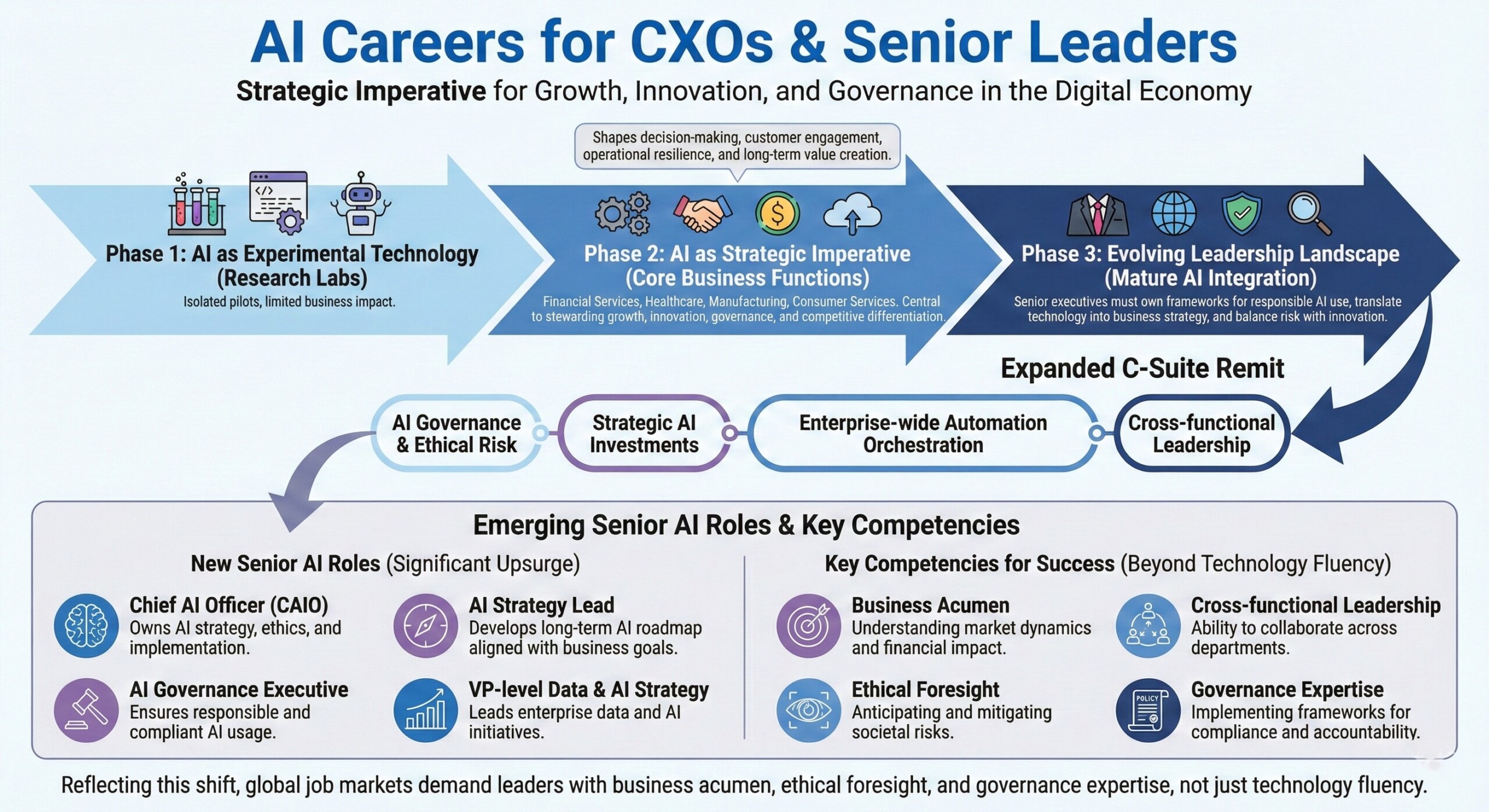
In today’s digital economy, AI is no longer an experimental technology tucked away in research labs. It has become a strategic imperative for organizations across sectors – from financial services and healthcare to manufacturing and consumer services. For CXOs and senior leaders, understanding AI is no longer optional; it is central to stewarding growth, innovation, governance, and competitive differentiation. AI increasingly shapes decision-making, customer engagement, operational resilience, and long-term value creation.
The leadership landscape is evolving rapidly as AI technologies mature and integrate into core business functions. Senior executives are expected to go beyond championing digital transformation: they must now own frameworks for responsible AI use, translate technology into business strategy, and balance risk with innovation. This shift expands the traditional C-suite remit into new domains such as AI governance, ethical risk, strategic AI investments, and enterprise-wide automation orchestration.
Reflecting this shift, global job markets show a significant upsurge in senior AI roles – from Chief AI Officers to AI Strategy Leads, AI Governance Executives, and VP-level data and AI strategy positions. These roles are not only about technology fluency; they demand business acumen, cross-functional leadership, ethical foresight, and governance expertise.
1. Chief AI Officer (CAIO) & AI Strategy Leadership
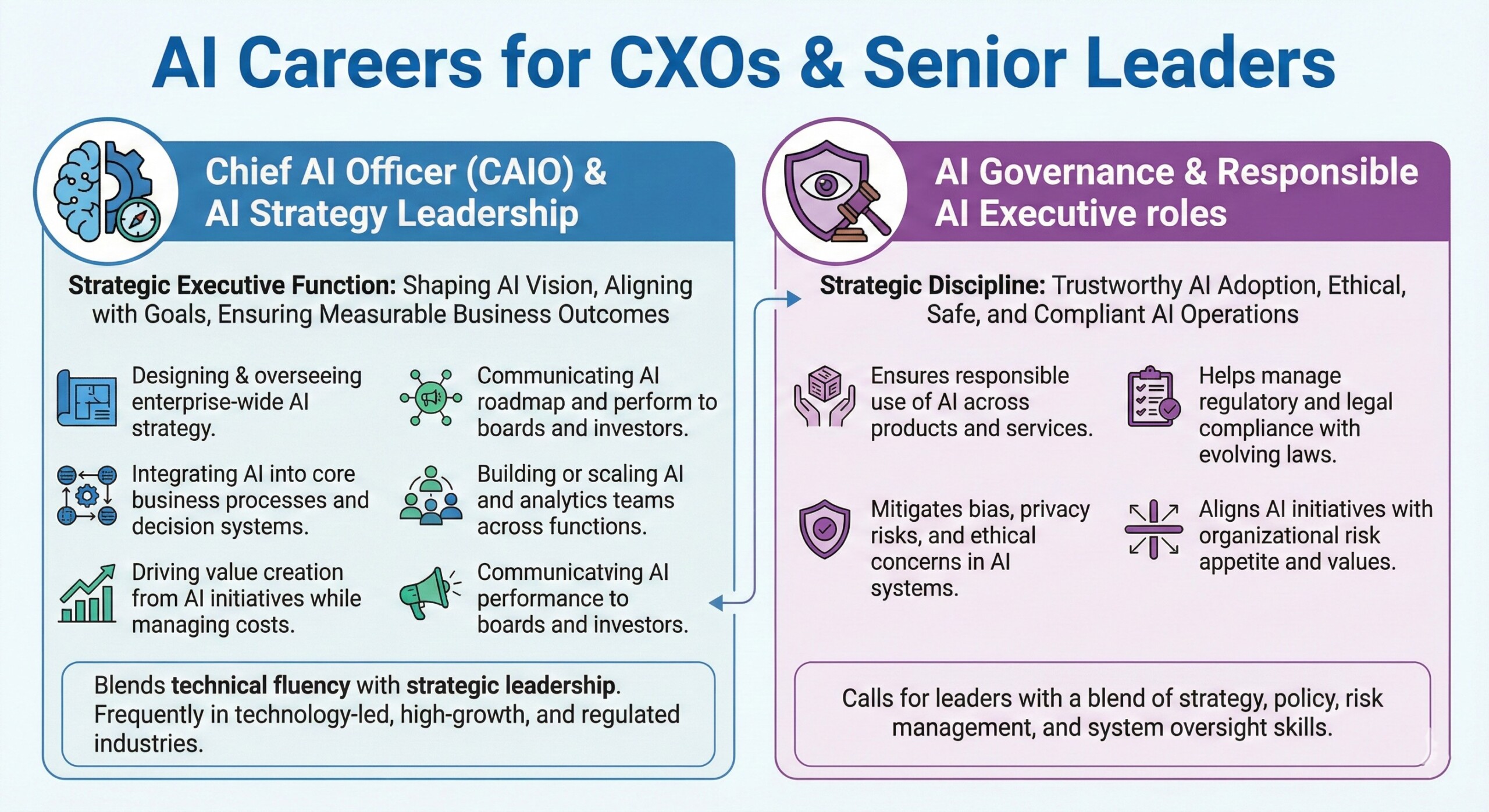
The role of the Chief AI Officer has quickly emerged as one of the most strategic executive functions in modern enterprises. A CAIO is accountable for shaping the AI vision, aligning it with organizational goals, and ensuring measurable business outcomes from AI investments.
Key responsibilities typically include:
- Designing and overseeing enterprise-wide AI strategy.
- Integrating AI into core business processes and decision systems.
- Driving value creation from AI initiatives while managing costs.
- Building or scaling AI and analytics teams across functions.
- Communicating AI roadmap and performance to boards and investors.
This role blends technical fluency with strategic leadership and is frequently seen in technology-led, high-growth, and regulated industries.
2. AI Governance & Responsible AI Executive roles
Governance is no longer just a compliance checkbox – it’s a strategic discipline essential for trustworthy AI adoption. Roles like Director/Sr. Director of AI Governance, VP of AI Governance & Responsible AI, and AI Governance & Risk Strategy Lead are in strong demand globally, reflecting a broader shift toward ethical, safe, and compliant AI operations.
Why AI governance matters:
- Ensures responsible use of AI across products and services.
- Helps manage regulatory and legal compliance with evolving laws.
- Mitigates bias, privacy risks, and ethical concerns in AI systems.
- Aligns AI initiatives with organizational risk appetite and values.
These roles call for leaders with a blend of strategy, policy, risk management, and system oversight skills. An excellent collection of learning videos awaits you on our Youtube channel.
3. Senior Strategy & Transformation roles in AI
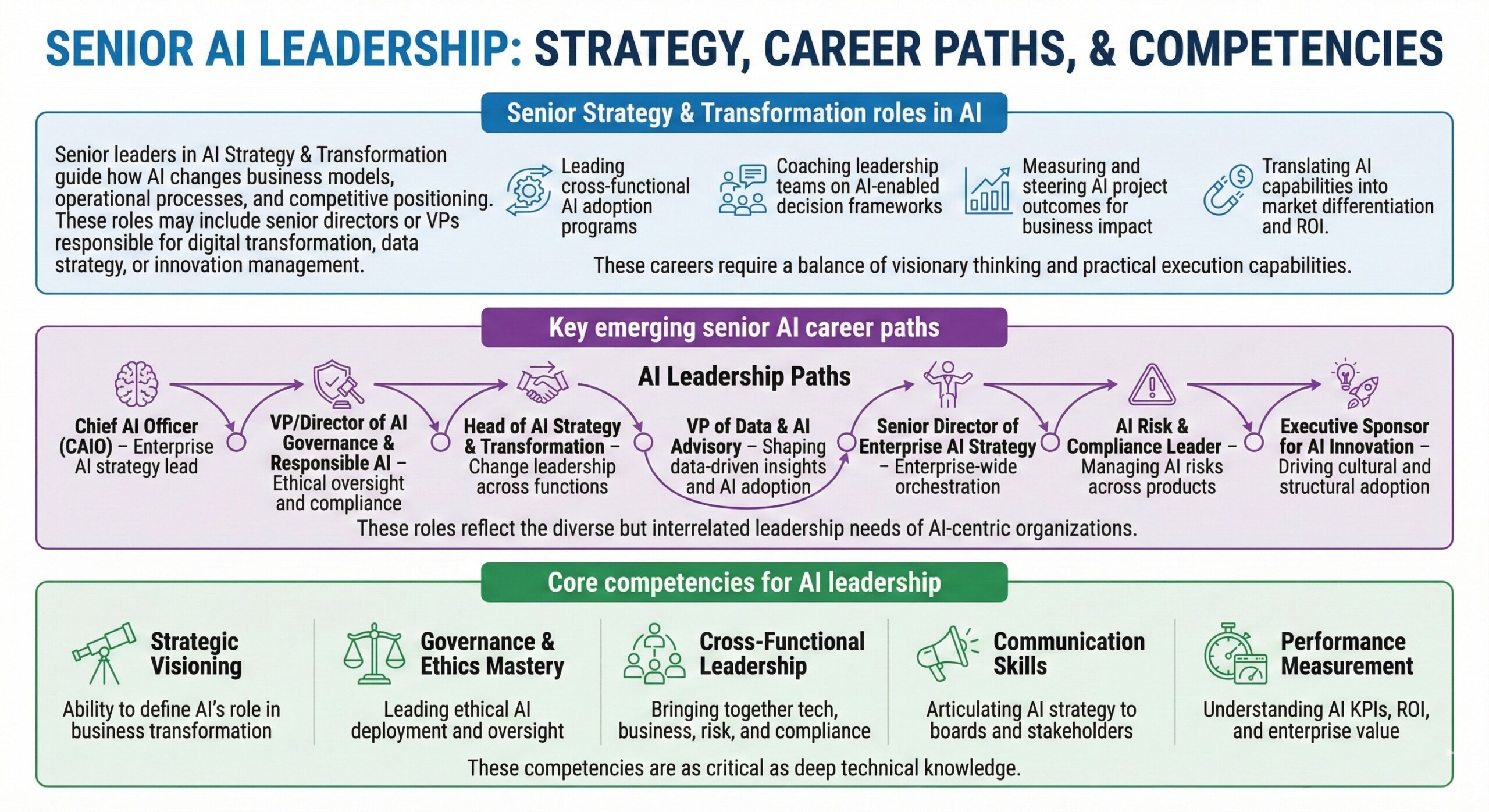
In many organizations, senior leaders are being appointed to AI Strategy & Transformation functions – where they guide how AI changes business models, operational processes, and competitive positioning. These roles may include senior directors or VPs responsible for digital transformation, data strategy, or innovation management.
Responsibilities of such roles often include:
- Leading cross-functional AI adoption programs.
- Coaching leadership teams on AI-enabled decision frameworks.
- Measuring and steering AI project outcomes for business impact.
- Translating AI capabilities into market differentiation and ROI.
These careers require a balance of visionary thinking and practical execution capabilities.
4. Key emerging senior AI career paths
Senior leaders considering a leap into AI leadership should explore paths such as:
- Chief AI Officer (CAIO) – Enterprise AI strategy lead.
- VP/Director of AI Governance & Responsible AI – Ethical oversight and compliance.
- Head of AI Strategy & Transformation – Change leadership across functions.
- VP of Data & AI Advisory – Shaping data-driven insights and AI adoption.
- Senior Director of Enterprise AI Strategy – Enterprise-wide orchestration.
- AI Risk & Compliance Leader – Managing AI risks across products.
- Executive Sponsor for AI Innovation – Driving cultural and structural adoption.
These roles reflect the diverse but interrelated leadership needs of AI-centric organizations. A constantly updated Whatsapp channel awaits your participation.
5. Core competencies for AI leadership
To succeed in these executive AI careers, leaders must cultivate:
- Strategic Visioning: Ability to define AI’s role in business transformation.
- Governance & Ethics Mastery: Leading ethical AI deployment and oversight.
- Cross-Functional Leadership: Bringing together tech, business, risk, and compliance.
- Communication Skills: Articulating AI strategy to boards and stakeholders.
- Performance Measurement: Understanding AI KPIs, ROI, and enterprise value.
These competencies are as critical as deep technical knowledge.
6. Organizational Impact Areas
Senior AI leaders often steer impact in areas such as:
- Operational Efficiency: AI-enabled automation and process optimization.
- Customer Experience: AI insights for personalization and engagement.
- Innovation Pipelines: Integrating AI into new product development.
- Risk Management: Proactive mitigation of AI and data risks.
- Decision Intelligence: Augmenting leadership decisions with AI insights.
These domains represent where executive AI leadership delivers measurable strategic value. Excellent individualised mentoring programmes available.
7. Board-Level AI Oversight & policy stewardship
As AI adoption scales, boards and executive committees are increasingly expected to provide structured oversight of AI strategy, risk, and compliance. In many organizations, this has led to the creation of board-level AI committees or expanded mandates within risk and audit committees. Senior leaders stepping into AI careers must understand how to interface with governance structures at the highest level.
Executive AI oversight typically includes:
- Defining enterprise AI principles and acceptable use policies.
- Monitoring regulatory compliance across jurisdictions.
- Reviewing high-risk AI deployments (credit scoring, hiring, healthcare, etc.).
- Ensuring transparency, auditability, and documentation standards.
- Evaluating long-term societal and reputational impact.
For CXOs, AI governance is no longer operational – it is fiduciary. Strategy ownership now extends into accountability frameworks and structured reporting mechanisms.
8. Regulatory readiness & Global AI policy alignment
AI regulation is evolving rapidly across major economies. Senior leaders in AI roles must track and operationalize compliance requirements across geographies, particularly in areas such as transparency, bias mitigation, data protection, and model documentation.
Key executive considerations include:
- Alignment with emerging AI regulations and sector-specific guidance.
- Building internal AI audit trails and model documentation systems.
- Establishing human-in-the-loop oversight for high-risk systems.
- Coordinating legal, compliance, and technology teams proactively.
- Embedding responsible AI standards into procurement and vendor contracts.
This requires not just awareness, but structured regulatory strategy. Leaders who can anticipate regulatory shifts and operationalize compliance frameworks will hold a strong strategic advantage. Subscribe to our free AI newsletter now.
9. Talent architecture & AI capability building
AI leadership is not only about technology or policy – it is about building institutional capability. CXOs entering AI careers must design sustainable talent architectures that combine data science, engineering, governance, domain expertise, and change management.
Executive ownership in this area includes:
- Designing centralized vs. federated AI operating models.
- Recruiting AI leadership talent and governance specialists.
- Upskilling senior managers in AI literacy and risk awareness.
- Embedding AI accountability into performance systems.
- Creating cross-functional AI councils for strategic alignment.
The long-term differentiator for organizations will not simply be access to AI tools – it will be their ability to institutionalize AI as a disciplined, governed, enterprise capability. Senior leaders who can architect that capability will define the next generation of AI-driven enterprises.
Summary
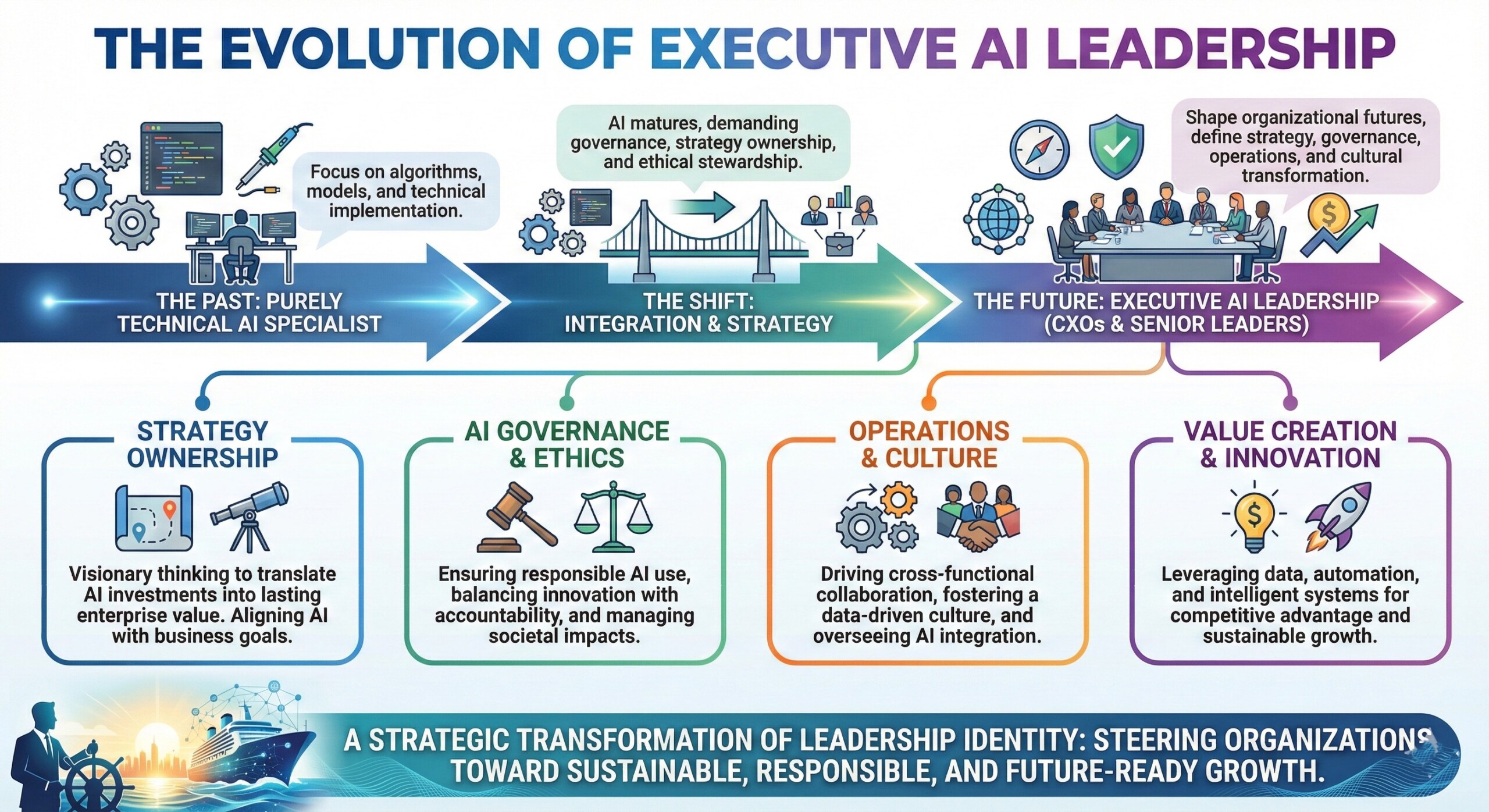
As artificial intelligence continues to mature, the era of the purely technical AI specialist is evolving into the era of executive AI leadership. CXOs and senior leaders who embrace AI governance, strategy ownership, and ethical stewardship will shape not just technology outcomes – they will define organizational futures. AI leadership spans strategy, governance, operations, and cultural transformation, elevating how businesses compete and innovate in a world driven by data, automation, and intelligent systems.
The rapid growth in senior AI roles – from CAIOs to AI governance executives – reflects enduring demand for leaders who can balance innovation with accountability. Organizations are now looking for executives who understand both the business potential of AI and its societal impacts. Success in these careers demands vision, cross-functional collaboration, and an ability to translate AI investments into lasting enterprise value.
For CXOs and senior leaders, the journey into AI leadership is more than a career move – it’s a strategic transformation of their own leadership identity. Those who step up to own AI governance and strategy will not just guide technologies, they will steer their organizations toward sustainable, responsible, and future-ready growth. Upgrade your AI-readiness with our masterclass.
Share this with the world
Related Articles