AI Careers for Engineers & Developers – ML, DL, data, and systems roles
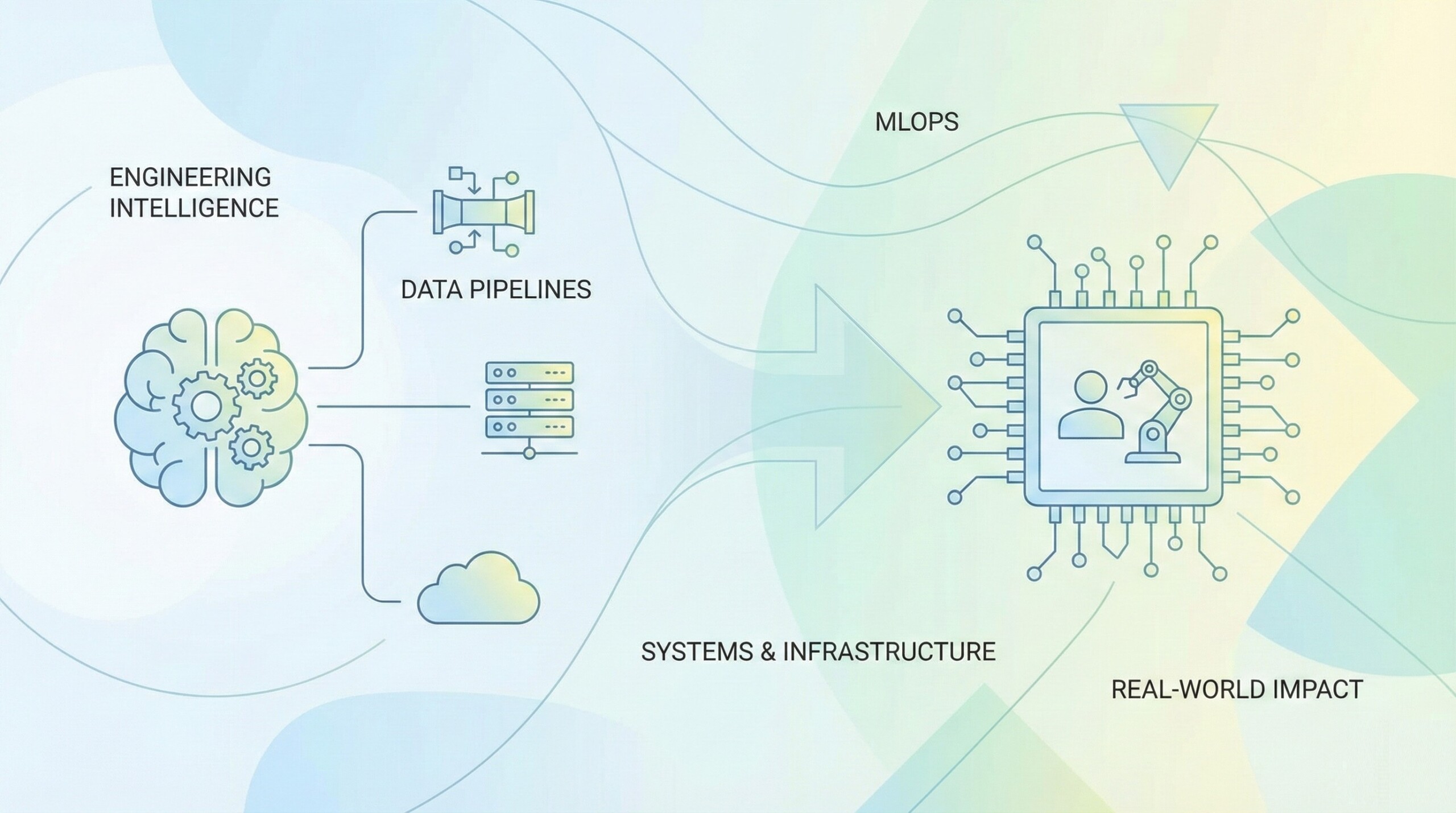
Artificial Intelligence has rapidly evolved from an academic curiosity into a core engineering discipline shaping modern software, products, and infrastructure. For engineers and developers, AI careers now span far beyond writing algorithms – they involve designing data pipelines, training and deploying models, optimizing systems, and integrating intelligence into real-world applications.
Whether working on machine learning models, deep learning architectures, or large-scale AI platforms, technical professionals today are building the foundations of how intelligent systems operate at scale. Understanding these roles is essential for engineers who want to remain relevant, impactful, and future-ready in an AI-driven technology landscape.
1. The expanding AI career landscape
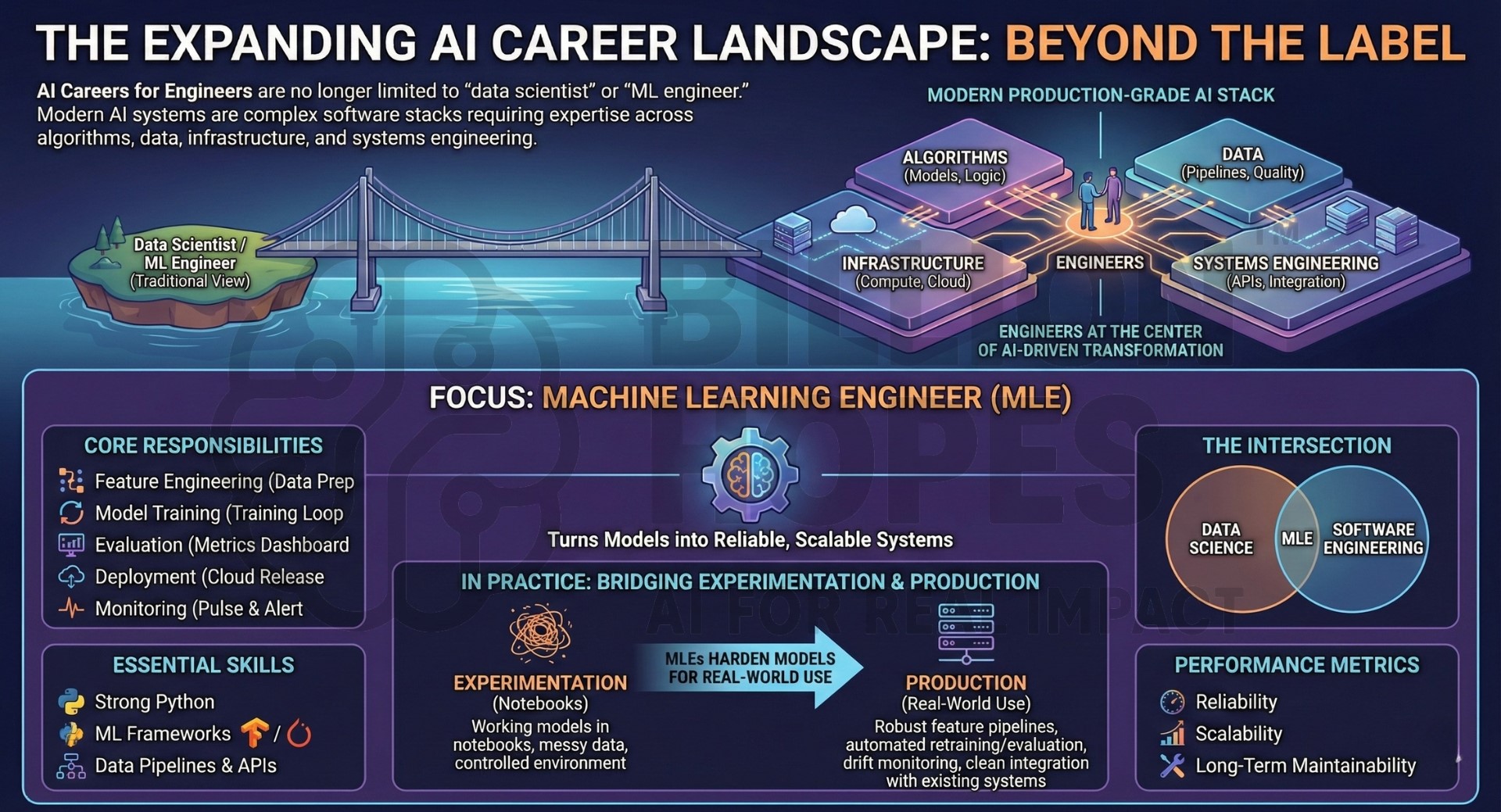
AI careers for engineers are no longer limited to “data scientist” or “ML engineer.” Modern AI systems are complex, production-grade software stacks that require expertise across algorithms, data, infrastructure, and systems engineering. Engineers who understand how models interact with data pipelines, compute, and real users are now at the center of AI-driven transformation across industries.
2. Machine Learning Engineer (MLE)
ML Engineers focus on turning models into reliable, scalable systems. Their work includes feature engineering, model training, evaluation, deployment, and monitoring. Strong Python skills, familiarity with ML frameworks, and an understanding of data pipelines and APIs are essential. This role sits at the intersection of data science and software engineering.
In practice, ML Engineers spend much of their time bridging the gap between experimentation and production. They take models that work in notebooks and harden them for real-world use – handling messy data, edge cases, performance constraints, and changing inputs. This means designing robust feature pipelines, setting up automated retraining and evaluation, monitoring model drift, and ensuring models integrate cleanly with existing software systems. Unlike pure researchers, ML Engineers are judged not just on model accuracy, but on reliability, scalability, and long-term maintainability of AI systems in production environments. An excellent collection of learning videos awaits you on our Youtube channel.
3. Deep Learning & AI Research Engineer
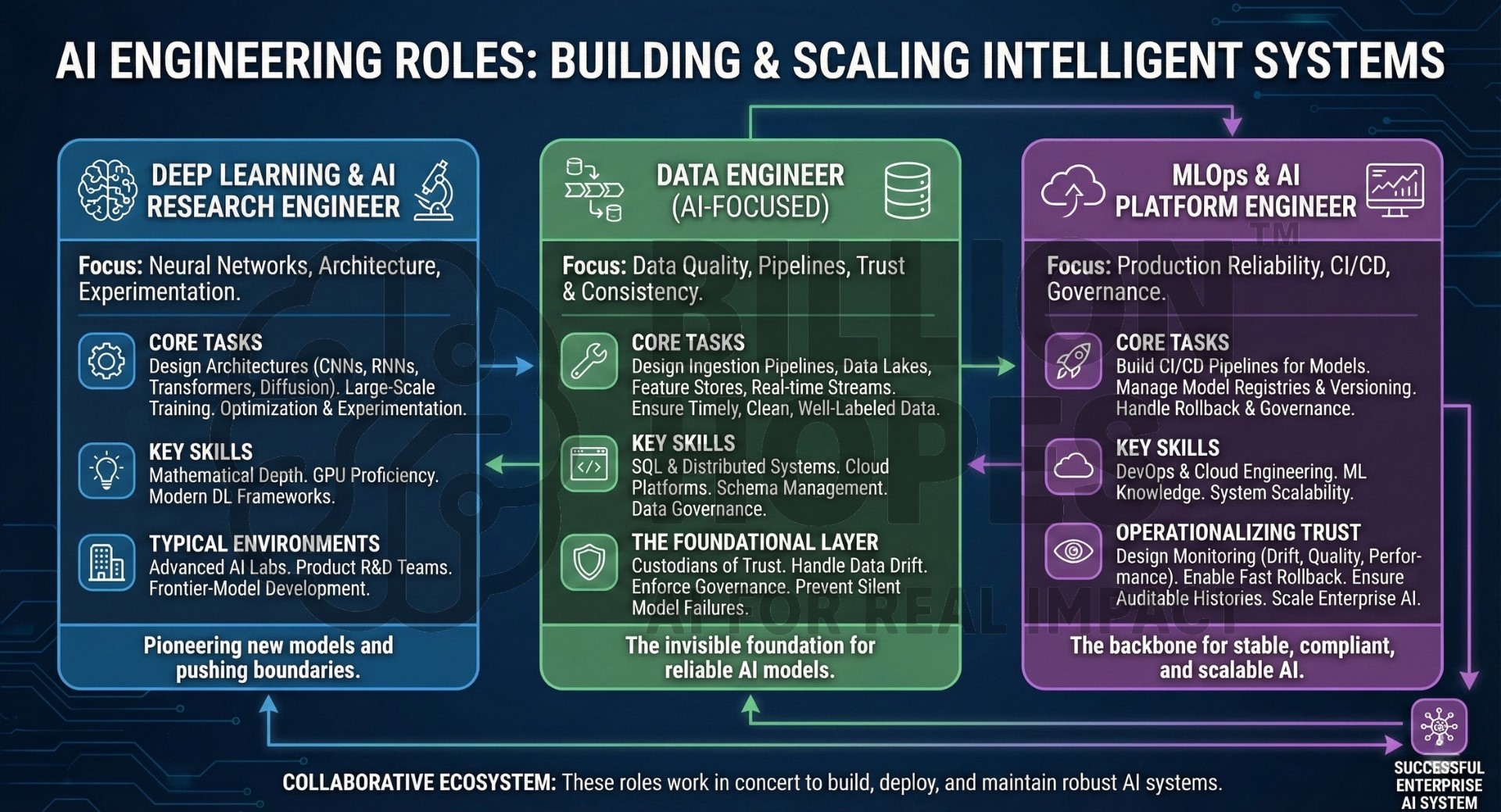
Deep Learning Engineers work with neural networks such as CNNs, RNNs, Transformers, and diffusion models. They handle large-scale training, architecture design, optimization, and experimentation. This role demands mathematical depth, comfort with GPUs, and experience with modern DL frameworks. It is common in advanced AI labs, product R&D teams, and frontier-model development.
4. Data Engineer (AI-focused)
AI systems live or die by data quality. Data Engineers design ingestion pipelines, data lakes, feature stores, and real-time streams that feed ML models. They work with SQL, distributed systems, and cloud platforms. In AI-first organizations, data engineers are as critical as model builders.
Beyond building pipelines, AI-focused Data Engineers act as custodians of trust and consistency in AI systems. They ensure that data is timely, clean, well-labeled, and versioned so models can be trained, audited, and improved reliably over time. This includes managing schema changes, handling data drift, enforcing governance and access controls, and enabling reproducibility across experiments and production. In practice, strong data engineering prevents silent model failures – making it the often invisible, but absolutely foundational layer on which all successful AI systems are built. A constantly updated Whatsapp channel awaits your participation.
5. MLOps & AI Platform Engineer
MLOps engineers ensure that models run reliably in production. They build CI/CD pipelines for models, manage model registries, handle versioning, monitoring, rollback, and governance. This role blends DevOps, cloud engineering, and ML knowledge, and is vital for enterprise-scale AI deployments. In addition, MLOps engineers are responsible for operationalizing trust in AI systems. They design monitoring to detect model drift, data quality issues, performance degradation, and unexpected behaviors long after deployment. When models fail – or regulations change – MLOps engineers enable fast rollback, safe updates, and auditable model histories. As organizations move from isolated AI experiments to dozens or hundreds of models in production, MLOps becomes the backbone that keeps AI systems stable, compliant, cost-efficient, and scalable across the enterprise.
6. Systems & Infrastructure Engineer for AI
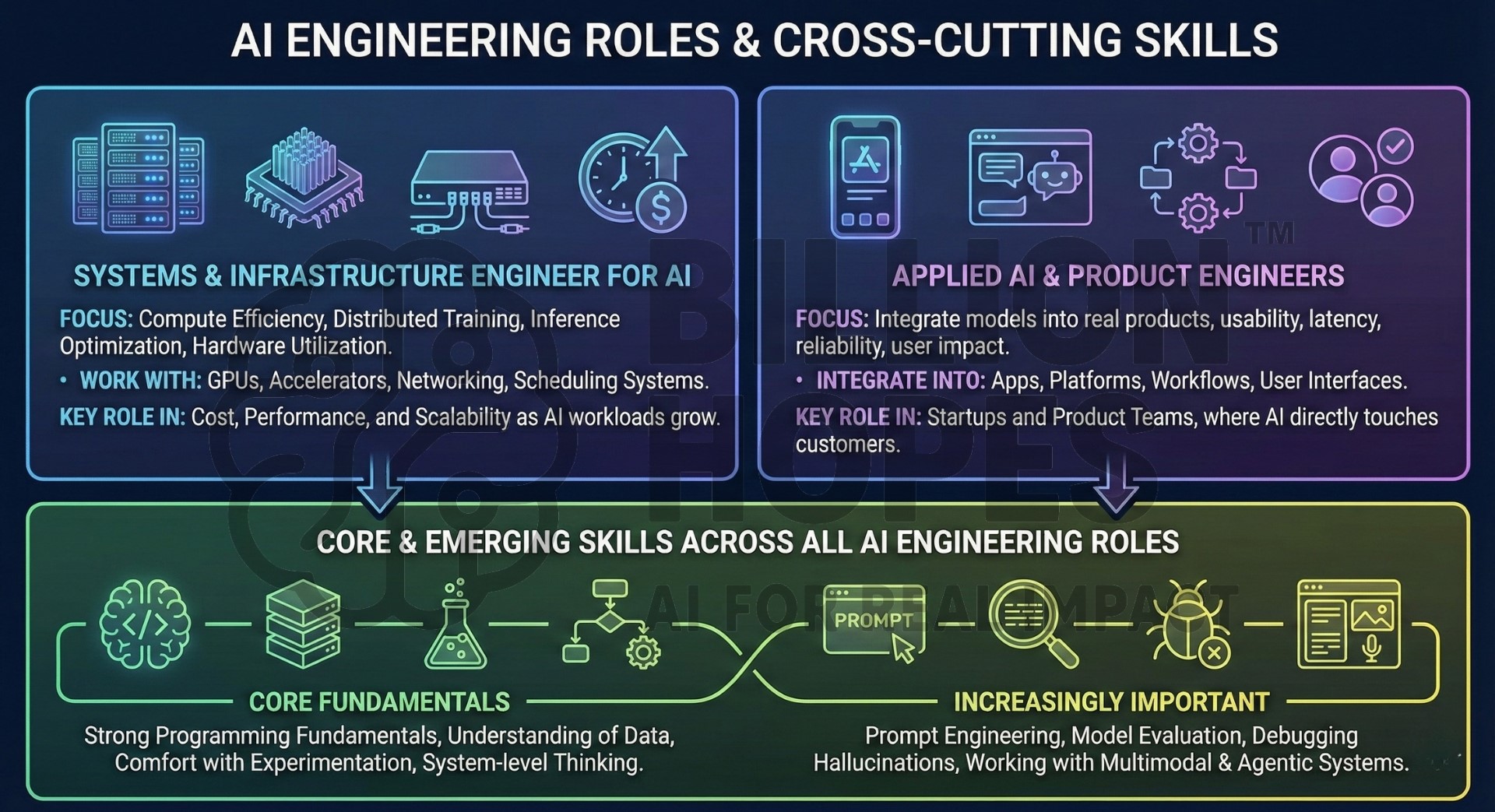
These engineers focus on compute efficiency, distributed training, inference optimization, and hardware utilization. They work with GPUs, accelerators, networking, and scheduling systems. As AI workloads grow larger and more expensive, systems engineers play a key role in cost, performance, and scalability. Excellent individualised mentoring programmes available.
7. Applied AI & Product Engineers
Applied AI engineers integrate models into real products – apps, platforms, workflows, and user interfaces. They care less about inventing new algorithms and more about usability, latency, reliability, and user impact. This role is common in startups and product teams where AI directly touches customers. Applied AI engineers integrate models into real products – apps, platforms, workflows, and user interfaces. They care less about inventing new algorithms and more about usability, latency, reliability, and user impact. This role is common in startups and product teams where AI directly touches customers.
8. Skills that cut across all AI engineering roles
Regardless of specialization, successful AI engineers share core skills: strong programming fundamentals, understanding of data, comfort with experimentation, and system-level thinking. Increasingly important are prompt engineering, model evaluation, debugging hallucinations, and working with multimodal and agentic systems. Subscribe to our free AI newsletter now.
9. Career paths and progression
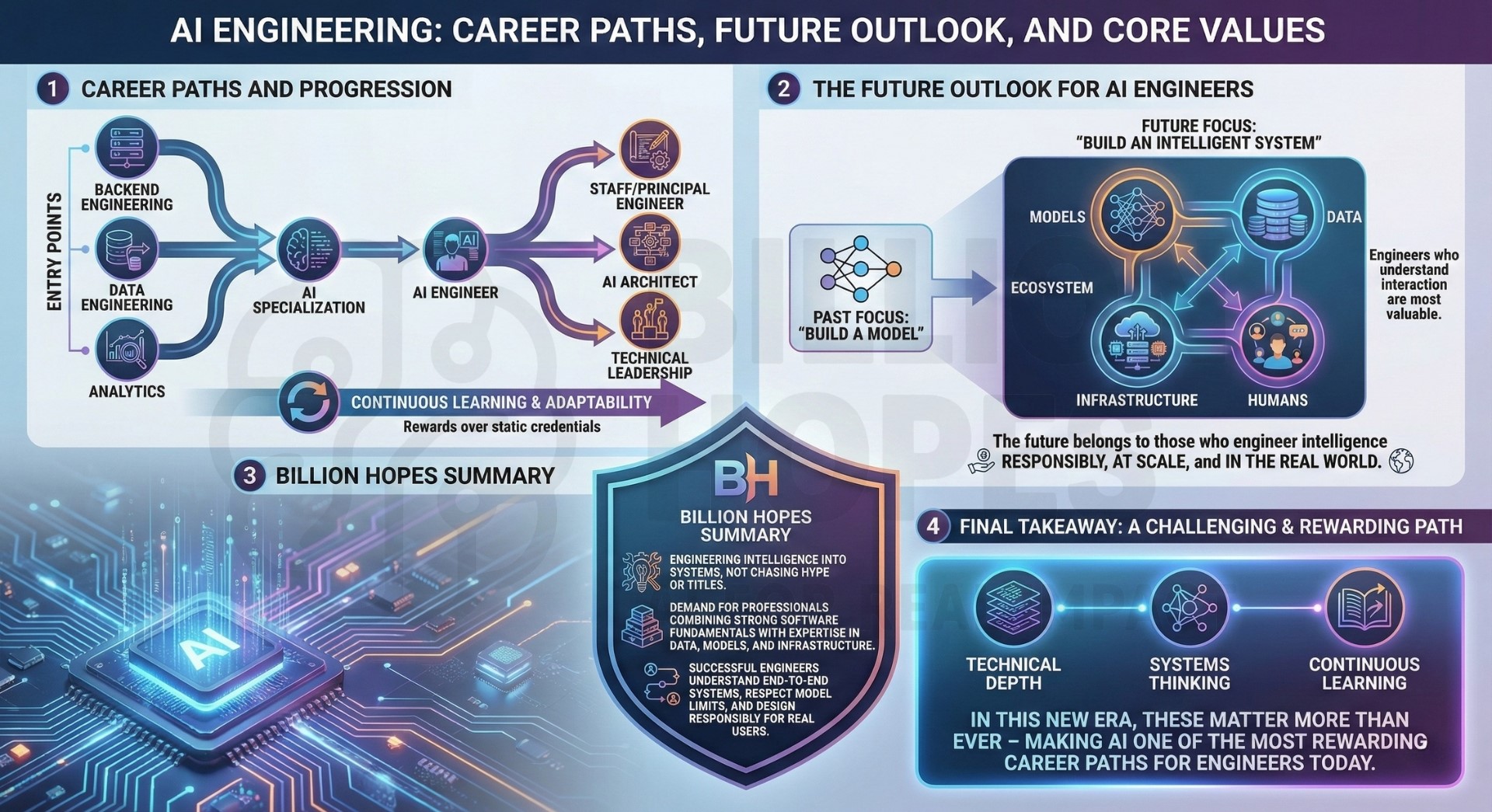
Engineers often enter AI through adjacent roles – backend engineering, data engineering, or analytics – and gradually specialize. Career growth can move toward staff/principal engineer roles, AI architect positions, or technical leadership. Unlike traditional IT, AI careers reward continuous learning and adaptability more than static credentials.
10. The future outlook for AI engineers
AI engineering is shifting from “build a model” to “build an intelligent system.” Engineers who understand how models, data, infrastructure, and humans interact will be the most valuable. The future belongs not just to those who know algorithms, but to those who can engineer intelligence responsibly, at scale, and in the real world. Upgrade your AI-readiness with our masterclass.
Billion Hopes summary
AI careers for engineers and developers are fundamentally about engineering intelligence into systems, not chasing hype or titles. As AI becomes embedded across industries, the demand will grow for professionals who can combine strong software fundamentals with data, models, and infrastructure expertise.
The most successful AI engineers will be those who understand end-to-end systems, respect the limits of models, and design responsibly for real users. In this new era, technical depth, systems thinking, and continuous learning matter more than ever – making AI one of the most challenging and rewarding career paths for engineers today.
Share this with the world
Related Articles