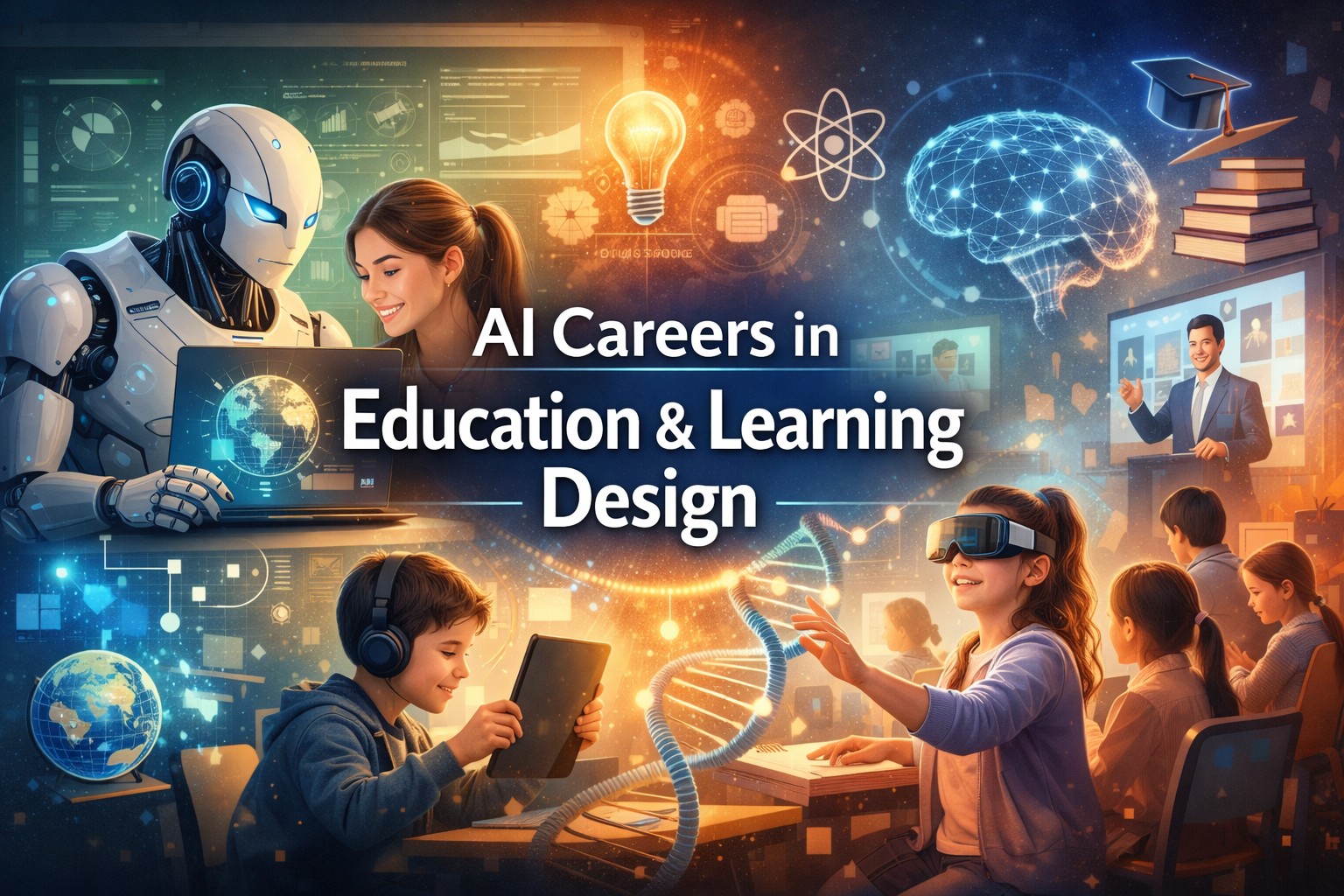
AI Careers in Education & Learning Design – AI tutors, curriculum design, and assessment
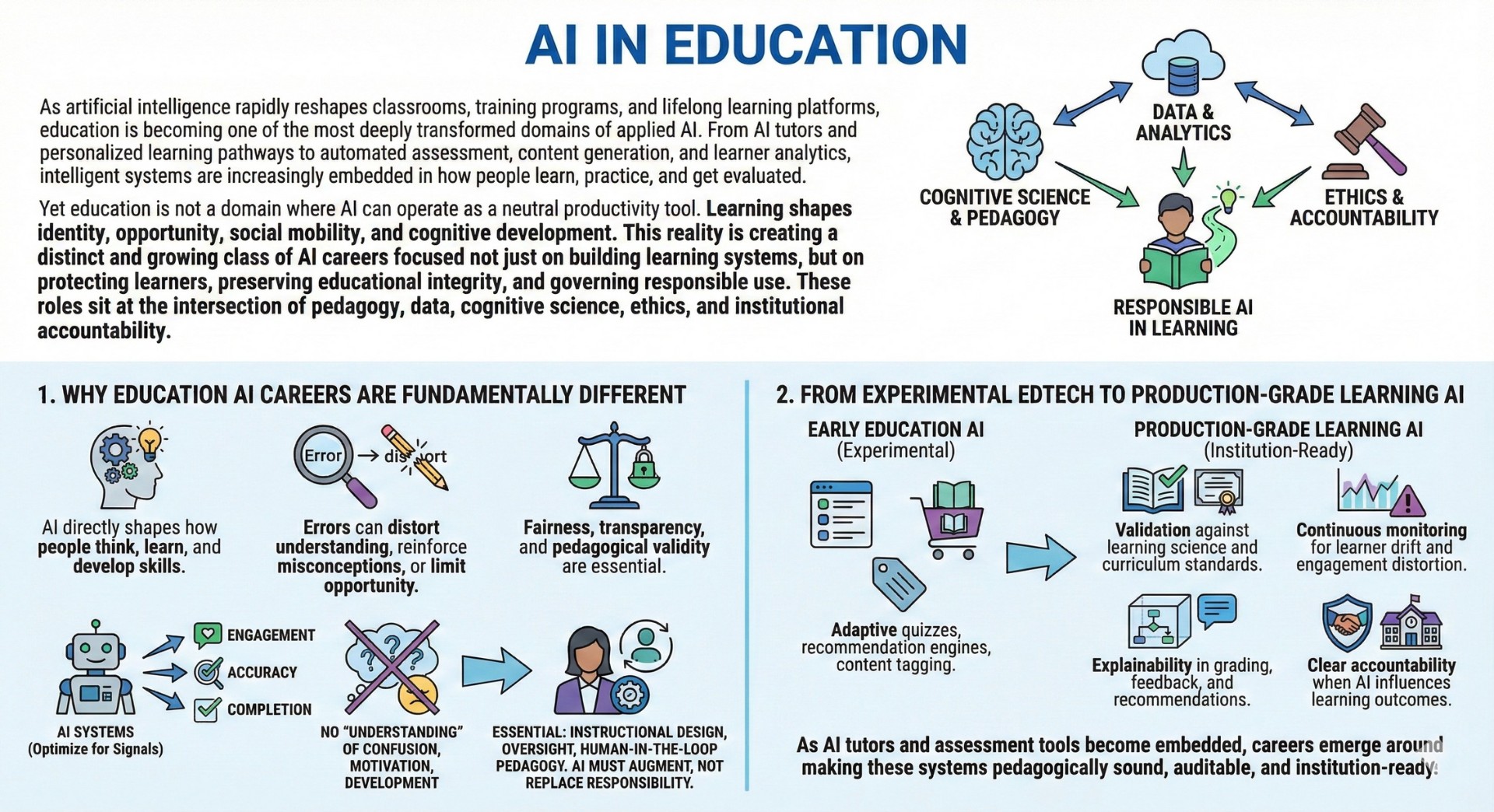
As artificial intelligence rapidly reshapes classrooms, training programs, and lifelong learning platforms, education is becoming one of the most deeply transformed domains of applied AI. From AI tutors and personalized learning pathways to automated assessment, content generation, and learner analytics, intelligent systems are increasingly embedded in how people learn, practice, and get evaluated.
Yet education is not a domain where AI can operate as a neutral productivity tool. Learning shapes identity, opportunity, social mobility, and cognitive development. This reality is creating a distinct and growing class of AI careers focused not just on building learning systems, but on protecting learners, preserving educational integrity, and governing responsible use. These roles sit at the intersection of pedagogy, data, cognitive science, ethics, and institutional accountability.
1. Why education AI careers are fundamentally different
Unlike general-purpose AI or enterprise automation, AI in education operates under three non-negotiable constraints:
- AI directly shapes how people think, learn, and develop skills
- Errors can distort understanding, reinforce misconceptions, or limit opportunity
- Fairness, transparency, and pedagogical validity are essential
AI tutors and assessment systems optimize for signals like engagement, accuracy, and completion rates – but they do not “understand” learning in a human sense. They lack intrinsic awareness of confusion, motivation, emotional state, or long-term cognitive development. This gap makes instructional design, educational oversight, and human-in-the-loop pedagogy essential. AI in education must augment teaching and learning design, not replace educational responsibility.
2. From experimental edtech to production-grade learning AI
Early education AI focused on adaptive quizzes, recommendation engines, and content tagging. Today, institutions and platforms are moving toward production-grade learning AI, which requires:
- Validation against learning science and curriculum standards
- Continuous monitoring for learner drift and engagement distortion
- Explainability in grading, feedback, and recommendations
- Clear accountability when AI influences learning outcomes
As AI tutors and assessment tools become embedded in schools, universities, and corporate learning systems, careers are emerging around making these systems pedagogically sound, auditable, and institution-ready. An excellent collection of learning videos awaits you on our Youtube channel.
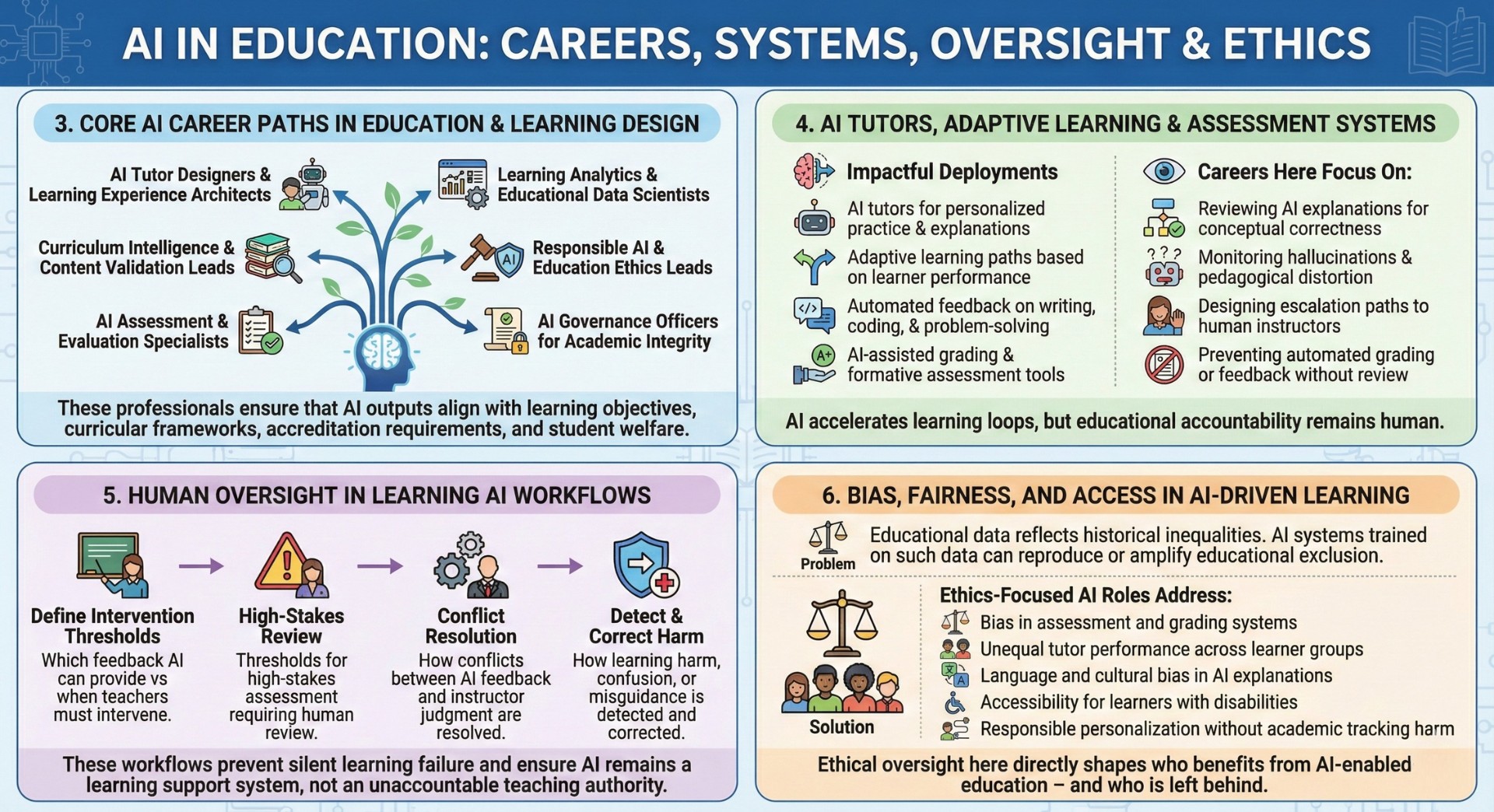
3. Core AI career paths in education & learning design
AI careers in education extend far beyond prompt engineering or content generation. Key roles include:
- AI tutor designers and learning experience architects
• Curriculum intelligence and content validation leads
• AI assessment and evaluation specialists
• Learning analytics and educational data scientists
• Responsible AI and education ethics leads
• AI governance officers for academic integrity
These professionals ensure that AI outputs align with learning objectives, curricular frameworks, accreditation requirements, and student welfare.
4. AI tutors, adaptive learning, and assessment systems
Some of the most impactful AI deployments in education operate in cognition-sensitive workflows.
Examples include:
• AI tutors for personalized practice and explanations
• Adaptive learning paths based on learner performance
• Automated feedback on writing, coding, and problem-solving
• AI-assisted grading and formative assessment tools
Careers here focus on:
• Reviewing AI explanations for conceptual correctness
• Monitoring hallucinations and pedagogical distortion
• Designing escalation paths to human instructors
• Preventing automated grading or feedback without review
AI accelerates learning loops, but educational accountability remains human. A constantly updated Whatsapp channel awaits your participation.
5. Human oversight in learning AI workflows
Educational AI cannot operate as an opaque authority over knowledge. Oversight professionals design workflows that define:
- Which feedback AI can provide vs when teachers must intervene
- Thresholds for high-stakes assessment requiring human review
- How conflicts between AI feedback and instructor judgment are resolved
- How learning harm, confusion, or misguidance is detected and corrected
These workflows prevent silent learning failure and ensure AI remains a learning support system, not an unaccountable teaching authority.
6. Bias, fairness, and access in AI-driven learning
Educational data reflects historical inequalities – unequal access to resources, language barriers, cultural bias in curricula, and systemic gaps in prior preparation. AI systems trained on such data can reproduce or amplify educational exclusion.
Ethics-focused AI roles address:
• Bias in assessment and grading systems
• Unequal tutor performance across learner groups
• Language and cultural bias in AI explanations
• Accessibility for learners with disabilities
• Responsible personalization without academic tracking harm
Ethical oversight here directly shapes who benefits from AI-enabled education – and who is left behind. Excellent individualised mentoring programmes available.
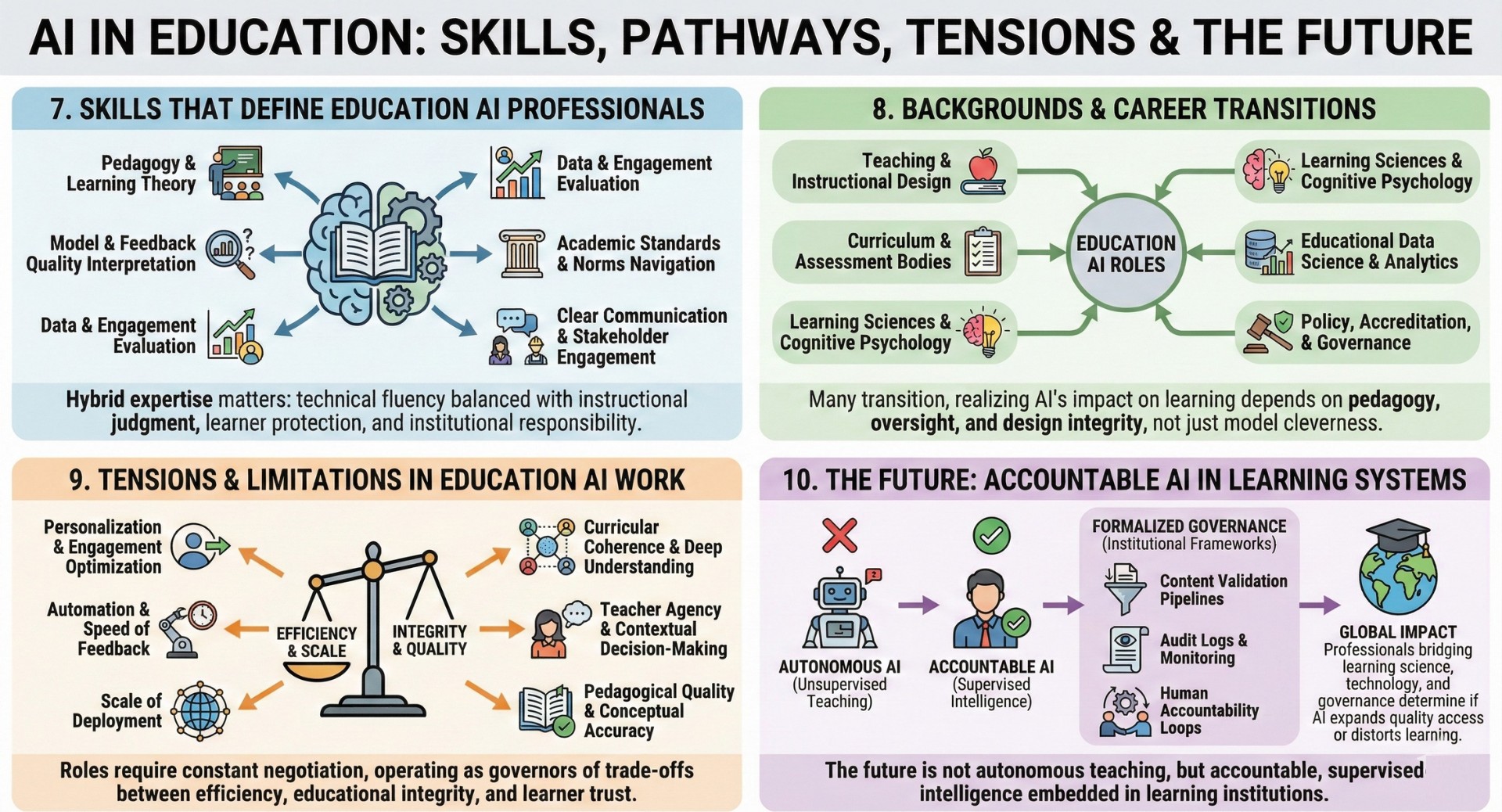
7. Skills that define education AI professionals
AI careers in education demand hybrid expertise. Key capabilities include:
- Understanding pedagogy, curriculum design, and learning theory
- Interpreting model uncertainty, hallucination risk, and feedback quality
- Evaluating data quality, learner proxies, and engagement metrics
- Navigating academic standards, accreditation, and assessment norms
- Communicating clearly with educators, administrators, and engineers
Technical fluency matters – but so do instructional judgment, learner protection, and institutional responsibility.
8. Backgrounds and career transitions
Professionals entering education AI roles often come from:
- Teaching, instructional design, and learning experience roles
• Curriculum development and assessment bodies
• Learning sciences and cognitive psychology
• Educational data science and analytics
• Policy, accreditation, and academic governance
Many transition after realizing that AI’s impact on learning depends more on pedagogy, oversight, and design integrity than on model cleverness alone. Subscribe to our free AI newsletter now.
9. Tensions and limitations in education AI work
AI careers in learning face persistent trade-offs:
- Personalization versus curricular coherence
- Engagement optimization versus deep understanding
- Automation versus teacher agency
- Scale of deployment versus pedagogical quality
- Speed of feedback versus conceptual accuracy
Automation promises scale and efficiency, but excessive reliance risks eroding teacher agency, professional judgment, and contextual decision-making that machines cannot replicate. Scaling AI systems across institutions increases reach and cost-effectiveness, yet often dilutes pedagogical quality when local cultural, cognitive, and classroom realities are abstracted away. Faster feedback loops improve motivation and iteration speed, but premature or shallow feedback can distort mental models, reinforce misconceptions, and undermine conceptual accuracy.
These roles require constant negotiation between efficiency, educational integrity, and learner trust. Professionals in AI for education therefore operate less like system builders and more like continuous governors of trade-offs – balancing efficiency with educational integrity, optimization with meaning, and technological power with learner trust.
10. The future: Accountable AI in learning systems
The future of AI in education is not autonomous teaching – it is accountable, supervised intelligence embedded in learning institutions. Schools, universities, and platforms are formalizing AI governance through content validation pipelines, audit logs for assessment, monitoring of learning outcomes, and human accountability loops.
As AI tutors, curriculum engines, and assessment systems scale globally, professionals who can bridge learning science, technology, and governance will determine whether AI expands access to high-quality education – or quietly distorts what it means to learn. Upgrade your AI-readiness with our masterclass.
Billion Hopes summary
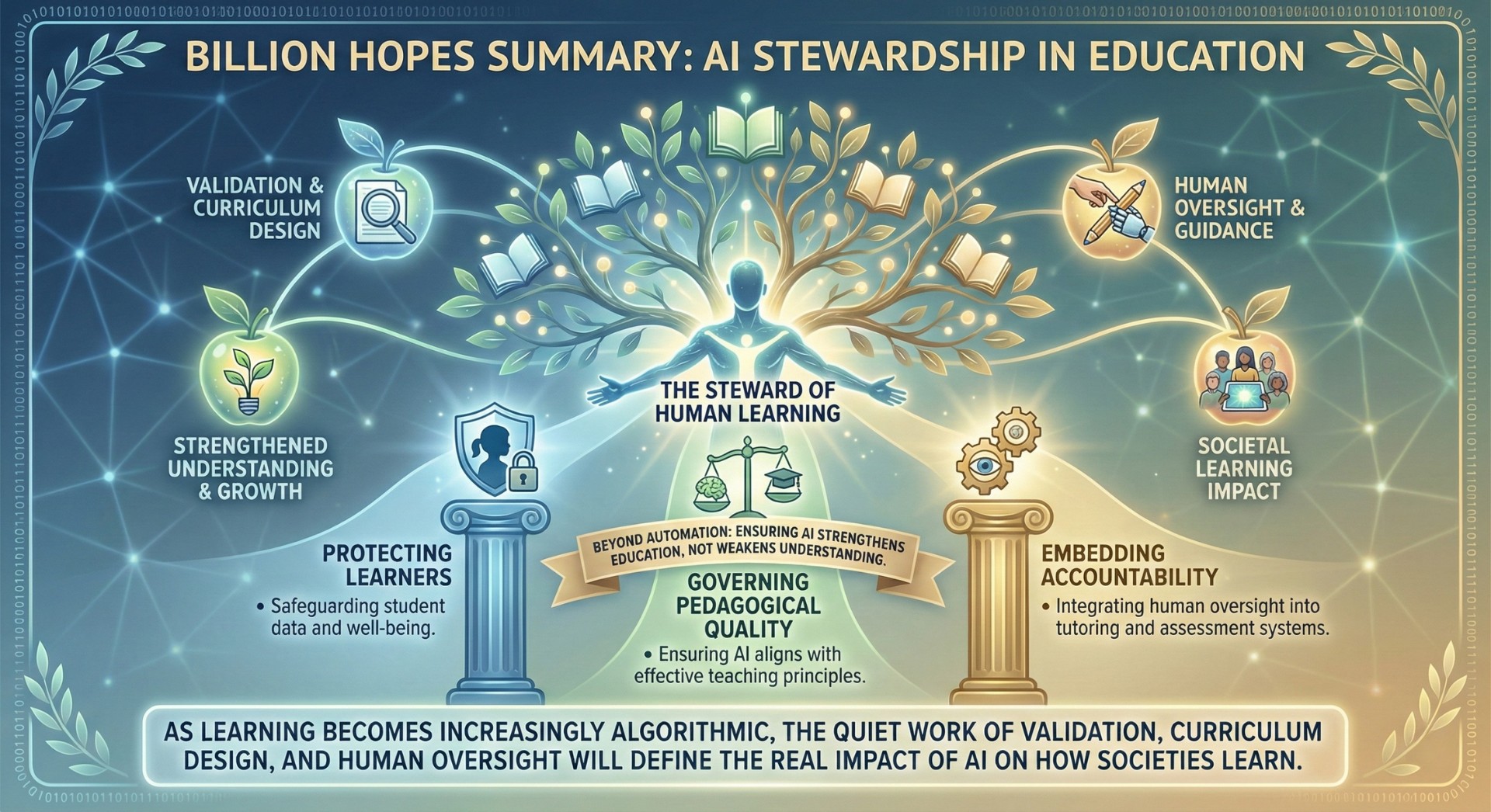
AI careers in education and learning design are about more than automation – they are about ‘stewardship’ of human learning. By protecting learners, governing pedagogical quality, and embedding accountability into intelligent tutoring and assessment systems, these roles ensure that AI strengthens education without weakening understanding. As learning becomes increasingly algorithmic, the quiet work of validation, curriculum design, and human oversight will define the real impact of AI on how societies learn.
Share this with the world
Related Articles