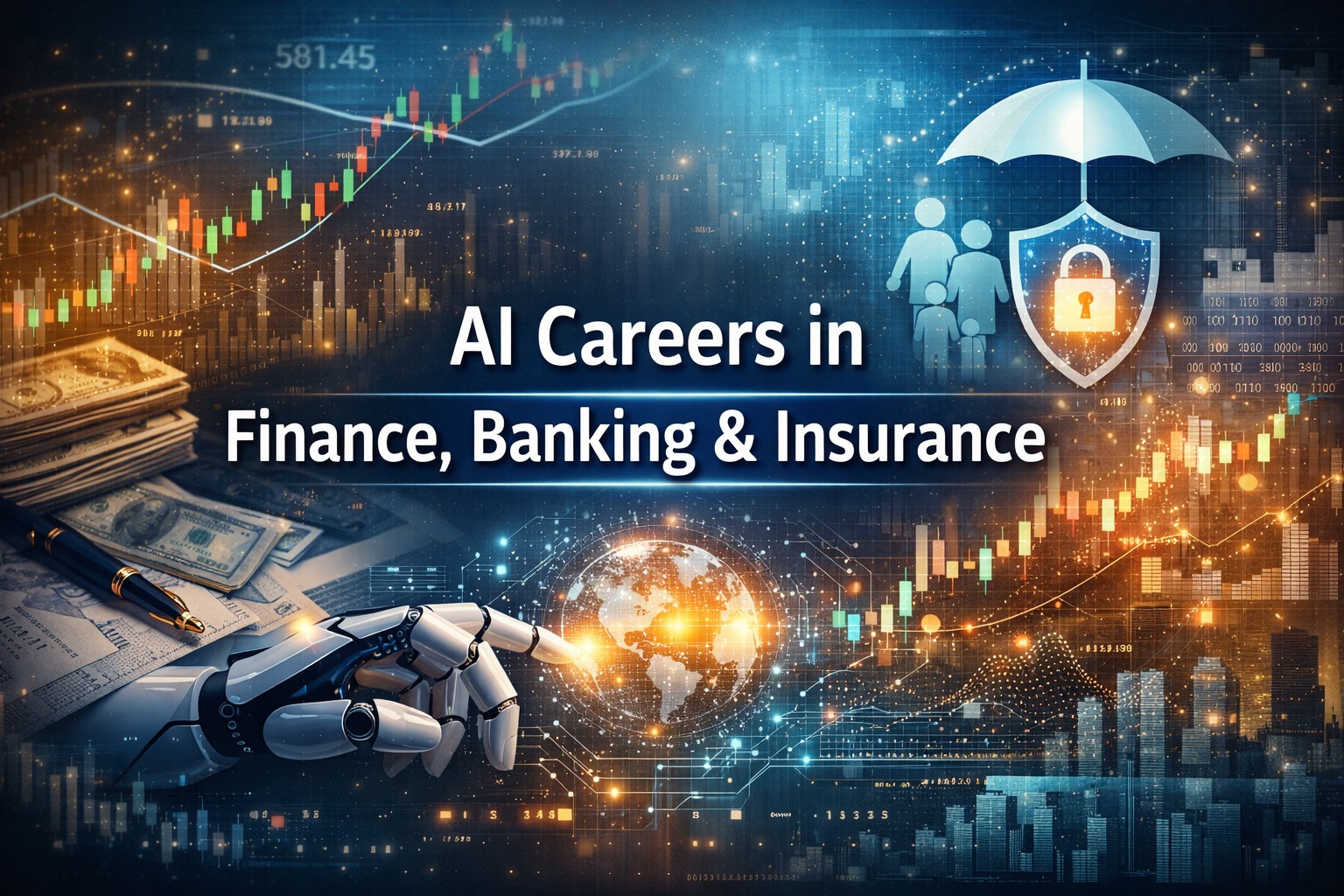
AI Careers in Finance, Banking & Insurance – Risk, fraud, compliance, and automation
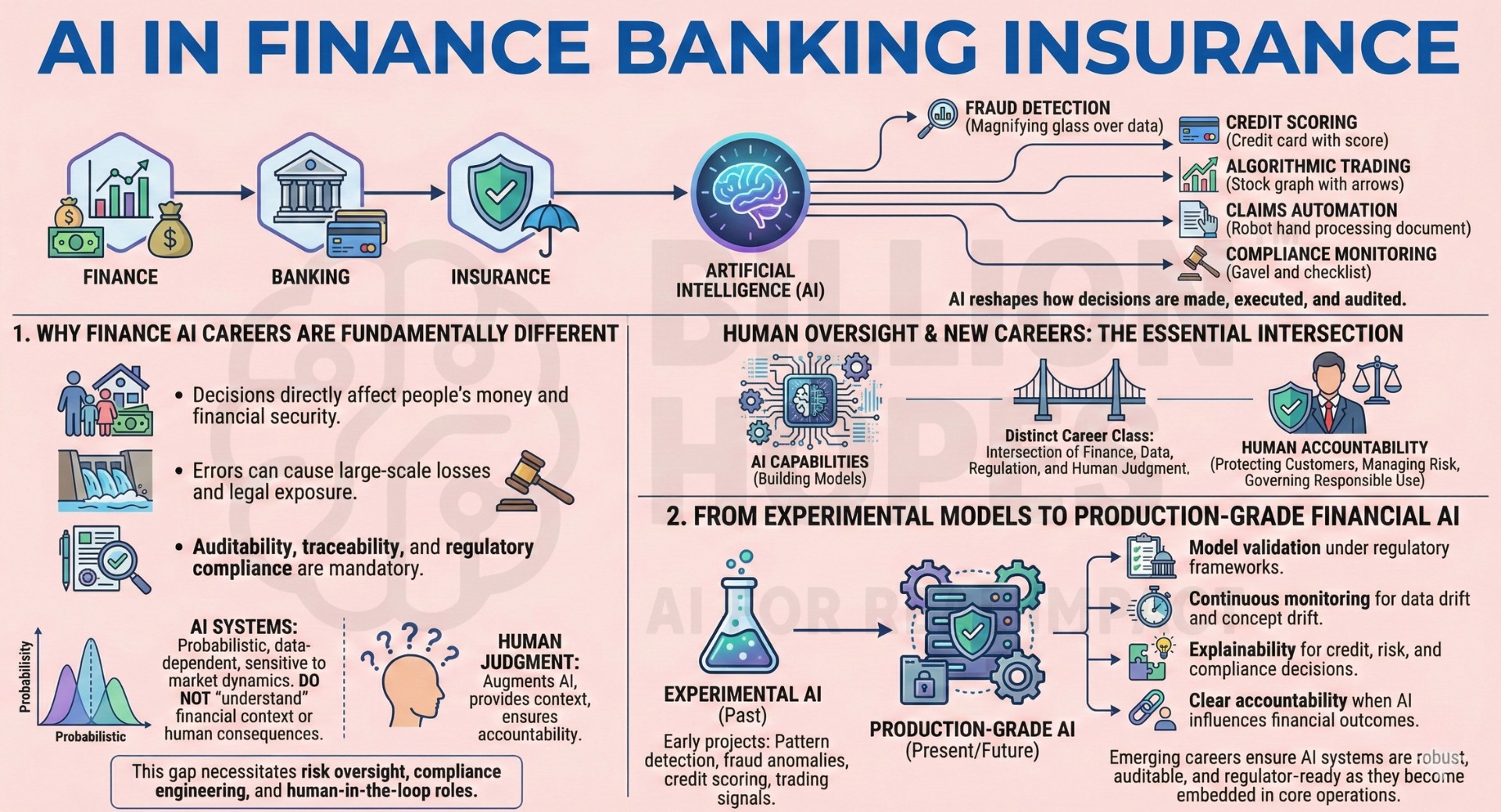
As we witness, artificial intelligence (AI) is reshaping finance, banking, and insurance more deeply than most other industries. From fraud detection and credit scoring to algorithmic trading, claims automation, and compliance monitoring, AI systems are increasingly embedded in how financial decisions are made, executed, and audited.
Yet finance is not a domain where AI can operate unchecked. Money, livelihoods, legal obligations, and systemic stability are at stake. This reality has created a distinct and growing class of AI careers focused not just on building models, but on protecting customers, managing risk, and governing responsible use. These roles sit at the intersection of finance, data, regulation, and human judgment.
1. Why finance AI careers are fundamentally different
Unlike consumer or enterprise AI, finance AI operates under three non-negotiable constraints:
• Decisions directly affect people’s money and financial security
• Errors can cause large-scale losses and legal exposure
• Auditability, traceability, and regulatory compliance are mandatory
AI systems in finance are probabilistic, data-dependent, and sensitive to market dynamics and behavioural shifts. They assist with credit decisions, fraud detection, pricing, and portfolio management – but they do not “understand” financial context or human consequences in a normative sense.
This gap has made risk oversight, compliance engineering, and human-in-the-loop roles essential. AI in finance must augment professional judgment, not replace accountability.
2. From experimental models to production-grade financial AI
Early financial AI projects focused on pattern detection – spotting fraud anomalies, scoring credit risk, or optimizing trading signals. Today, organizations are moving toward production-grade AI, which requires:
• Model validation under regulatory frameworks
• Continuous monitoring for data drift and concept drift
• Explainability for credit, risk, and compliance decisions
• Clear accountability when AI influences financial outcomes
As AI systems become embedded in core banking and insurance operations, careers are emerging around making these systems robust, auditable, and regulator-ready. An excellent collection of learning videos awaits you on our Youtube channel.
3. Core AI career paths in finance, banking & insurance
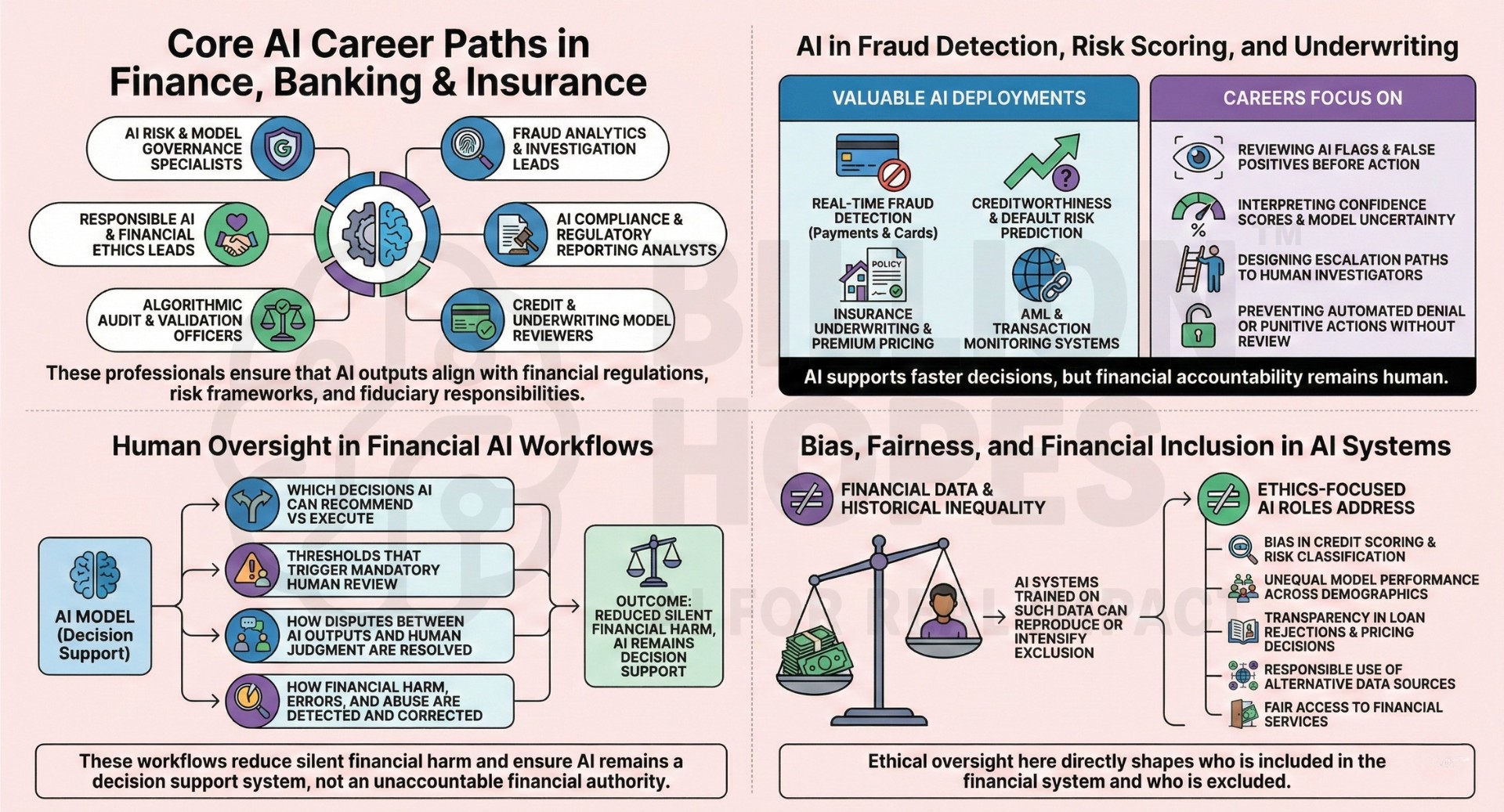
AI careers in finance extend far beyond machine learning engineering. Key roles include:
• AI risk and model governance specialists
• Fraud analytics and investigation leads
• AI compliance and regulatory reporting analysts
• Credit and underwriting model reviewers
• Algorithmic audit and validation officers
• Responsible AI and financial ethics leads
These professionals ensure that AI outputs align with financial regulations, risk frameworks, and fiduciary responsibilities.
4. AI in fraud detection, risk scoring, and underwriting
Some of the most valuable AI deployments in finance operate in risk-sensitive workflows.
Examples include:
• Real-time fraud detection in payments and cards
• Creditworthiness and default risk prediction
• Insurance underwriting and premium pricing
• AML and transaction monitoring systems
Careers here focus on:
• Reviewing AI flags and false positives before action
• Interpreting confidence scores and model uncertainty
• Designing escalation paths to human investigators
• Preventing automated denial or punitive actions without review
AI supports faster decisions, but financial accountability remains human. A constantly updated Whatsapp channel awaits your participation.
5. Human oversight in financial AI workflows
Financial AI cannot operate as a black box at scale. Oversight professionals design workflows that define:
• Which decisions AI can recommend vs execute
• Thresholds that trigger mandatory human review
• How disputes between AI outputs and human judgment are resolved
• How financial harm, errors, and abuse are detected and corrected
These workflows reduce silent financial harm and ensure AI remains a decision support system, not an unaccountable financial authority.
6. Bias, fairness, and financial inclusion in AI systems
Financial data reflects historical inequality – unequal access to credit, skewed underwriting, and demographic disparities. AI systems trained on such data can reproduce or intensify exclusion.
Ethics-focused AI roles address:
• Bias in credit scoring and risk classification
• Unequal model performance across demographics
• Transparency in loan rejections and pricing decisions
• Responsible use of alternative data sources
• Fair access to financial services
Ethical oversight here directly shapes who is included in the financial system and who is excluded.
Excellent individualised mentoring programmes available.
7. Skills that define finance AI professionals
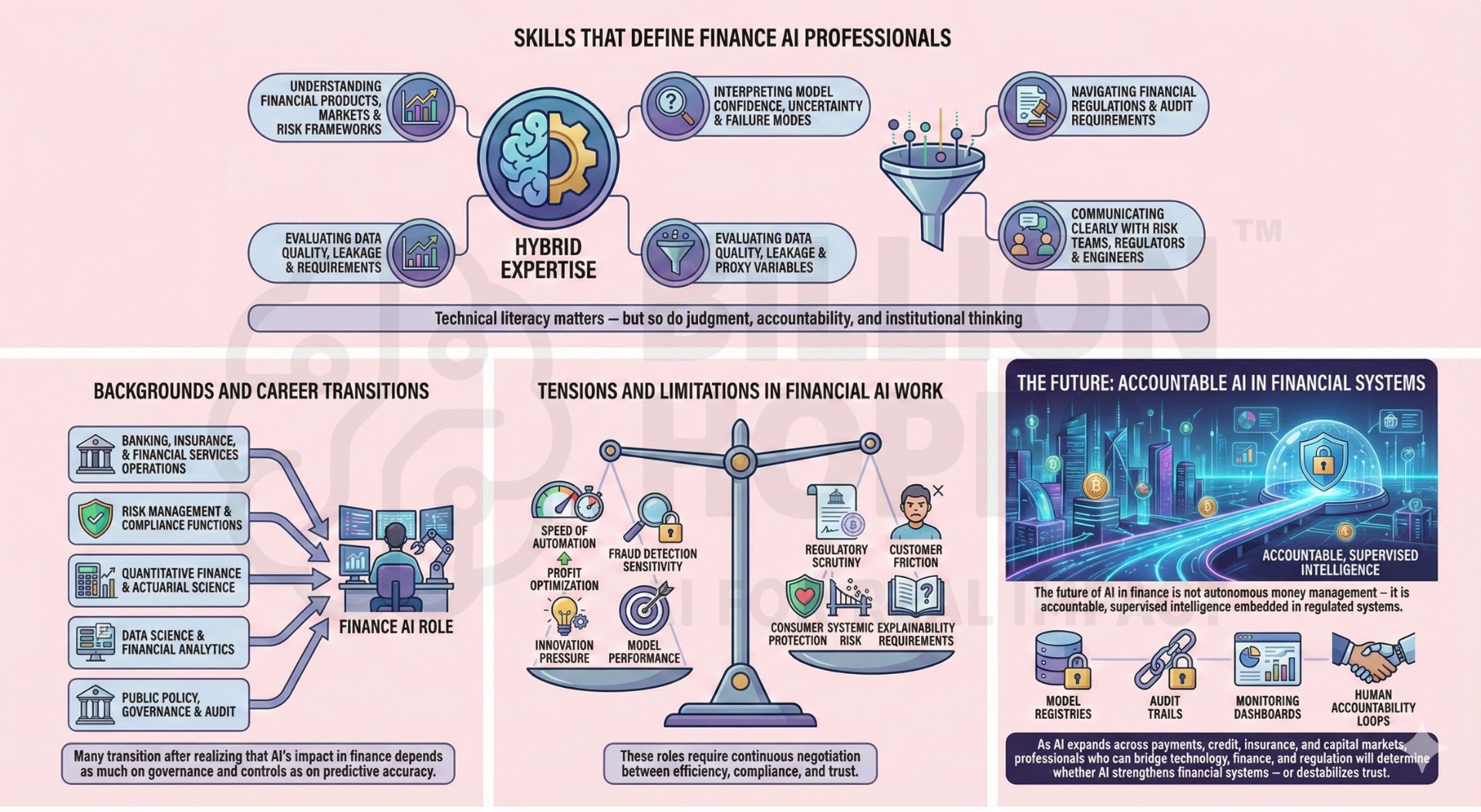
AI careers in finance demand hybrid expertise. Key capabilities include:
• Understanding financial products, markets, and risk frameworks
• Interpreting model confidence, uncertainty, and failure modes
• Evaluating data quality, leakage, and proxy variables
• Navigating financial regulations and audit requirements
• Communicating clearly with risk teams, regulators, and engineers
Technical literacy matters – but so do judgment, accountability, and institutional thinking.
8. Backgrounds and career transitions
Professionals entering finance AI roles often come from:
• Banking, insurance, and financial services operations
• Risk management and compliance functions
• Quantitative finance and actuarial science
• Data science and financial analytics
• Public policy, governance, and audit
Many transition after realizing that AI’s impact in finance depends as much on governance and controls as on predictive accuracy.
Subscribe to our free AI newsletter now.
9. Tensions and limitations in financial AI work
AI careers in finance face persistent trade-offs:
• Speed of automation versus regulatory scrutiny
• Fraud detection sensitivity versus customer friction
• Profit optimization versus consumer protection
• Innovation pressure versus systemic risk
• Model performance versus explainability requirements
These roles require continuous negotiation between efficiency, compliance, and trust.
10. The future: Accountable AI in financial systems
The future of AI in finance is not autonomous money management – it is accountable, supervised intelligence embedded in regulated systems. Institutions are formalizing AI governance through model registries, audit trails, monitoring dashboards, and human accountability loops.
As AI expands across payments, credit, insurance, and capital markets, professionals who can bridge technology, finance, and regulation will determine whether AI strengthens financial systems – or destabilizes trust. Upgrade your AI-readiness with our masterclass.
Billion Hopes summary
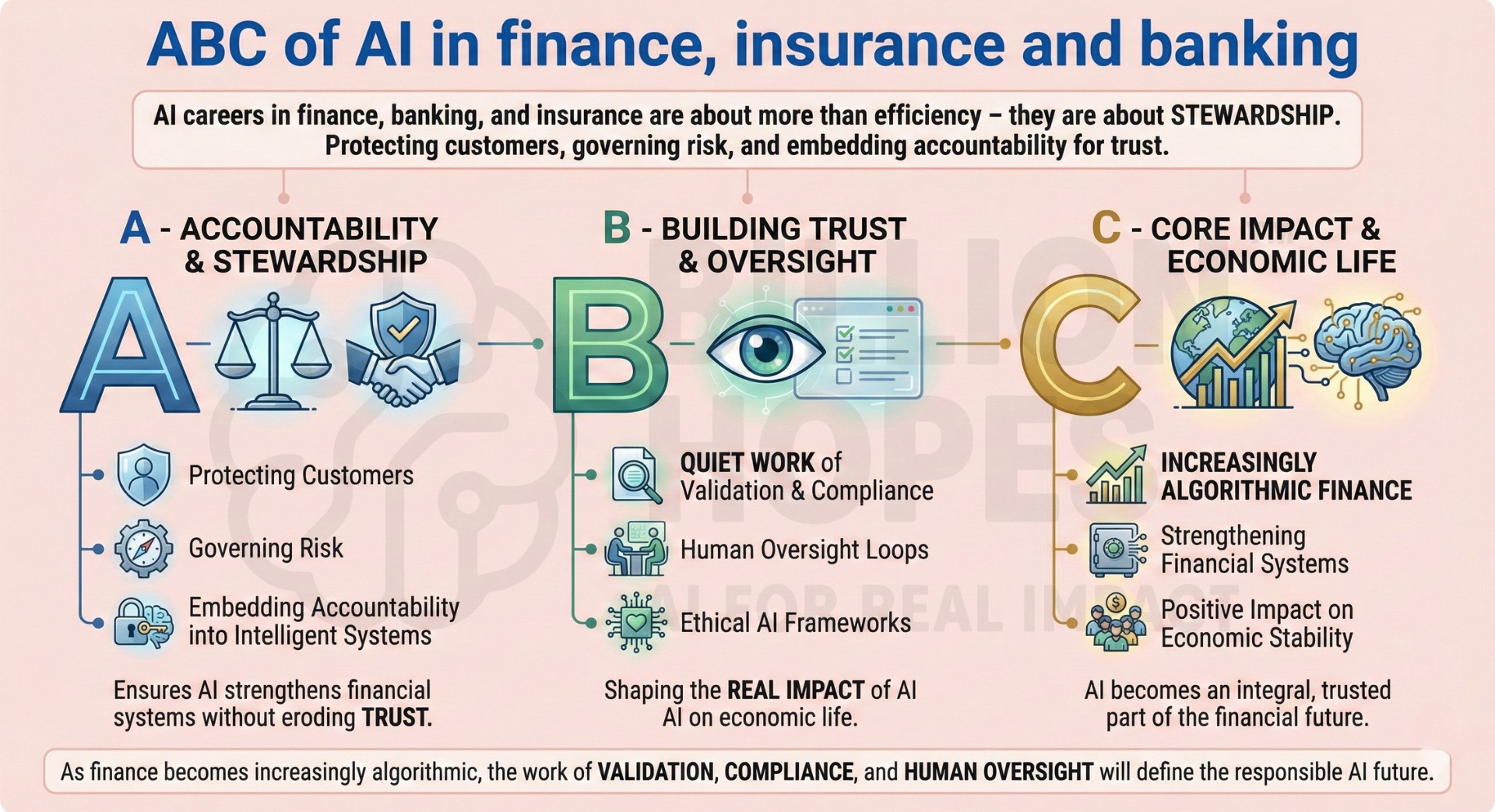
AI careers in finance, banking, and insurance are about more than efficiency – they are about stewardship. By protecting customers, governing risk, and embedding accountability into intelligent systems, these roles ensure that AI strengthens financial systems without eroding trust. As finance becomes increasingly algorithmic, the quiet work of validation, compliance, and human oversight will shape the real impact of AI on economic life.
Share this with the world
Related Articles