AI is everywhere, except in enterprise profits & outcomes

AI is everywhere, except in enterprise profits & outcomes
What’s going on, and how to fix it
1. The Enterprise AI Paradox: High Adoption, Near-Zero Returns
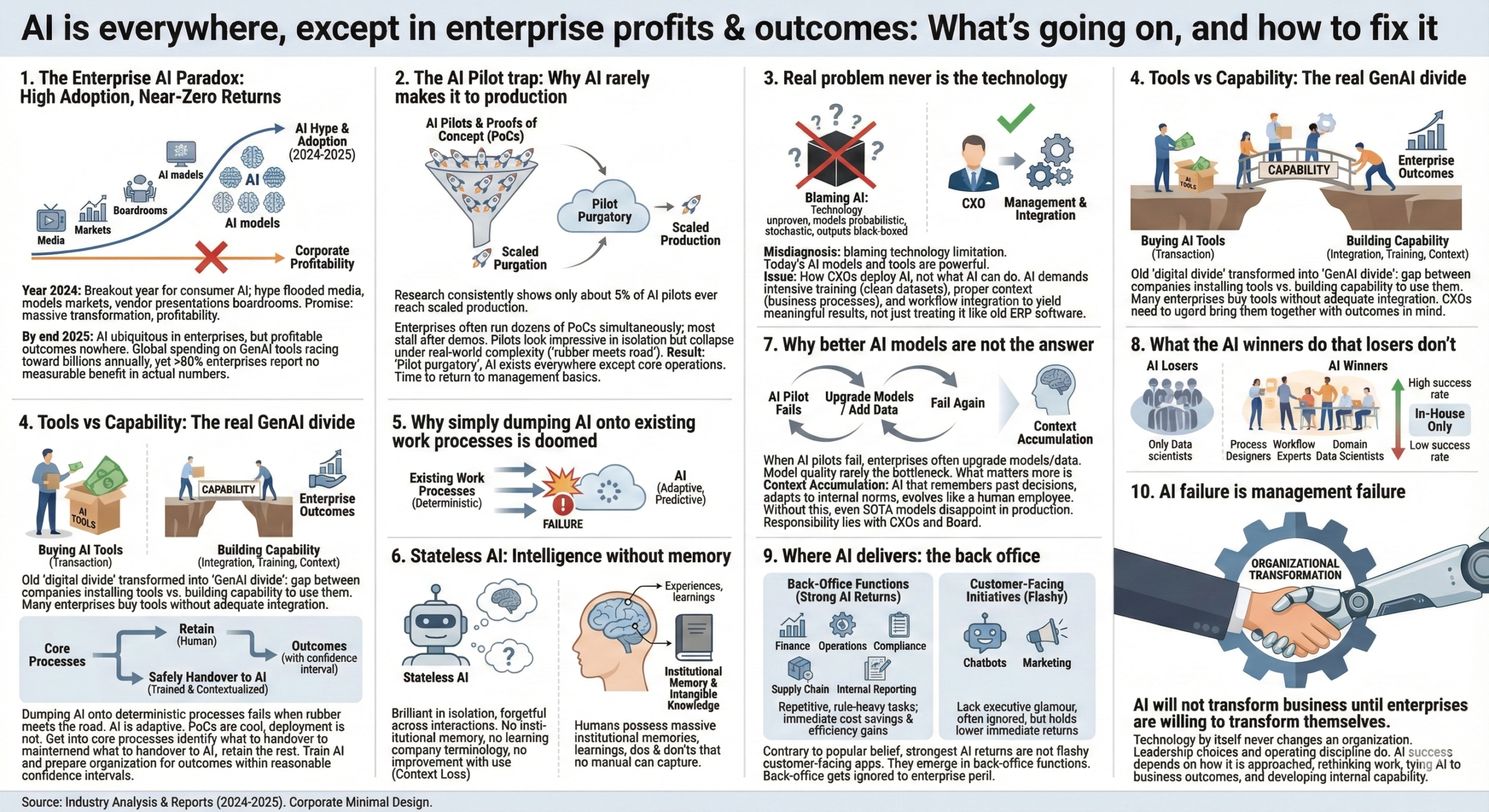
Year 2024 was the breakout year for consumer AI. Hype flooded the media, models flooded the markets, and vendors presentations flooded Corporate Boardrooms. Everyone had one promise to make: a massive transformation and solid uptick in corporate profitability.
As 2025 ended, it was clear that while AI was now ubiquitous in enterprises, but profitable outcomes nowhere were. Boardrooms were energetically discussing GenAI strategies and AI-embedded but the ground impact wasn’t being felt. Global enterprise spending on Generative AI tools was racing toward several billion each year, but this explosion in activity was accompanied by more than 80% enterprises reporting no measurable benefit in their actual numbers.
2. The AI Pilot trap: Why AI rarely makes it to production
Research consistently shows that only about 5% of AI pilots ever reach scaled production. Enterprises often run dozens of proofs of concept simultaneously, but most stall after demos. These pilots look impressive in isolation but collapse under real-world complexity, when rubber meets the road. The result is “pilot purgatory”, a state where AI exists everywhere except inside core business operations. That isn’t what enterprises bargained for.
Something fundamental is going wrong, and it’s time to fix it once and for all. Time to return to the basics of management, once more.
3. Real problem never is the technology
A lazy analysis leads to blames at the doors of AI itself: the technology is unproven, the models are probabilistic and stochastic, the outputs are “black boxed” and so on.
This is misdiagnosis of the real problem as a technology limitation. In reality, today’s AI models and tools are more powerful than ever. The issue is how CXOs deploy AI, not what AI can do. Many enterprises are simply treating AI as normal ERP or computer software of the earlier decades. But AI demands intensive training (using clean datasets), proper context (to understand business processes), and workflow integration (to yield meaningful results).
4. Tools vs Capability: The real GenAI divide
There used to be a digital divide earlier, and that has now transformed into a “GenAI divide” – gap between companies that install AI tools and those that build the capability to use them. Many enterprises are sadly on the wrong side of it, buying AI tools without working on adequate integration. That is not the case with individual employees, who definitely benefit from using AI tools, but that doesn’t automatically translate to enterprise outcomes.
First, CXOs need to upgrade their AI understanding itself. Then they need to take a helicopter view of their work processes. Then they need to bring the two together with the outcomes in mind. Only then will any meaningful AI transformation happen, if at all.
5. Why simply dumping AI onto existing work processes is doomed
CXOs are plugging or dumping AI onto existing work processes, but those processes were deterministic in nature since the beginning, not adaptive or predictive at all (which AI is). So pilot projects abound, but they die when rubber meets the road. Proof-of-concept is cool, deployment not. To make matters worse, many pilots are isolated ones, thereby building vulnerabilities that cannot be done away with.
Get into your core processes, find which ones can be safely handed over to an AI, and retain the rest. Then train that AI and prepare the organization to accept the outcomes in a reasonable confidence interval.
6. Stateless AI: Intelligence without memory
AI does not remember, unless you actively want it to. This overlooked failure mode is context loss. Since most AI systems operate as stateless tools they are brilliant in isolation but forgetful across interactions. They do not retain institutional memory, learn company terminology, or improve with use. Enterprises believe they have “smart” systems, but in reality they deploy algorithms that suffer from organizational amnesia, limiting long-term value.
Humans, on the other hand, have massive institutional memories, a vast collection of intangible knowledge bits of interactions, dos and don’ts, learnings and lessons, that no Operations Manual can ever capture.
7. Why better AI models are not the answer
When AI pilots fail, enterprises often respond by upgrading models or adding more data. But model quality is rarely the bottleneck. As seen above, what may matter more context accumulation – AI that remembers past decisions, adapts to internal norms, and evolves like a human employee. Without this, even state-of-the-art models disappoint in production environments.
The responsibility to do this lies squarely with the CXOs and the Board.
8. What the AI winners do that losers don’t
The small minority of successful organizations take a fundamentally different approach.
They did first things first. They invested in process designers, workflow architects, and domain experts, not just data scientists. They treated AI deployment as an organizational change initiative. Crucially, companies that partner with external domain specialists show significantly higher success rates than those attempting to build everything in-house.
Now that’s hardly AI, but raw management wisdom. Isn’t it?
9. Where AI delivers: the back office
Contrary to popular belief, the strongest AI returns are not coming from flashy customer-facing initiatives. They are emerging in back-office functions: finance, operations, compliance, supply chain, and internal reporting. These areas contain repetitive, rule-heavy tasks where AI can drive immediate cost savings and efficiency gains, even if they lack executive glamour.
Yes, customer-facing apps will have their day, but it’s back-office that’s getting ignored, much to enterprise peril
10. AI failure is management failure
The story of enterprise AI today mirrors every major technology wave before it.
Technology by itself never changes an organization. Leadership choices and operating discipline do. The divide between AI leaders and followers has little to do with regulations or which model they selected, and everything to do with how AI is approached. Unless enterprises rethink how work is done, tie AI directly to business outcomes, and develop internal capability rather than simply procuring tools, AI will continue to circulate as experiments instead of becoming a production force.
AI will not transform business until enterprises are willing to transform themselves.
Share this with the world
Related Articles