AI Product & Program Management Careers – Translating business needs into AI systems
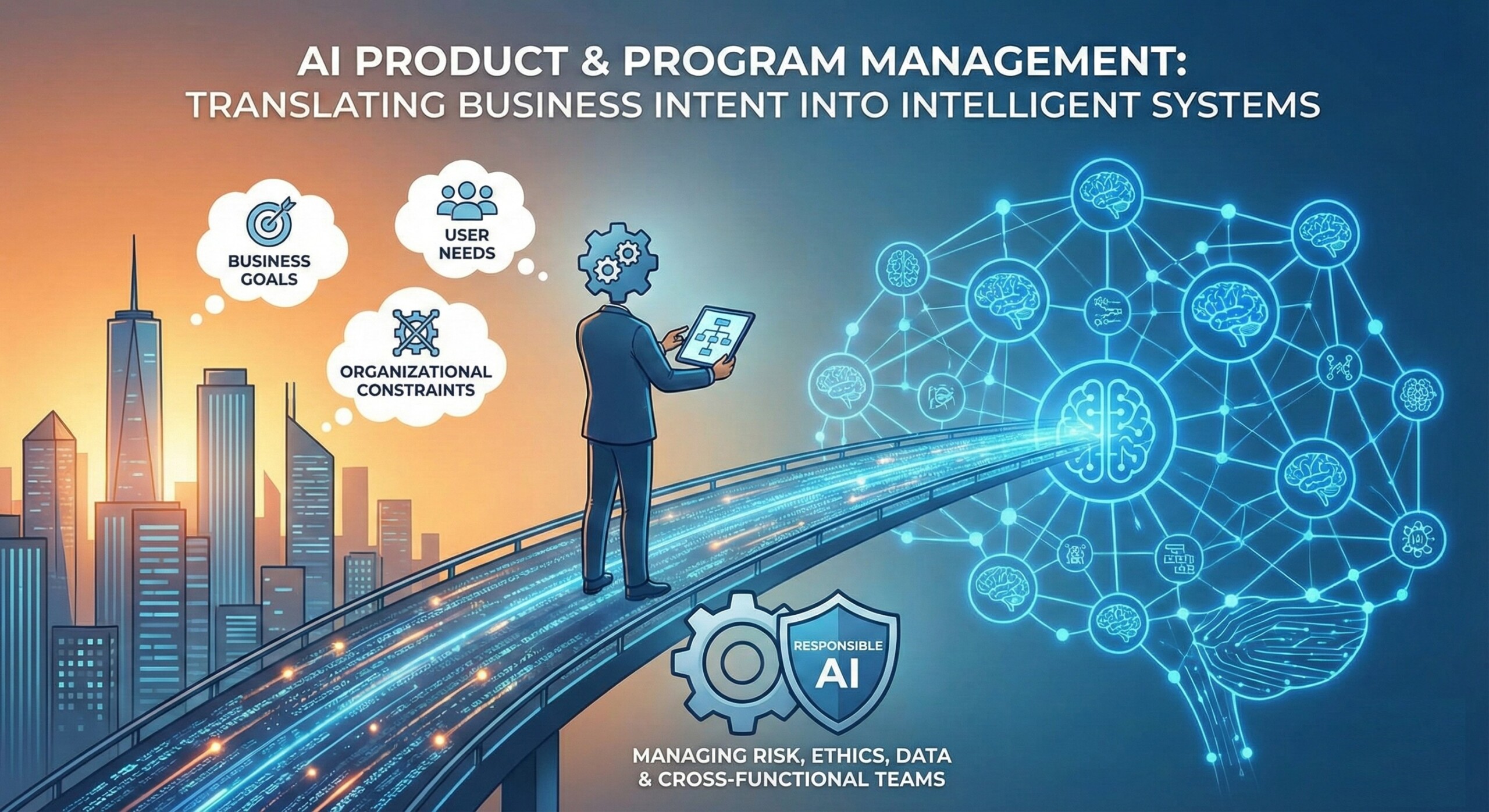
Artificial Intelligence has moved from experimental innovation into a core capability embedded within products, platforms, and organizational workflows. As AI systems grow more complex and impactful, the role of product and program managers has become critical. AI Product and Program Management is not about managing algorithms directly, but about translating business goals, user needs, and organizational constraints into deployable, responsible AI systems.
Unlike traditional software products, AI systems are probabilistic, data-dependent, and continuously evolving. Managing them requires a deep understanding of trade-offs between accuracy, cost, risk, compliance, and user trust. AI product and program managers sit at the intersection of business strategy, engineering execution, data realities, and ethical responsibility. Understanding these roles is essential for professionals who want to shape how AI is actually used in the real world.
1. The expanding AI product and program management landscape
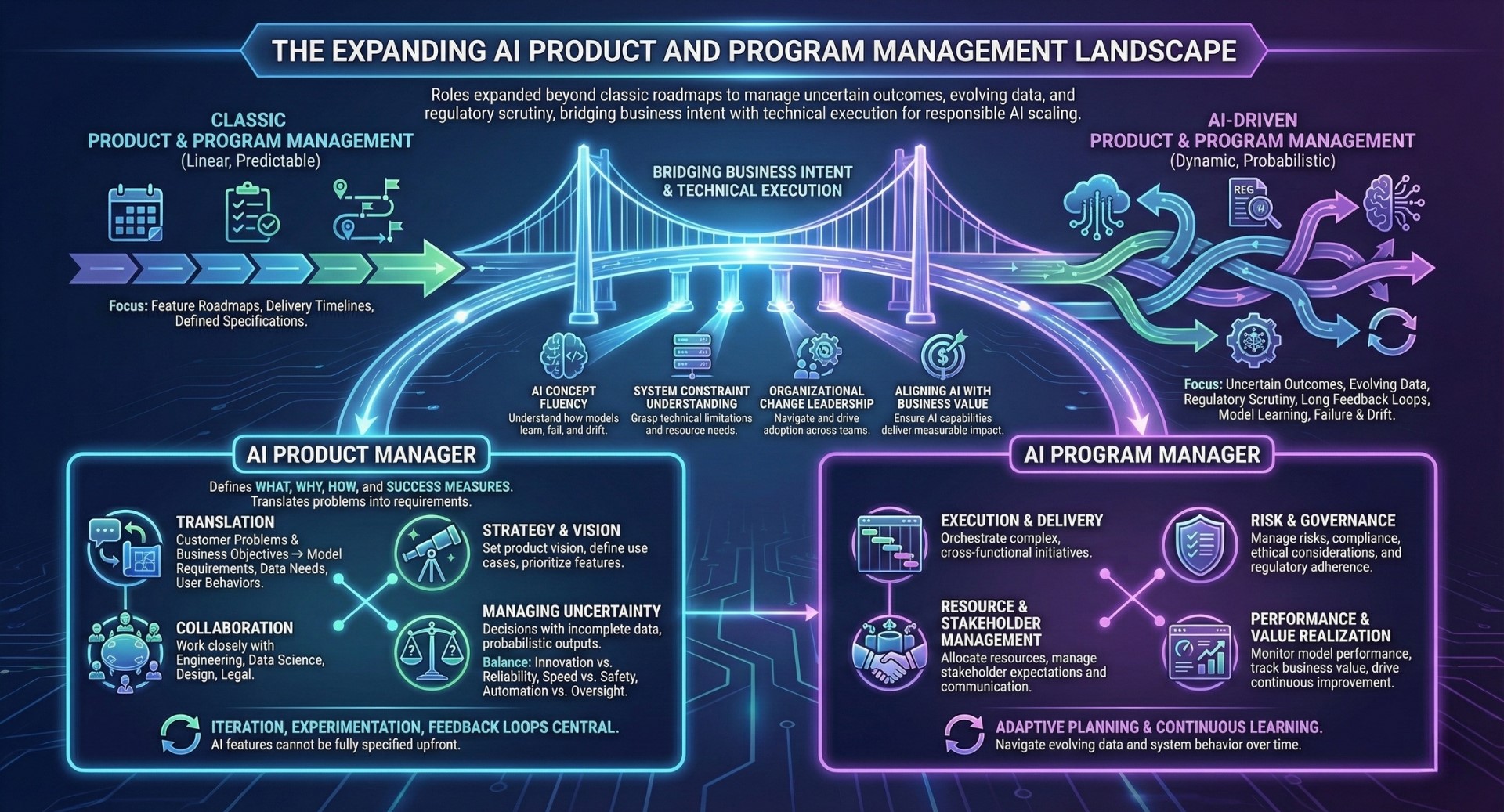
AI product and program roles have expanded well beyond classic feature roadmaps and delivery timelines. Modern AI initiatives involve uncertain outcomes, evolving data, regulatory scrutiny, and long feedback loops. Product and program managers must understand how models learn, fail, and drift over time, while aligning AI capabilities with measurable business value.
These roles now require fluency in AI concepts, system constraints, and organizational change. Managers who can bridge business intent with technical execution are central to scaling AI responsibly across enterprises, governments, and consumer platforms.
2. AI Product Manager
AI Product Managers define what an AI system should do, why it matters, and how success will be measured. They translate customer problems and business objectives into model requirements, data needs, and user-facing behaviors. This includes setting product vision, defining use cases, prioritizing features, and working closely with engineering, data science, design, and legal teams.
In practice, AI Product Managers manage uncertainty. They make decisions with incomplete data, probabilistic outputs, and evolving model performance. They must balance innovation with reliability, speed with safety, and automation with human oversight. Unlike traditional products, AI features cannot be fully specified upfront, making iteration, experimentation, and feedback loops central to the role. An excellent collection of learning videos awaits you on our Youtube channel.
3. AI Program Manager
AI Program Managers focus on orchestration and execution across complex, multi-team AI initiatives. They coordinate timelines, dependencies, budgets, and risk across data teams, ML engineers, infrastructure, compliance, and business stakeholders. Their role is critical when AI projects span multiple models, regions, or regulatory environments.
AI programs often fail not because models are weak, but because dependencies are misaligned. Program Managers ensure that data readiness, infrastructure capacity, governance approvals, and deployment plans move in sync. They are responsible for turning fragmented AI efforts into cohesive, scalable programs that actually ship.
4. Translating business problems into AI use cases
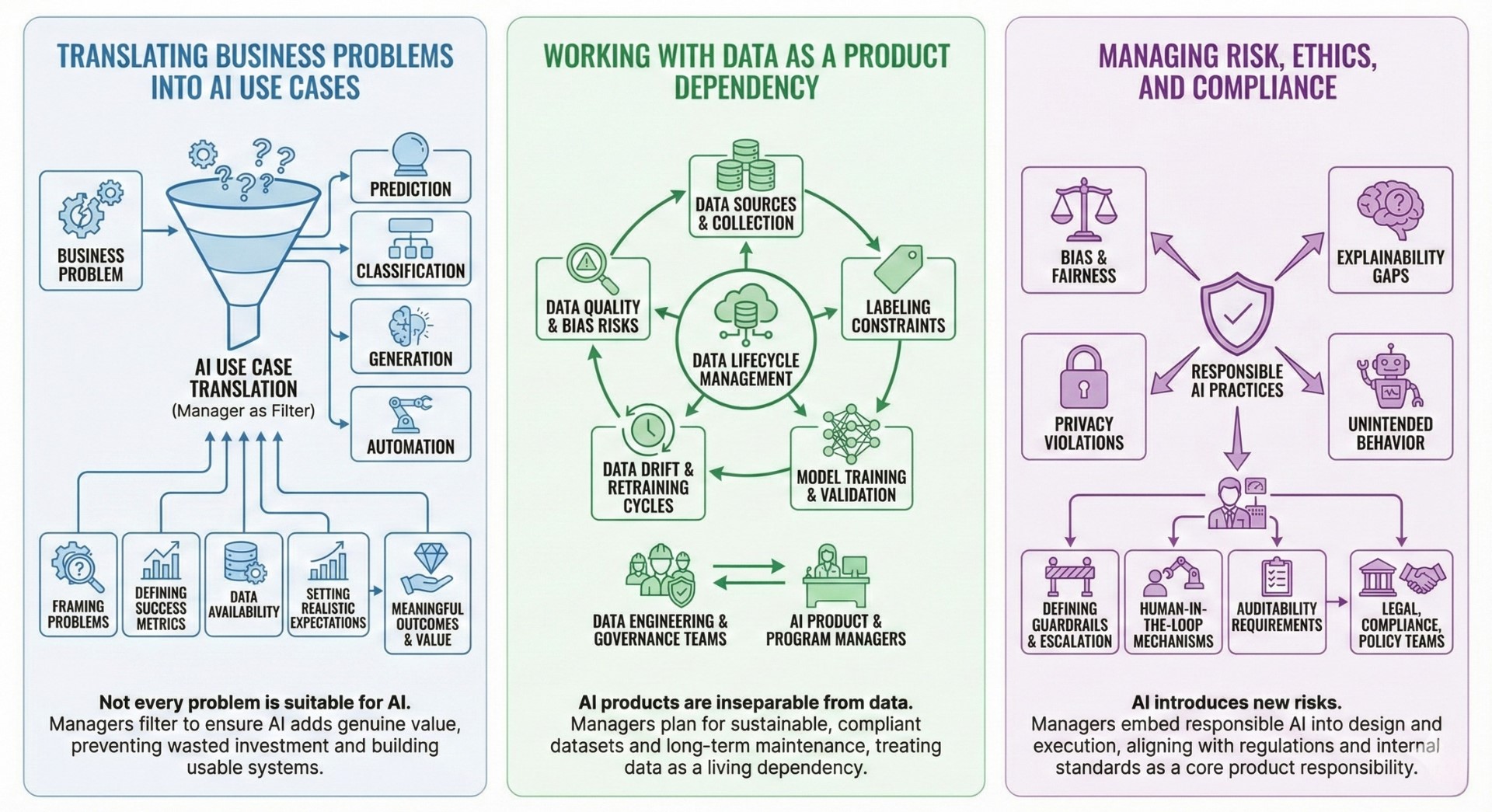
One of the most critical skills in AI product and program management is use-case translation. Not every business problem is suitable for AI, and not every AI capability creates value. Managers must identify where prediction, classification, generation, or automation meaningfully improves outcomes.
This involves framing problems correctly, defining success metrics, understanding data availability, and setting realistic expectations. Poorly framed AI initiatives often lead to wasted investment, mistrust, or unusable systems. Strong managers act as filters, ensuring AI is applied where it genuinely adds value. A constantly updated Whatsapp channel awaits your participation.
5. Working with data as a product dependency
Unlike traditional software, AI products are inseparable from data. Product and Program Managers must understand data sources, quality issues, labeling constraints, bias risks, and lifecycle management. Decisions about data collection and governance often matter more than model choice.
In practice, managers work closely with data engineering and governance teams to ensure datasets are representative, compliant, and sustainable. They must plan for data drift, retraining cycles, and long-term maintenance. Treating data as a living product dependency is essential for AI systems that remain useful over time.
6. Managing risk, ethics, and compliance
AI systems introduce new categories of risk, including bias, explainability gaps, privacy violations, and unintended behaviour. AI Product and Program Managers play a key role in embedding responsible AI practices into design and execution.
This includes defining guardrails, escalation paths, human-in-the-loop mechanisms, and auditability requirements. Managers must work with legal, compliance, and policy teams to align AI systems with regulations and internal standards. Responsible AI is not a separate function; it is a core product responsibility. Excellent individualised mentoring programmes available.
7. Cross-functional leadership and communication
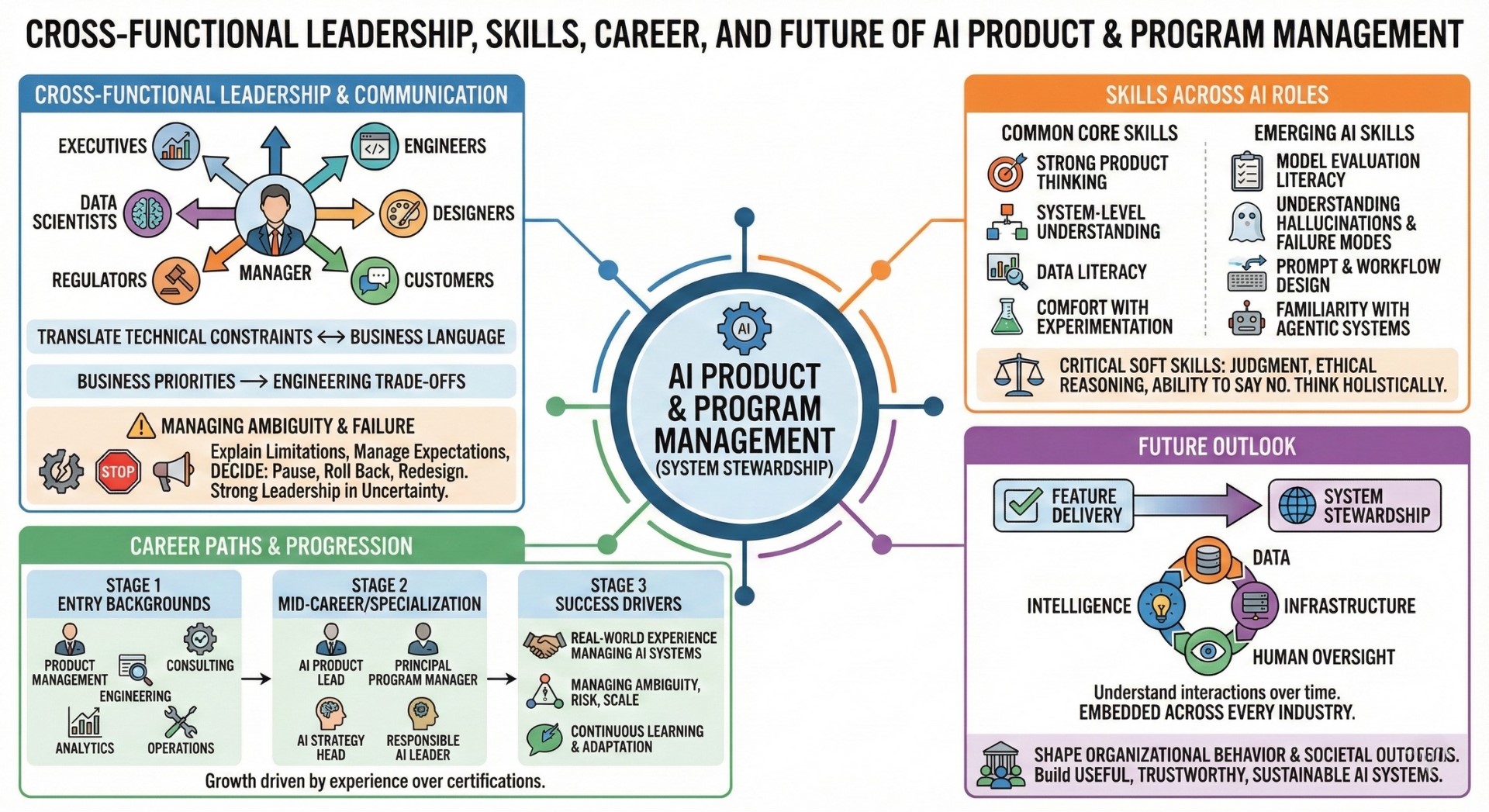
AI initiatives involve deeply cross-functional teams. Product and Program Managers must communicate effectively with executives, engineers, data scientists, designers, regulators, and customers. They translate technical constraints into business language and business priorities into engineering trade-offs.
Clear communication is especially critical when AI systems fail or behave unexpectedly. Managers are often responsible for explaining model limitations, managing stakeholder expectations, and deciding when to pause, roll back, or redesign systems. Strong leadership in ambiguity defines success in these roles.
8. Skills that cut across AI product and program roles
Successful AI Product and Program Managers share a common skill set. This includes strong product thinking, system-level understanding, data literacy, and comfort with experimentation. Increasingly important skills include model evaluation literacy, understanding hallucinations and failure modes, prompt and workflow design, and familiarity with agentic systems.
Equally important are judgment, ethical reasoning, and the ability to say no to inappropriate AI use cases. These roles reward professionals who can think holistically rather than those who chase novelty. Subscribe to our free AI newsletter now.
9. Career paths and progression
Professionals often enter AI product and program roles from product management, consulting, engineering, analytics, or operations backgrounds. Over time, they may specialize as AI Product Leads, Principal Program Managers, AI Strategy Heads, or Responsible AI leaders.
Career growth is driven less by certifications and more by experience managing real AI systems through ambiguity, risk, and scale. The ability to learn continuously and adapt to evolving AI capabilities is central to long-term success.
10. The future outlook for AI product and program managers
AI product and program management is shifting from feature delivery to system stewardship. The future belongs to managers who understand how intelligence, data, infrastructure, and human oversight interact over time.
As AI becomes embedded across every industry, these roles will shape not just products, but organizational behavior and societal outcomes. The most valuable professionals will be those who can translate business ambition into AI systems that are useful, trustworthy, and sustainable in the real world. Upgrade your AI-readiness with our masterclass.
Billion Hopes summary
AI Product and Program Management careers are fundamentally about translating intent into intelligence. They require balancing business goals with technical realities, managing risk alongside innovation, and designing systems that evolve responsibly over time. As AI becomes a permanent layer of modern organizations, the demand will grow for leaders who can guide AI from idea to impact. In this landscape, systems thinking, ethical judgment, and execution excellence matter more than hype or titles, making AI product and program management one of the most influential career paths of the AI era.
Share this with the world
Related Articles