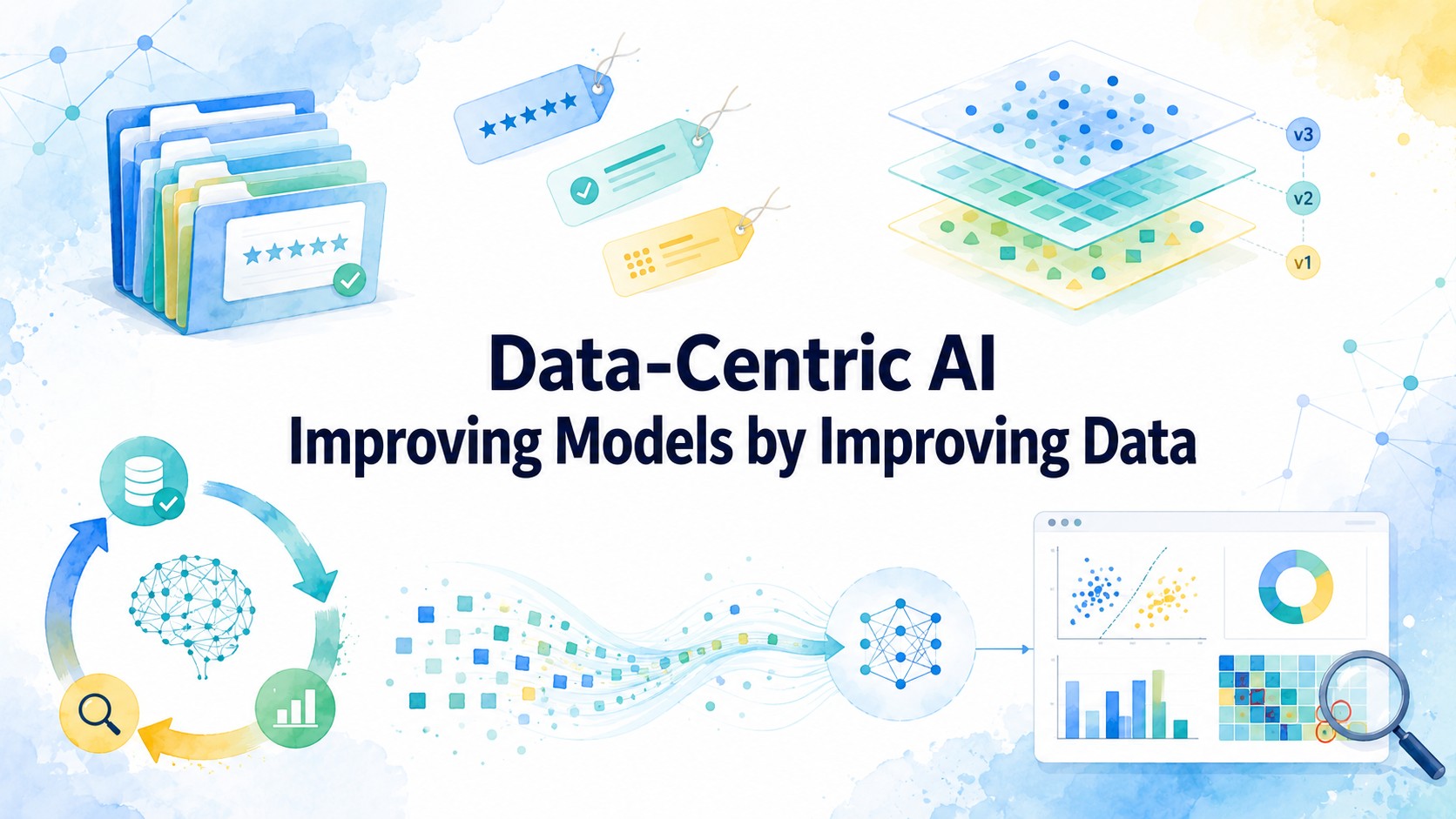
Data-Centric AI Improving Models by Improving Data
Data-Centric AI Improving Models by Improving Data
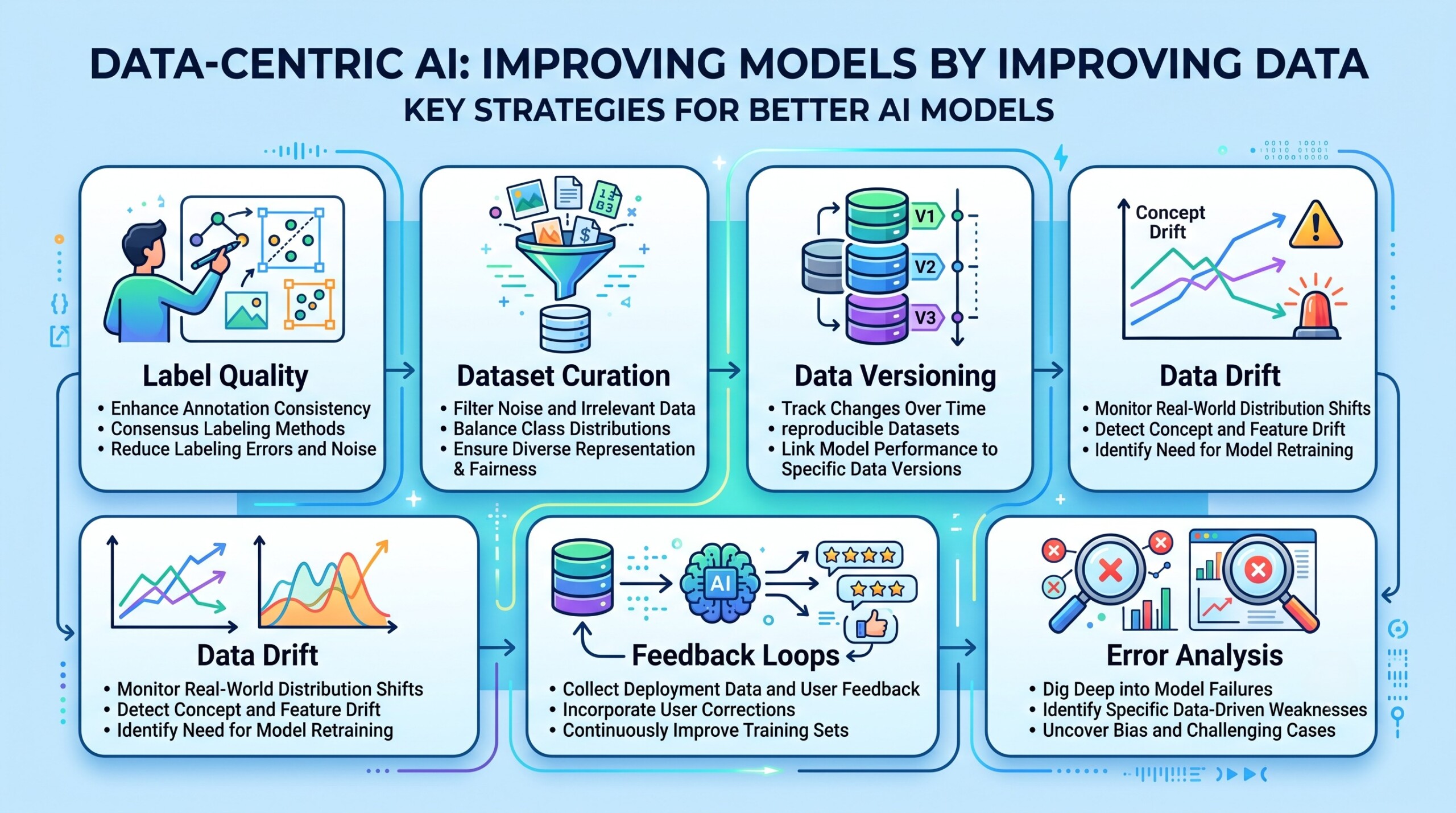
Label quality, dataset curation, data versioning, data drift, feedback loops, error analysis.
Introduction
For many years, artificial intelligence development was largely model-centric. Teams focused on building bigger neural networks, tuning algorithms, experimenting with architectures, and increasing computing power. The assumption was simple: if the model is powerful enough, performance will improve. This approach has produced remarkable progress, especially in deep learning, computer vision, natural language processing, and generative AI.
However, as AI systems move from laboratories into real-world business, healthcare, education, manufacturing, finance, governance, and public services, one truth has become increasingly clear: even the best model cannot perform well on poor-quality data.
This is where data-centric AI becomes important. Data-centric AI is an approach that focuses on systematically improving the quality, relevance, consistency, and reliability of data rather than only changing the model. Instead of asking, “How can we make the model more complex?”, data-centric AI asks, “How can we make the data better so that the model learns the right patterns?”
In practical terms, data-centric AI includes improving label quality, curating datasets carefully, tracking data versions, detecting data drift, creating feedback loops, and conducting structured error analysis. These practices help organizations build AI systems that are more accurate, reliable, explainable, and useful in real-world environments.
Let’s dive deep into the topic now.
1. Data quality is often more important than model complexity
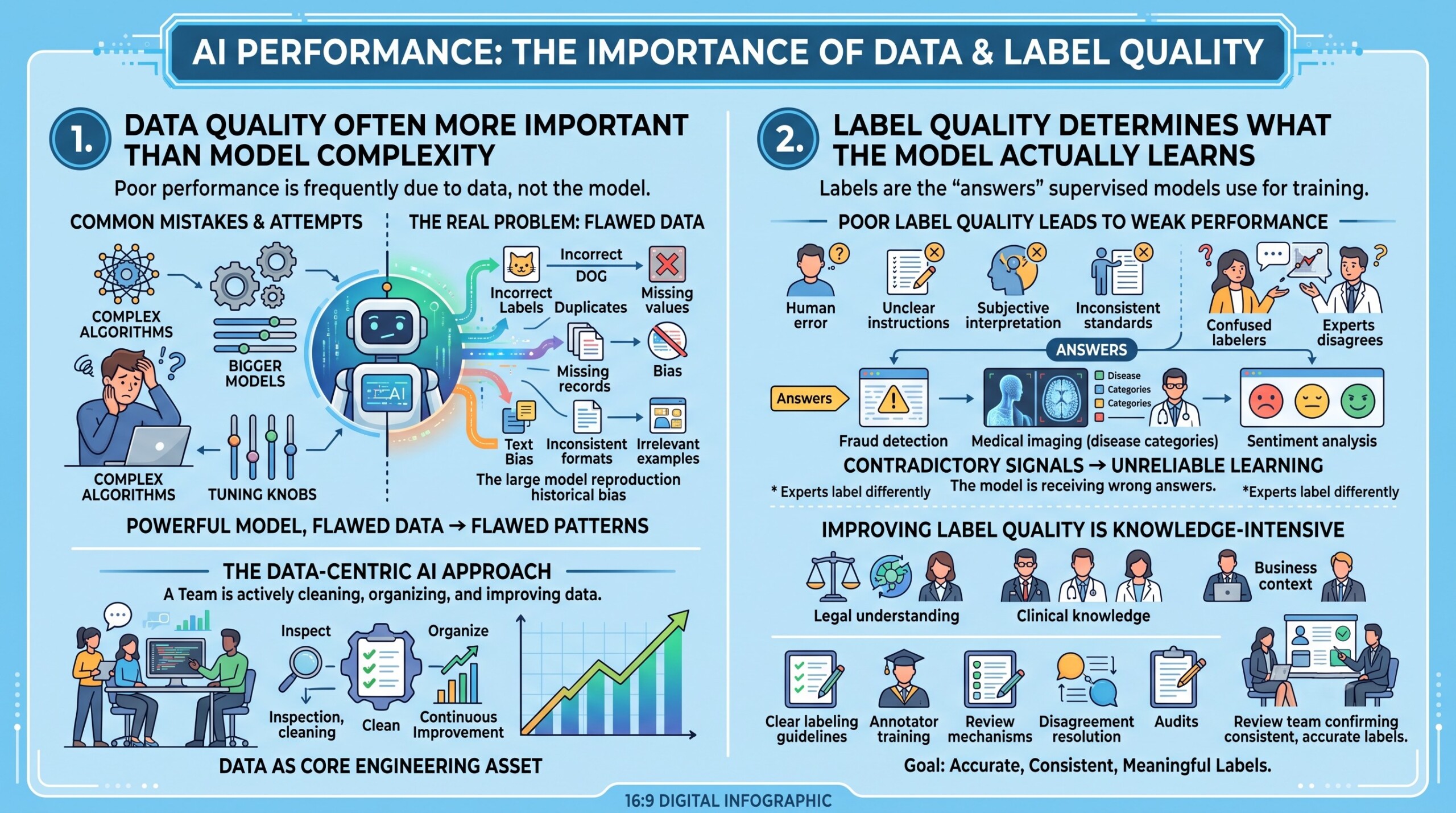
A common mistake in AI projects is to blame the model whenever performance is poor. Teams may try a larger model, a different algorithm, more hyperparameter tuning, or additional computing resources. While these steps can help, they often fail when the real problem lies in the data.
If the dataset contains incorrect labels, duplicate records, missing values, biased samples, inconsistent formats, or irrelevant examples, the model learns from those weaknesses. A powerful model trained on flawed data may simply become better at learning flawed patterns.
For example, in an image classification project, if some images of cats are wrongly labeled as dogs, the model receives contradictory signals. In a customer support chatbot, if past conversations are poorly categorized, the AI may learn incorrect response patterns. In a loan approval system, if historical data reflects unfair lending practices, the model may reproduce those biases.
Data-centric AI treats data as a core engineering asset. It encourages teams to inspect, clean, organize, and continuously improve data with the same seriousness they apply to model design. In many real-world projects, this shift can produce larger performance gains than simply changing the algorithm.
2. Label quality determines what the model actually learns
Labels are the answers that supervised learning models use during training. If a model is trained to detect fraud, labels indicate whether past transactions were fraudulent or legitimate. If a model is trained to classify medical images, labels indicate the disease category. If a model is trained for sentiment analysis, labels indicate whether text is positive, negative, or neutral.
Poor label quality is one of the biggest hidden reasons behind weak AI performance. Labels may be wrong because of human error, unclear instructions, subjective interpretation, or inconsistent labeling standards. In some cases, two experts may label the same data differently because the categories are not clearly defined.
Improving label quality requires clear labeling guidelines, well-trained annotators, review mechanisms, and disagreement resolution. Organizations should not treat labeling as a low-level clerical activity. In many AI systems, labeling is a knowledge-intensive process. For example, labeling legal documents requires legal understanding. Labeling medical scans requires clinical knowledge. Labeling customer complaints requires business context. When labels are created carelessly, the model’s learning becomes unreliable.
A data-centric approach improves label quality through audits, consensus labeling, expert review, active learning, and continuous correction. The goal is not merely to collect more labeled data, but to ensure that the labels are accurate, consistent, and meaningful. An excellent collection of learning videos awaits you on our Youtube channel.
3. Dataset curation helps the model learn from the right examples
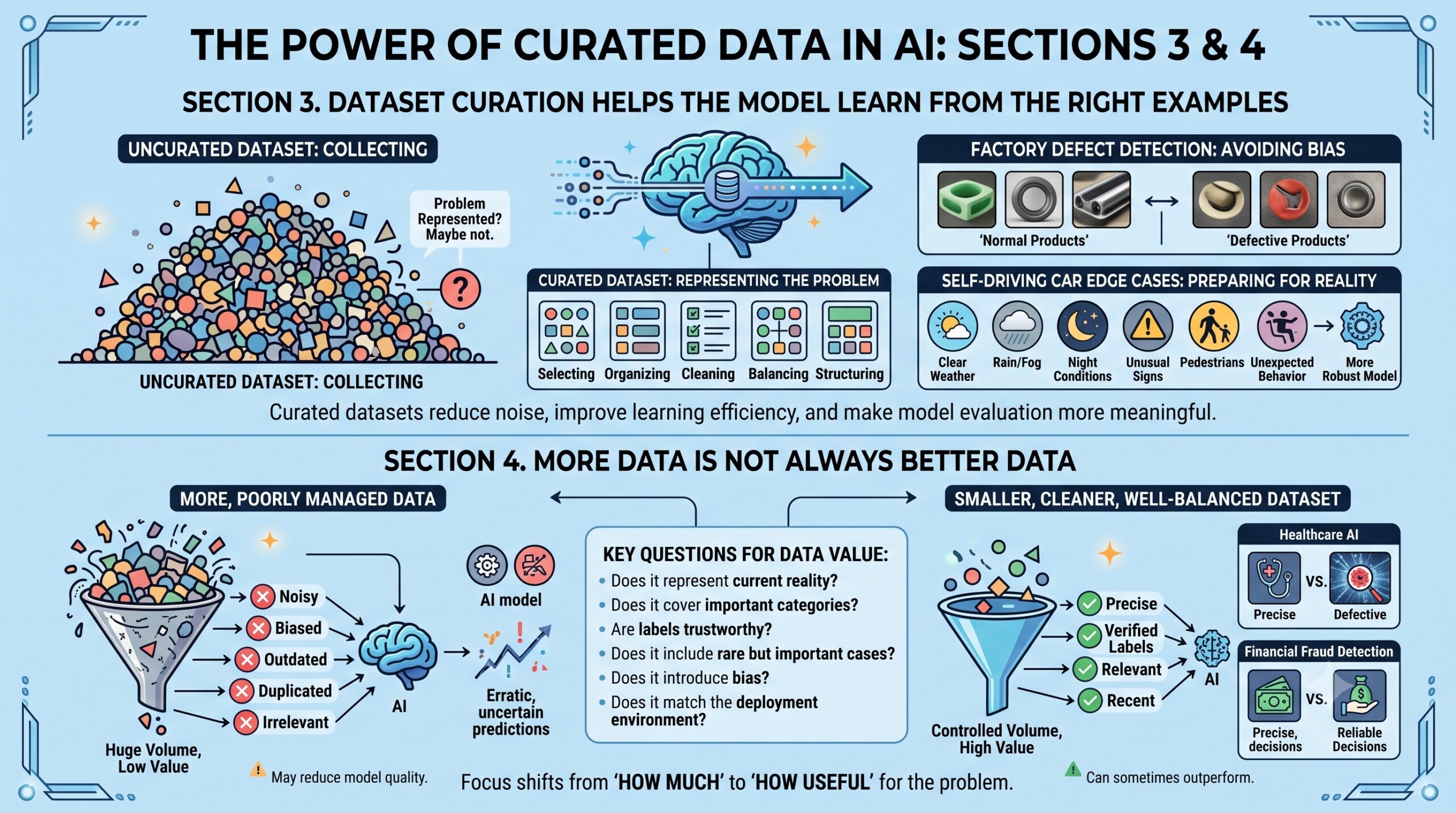
Collecting large amounts of data is not the same as building a useful dataset. A dataset must be curated carefully so that it represents the problem the AI system is expected to solve.
Dataset curation involves selecting, organizing, cleaning, balancing, and structuring data. It includes removing irrelevant records, identifying duplicates, correcting inconsistencies, handling missing values, and ensuring that important categories are properly represented.
For example, suppose a company wants to build an AI system to detect defective products in a factory. If the dataset contains thousands of images of normal products but only a few images of defective ones, the model may become very good at recognizing normal products but weak at identifying defects. In such a case, simply increasing the dataset size may not solve the problem unless the additional data includes enough examples of defects.
Good dataset curation also requires attention to edge cases. These are unusual, rare, or difficult examples that the model may encounter in real life. A self-driving car system, for instance, cannot be trained only on clear roads in good weather. It also needs examples involving rain, fog, night conditions, unusual road signs, pedestrians, and unexpected vehicle behavior.
Curated datasets help models become more robust. They reduce noise, improve learning efficiency, and make model evaluation more meaningful.

4. More data is not always better data
A popular belief in AI is that more data automatically leads to better performance. While more data can help, it is not always the best solution. If additional data is noisy, biased, outdated, duplicated, or irrelevant, it may reduce model quality instead of improving it.
A smaller, cleaner, well-balanced dataset can sometimes outperform a much larger but poorly managed dataset. This is especially true when the task requires precision, domain expertise, or reliable decision-making. For example, in healthcare AI, a small dataset labeled carefully by experienced doctors may be more valuable than a massive dataset with uncertain or inconsistent labels. In financial fraud detection, recent and well-verified transaction data may be more useful than old data from a different market environment.
Data-centric AI encourages teams to measure the value of data, not just its volume. Useful questions include: Does this data represent current reality? Does it cover the important categories? Are the labels trustworthy? Does it include rare but important cases? Does it introduce bias? Does it match the environment where the model will be deployed?
The focus shifts from “How much data do we have?” to “How useful is this data for the problem we are solving?” A constantly updated Whatsapp channel awaits your participation.
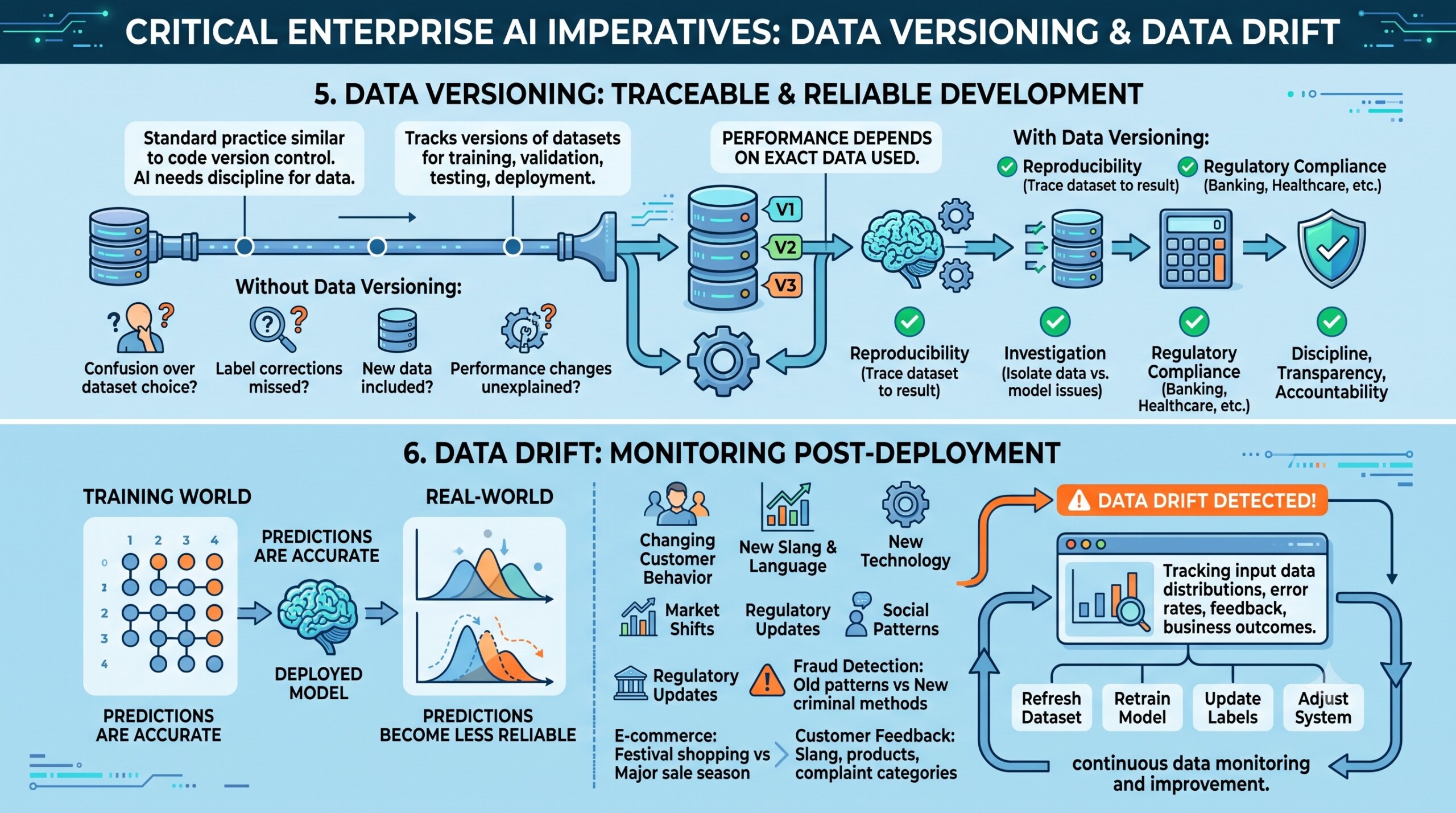
5. Data versioning makes AI development traceable and reliable
In software development, version control is standard practice. Developers track changes to code so they can understand what changed, when it changed, and why. AI systems need a similar discipline for data.
Data versioning means keeping track of different versions of datasets used for training, validation, testing, and deployment. This is important because model performance depends not only on the algorithm but also on the exact data used to train it.
Without data versioning, teams may struggle to answer basic questions. Which dataset was used to train the current model? Were any labels corrected after training? Did the training data include new customer segments? Was duplicate data removed? Why did model performance improve or decline between two experiments?
Data versioning supports reproducibility. If a model performs well, the team can trace the dataset that produced that result. If a model fails, the team can investigate whether the issue came from data changes, label changes, feature changes, or model changes. In regulated sectors such as banking, insurance, healthcare, and public administration, data versioning is even more important. Organizations may need to explain how a model was trained, what data was used, and whether the process followed governance standards.
Data versioning brings discipline, transparency, and accountability into AI development.
6. Data drift shows why AI systems must be monitored after deployment
An AI model does not operate in a frozen world. Customer behavior changes, markets change, language changes, technology changes, regulations change, and social patterns change. When the real-world data seen by a deployed model starts to differ from the data on which it was trained, this is called data drift.
Data drift can reduce model performance over time. A model that worked well last year may become less accurate today because the environment has changed. For example, an e-commerce recommendation system trained on pre-festival shopping behavior may perform poorly during a major sale season. A fraud detection model trained on old fraud patterns may fail when criminals adopt new methods. A language model used for customer feedback analysis may struggle when customers start using new slang, product names, or complaint categories.
Data drift does not always announce itself clearly. The system may continue producing predictions, but those predictions may slowly become less reliable. This is why deployed AI systems need monitoring.
A data-centric approach includes tracking input data distributions, model outputs, error rates, user complaints, and business outcomes. When drift is detected, the team may need to refresh the dataset, retrain the model, update labels, or adjust the system. AI deployment is not the end of the project. It is the beginning of continuous data monitoring and improvement. Excellent individualised mentoring programmes available.
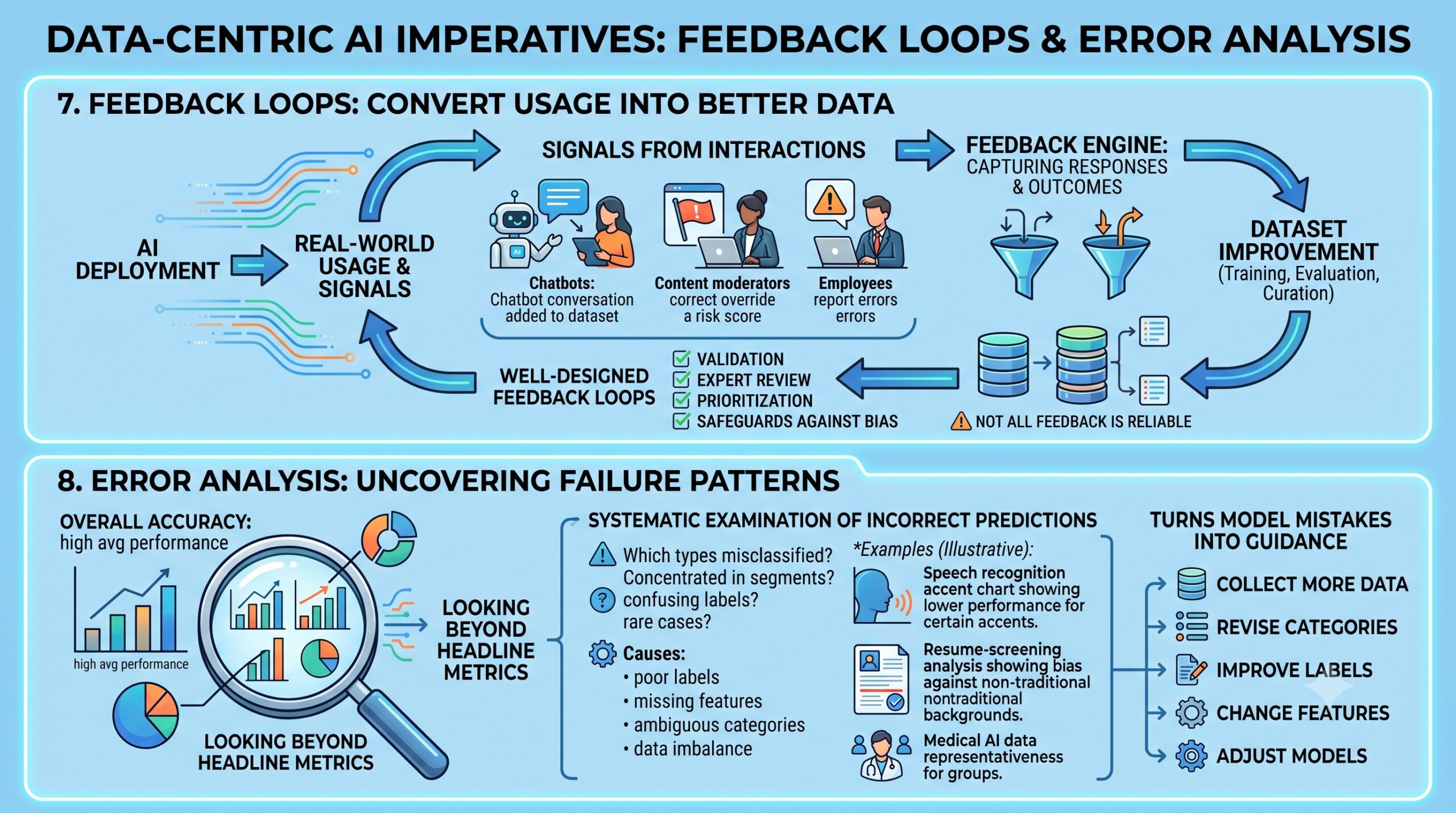
7. Feedback loops convert real-world usage into better data
Once an AI system is used in the real world, it starts generating valuable signals. Users accept or reject recommendations, customers complain about wrong answers, doctors correct predictions, analysts override risk scores, and employees report errors. These interactions can become powerful feedback loops.
A feedback loop is a process through which real-world outcomes and user responses are captured and used to improve the AI system. Instead of treating deployment as a final stage, data-centric AI treats deployment as a source of learning.
For example, if a customer support chatbot gives an incorrect answer, the conversation can be reviewed and added to a dataset for future improvement. If a content moderation system wrongly flags harmless content, that example can be corrected and used to improve the model. If a sales forecasting model consistently underestimates demand in certain regions, those cases can be analyzed and added to the training process.
However, feedback loops must be designed carefully. Not all feedback is equally reliable. Some users may provide incorrect corrections. Some feedback may reflect temporary emotions rather than factual errors. Some systems may create self-reinforcing patterns where the model influences the data it later learns from.
Good feedback loops include validation, expert review, prioritization, and safeguards against bias. When designed well, they help AI systems improve continuously and stay aligned with real-world needs.
8. Error analysis reveals where the model is failing and why
Overall accuracy can be misleading. A model may show high average performance while performing poorly on specific groups, categories, regions, languages, or edge cases. Error analysis helps teams look beyond headline metrics and understand the actual failure patterns.
Error analysis involves examining incorrect predictions systematically. Instead of simply counting how many mistakes the model made, teams ask deeper questions: Which types of examples are most often misclassified? Are errors concentrated in a particular customer segment? Are certain labels confusing? Is the model failing on rare cases? Are errors caused by poor labels, missing features, ambiguous categories, or data imbalance?
For example, a speech recognition model may perform well overall but poorly for certain accents. A resume-screening model may appear accurate but disadvantage candidates from non-traditional backgrounds. A medical AI system may perform better for some demographic groups than others if the training data is not representative.
Error analysis helps teams identify whether the solution requires more data, better labels, different features, revised categories, or model changes. It also helps prioritize improvements. Not all errors have the same importance. In a movie recommendation system, a wrong suggestion may be harmless. In a medical diagnosis system, a wrong prediction can have serious consequences.
Data-centric AI uses error analysis as a continuous improvement method. It turns model mistakes into guidance for better data collection, labeling, and curation. Subscribe to our free AI newsletter now.
9. Data governance is essential for trustworthy AI
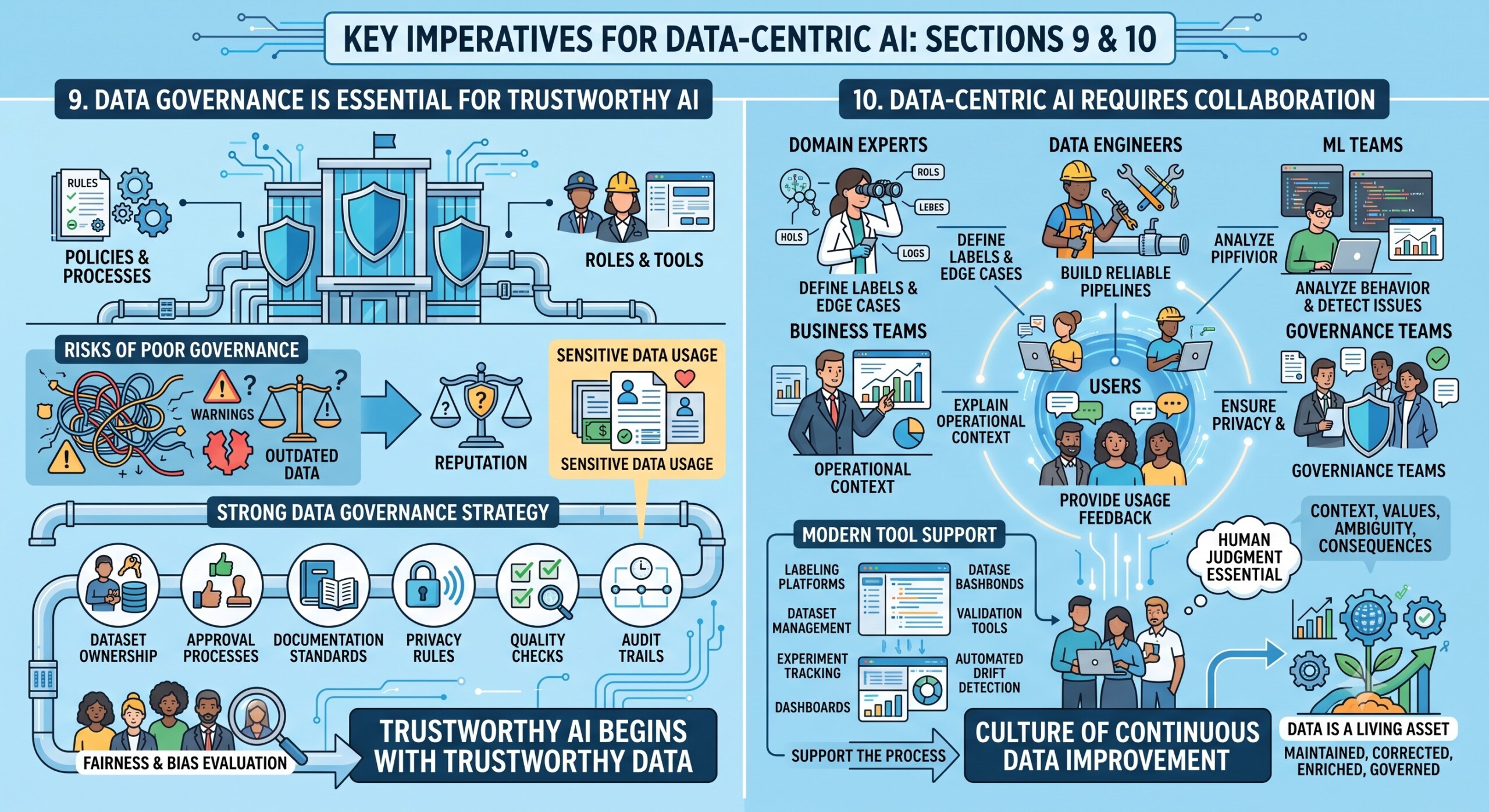
Data-centric AI is not only a technical practice. It is also a governance practice. Organizations must know where their data comes from, who has access to it, how it is labeled, how it is updated, and whether it is used responsibly.
Data governance includes policies, processes, roles, and tools that ensure data is accurate, secure, ethical, and compliant. This is especially important when AI systems use personal data, financial records, health information, employee data, or citizen data.
Without governance, data improvement efforts can become chaotic. Teams may use outdated datasets, mix sensitive information without proper controls, or train models on data that should not be used. Poor governance can create legal, ethical, reputational, and operational risks.
A strong data-centric AI strategy should define ownership of datasets, approval processes for data changes, documentation standards, privacy rules, quality checks, and audit trails. It should also include fairness and bias evaluation, especially when AI systems affect people’s opportunities, rights, or access to services.
Trustworthy AI begins with trustworthy data. If the data pipeline is unclear, the AI system built on top of it will also be difficult to trust.
10. Data-centric AI requires collaboration between humans, tools, and domain experts
Improving data is not a one-time technical task that can be handed only to data scientists. It requires collaboration among domain experts, business teams, data engineers, machine learning engineers, annotators, compliance teams, and end users.
Domain experts help define meaningful labels and identify real-world edge cases. Data engineers build reliable pipelines. Machine learning teams analyze model behavior and detect performance issues. Business teams explain operational context. Users provide feedback from actual usage. Governance teams ensure privacy, compliance, and accountability.
Modern tools can support this process through data labeling platforms, dataset management systems, experiment tracking, data validation tools, monitoring dashboards, and automated drift detection. However, tools alone are not enough. Human judgment remains essential, especially when the data involves context, values, ambiguity, or consequences for people.
Data-centric AI works best when organizations create a culture of continuous data improvement. In such a culture, data is not treated as a static raw material. It is treated as a living asset that must be maintained, questioned, corrected, enriched, and governed over time.
This cultural shift is often more important than any single technical tool. Upgrade your AI-readiness with our masterclass.
Conclusion
Data-centric AI changes the way we think about building intelligent systems. Instead of assuming that better AI always requires bigger models, it reminds us that better AI often begins with better data.
Label quality tells the model what to learn. Dataset curation determines whether the model sees the right examples. Data versioning makes the development process traceable. Drift monitoring ensures that models remain useful after deployment. Feedback loops allow real-world usage to improve future performance. Error analysis reveals hidden weaknesses. Governance ensures that data is used responsibly and transparently.
In the coming years, organizations that succeed with AI will not be those that simply chase the largest models or the latest algorithms. They will be the ones that build disciplined systems for managing, improving, and learning from data.
The central lesson is simple but powerful: models are only as good as the data that shapes them. To improve AI, we must improve the data. Data-centric AI is not a secondary activity; it is one of the foundations of reliable, responsible, and high-performing artificial intelligence.