The AI Job Landscape – 2026 and beyond – How AI Is Reshaping Work, Roles, and Careers
1. The end of the “Job Apocalypse” narrative
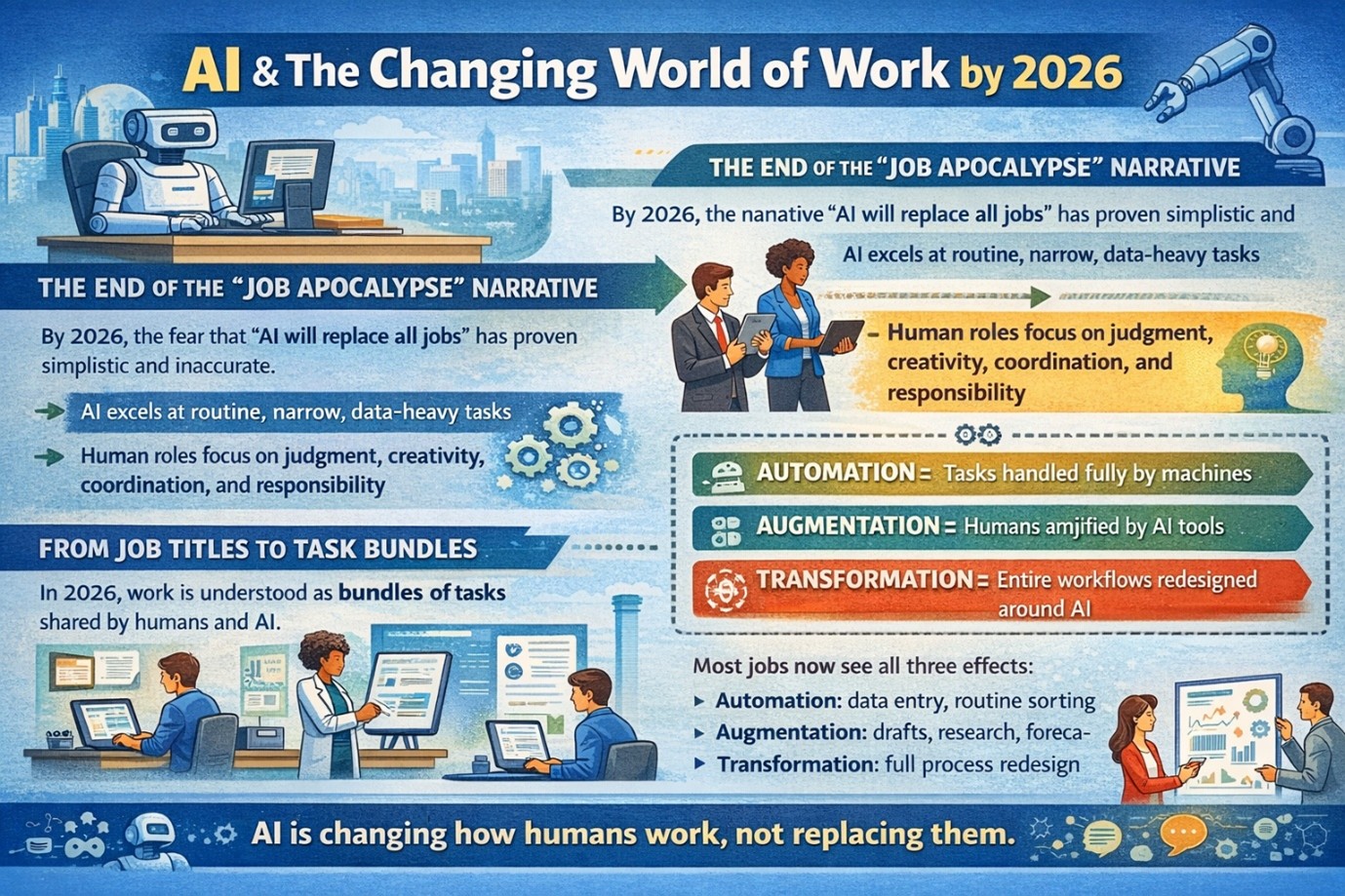
By 2026, the narrative around AI and jobs has matured. The early fear that “AI will replace all jobs” has proven simplistic and inaccurate. What we see instead is task-level automation, not wholesale job elimination. AI systems excel at narrow, repetitive, data-heavy tasks, while human roles increasingly focus on judgment, creativity, coordination, and responsibility.
Jobs rarely disappear overnight. They fragment, evolve, and recombine. Accountants didn’t vanish with spreadsheets; pilots didn’t disappear with autopilot. Similarly, AI is not erasing work—it is changing what humans are paid to do.
Let your personal observations always be the guide. Trust what you see and experience daily.
2. From job titles to task bundles
Traditional job descriptions assumed a stable bundle of tasks. AI has broken that assumption. In 2026, work is better understood as a collection of tasks, some automated, some augmented, and some still uniquely human.
For example:
- A marketing manager now uses AI for drafts, analytics, and testing.
- A doctor uses AI for diagnostics but retains decision authority.
- A lawyer uses AI for research, not judgment.
Careers are no longer defined by static titles, but by how humans and machines share tasks. Yes, AI will take over some tasks, and destroy some others, but the overall holistic job will always remain, never to be destroyed. An excellent collection of learning videos awaits you on our Youtube channel
3. Three broad effects of AI on work
Across industries, AI impacts work in three consistent ways:
- Automation – Tasks fully handled by machines (data entry, routine classification).
- Augmentation – Humans work faster and better using AI tools.
- Transformation – Entire workflows are redesigned around AI.
Most jobs experience all three effects simultaneously, which explains why career disruption feels confusing – but not catastrophic. Furthermore, humans willing to learn new skills in the AI-first world are likely to emerge much stronger than in earlier eras of work. The key is constant learning.
4. New AI-native roles are emerging
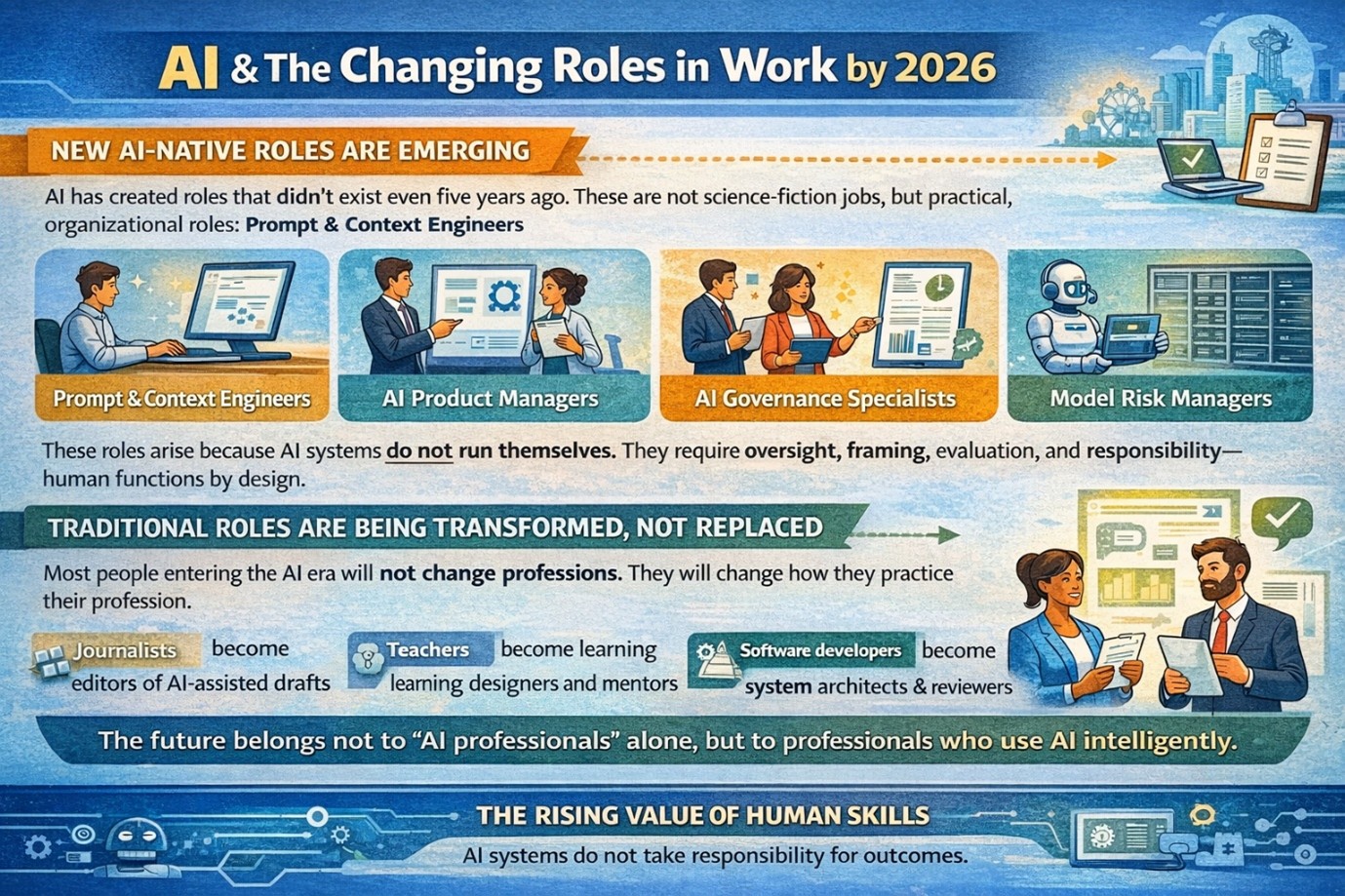
AI has created roles that did not exist even five years ago. These are not science-fiction jobs, but practical, organizational roles:
- Prompt & Context Engineers
- AI Product Managers
- AI Governance Specialists
- Model Risk Managers
- Human-in-the-Loop Supervisors
- AI Systems Integrators
These roles arise because AI systems do not run themselves. They require oversight, framing, evaluation, and responsibility – human functions by design. There is no reason to assume these roles will vanish or be subsumed. On the contrary, many new roles will be created by AI, needing more (not less) human intervention and supervision. A constantly updated Whatsapp channel awaits your participation.
5. Traditional roles being transformed, not replaced
Most people entering the AI era will not change professions. They will change how they practice their profession.
Examples:
- Journalists become editors of AI-assisted drafts.
- Teachers become learning designers and mentors.
- Software developers become system architects and reviewers.
- HR professionals become workforce-AI coordinators.
The future belongs not to “AI professionals” alone, but to professionals who use AI intelligently. This may sound clichéd but is true. Ask any practising professional.
6. The rising value of human skills
As machines take over predictable tasks, human skills increase in value, not decrease. In 2026, employers consistently prioritize:
- Critical thinking
- Ethical judgment
- Communication and persuasion
- Contextual understanding
- Emotional intelligence
- Accountability and trust
AI systems do not take responsibility for outcomes. Humans still do. That alone ensures enduring demand for human-led roles. It’s time to invest more in your softer skills, and work on connecting better with fellow humans. Excellent individualised mentoring programmes available.
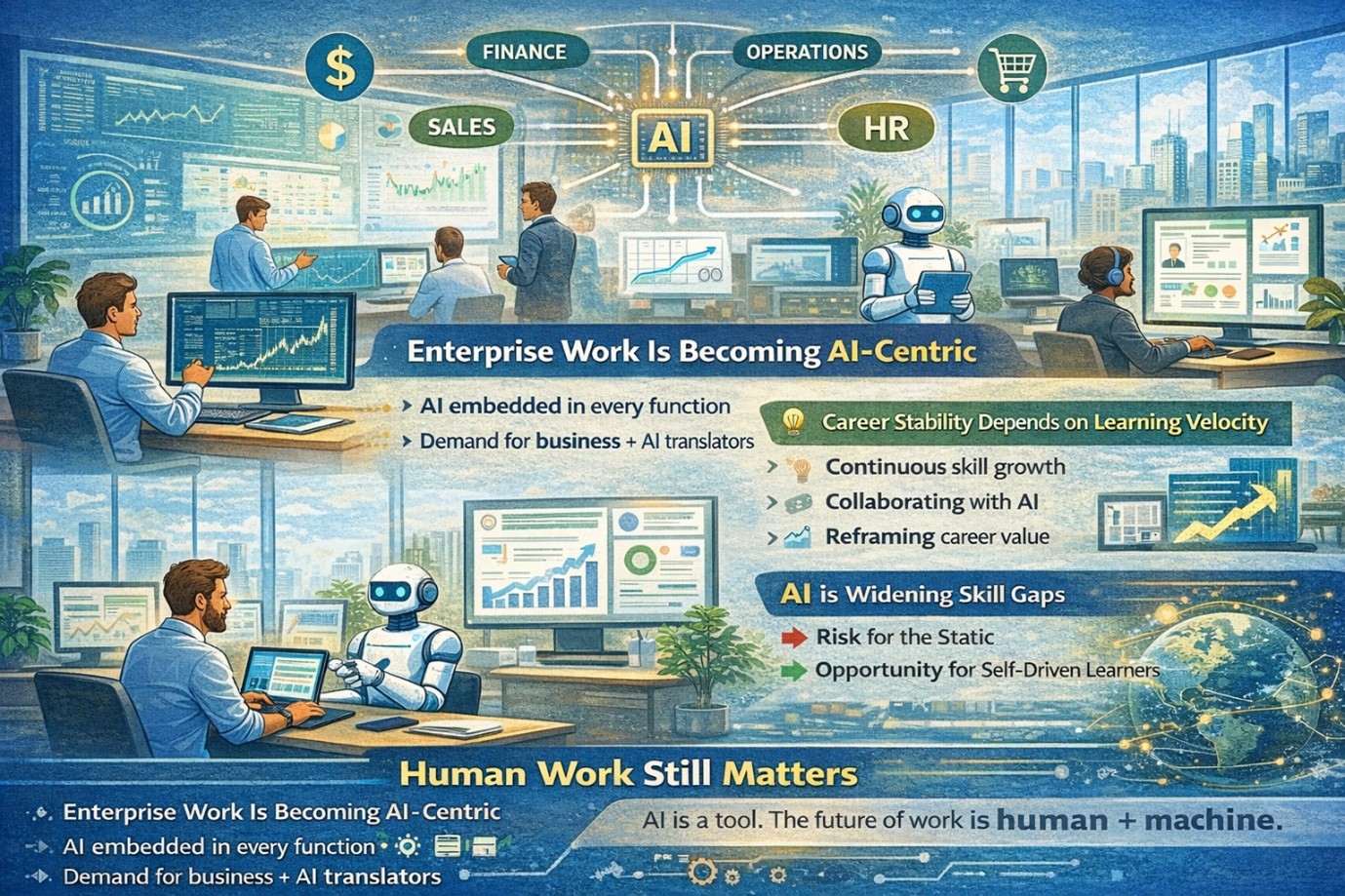
7. Enterprise work is becoming AI-centric
Inside organizations, AI is no longer an “IT experiment.” It is embedded across functions:
- Finance uses AI for forecasting and fraud detection.
- Operations use AI for optimization and planning.
- Sales uses AI for personalization and lead scoring.
- HR uses AI for screening and workforce analytics.
This creates demand for enterprise AI translators—people who understand business, data, risk, and people together. But be warned: AI adoption in enterprises is tough, and many projects simply fail due to lack of an integrated vision and strategy.
8. Career stability now depends on learning velocity
In earlier decades, a degree could stabilize a career for 20 years. In 2026, stability comes from learning velocity, not credentials alone.
Successful professionals:
- Continuously update skills
- Understand AI capabilities and limits
- Learn to collaborate with intelligent tools
- Reframe their value regularly
AI rewards those who adapt deliberately, not those who resist or blindly chase trends. AI is a powerful suite of solutions that need careful adoption and transformation natively. Subscribe to our free AI newsletter now.
9. New inequalities – and new opportunities
AI is widening skill gaps, but also lowering entry barriers. A single professional with AI tools can now perform work once requiring entire teams.
This creates:
- Risk for those who remain static
- Opportunity for self-driven learners
- Global access to high-value work
The AI job landscape is not equal, but it is open. Access depends more on mindset and learning than on geography or background. It is time for governments and regulators to ensure that these opportunities filter down to every segment of society.
10. The Big Picture: Human work matters
Looking beyond 2026, one truth remains clear: AI is a tool, not a worker. It has no intent, values, or responsibility. Societies still rely on humans for meaning, trust, governance, creativity, and care.
The future of work is not human vs machine. It is human with machine.
Those who understand this will not fear AI careers. They will shape them. Humans with a smart mind to bring their best human face forward will be big winners in this AI era.
Closing thought from Billion Hopes
AI is not taking away work—it is asking humans to work at a higher level of thinking, responsibility, and purpose. The careers of the future will belong to those who learn to guide intelligent tools wisely, ethically, and creatively. Upgrade your AI-readiness with our masterclass.
Share this with the world
Related Articles