AI Systems Architecture & Agent Orchestration Careers
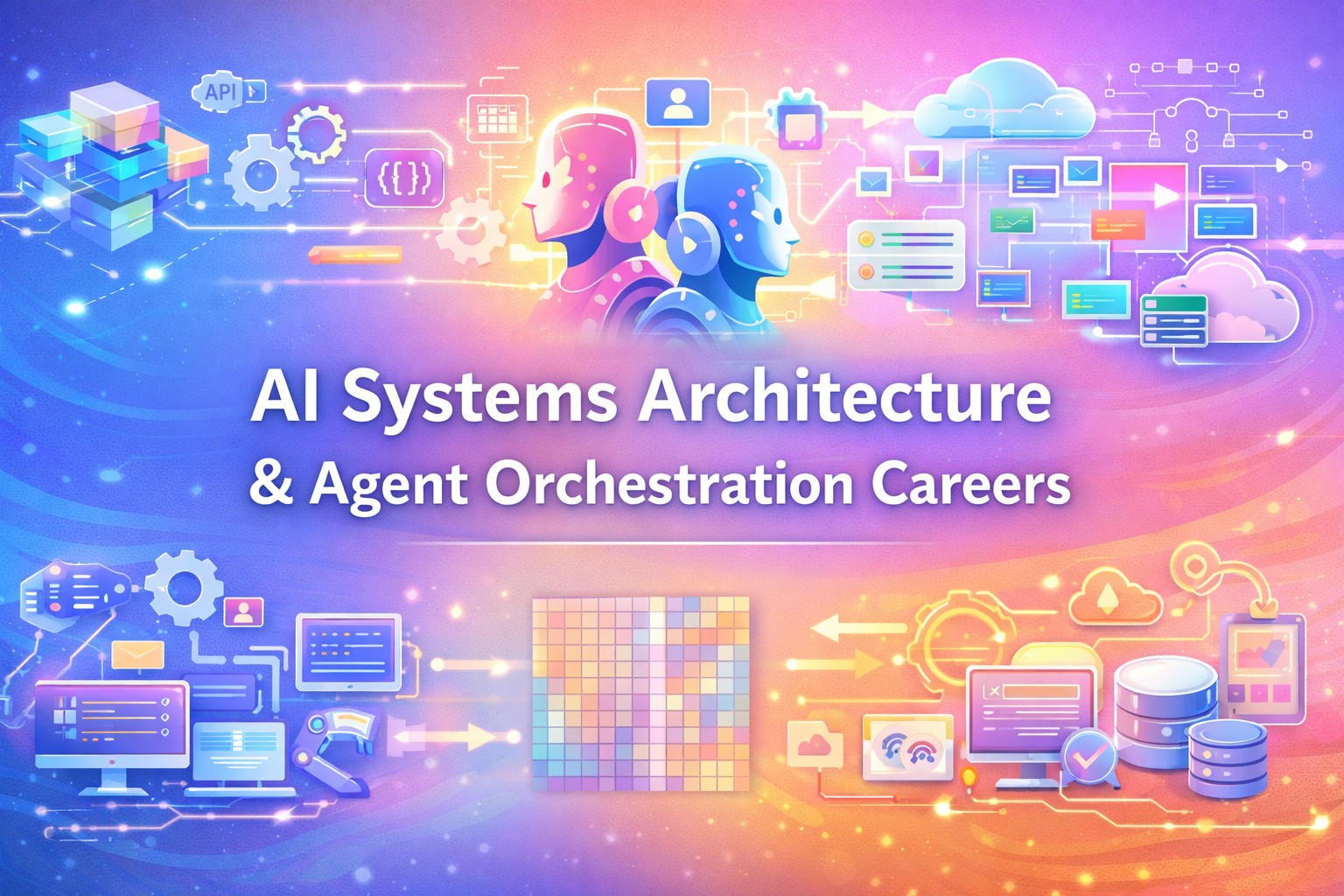
AI Systems Architecture & Agent Orchestration Careers
Multi-agent systems and workflows; Toolchains, APIs, and automation pipelines; Designing end-to-end AI ecosystems
Introduction
Artificial intelligence has moved beyond standalone models into complex, interconnected systems that operate across data pipelines, APIs, and distributed environments. Modern AI is no longer just about training models. It is about designing systems that integrate models into real-world workflows, automate decisions, and interact with users and other systems in a coordinated way.
This shift has given rise to a new class of roles focused on AI systems architecture and agent orchestration. These roles require a blend of software engineering, data engineering, and applied machine learning knowledge. They are responsible for building scalable, reliable, and efficient AI ecosystems that can handle tasks such as multi-agent collaboration, real-time inference, and automated decision pipelines.
The emergence of frameworks like LangChain, LlamaIndex, and Ray highlights how the industry is moving toward modular and orchestrated AI systems. These tools allow developers to connect models, tools, and data sources into cohesive systems that deliver practical value. An excellent collection of learning videos awaits you on our Youtube channel.
Let’s dive deep.
1. Rise of Multi-Agent Systems and Collaborative AI
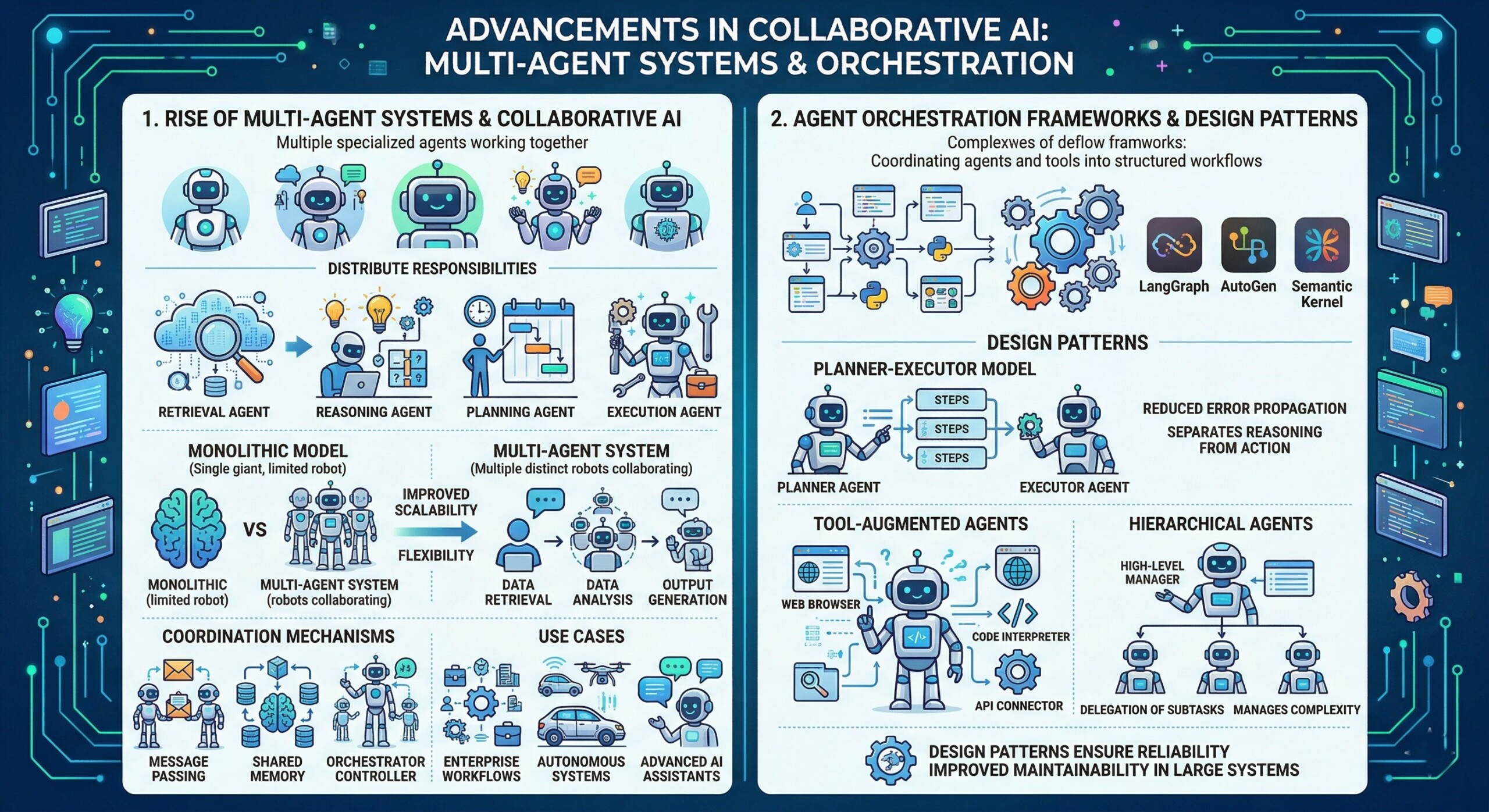
Multi-agent systems involve multiple AI agents working together to solve complex problems. Each agent may specialize in a specific task such as retrieval, reasoning, planning, or execution. Instead of relying on a single monolithic model, these systems distribute responsibilities across agents.
This approach improves scalability and flexibility. For example, one agent can retrieve data, another can analyze it, and a third can generate outputs. Coordination mechanisms such as message passing, shared memory, or orchestrator controllers are used to manage interactions. This architecture is increasingly used in enterprise workflows, autonomous systems, and advanced AI assistants.
2. Agent Orchestration Frameworks and Design Patterns
Agent orchestration is the process of coordinating multiple agents and tools into a structured workflow. Frameworks like LangGraph and orchestration patterns such as planner-executor, tool-augmented agents, and hierarchical agents are becoming standard.
Design patterns play a critical role in ensuring reliability. For example, planner-executor models separate reasoning from action, reducing error propagation. Hierarchical agents allow high-level agents to delegate subtasks to specialized agents. These patterns help manage complexity and improve maintainability in large AI systems. A constantly updated Whatsapp channel awaits your participation.
3. Toolchains and API Integration in AI Systems
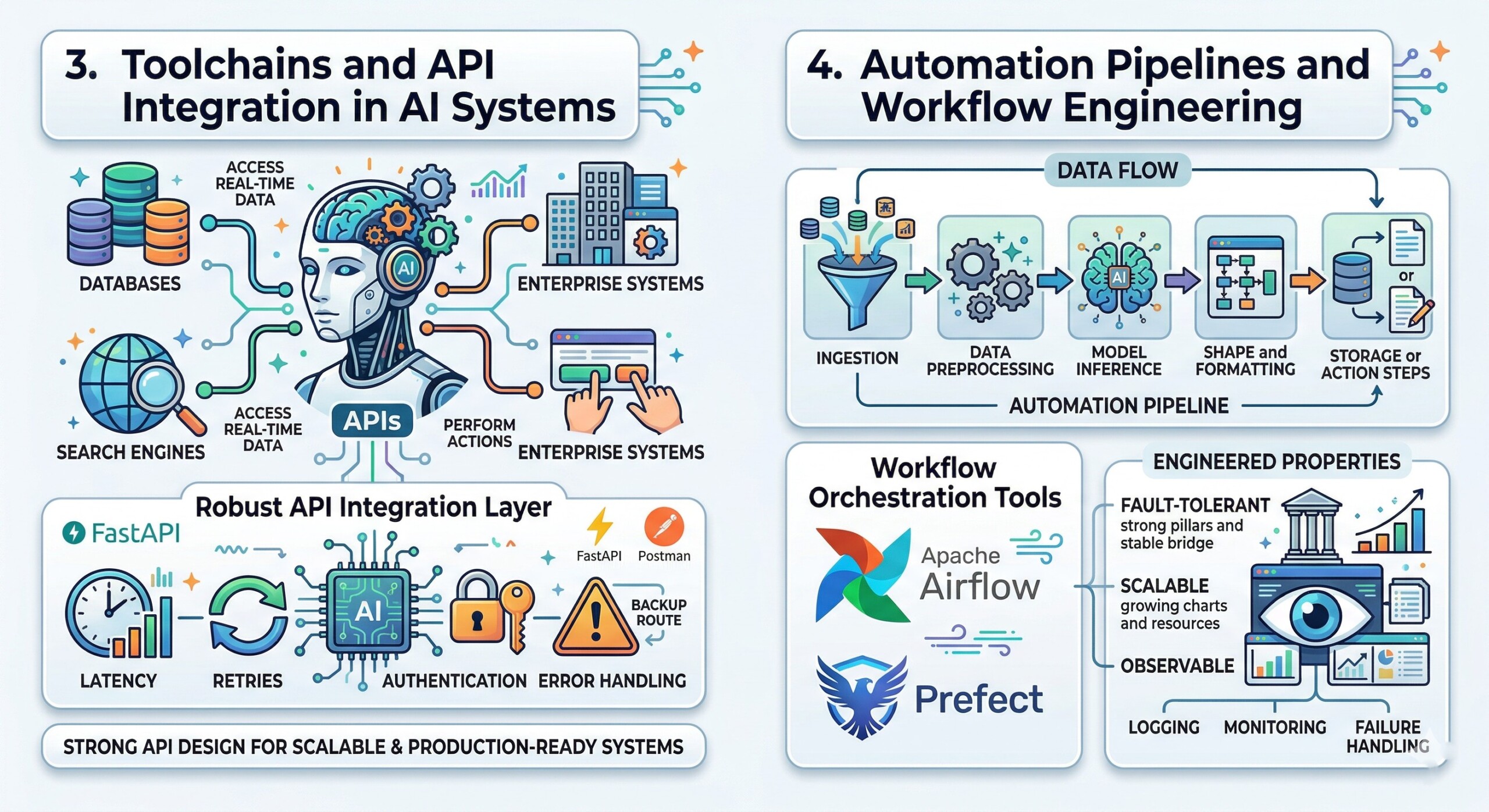
Modern AI systems rely heavily on toolchains and APIs. Models are connected to external tools such as databases, search engines, and enterprise systems through API calls. This enables AI systems to access real-time data and perform actions beyond text generation.
Developers must design robust API integration layers that handle latency, retries, authentication, and error handling. Tools such as FastAPI and Postman are commonly used in building and testing these integrations. Strong API design is essential for scalable and production-ready AI systems.
4. Automation Pipelines and Workflow Engineering
Automation pipelines define how data flows through an AI system from ingestion to output. These pipelines often include data preprocessing, model inference, post-processing, and storage or action steps.
Workflow orchestration tools such as Apache Airflow and Prefect are widely used to manage these pipelines. Engineers must ensure that pipelines are fault-tolerant, scalable, and observable. This includes logging, monitoring, and handling failures gracefully. Excellent individualised mentoring programmes available.
5. Designing End-to-End AI ecosystems
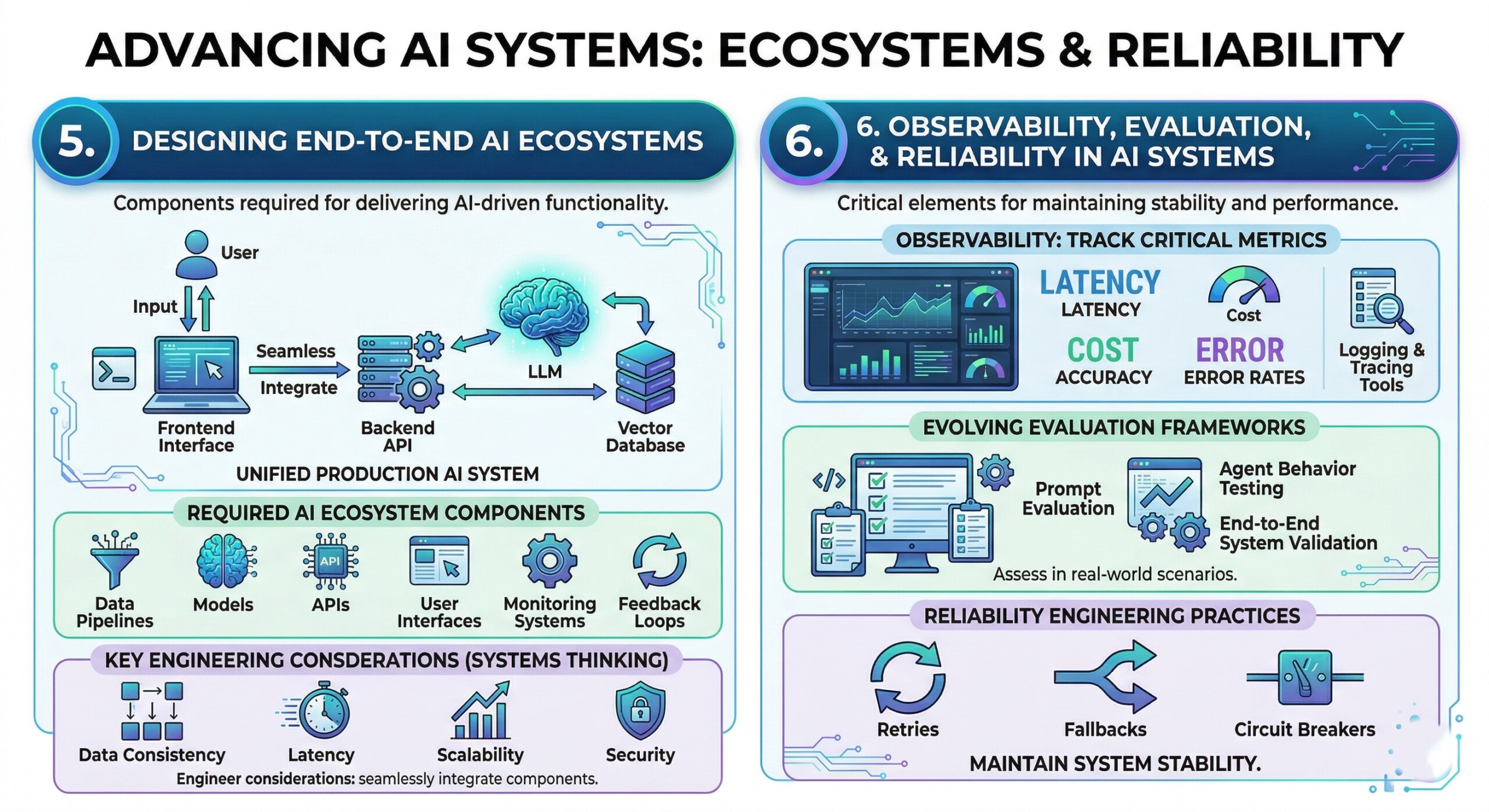
An AI ecosystem includes all components required for delivering AI-driven functionality. This includes data pipelines, models, APIs, user interfaces, monitoring systems, and feedback loops.
Designing such ecosystems requires a systems thinking approach. Engineers must consider data consistency, latency, scalability, and security. Integration between components must be seamless. For example, a production AI system may combine a vector database, an LLM, a backend API, and a frontend interface into a unified system.
6. Observability, evaluation, and reliability in AI systems
As AI systems become more complex, observability becomes critical. Engineers must track metrics such as latency, accuracy, cost, and error rates. Logging and tracing tools help identify issues in multi-agent workflows.
Evaluation frameworks are also evolving to assess AI system performance in real-world scenarios. This includes prompt evaluation, agent behavior testing, and end-to-end system validation. Reliability engineering practices such as retries, fallbacks, and circuit breakers are essential to maintain system stability. Subscribe to our free AI newsletter now.
7. Career opportunities and skill requirements
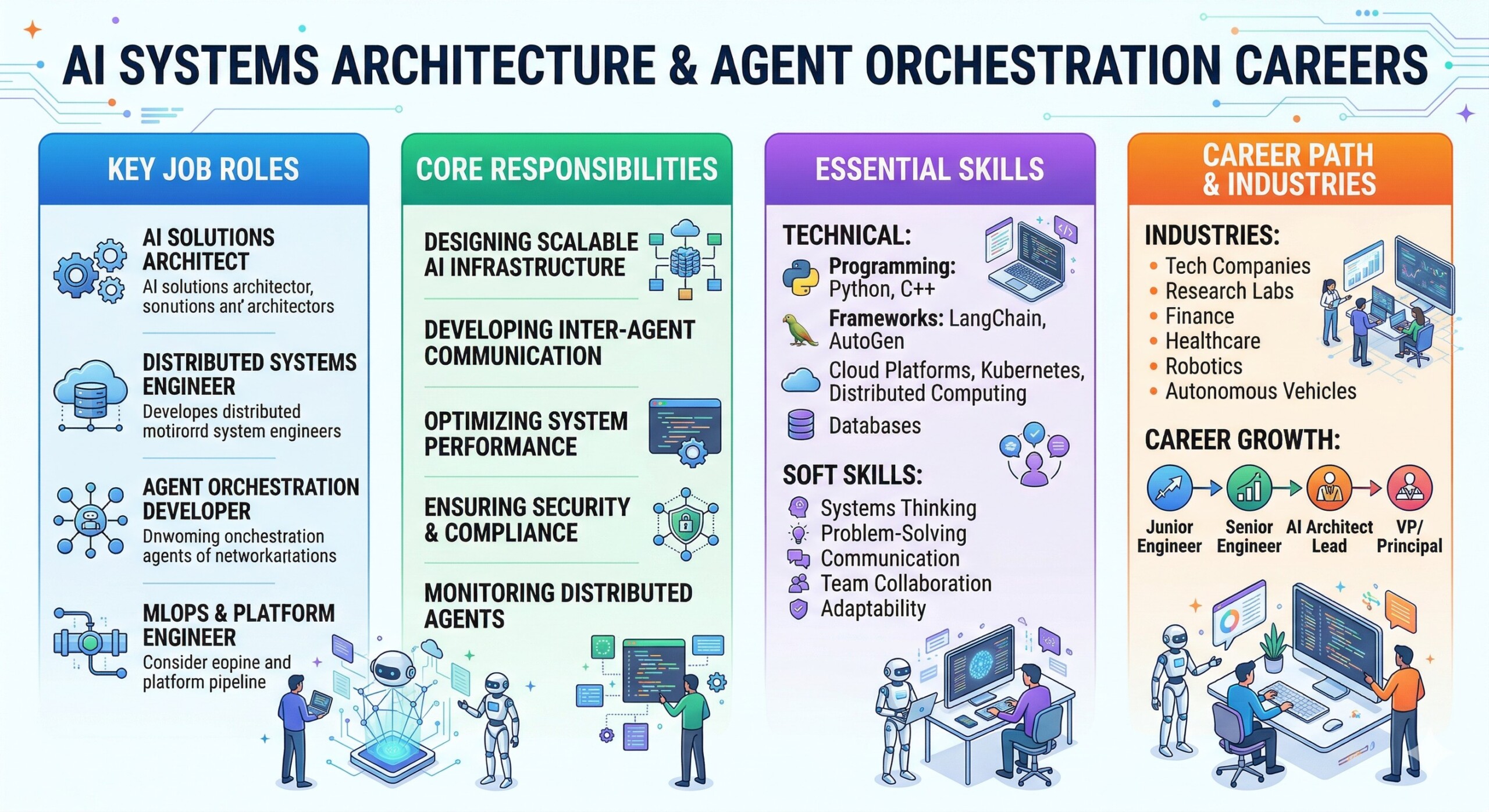
Careers in AI systems architecture and agent orchestration are rapidly expanding. Roles include AI systems engineer, LLM engineer, AI platform architect, and automation engineer.
Key skills include:
- Strong programming skills in Python and distributed systems
- Understanding of machine learning and LLM capabilities
- Experience with APIs, cloud platforms, and microservices
- Knowledge of orchestration frameworks and workflow tools
Professionals in this space are expected to bridge the gap between research and production, turning AI models into scalable and reliable systems.
Conclusion
AI is entering a new phase where success depends not only on model performance but also on system design and orchestration. Multi-agent systems, automation pipelines, and integrated toolchains are redefining how AI solutions are built and deployed.
Careers in AI systems architecture and agent orchestration are at the forefront of this transformation. They require a multidisciplinary approach that combines engineering rigor with an understanding of AI capabilities. As organizations continue to adopt AI at scale, the demand for professionals who can design and manage end-to-end AI ecosystems will continue to grow.
Mastering these skills is essential for anyone looking to build impactful AI solutions in the current and future landscape. Upgrade your AI-readiness with our masterclass.