Building a Sustainable AI Career
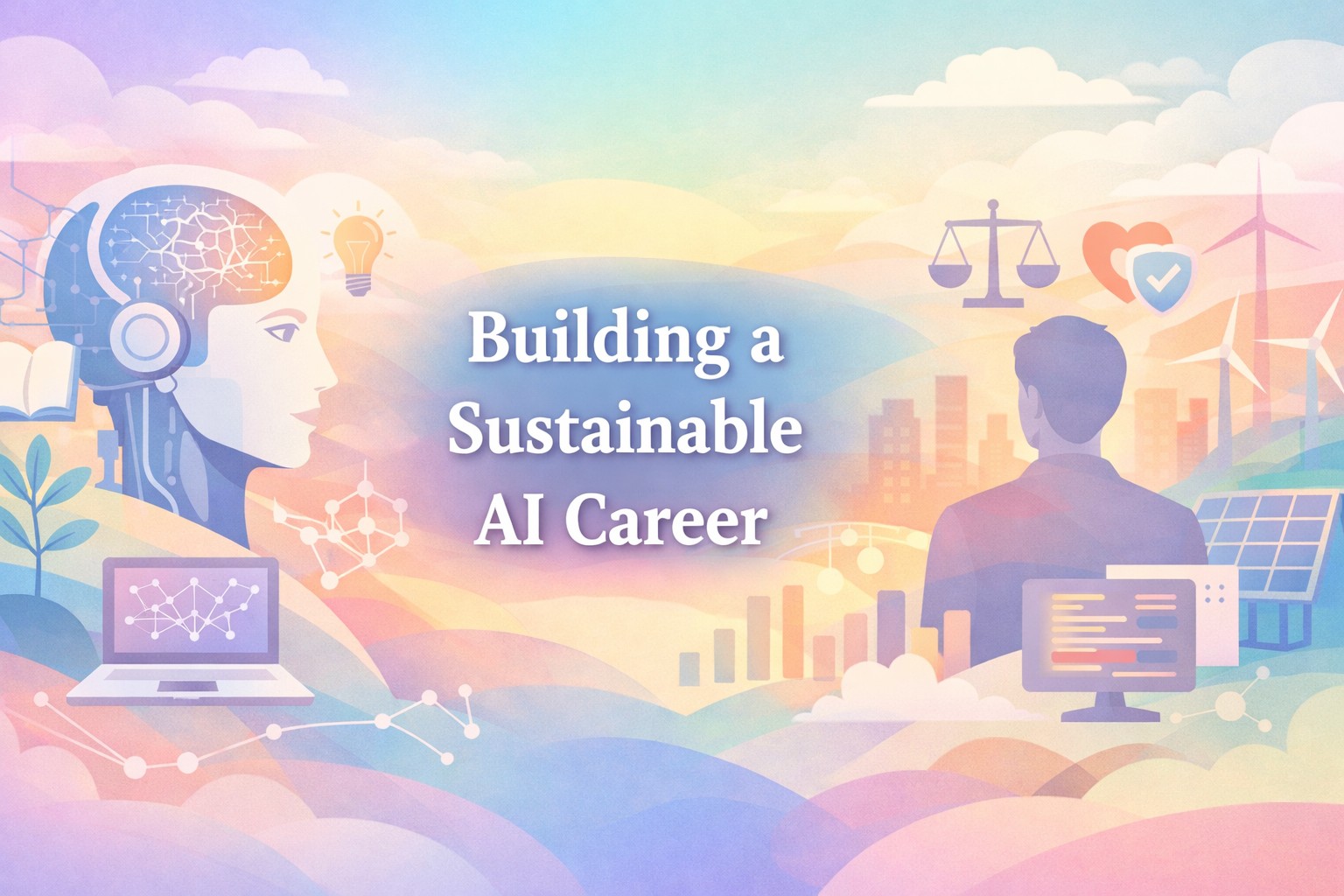
Building a Sustainable AI Career
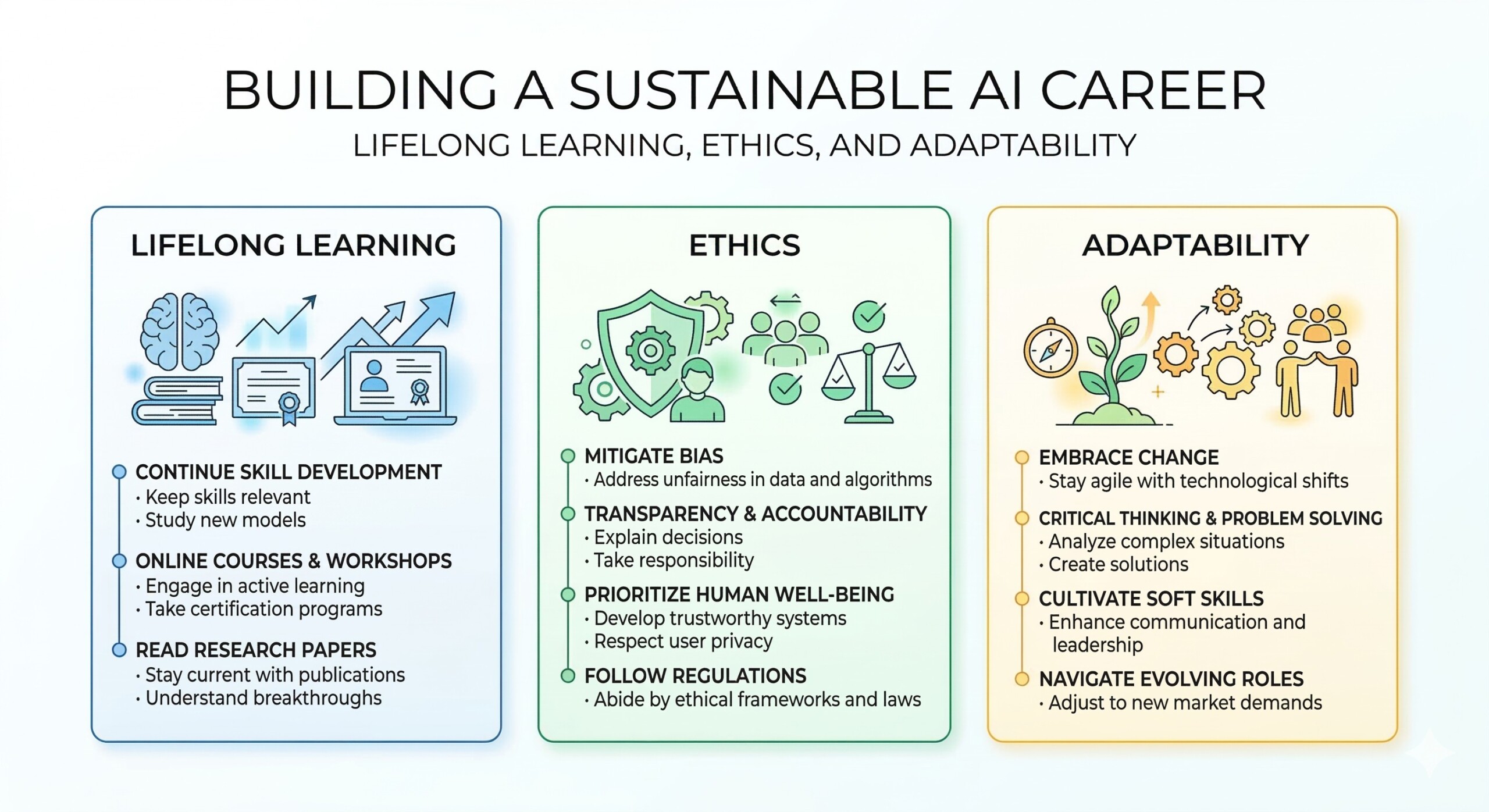
Lifelong learning, ethics, and adaptability
Introduction
Artificial Intelligence is no longer a niche field reserved for researchers or large technology firms – it has become a foundational layer across industries. From healthcare diagnostics and financial modeling to education and governance, AI is reshaping how decisions are made and how value is created. The rise of generative AI and automation has further accelerated this transformation, making AI careers both highly attractive and highly dynamic.
However, this rapid evolution comes with a challenge: volatility. Skills that are in demand today can become outdated within a short span of time. Building a sustainable AI career, therefore, is not about mastering a single tool or framework, but about developing a mindset rooted in continuous learning, ethical responsibility, and adaptability. Those who succeed in AI are not just technically skilled—they are intellectually agile and future-ready.
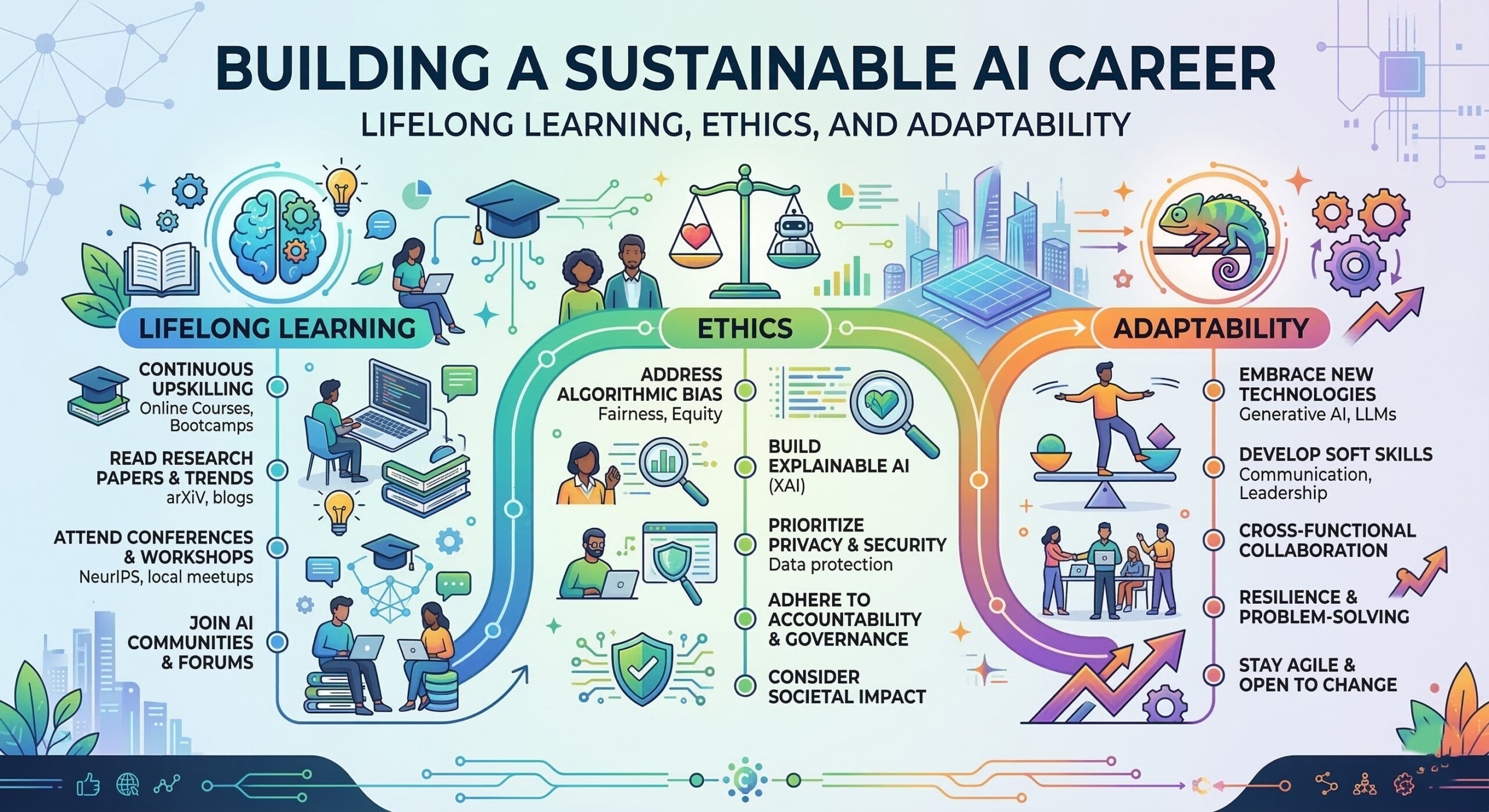
1. Commit to lifelong learning
AI is evolving at an unprecedented pace, with new models, frameworks, and paradigms emerging continuously. The shift from traditional machine learning to deep learning, and now to generative and multimodal AI systems, highlights how quickly the landscape changes. In such an environment, learning cannot be occasional – it must be continuous.
Professionals must actively engage with new developments through research papers, industry reports, courses, and hands-on experimentation. However, sustainable learning is not about chasing every new trend. It is about identifying meaningful shifts and understanding them deeply. For example, understanding how large language models work is more valuable than simply using them.
Over time, this approach builds intellectual resilience. You become capable of learning new technologies faster because you understand the underlying patterns. Lifelong learning, therefore, is not just about staying updated – it is about staying relevant.
2. Build strong fundamentals first
In a rapidly changing field, fundamentals act as anchors. Core concepts such as probability, statistics, linear algebra, and algorithms provide the foundation upon which all AI systems are built. While tools and libraries may change, these principles remain consistent.
A strong foundation allows you to move beyond surface-level implementation. Instead of simply applying models, you begin to understand their behavior, limitations, and potential improvements. This depth of understanding is what differentiates long-term professionals from short-term practitioners.
Moreover, fundamentals enable flexibility. Whether the industry shifts toward new architectures or entirely new paradigms, foundational knowledge allows you to adapt without starting from scratch. Investing in fundamentals early is one of the most powerful decisions for long-term career sustainability. An excellent collection of learning videos awaits you on our Youtube channel.
3. Develop cross-disciplinary skills
AI delivers value only when applied to real-world problems. This makes cross-disciplinary understanding essential. Professionals who combine AI expertise with domain knowledge – such as healthcare, finance, education, or policy – are far more effective than those who operate purely at a technical level.
In addition, communication plays a critical role. AI professionals must often explain complex concepts to non-technical stakeholders, translate business problems into technical solutions, and align outcomes with organizational goals. These abilities significantly enhance professional impact.
As AI becomes more integrated into decision-making processes, the ability to connect technology with human and business contexts will define success. The future belongs to professionals who can bridge these worlds effectively.
4. Prioritize ethical responsibility
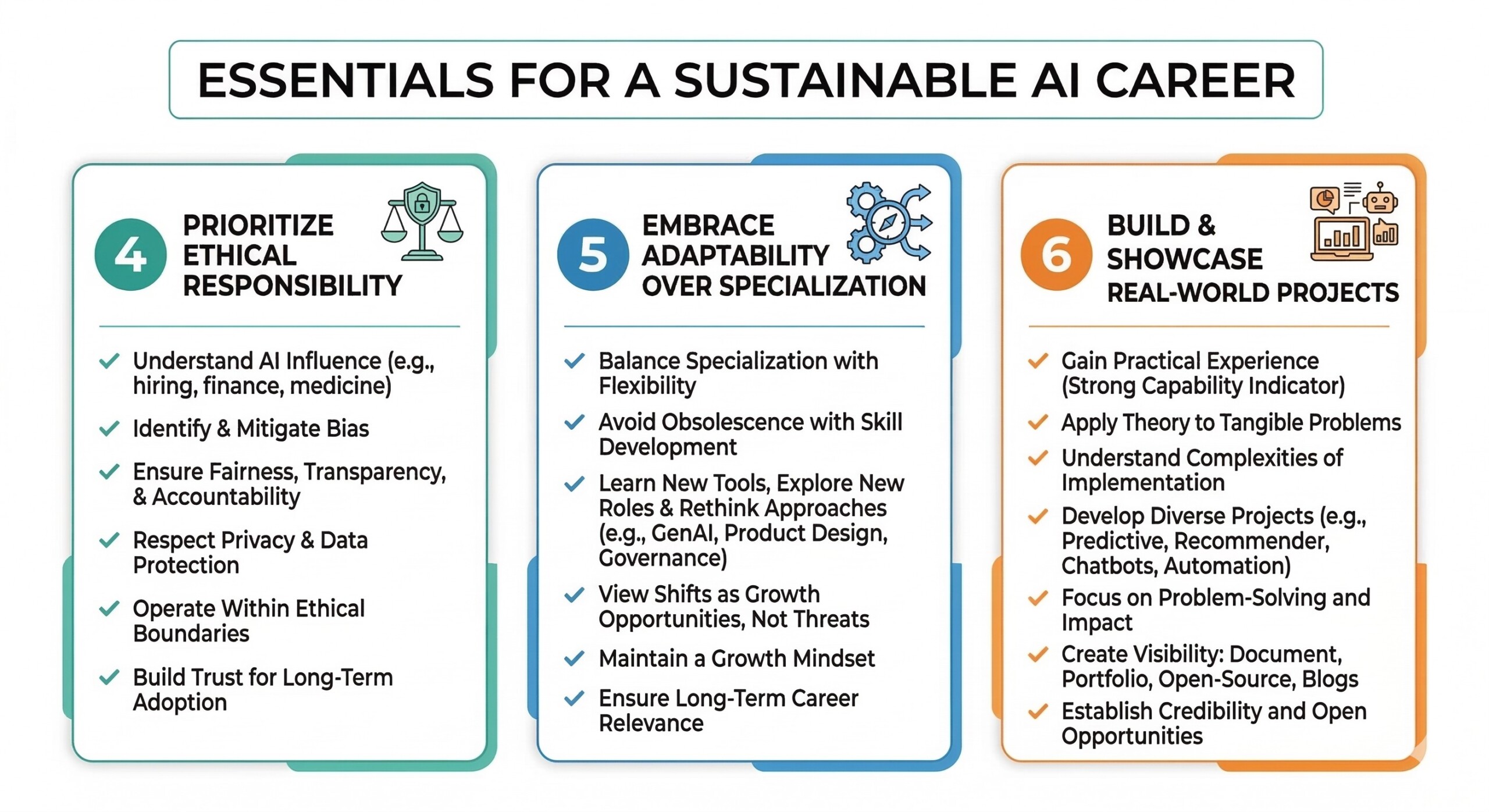
AI systems increasingly influence decisions that affect people’s lives. From hiring algorithms to credit scoring and medical recommendations, the consequences of AI are real and significant. This makes ethical responsibility a central pillar of any sustainable AI career.
Professionals must understand and address issues such as bias, fairness, transparency, and accountability. Biased data can lead to unfair outcomes, while opaque models can reduce trust. Responsible AI development requires conscious effort to identify and mitigate these risks.
Privacy and data protection are equally critical. With growing global awareness and regulation around data usage, professionals must ensure that systems respect user rights and operate within ethical boundaries.
In the long term, trust will be a defining factor in AI adoption. Those who build and advocate for ethical AI will not only contribute positively to society but also position themselves as leaders in the field. A constantly updated Whatsapp channel awaits your participation.
5. Embrace adaptability over specialization alone
Specialization is valuable, but in AI, it must be balanced with adaptability. The field has already undergone multiple transformations, and this trend is likely to continue. Professionals who rigidly stick to one niche risk becoming obsolete as technologies evolve.
Adaptability involves both skill and mindset. It means being willing to learn new tools, explore new roles, and rethink existing approaches. For instance, many professionals are now transitioning from traditional model-building roles to working with generative AI systems, AI product design, or AI governance.
Rather than resisting change, successful individuals anticipate and embrace it. They view shifts in the industry as opportunities for growth rather than threats. This ability to evolve is what ensures long-term relevance.
6. Build and showcase real-world projects
Practical experience is one of the strongest indicators of capability in AI. Real-world projects allow professionals to apply theoretical knowledge, solve tangible problems, and understand the complexities of implementation.
Projects can range from building predictive models and recommendation systems to developing AI-powered applications such as chatbots or automation tools. What matters is not just the technical execution, but also the problem being solved and the impact created.
Equally important is visibility. Documenting projects, maintaining a portfolio, contributing to open-source platforms, and sharing insights through blogs or presentations help establish credibility. In an increasingly competitive field, demonstrated ability often speaks louder than qualifications.
Over time, a strong portfolio becomes a powerful asset, opening doors to opportunities and collaborations. Excellent individualised mentoring programmes available.
7. Cultivate a growth mindset and community engagement
A sustainable AI career is not built in isolation. Engaging with the broader AI community provides exposure to new ideas, feedback, and opportunities. Conferences, forums, online communities, and collaborative projects all contribute to professional growth.
At the same time, a growth mindset is essential. The AI journey is filled with challenges, rapid changes, and occasional setbacks. Viewing these as opportunities to learn rather than obstacles fosters resilience and continuous improvement.
Sharing knowledge – whether through writing, teaching, or mentoring – further strengthens understanding and builds professional presence. Over time, community engagement not only enhances learning but also creates a network of support and collaboration. Subscribe to our free AI newsletter now.
Conclusion
Building a sustainable AI career is not about reaching a fixed milestone—it is about continuously evolving with the field. The rapid pace of innovation demands curiosity, discipline, and a willingness to adapt. Those who invest in learning, strengthen their foundations, and remain ethically grounded will be best positioned to navigate this dynamic landscape.
Ultimately, the most successful AI professionals will be those who combine technical expertise with human values. By aligning innovation with responsibility and adaptability with purpose, individuals can build careers that are not only successful but also meaningful and enduring. Upgrade your AI-readiness with our masterclass.