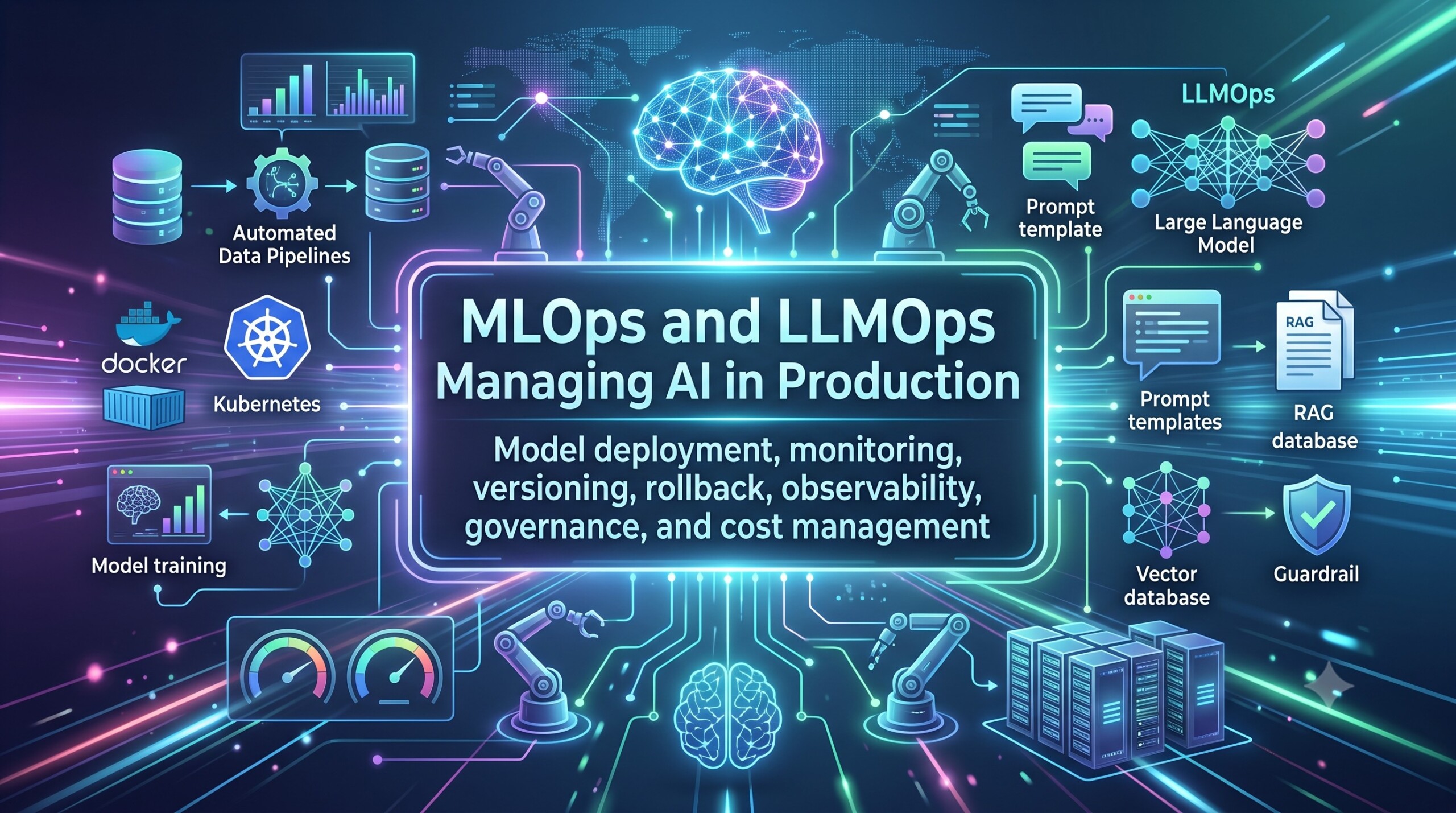
MLOps and LLMOps Managing AI in Production
MLOps and LLMOps Managing AI in Production
Model deployment, monitoring, versioning, rollback, observability, governance, and cost management
Introduction
Building an AI model is only the beginning. The real challenge starts when the model is used by real people, real systems, real data, and real business processes. A model that works well in a notebook may fail in production because the input data changes, latency is too high, costs become unpredictable, users ask unexpected questions, or the system produces unsafe output.
This is where MLOps and LLMOps become important.
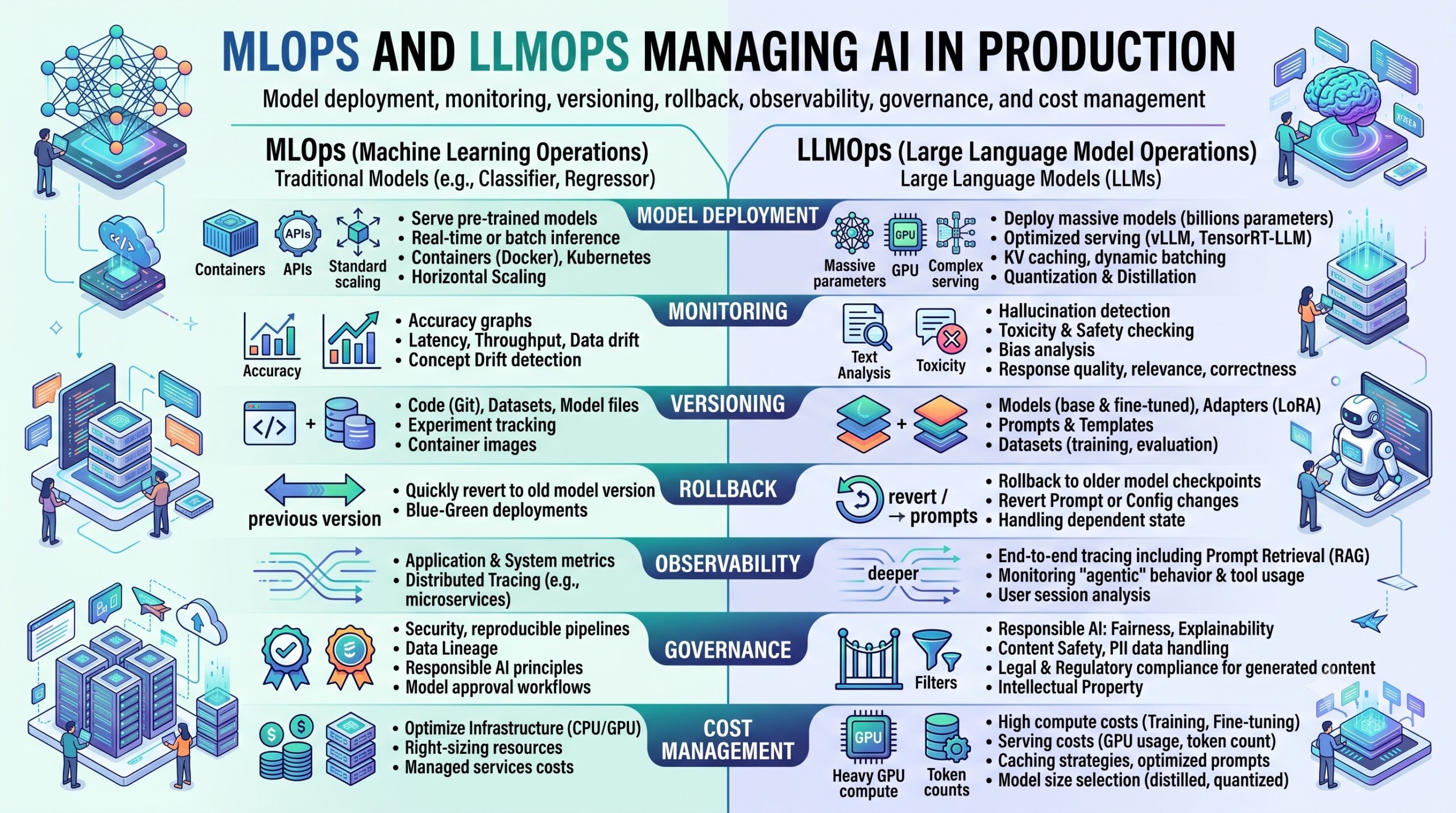
MLOps, or Machine Learning Operations, is the discipline of taking machine learning models from experimentation to reliable production use. It combines machine learning, software engineering, DevOps, data engineering, monitoring, governance, and automation.
LLMOps, or Large Language Model Operations, extends MLOps for generative AI systems. It includes all the usual MLOps concerns, but adds new challenges: prompt management, retrieval-augmented generation, vector databases, hallucination checks, token costs, model routing, guardrails, human feedback, agent traces, and governance of generated content.
As of July 2026, production AI is no longer only about “deploying a model.” It is about managing a complete AI system: model, data, prompt, context, APIs, infrastructure, evaluation, security, compliance, and cost.
Let’s dive deep into the topic now.
1. Production AI is a system, not just a model
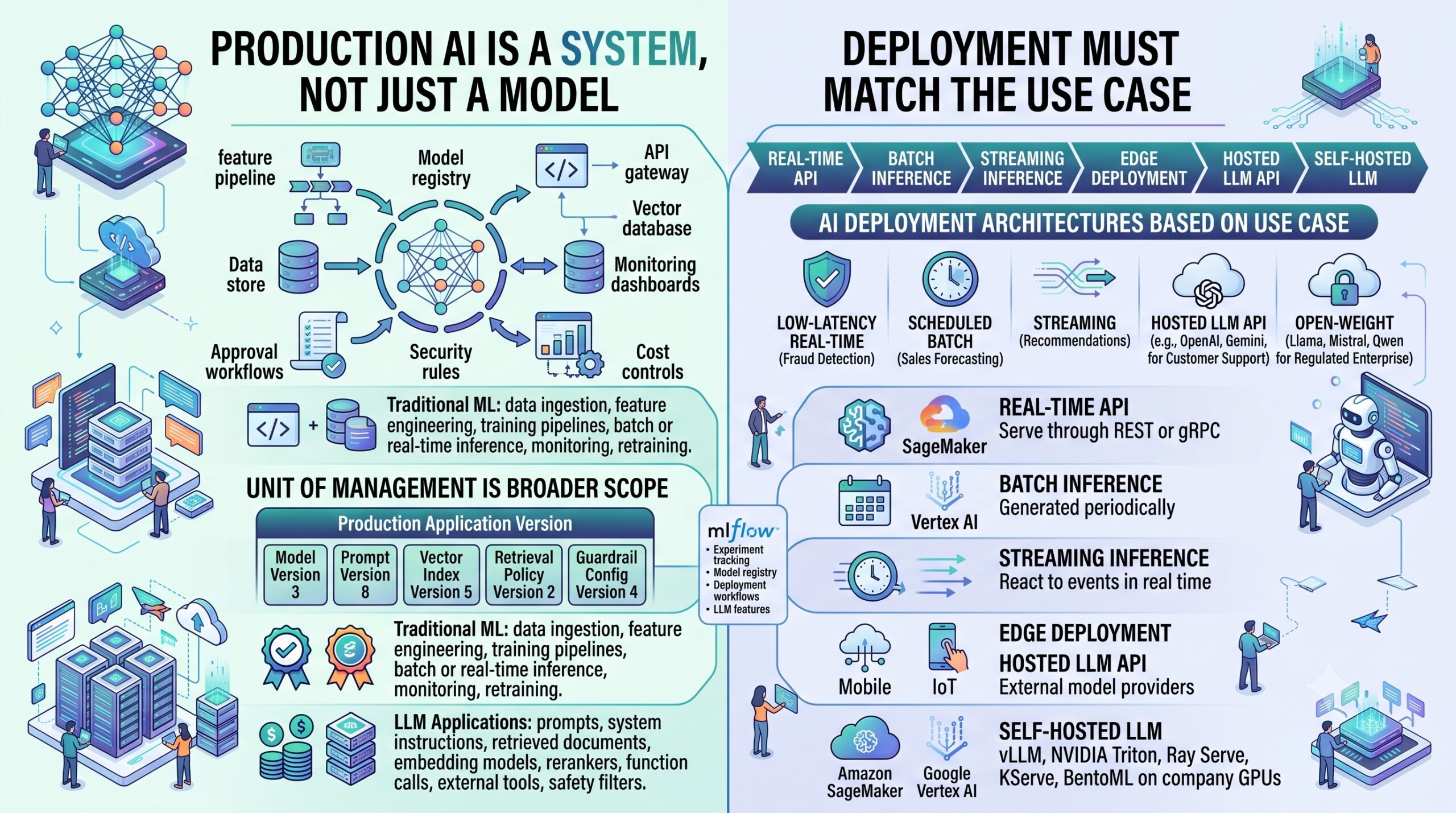
A common mistake is to think that deploying AI means uploading a trained model to a server. In reality, a production AI application has many moving parts. There may be a model, a feature pipeline, a data store, a model registry, an API gateway, a vector database, monitoring dashboards, feedback loops, approval workflows, security rules, and cost controls.
For traditional ML, the system may include data ingestion, feature engineering, training pipelines, batch or real-time inference, model monitoring, and retraining. For LLM applications, the system may also include prompts, system instructions, retrieved documents, embedding models, rerankers, function calls, external tools, and safety filters.
This means the unit of management is not simply “model version 3.” It may be “model version 3, prompt version 8, vector index version 5, retrieval policy version 2, and guardrail configuration version 4.” If any one of these changes, the output can change.
Modern platforms reflect this broader scope. MLflow, for example, supports experiment tracking, model evaluation, model registry, deployment workflows, LLM evaluation, prompt management, tracing, and cost/access management features for AI applications.
2. Deployment must match the use case
AI deployment is not one fixed pattern. The right deployment architecture depends on the use case.
A fraud detection model may need low-latency real-time inference. A sales forecasting model may run as a scheduled batch job. A recommendation system may need streaming features and near-real-time updates. A customer-support LLM may call a hosted API such as OpenAI, Anthropic, Gemini, or Amazon Bedrock. A regulated enterprise may deploy open-weight models such as Llama, Mistral, or Qwen inside its own cloud or private data center.
Common deployment patterns include:
- Real-time API deployment, where the model serves predictions through REST or gRPC endpoints.
- Batch inference, where predictions are generated periodically for large datasets.
- Streaming inference, where the system reacts to events in real time.
- Edge deployment, where models run on mobile devices, IoT devices, or local machines.
- Hosted LLM API deployment, where the application calls external model providers.
- Self-hosted LLM deployment, where the company runs models on GPUs using tools such as vLLM, NVIDIA Triton, Ray Serve, KServe, Seldon, or BentoML.
Cloud providers have mature deployment options. Amazon SageMaker supports multiple model deployment options for inference, while Google Vertex AI provides MLOps tooling for model collaboration, monitoring, alerting, and diagnosis. An excellent collection of learning videos awaits you on our Youtube channel.
3. CI/CD becomes CI/CD/CT for AI
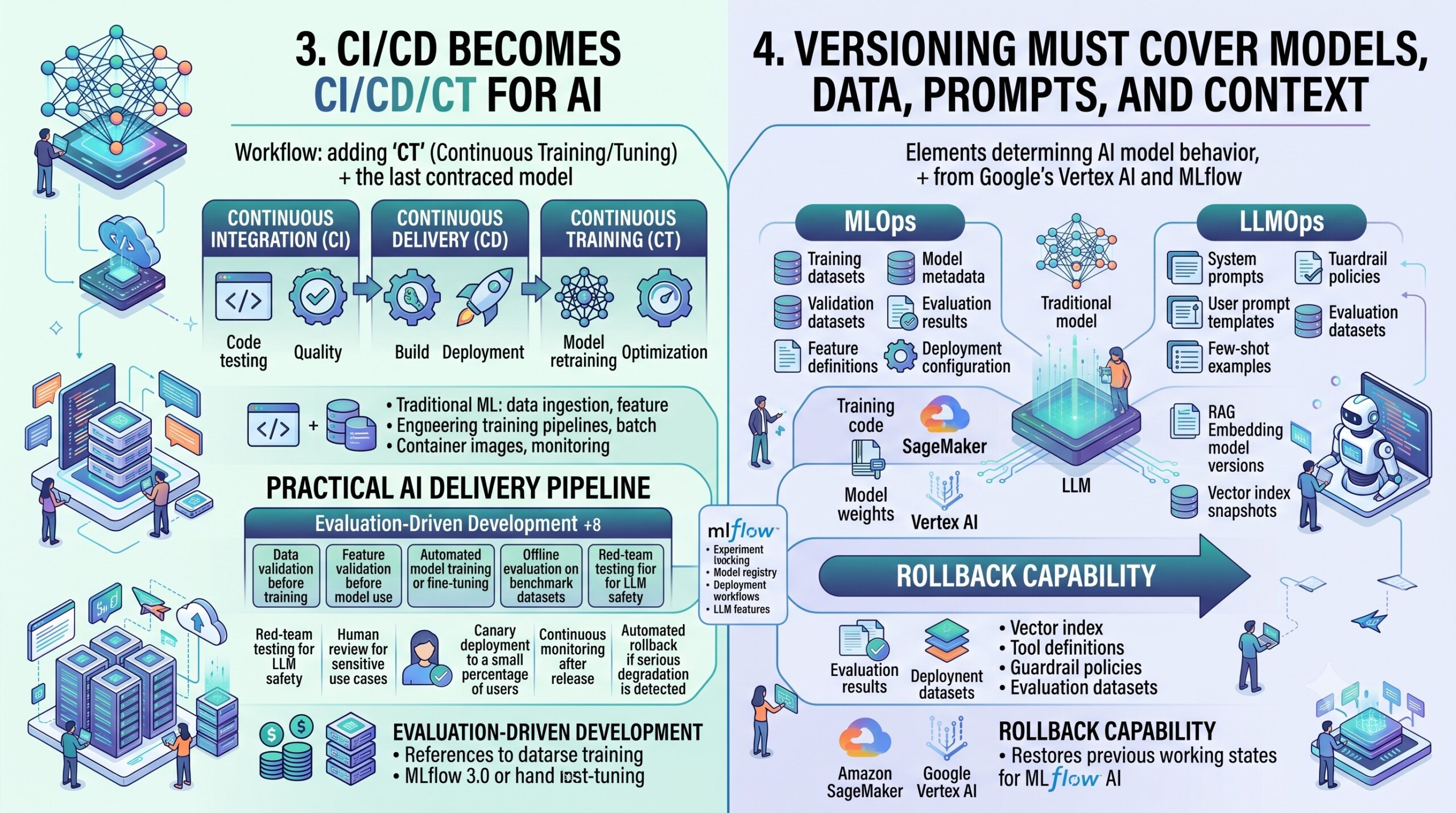
In software engineering, CI/CD means continuous integration and continuous delivery. Code is tested, built, and deployed through automated pipelines. In AI, this is not enough. We also need CT: continuous training or continuous tuning.
A production AI pipeline must check code quality, data quality, model quality, security, fairness, latency, cost, and business performance. For LLM systems, the pipeline should also test prompts, retrieval quality, hallucination risk, jailbreak resistance, tool-calling behaviour, and answer quality.
A practical AI delivery pipeline may include:
- Data validation before training.
- Feature validation before model use.
- Automated model training or fine-tuning.
- Offline evaluation on benchmark datasets.
- Red-team testing for LLM safety.
- Human review for sensitive use cases.
- Canary deployment to a small percentage of users.
- Continuous monitoring after release.
- Automated rollback if serious degradation is detected.
This is why AI teams increasingly use evaluation-driven development. In LLMOps, every change to a prompt, model, retrieval strategy, or agent tool should be evaluated before release. MLflow 3.0, for example, emphasizes evaluation datasets created from production traces and LLM judges for quality assessment.

4. Versioning must cover models, data, prompts, and context
In normal software, Git can version the code. In AI, Git alone is not enough.
A model’s behaviour depends on training data, preprocessing logic, hyperparameters, code, features, model weights, prompts, context documents, embedding models, vector indexes, and runtime configuration. If these are not versioned, debugging becomes guesswork.
For MLOps, teams should version:
- Training datasets
- Validation datasets
- Feature definitions
- Training code
- Model weights
- Model metadata
- Evaluation results
- Deployment configuration
For LLMOps, teams should additionally version:
- System prompts
- User prompt templates
- Few-shot examples
- RAG documents
- Embedding model versions
- Vector index snapshots
- Tool definitions
- Guardrail policies
- Evaluation datasets
This is especially important for rollback. If an LLM application becomes unsafe or inaccurate after a prompt change, the team must be able to restore the previous working prompt, retrieval configuration, and model routing policy. Google’s Vertex AI includes model registry capabilities for organizing, tracking, training, and deploying model versions, and MLflow provides model registry and prompt-management capabilities for both ML and LLM systems. A constantly updated Whatsapp channel awaits your participation.
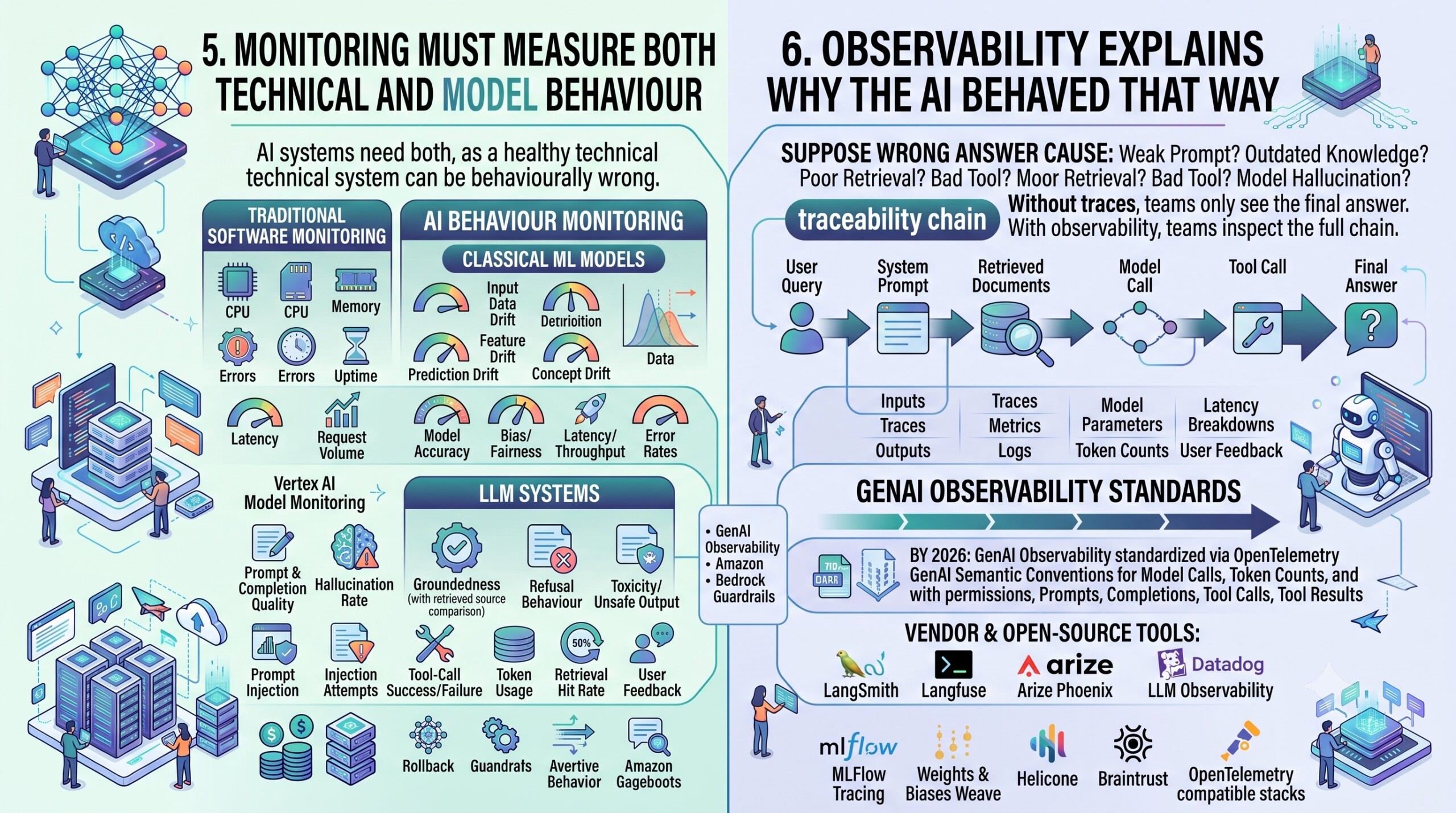
5. Monitoring must measure both technical and model behaviour
Traditional software monitoring checks CPU, memory, errors, uptime, latency, and request volume. AI monitoring must go further because the system may be technically healthy but behaviourally wrong.
For classical ML models, monitoring should track:
- Input data drift
- Feature drift
- Prediction drift
- Concept drift
- Model accuracy, where labels are available
- Bias and fairness metrics
- Latency and throughput
- Error rates and failed predictions
For LLM systems, monitoring should track:
- Prompt and completion quality
- Hallucination rate
- Groundedness in retrieved sources
- Refusal behaviour
- Toxicity or unsafe output
- Prompt injection attempts
- Tool-call success and failure
- Token usage
- Retrieval hit rate
- User feedback
This distinction is important. A server may show 99.9% uptime while the model silently becomes inaccurate because customer behaviour, market conditions, or input data patterns changed. Vertex AI Model Monitoring supports monitoring jobs for model behaviour, and Amazon Bedrock Guardrails exposes runtime metrics through CloudWatch for monitoring guardrail behaviour.
6. Observability explains why the AI behaved that way
Monitoring tells us that something is wrong. Observability helps us understand why.
In production AI, observability means collecting logs, metrics, traces, inputs, outputs, intermediate decisions, retrieval results, model parameters, token counts, latency breakdowns, and user feedback. For LLM applications, a trace may show the original user query, the system prompt, retrieved documents, model call, tool call, final answer, guardrail decision, and user rating.
This is essential for debugging. Suppose a customer-support chatbot gives a wrong answer. The cause may be a weak prompt, outdated knowledge base, poor retrieval, wrong embedding model, missing guardrail, bad tool response, or a model hallucination. Without traces, the team only sees the final answer. With observability, the team can inspect the full chain of events.
By 2026, GenAI observability was becoming more standardized. OpenTelemetry’s GenAI semantic conventions standardize how generative AI operations are recorded, including the model being called, token counts, and, where enabled, prompts, completions, tool calls, and tool results.
Vendor and open-source tools in this space include LangSmith, Langfuse, Arize Phoenix, Datadog LLM Observability, MLflow Tracing, Weights & Biases Weave, Helicone, Braintrust, and OpenTelemetry-compatible observability stacks. Excellent individualised mentoring programmes available.
7. Rollback is a first-class production requirement
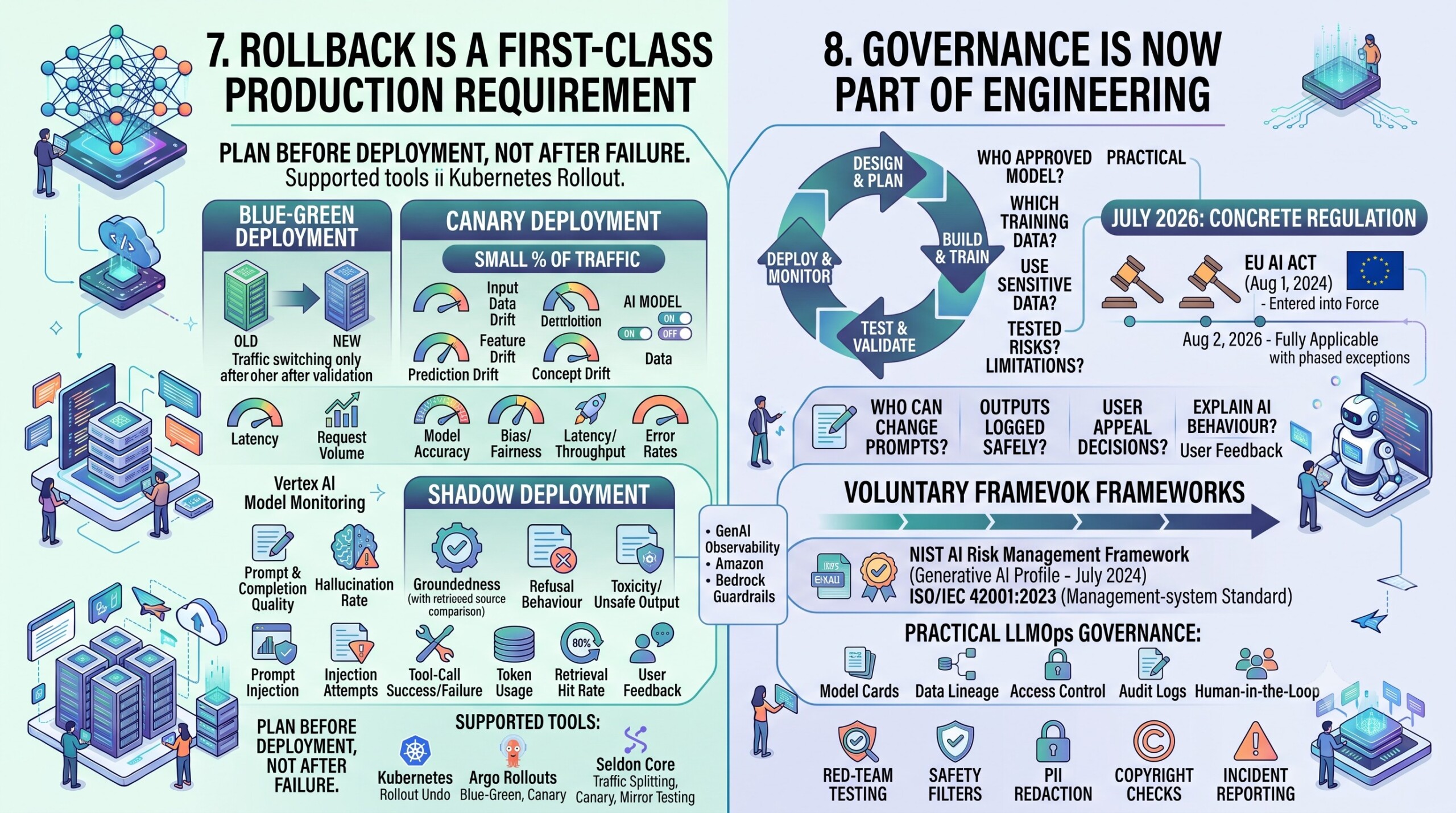
Every AI release should assume that something may go wrong. A new model may reduce accuracy for a user segment. A new prompt may increase hallucinations. A new embedding model may break retrieval. A new guardrail may block valid user requests. A new open-source model may reduce cost but increase latency.
Rollback must therefore be planned before deployment, not after failure.
Useful deployment and rollback strategies include:
- Blue-green deployment, where old and new versions run side by side and traffic is switched only after validation.
- Canary deployment, where a new version receives a small percentage of production traffic first.
- Shadow deployment, where the new model receives real traffic copies but does not affect users.
- Champion-challenger testing, where the current production model is compared with a candidate model.
- Feature flags, where AI features can be switched on or off for selected users.
- Prompt rollback, where the previous prompt template is restored quickly.
- Vector index rollback, where a previous retrieval index is restored if a knowledge update causes errors.
Kubernetes supports rollout undo for returning to a previous deployment revision, while Argo Rollouts provides advanced Kubernetes deployment patterns such as blue-green and canary releases. Seldon Core supports traffic splitting for A/B testing and canary deployment, as well as mirror testing for shadow evaluation.
8. Governance is now part of engineering
AI governance is no longer only a legal or policy discussion. It must be built into the engineering workflow.
Good governance answers practical questions:
- Who approved this model for production?
- Which data was used to train or fine-tune it?
- Does the system use personal or sensitive data?
- What risks were tested?
- What are the known limitations?
- Who can change prompts or model routing?
- Are outputs logged safely?
- Can users appeal or challenge automated decisions?
- Can we explain how the system behaved in a particular case?
As of July 2026, governance is especially important because regulation is becoming more concrete. The EU AI Act entered into force on 1 August 2024 and becomes fully applicable on 2 August 2026, with phased exceptions for different obligations.
Organizations also use voluntary and management frameworks. NIST released its Generative AI Profile for the AI Risk Management Framework in July 2024, covering risks and actions specific to generative AI. ISO/IEC 42001:2023 provides a management-system standard for establishing, maintaining, and improving organizational AI governance.
In practical LLMOps, governance includes model cards, data lineage, access control, audit logs, human-in-the-loop review, red-team testing, safety filters, PII redaction, copyright checks, and incident reporting. Subscribe to our free AI newsletter now.
9. Cost management must be designed, not added later
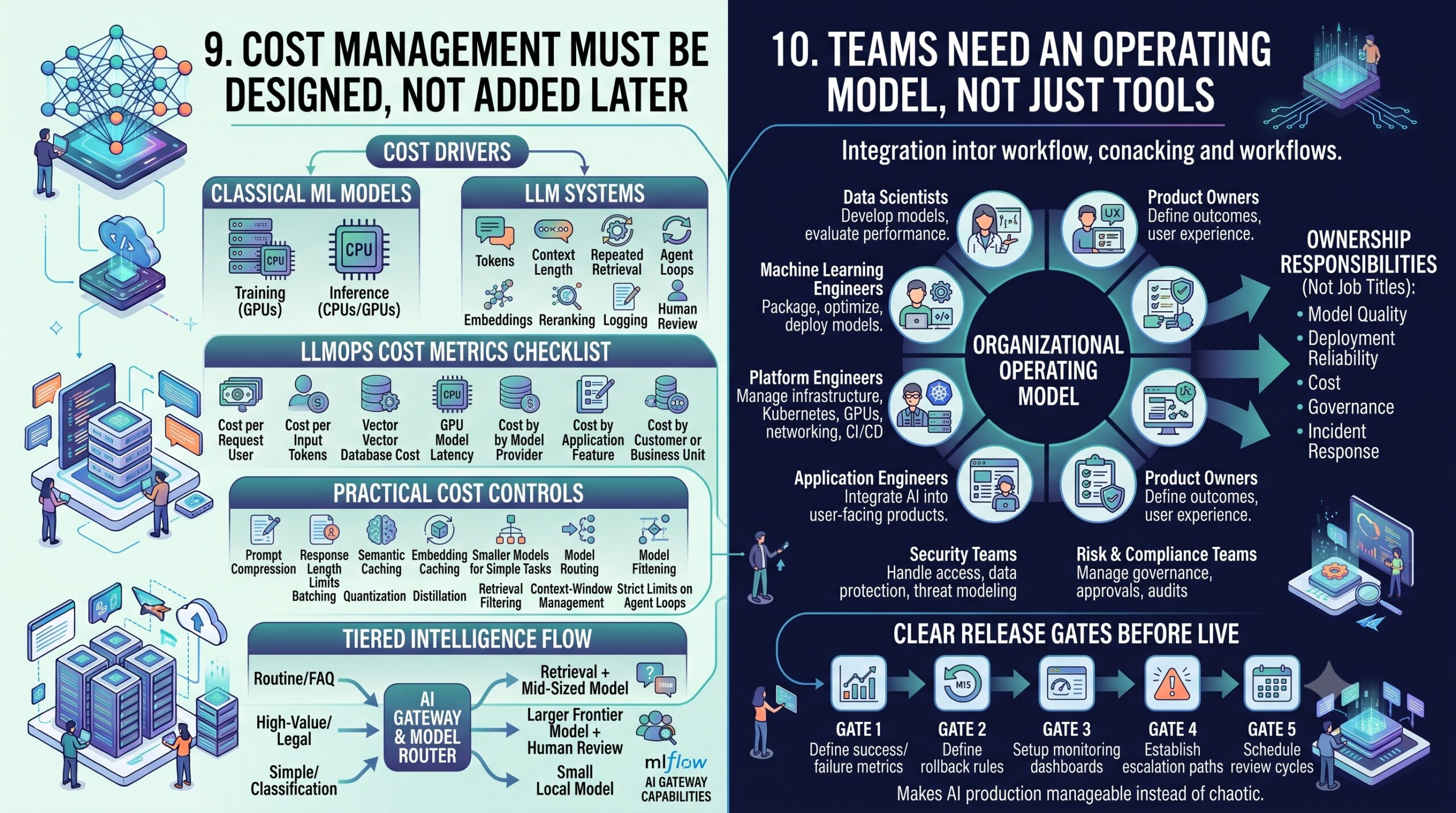
AI production can become expensive very quickly. Classical ML systems may require GPUs for training and CPUs or GPUs for inference. LLM systems can generate high costs through tokens, context length, repeated retrieval, agent loops, tool calls, embeddings, reranking, logging, and human review.
LLMOps cost management should track:
- Cost per request
- Cost per user
- Input tokens
- Output tokens
- Embedding cost
- Vector database cost
- GPU utilization
- Cache hit rate
- Model latency
- Cost by model provider
- Cost by application feature
- Cost by customer or business unit
Practical cost controls include prompt compression, response length limits, semantic caching, embedding caching, smaller models for simple tasks, model routing, batching, quantization, distillation, retrieval filtering, context-window management, and strict limits on agent loops.
A useful pattern is tiered intelligence. Not every query needs the largest model. A simple classification task may use a small local model. A routine FAQ may use retrieval plus a mid-sized model. A high-value legal or strategic task may use a larger frontier model with human review.
This is why AI gateways and model routers are becoming important. They help organizations control access to models, enforce policies, route requests, monitor usage, and manage costs. MLflow, for example, describes AI Gateway capabilities for managing model access and cost in LLM applications.
10. Teams need an operating model, not just tools
Tools are necessary, but they do not solve production AI by themselves. An organization needs a clear operating model.
A mature AI production team usually includes:
- Data scientists who develop models and evaluate performance.
- Machine learning engineers who package, optimize, and deploy models.
- Data engineers who manage pipelines and data quality.
- Platform engineers who manage infrastructure, Kubernetes, GPUs, networking, and CI/CD.
- Application engineers who integrate AI into user-facing products.
- Security teams who handle access, data protection, and threat modeling.
- Risk and compliance teams who manage governance, approvals, and audits.
- Product owners who define business outcomes and user experience.
For smaller organizations, one person may cover multiple roles. The important thing is not the job title, but the responsibility. Someone must own model quality. Someone must own deployment reliability. Someone must own cost. Someone must own governance. Someone must own incident response.
The most practical production AI teams work with clear release gates. Before an AI system goes live, they define success metrics, failure metrics, rollback rules, monitoring dashboards, escalation paths, and review cycles. This makes AI production manageable instead of chaotic.
Conclusion
MLOps and LLMOps are the disciplines that make AI reliable in the real world. They turn experimental models into governed, monitored, cost-controlled, and continuously improved production systems.
For traditional machine learning, MLOps focuses on data pipelines, model training, deployment, monitoring, retraining, versioning, and rollback. For generative AI, LLMOps adds prompts, RAG pipelines, embeddings, vector databases, guardrails, hallucination checks, token economics, agent observability, and human feedback.
The key lesson is simple: production AI is not a one-time deployment. It is a lifecycle.
A responsible AI system must be deployed carefully, monitored continuously, observed deeply, versioned completely, rolled back quickly, governed transparently, and optimized economically. Organizations that understand this will move beyond AI demos and build AI systems that are useful, safe, scalable, and sustainable. Upgrade your AI-readiness with our masterclass.