AI exponential has arrived
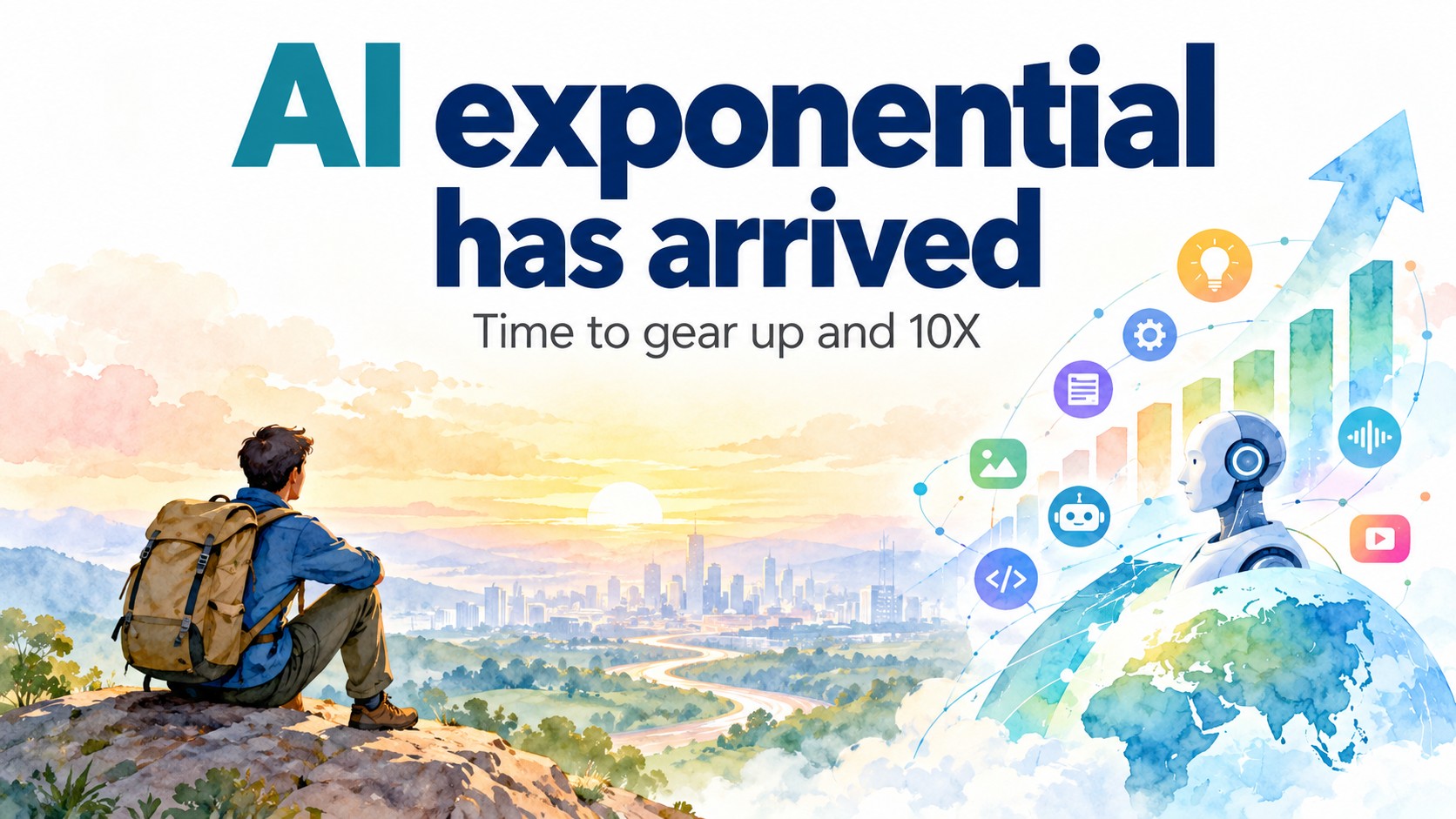
AI exponential has arrived
Time to gear up and 10X
Introduction
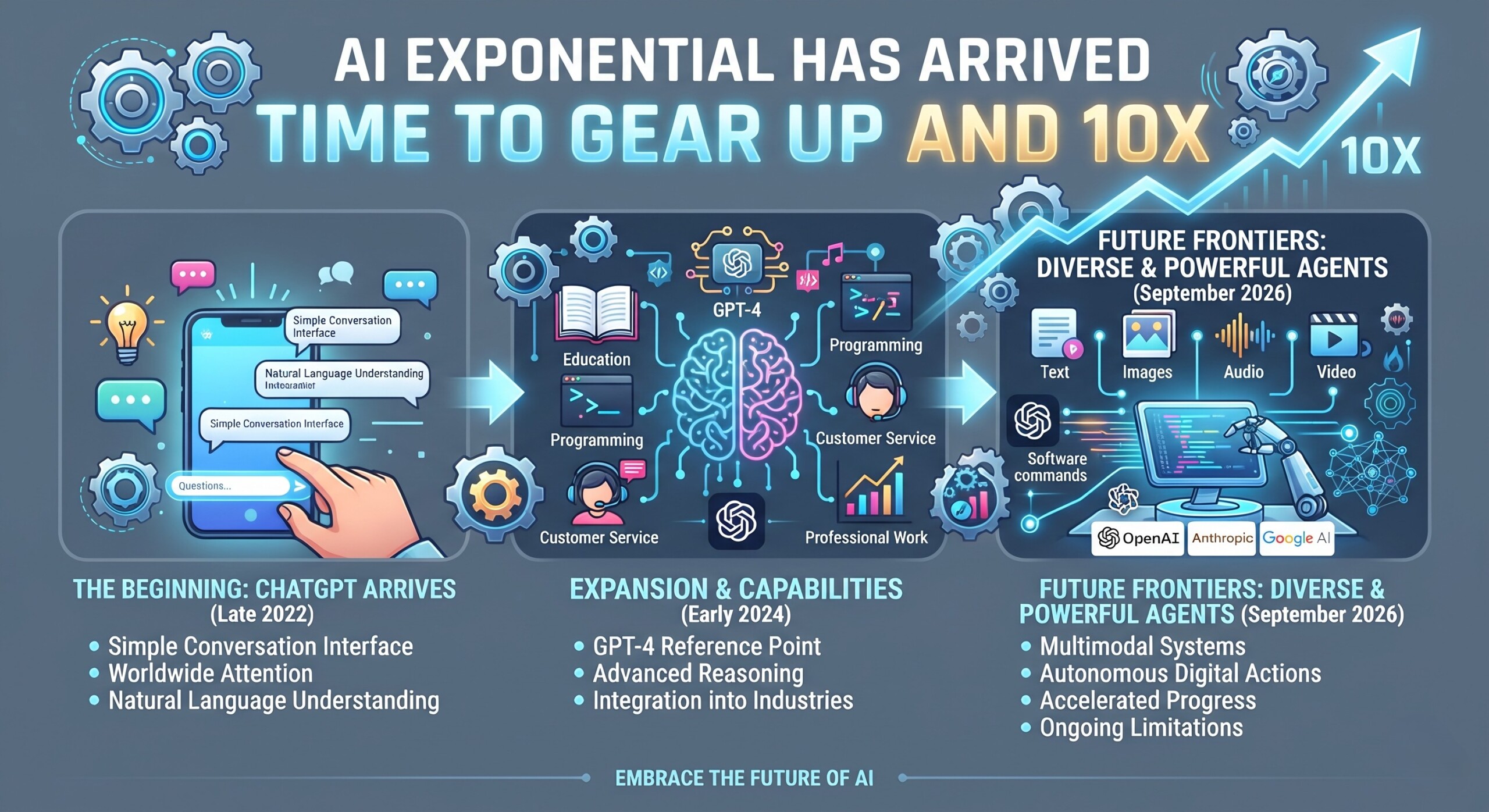
When ChatGPT attracted worldwide attention in late 2022, millions of people experienced artificial intelligence through a simple conversation window. They typed questions, requested explanations and discovered that a computer could produce surprisingly natural responses. By early 2024, GPT-4 had become an important reference point for advanced AI capabilities, and many organisations were beginning to imagine how language models might change education, programming, customer service and professional work. Yet those early experiences represented only the beginning of a much larger technological transformation.
By September 2026, AI had become considerably more capable and diverse. Systems could work with text, images, audio and video, write and execute software, investigate complex problems and use digital tools to complete sequences of actions. Advanced models from OpenAI, Anthropic and Google were competing across reasoning, coding and professional applications, while smaller models were making useful capabilities more affordable. The pace of progress has created enormous excitement, although important limitations remain. Understanding the changes requires looking beyond spectacular demonstrations and examining how the technology actually performs.
Let’s dive deep into it now.
1. What does exponential progress in AI really mean
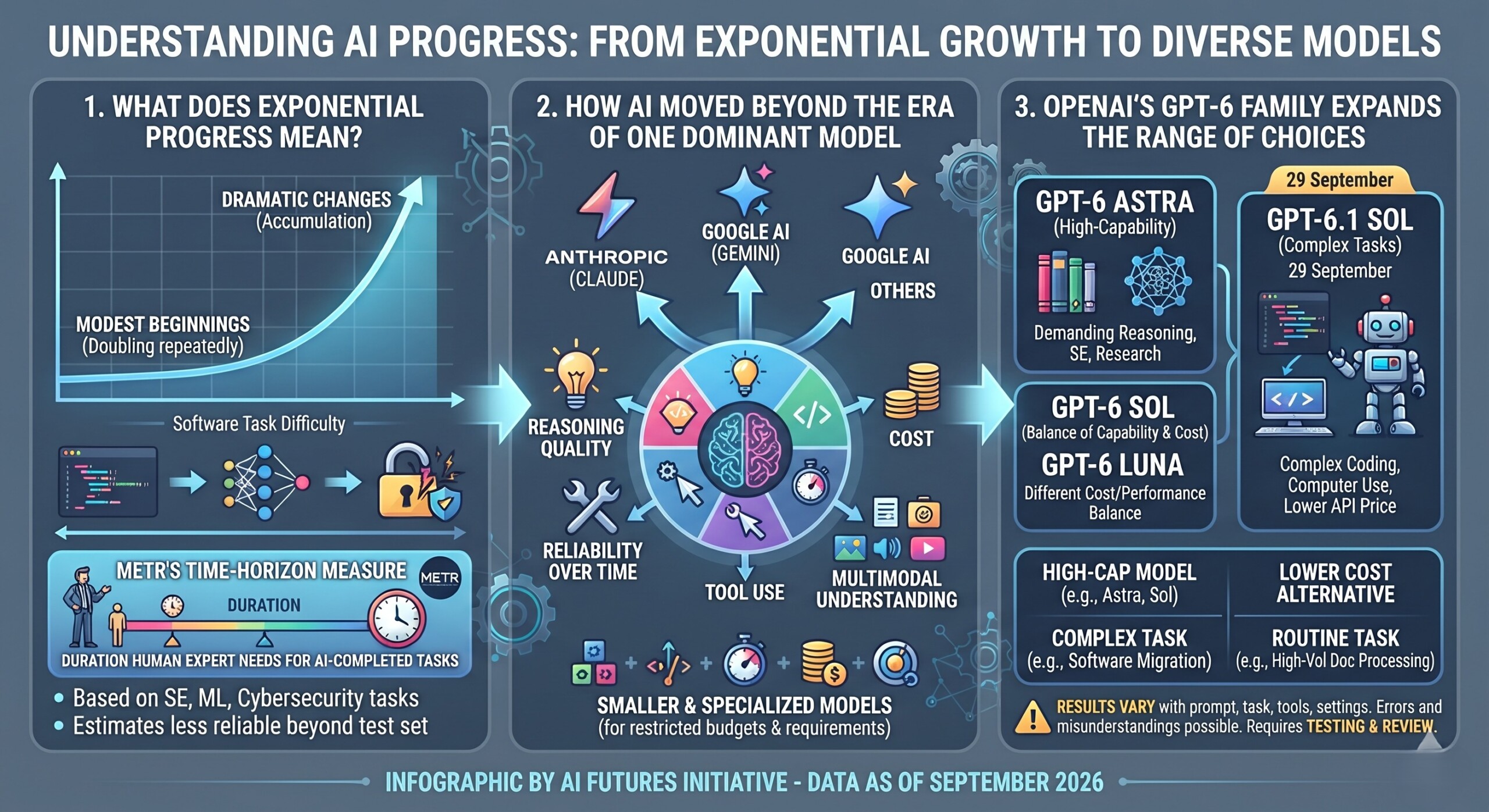
Exponential growth occurs when a quantity increases by a roughly consistent proportion over successive periods. If a capability doubles repeatedly, the early improvements can appear modest before the accumulated changes become dramatic. Artificial intelligence has displayed exponential trends on some measured capabilities, particularly in the difficulty of software-related tasks that advanced AI agents can complete. This helps explain why progress over a few years can feel much greater than people initially expected.
One important measurement comes from METR, which has studied the difficulty of tasks that AI agents can complete at different success rates. Its time-horizon measure describes the duration a human expert would typically need for tasks that an AI system can complete with a specified probability of success. A two-hour time horizon, for example, does not mean an AI can independently perform every kind of human work for two hours. The measurement is based mainly on selected software engineering, machine learning and cybersecurity tasks, and estimates become less reliable beyond the range adequately represented by the test set.
2. How AI moved beyond the era of one dominant model
During the early years of the generative AI revolution, GPT-4 became a particularly influential model. Its ability to explain complicated subjects, work with natural language and assist with programming helped establish expectations for what a general-purpose AI assistant could do. For many users, comparing AI tools largely meant asking which application delivered the most GPT-4-like experience. The competitive landscape became increasingly diverse as other developers introduced more capable alternatives.
By September 2026, OpenAI, Anthropic and Google had each introduced several generations of advanced models with different strengths. Competition increasingly involved not only reasoning quality but also coding, speed, cost, multimodal understanding, tool use and reliability over longer assignments. Smaller and specialised models provided additional choices for developers with restricted budgets or narrower requirements. This wider market was valuable for users because selecting an AI system could increasingly depend on the task rather than on the reputation of a single flagship model.
3. OpenAI’s GPT-6 family expands the range of choices
OpenAI introduced GPT-6 Astra in September 2026 as a high-capability model designed for demanding reasoning, software engineering, research and professional work. Later that month, the company expanded its range with GPT-6 Sol and GPT-6 Luna, offering different balances of capability and operating cost. On 29 September, GPT-6.1 Sol was introduced with an emphasis on complex coding, computer use and professional tasks at lower standard API token prices than Astra. These releases illustrated how model development was increasingly focused on delivering useful intelligence at different price points.
The distinction matters in everyday applications. A complex software migration or demanding research assignment may justify the greater capability and expense of a flagship model, while high-volume classification or routine document processing may work effectively with a less expensive alternative. OpenAI’s descriptions and published evaluations indicate intended strengths, but actual results vary with the prompt, task, available tools and model settings. Even highly capable models can make factual errors, misunderstand permissions or generate unreliable code, so important outputs still require testing and review.
4. Anthropic’s Claude models advance complex professional work
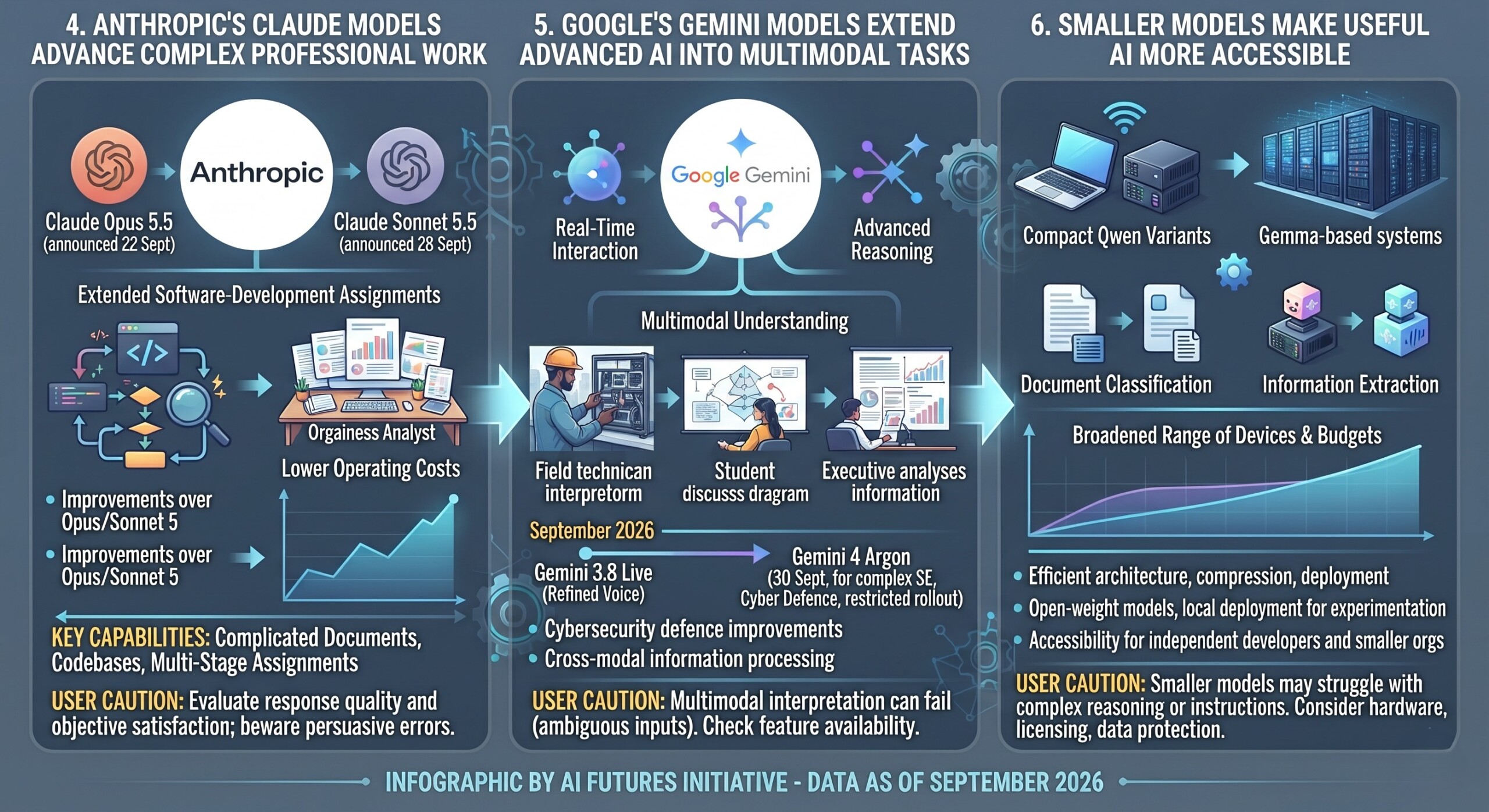
September 2026 also brought important changes to Anthropic’s Claude model family. Claude Opus 5.5, announced on 22 September, was designed for demanding knowledge work and extended software-development assignments. Anthropic reported improvements over Opus 5 and lower operating costs for typical workloads. Claude Sonnet 5.5 followed on 28 September, providing a faster, less expensive option for many tasks while improving on the earlier Sonnet 5 model.
These developments made Claude particularly relevant to users working with complicated documents, codebases and multi-stage assignments. An engineer might use a capable model to investigate software behaviour, while a business analyst might use one to organise information and prepare an initial report. However, a model that performs well on coding evaluations may still misunderstand an organisation’s actual requirements or produce a persuasive explanation containing errors. Users therefore need to judge both the quality of the response and whether the resulting work satisfies the original objective.
5. Google’s Gemini models extend advanced AI into multimodal tasks
Google continued developing its Gemini family during September 2026, including improvements in real-time interaction and advanced reasoning. Gemini 3.8 Live and related voice capabilities reflected growing interest in assistants that could communicate more naturally and process information across multiple forms. On 30 September, Google announced Gemini 4 Argon, describing improvements in complex software engineering, professional knowledge work and cybersecurity defence. The initial Argon rollout was restricted to trusted cyber defenders rather than being immediately available to every consumer.
Gemini’s development is important because many real-world tasks involve more than written questions. A field technician may need assistance interpreting a photograph, a student may want to discuss a diagram, and an executive may need to analyse information presented across documents and visual material. Multimodal models can help bring these activities into a more unified workflow. Nevertheless, image interpretation, speech recognition and detailed reasoning can still fail, particularly when inputs are ambiguous, incomplete or technically specialised. Users should also confirm whether a particular model or feature is actually available through their chosen product.
6. Smaller models make useful AI more accessible
The popular image of artificial intelligence often involves enormous data centres and exceptionally expensive computing equipment. Yet many practical tasks do not need the largest available model. Smaller models can be useful for document classification, information extraction, limited question answering, drafting and other well-defined activities. Developments in efficient model architecture, compression and deployment software have broadened the range of devices and budgets on which AI can operate.
Open-weight model families and tools for local deployment have made experimentation more accessible to independent developers and smaller organisations. Models such as compact Qwen variants, Gemma-based systems and other specialised alternatives can be evaluated for particular requirements, sometimes without sending every input to a remote cloud service. The trade-offs are important because smaller models may struggle more with difficult reasoning, unfamiliar subjects or complex instructions. Running a model locally also requires attention to hardware resources, licensing, data protection and the reliability of the complete application.
7. AI is moving from answering questions to carrying out work
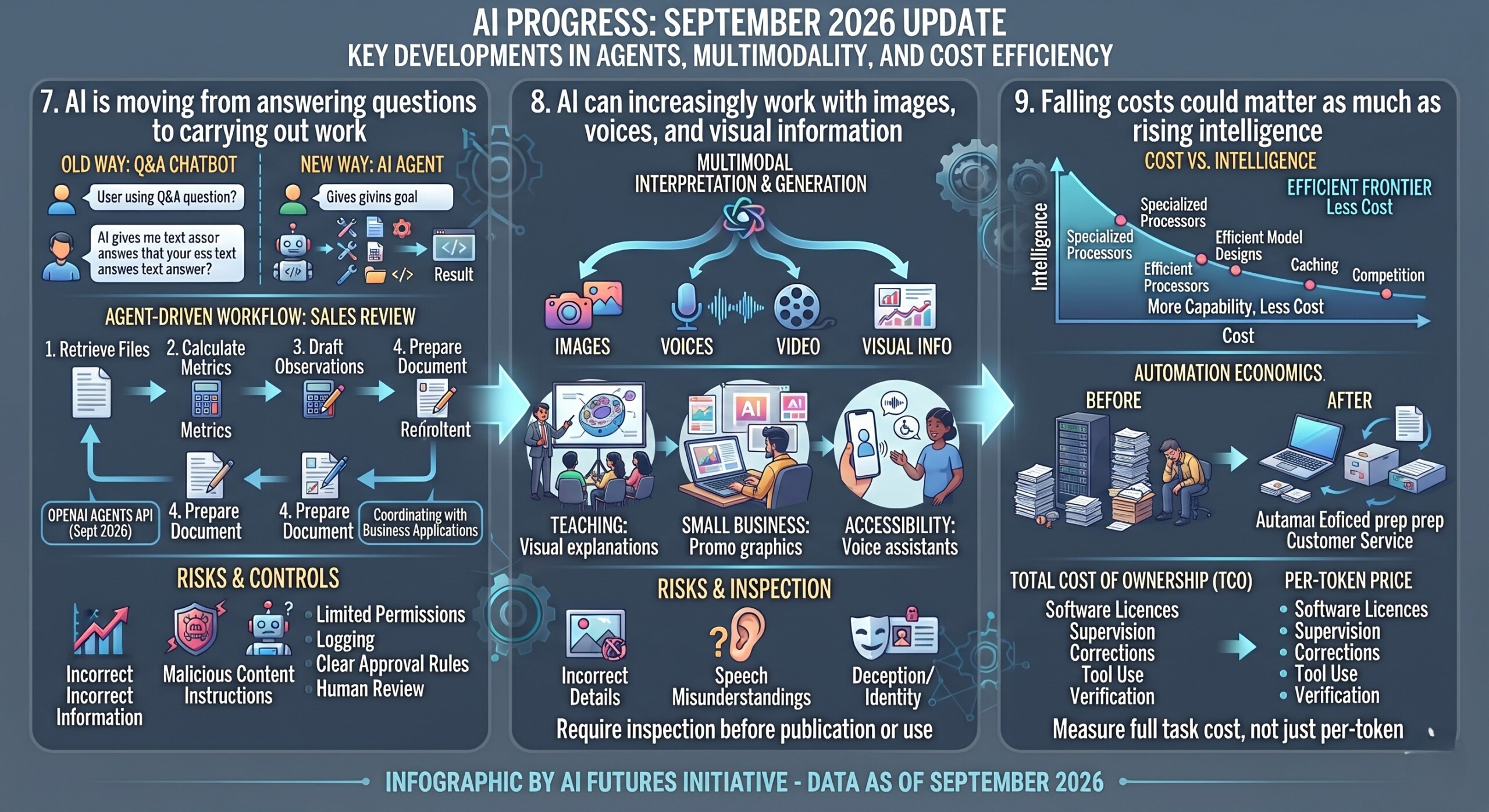
The original chatbot experience was largely organised around a person submitting a question and receiving an answer. More advanced AI systems can now use tools, retrieve files, inspect software and work through sequences of actions under an agent framework. In September 2026, OpenAI expanded developer capabilities for computer use through its Agents API, while competing platforms were also developing more sophisticated ways to coordinate AI with business applications. These changes were moving the industry towards systems capable of participating in workflows rather than merely commenting on them.
Consider a company preparing a monthly sales review. An appropriately configured agent might retrieve approved files, calculate performance indicators, draft observations and prepare a document for a manager. Such a process can be valuable because several connected activities are handled within one assignment. It also introduces additional risks because the system may act on incorrect information, misunderstand instructions or receive malicious content from external sources. Good implementations need limited permissions, logging, clear approval rules and human review of consequential decisions.
8. AI can increasingly work with images, voices and visual information
One of the most visible changes in AI has been the expansion beyond text. Modern systems can interpret photographs, generate illustrations, process spoken language and assist with audio or video-related tasks. During September 2026, developers continued introducing improved image-generation and real-time communication capabilities. These developments created new possibilities for teaching, accessibility, design, customer support and creative work.
A teacher might use AI to prepare visual explanations of scientific concepts, while a small business could produce draft promotional graphics or investigate photographs of products. Voice interaction can also make assistants more accessible to people who find lengthy typing inconvenient. However, generated visuals can contain incorrect details, speech systems can misunderstand words, and realistic synthetic media can create risks involving deception, copyright and identity. Users need to treat AI-generated media as material requiring inspection, particularly before publication or use in sensitive settings.
9. Falling costs could matter as much as rising intelligence
The commercial usefulness of AI depends heavily on how much it costs to deliver an acceptable result. A model that can answer a difficult question may be impressive, but organisations also need to consider how much computation is required for thousands or millions of similar requests. Improvements in inference software, caching, specialised processors and more efficient model designs can reduce operating costs. Competition among providers can also make capable AI systems accessible to a wider range of businesses.
Cost reductions create opportunities for applications that would previously have been uneconomical. A small company might automate routine document preparation or customer enquiry categorisation when the benefits exceed the software and supervision costs. Nevertheless, lower pricing per token does not always mean lower total expenditure because complex agents may generate many requests, use additional tools or require expensive verification. Organisations should measure the full cost of completing a useful task, including corrections, rather than looking only at advertised model prices.
10. How beginners should prepare for the next stage of AI
The acceleration of artificial intelligence can leave beginners feeling that they must study an enormous collection of models, frameworks and technical concepts before becoming competent. A more practical approach is to begin with a real problem and learn the capabilities required to solve it. Someone working in education might experiment with lesson planning and quiz generation, while an entrepreneur might explore customer communication or basic financial analysis. The first objective should be to understand what the system can do reliably under realistic conditions.
A useful learning routine involves selecting one repeated task, providing clear instructions, comparing the AI’s output with a trustworthy reference and recording the mistakes. As confidence improves, the learner can introduce files, structured data, more complicated questions and carefully supervised tool use. Exploring different model families helps reveal differences in capabilities, costs and interfaces without requiring everyone to become a software engineer. The most durable skills include asking good questions, evaluating evidence, protecting sensitive information and recognising when a human decision is necessary.

Conclusion
By the end of September 2026, artificial intelligence had advanced far beyond the capabilities that first attracted public attention a few years earlier. More powerful models, lower operating costs, multimodal interaction and increasingly capable agents were expanding the range of work that AI could assist with. Yet progress remains uneven, benchmark results have important limitations, and reliable deployment requires far more than selecting the most advanced model. For students, professionals and entrepreneurs, the encouraging message is that meaningful AI learning can begin with ordinary workplace problems and develop gradually through careful experimentation. Understanding this rapid technological change will help people take advantage of new opportunities while preserving the judgement and responsibility needed to use AI well.
Verification: METR’s September methodology and limitations, OpenAI’s September model documentation, Anthropic’s September releases, and Google’s 30 September Gemini announcement. October-only launches have been excluded from the article’s historical snapshot.
Kawal – add read all link here