AI Agents in Business Processes
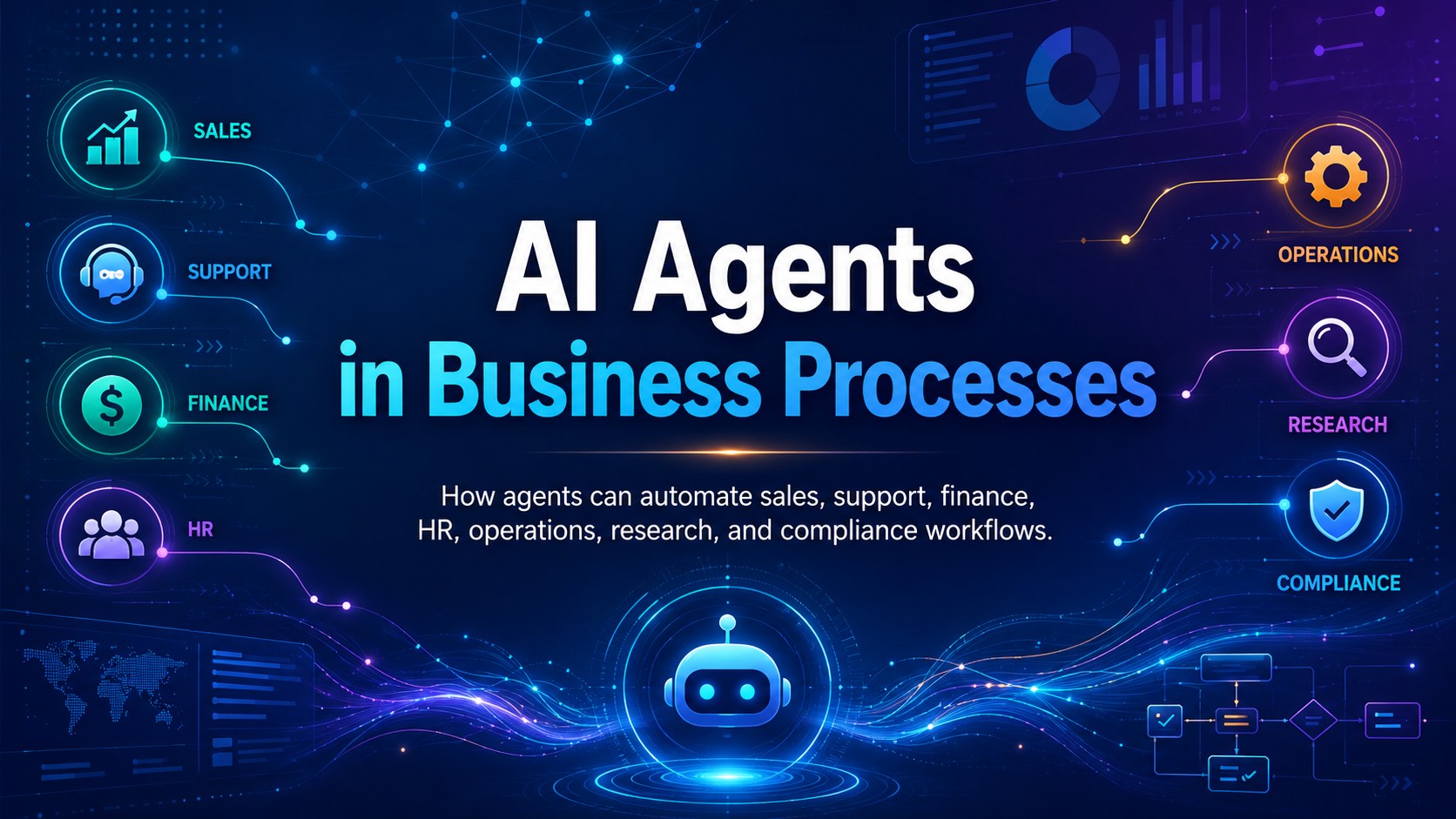
AI Agents in Business Processes
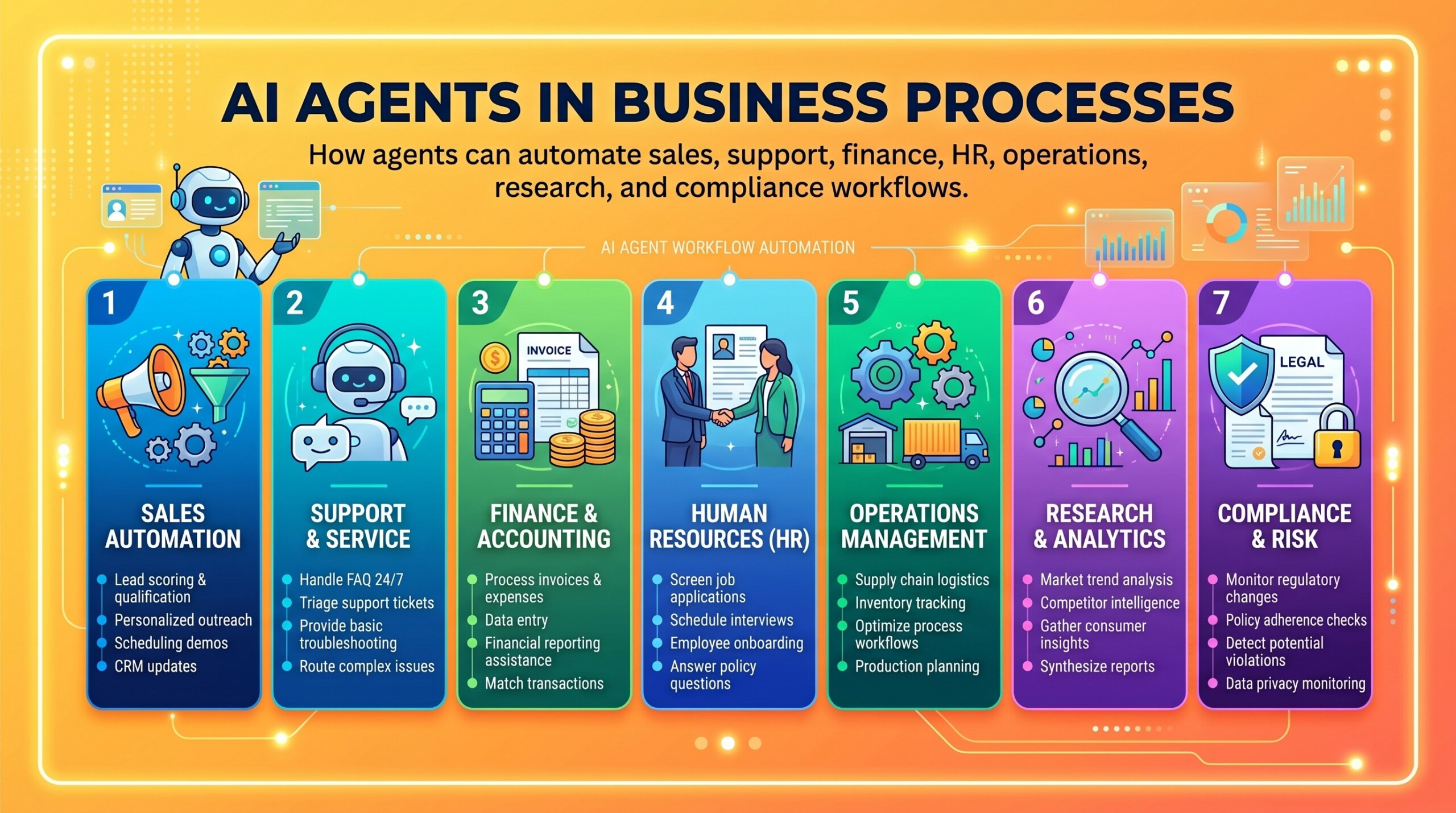
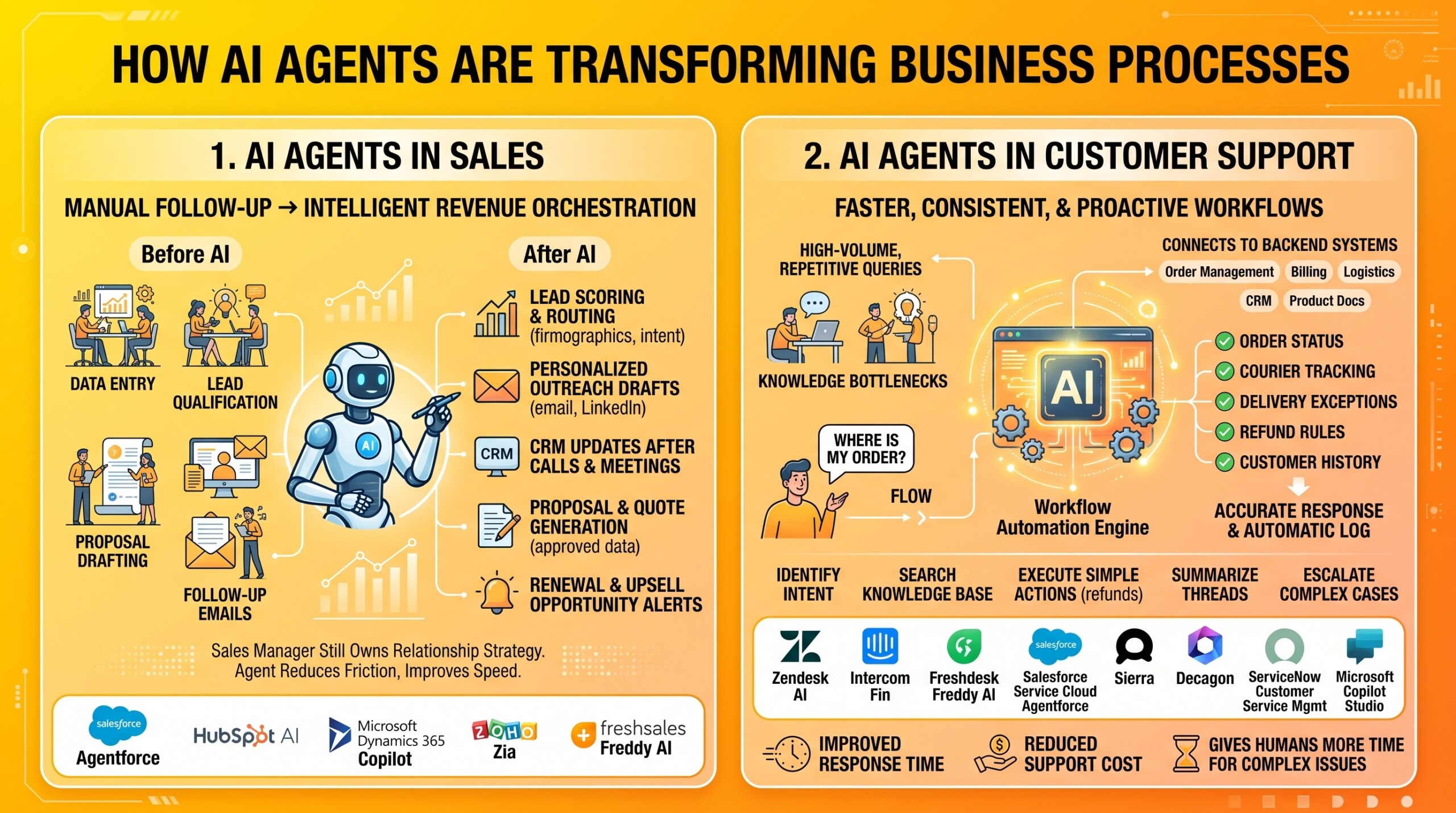
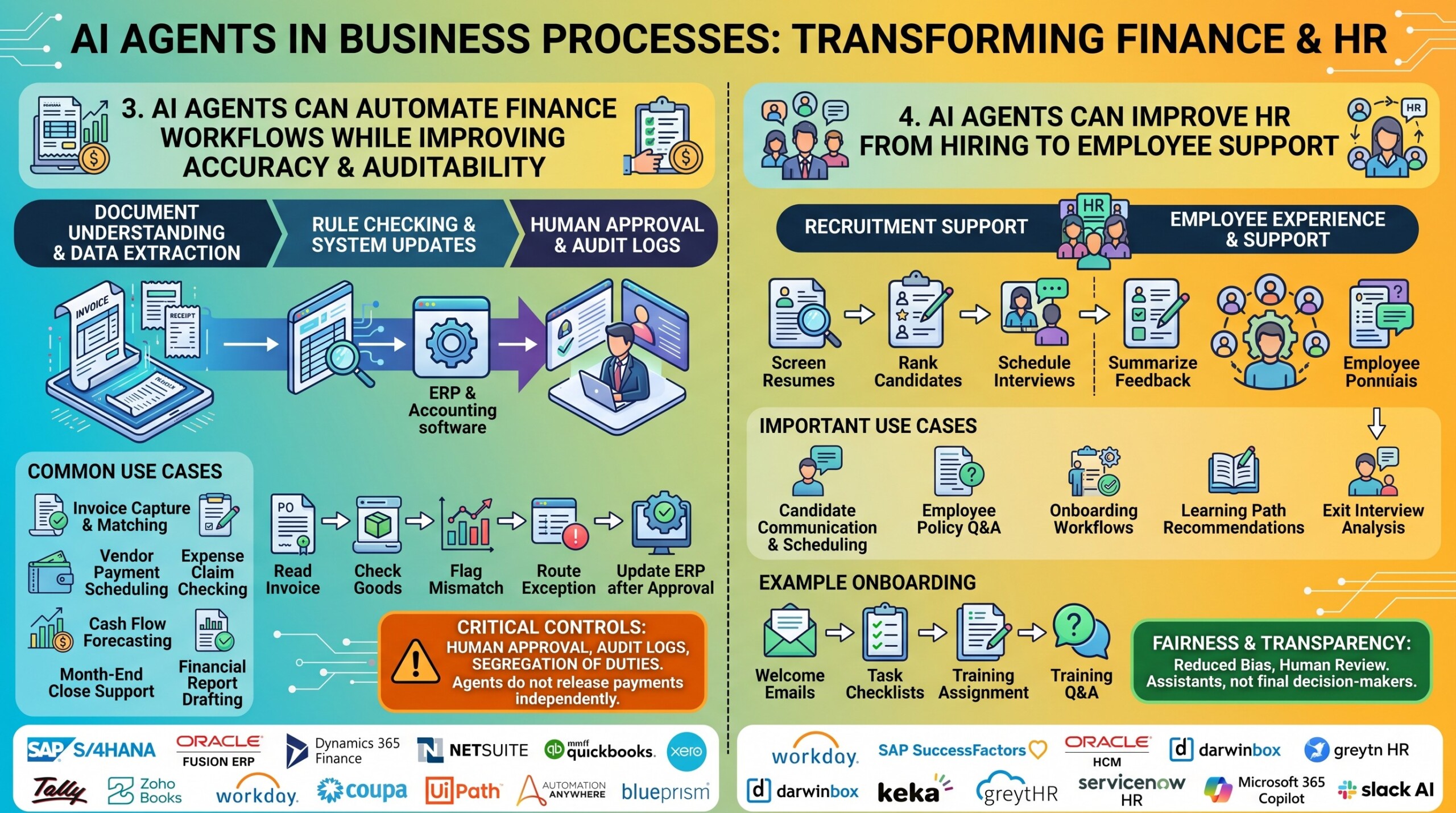
How agents can automate sales, support, finance, HR, operations, research, and compliance workflows.
Introduction
Artificial intelligence is moving from single chatbots to teams of specialized agents. A single AI assistant can answer questions, draft documents, summarize files, or call tools. But many real-world tasks are too complex for one agent to handle well. A business problem may require research, data analysis, legal review, customer communication, software execution, compliance checking, and final decision-making. This is where multi-agent systems become important.
A multi-agent system is a setup where multiple AI agents work together toward a shared goal. Each agent may have a role, skill, memory, tool access, workflow responsibility, or decision authority. One agent may act as a researcher, another as a planner, another as a coder, another as a critic, and another as a coordinator. Instead of expecting one large model to do everything, we design a team of smaller, focused agents that collaborate. This idea is not only theoretical anymore. It is now appearing in various products and platforms from OpenAI, Microsoft, Google, Amazon Web Services, LangChain, CrewAI, IBM, NVIDIA, Salesforce, ServiceNow, Atlassian, Zapier, UiPath, and many enterprise automation vendors.
The reason is simple: enterprises do not want AI that only talks. They want AI systems that can plan, delegate, check, negotiate, use tools, monitor progress, and complete workflows with accountability. Multi-agent collaboration is especially relevant for business transformation, education, software development, customer support, healthcare operations, finance, logistics, legal research, cybersecurity, and public administration. It allows AI systems to divide work intelligently, reduce errors through review, and combine different forms of expertise. But it also introduces new challenges such as coordination failure, conflicting outputs, tool misuse, security risks, cost escalation, and lack of transparency.
Let’s dive deep into the topic now.
1. From single agents to agent teams
The first wave of generative AI was built around single assistants. A user asked a question, the model generated a response. This worked well for writing, summarization, ideation, and general Q&A. But as organizations started using AI for operational work, they discovered that one assistant often lacked structure. It could forget constraints, skip steps, hallucinate, or fail to verify its own work.
Agent teams solve this by dividing responsibility. In a multi-agent setup, one agent can focus on understanding the user’s goal, another can search documents, another can run calculations, another can write a report, and another can check the report for errors. This resembles human teamwork, where specialists collaborate under a manager or project lead.
Modern platforms increasingly support this pattern. Amazon Bedrock Agents offers multi-agent collaboration where a supervisor agent coordinates specialized collaborator agents. OpenAI Agents SDK supports handoffs between agents. Google ADK supports multi-agent orchestration and workflows. Microsoft Agent Framework brings together ideas from AutoGen and Semantic Kernel for enterprise-ready agent systems. LangGraph allows developers to define agents and workflow steps as a graph. CrewAI allows teams of role-based agents to complete tasks together.
The key idea is this: instead of asking, “What can one AI do?”, we ask, “What combination of agents can solve this task reliably?”
2. Role specialization: why every agent should not do everything
Role specialization is one of the most important design principles in multi-agent systems. Each agent should have a clear job. This reduces confusion, improves reliability, and makes the system easier to debug.
For example, an enterprise report-generation system may include:
- A research agent that collects information from trusted sources
- A data agent that reads spreadsheets, databases, or dashboards
- A writing agent that converts findings into a readable article or report
- A critic agent that checks logic, completeness, and factual consistency
- A compliance agent that checks whether the output follows company policy
This is similar to how a consulting team works. A junior analyst collects data, a domain expert interprets it, a manager organizes the storyline, and a partner reviews the final recommendation. Multi-agent AI brings a similar structure into software.
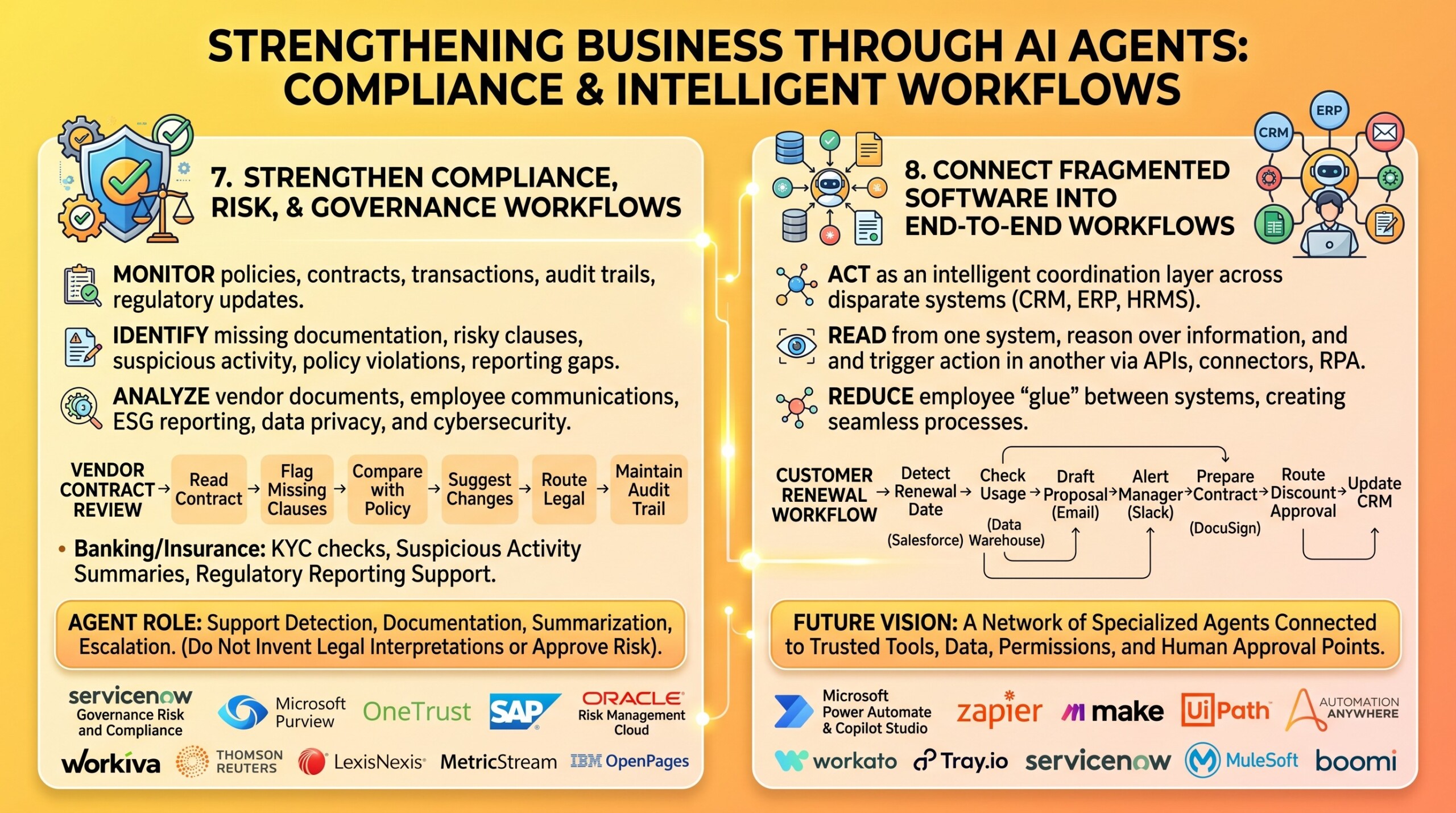
Role specialization also helps in tool access control. Not every agent should have access to every tool. A financial calculation agent may access spreadsheets, but not email. A customer service agent may access a CRM system, but not payroll data. A compliance agent may inspect outputs, but not make external changes. This makes the system safer and more auditable.
Vendors are moving in this direction. CrewAI emphasizes role-based agents and crews. LangGraph gives developers graph-based control over agent flows. IBM watsonx Orchestrate focuses on managing how agents work together. Enterprise platforms such as ServiceNow, Salesforce Agentforce, and Microsoft Copilot Studio are also pushing toward specialized workplace agents connected to enterprise systems. An excellent collection of learning videos awaits you on our Youtube channel.
3. Coordination: the central challenge of multi-agent systems
When multiple agents work together, coordination becomes the most important challenge. Without coordination, agents may duplicate work, contradict one another, wait indefinitely, or produce outputs that do not fit together.
Good coordination answers five questions:
- Who owns the overall task?
- Which agent should do which part?
- In what order should agents act?
- How should intermediate results be shared?
- Who decides when the task is complete?
There are several coordination patterns. The simplest is a sequential workflow, where Agent A passes work to Agent B, then Agent B passes work to Agent C. Another is a supervisor model, where one central agent delegates tasks and combines results. A third is a graph model, where agents are nodes and transitions are controlled by rules, conditions, or model decisions. A fourth is a marketplace model, where agents bid for tasks based on capability or confidence.
In production systems, coordination cannot be left entirely to free-form conversation between agents. Developers often need guardrails, state management, structured outputs, logging, retries, and human review. This is why platforms such as OpenAI Agents SDK, LangGraph, Google ADK, Microsoft Agent Framework, and NVIDIA NeMo Agent Toolkit are important. They help developers move from experimental agent demos to controlled agent workflows.
A good multi-agent system is not just a group chat of bots. It is an engineered collaboration system.
4. Negotiation between agents
Negotiation happens when agents need to resolve competing goals, limited resources, conflicting interpretations, or different recommendations. This is especially useful in planning, scheduling, procurement, logistics, legal reasoning, and business decision-making.
For example, imagine an AI travel-planning system. One agent optimizes for cost, another for comfort, another for time, and another for safety. The cheapest option may not be the safest. The fastest route may be too expensive. The comfort-focused agent may prefer a premium hotel, while the budget agent rejects it. A negotiation mechanism helps the system produce a balanced recommendation.
Negotiation can take many forms:
- Rule-based negotiation, where constraints are fixed in advance
- Preference-based negotiation, where agents rank options
- Market-style negotiation, where agents bid using cost, time, or value
- Argument-based negotiation, where agents justify their recommendations
- Human-in-the-loop negotiation, where a human makes the final decision
In enterprise use, negotiation is valuable because business decisions rarely have one perfect answer. A procurement decision may need to balance vendor reputation, cost, delivery timeline, compliance, and strategic fit. Multi-agent systems can represent these perspectives separately and then negotiate toward a final choice.
However, negotiation must be controlled. Agents should not invent authority, bypass rules, or optimize for hidden goals. The system must define what agents are allowed to decide, what must be escalated to humans, and what evidence is required before a recommendation is accepted. A constantly updated Whatsapp channel awaits your participation.
5. Debate and critique: using disagreement to improve quality
One of the most powerful uses of multi-agent collaboration is structured debate. Instead of trusting the first answer, we ask multiple agents to challenge, verify, or improve it.
A debate system may include:
- A proposer agent that creates an initial answer
- A critic agent that finds weaknesses, missing assumptions, or factual errors
- A defender agent that improves or justifies the answer
- A judge agent that compares versions and selects the strongest output
This is useful because AI models can sound confident even when they are wrong. A critic agent can detect unsupported claims, vague reasoning, contradictions, or missing evidence. A debate process can improve reliability, especially in tasks such as legal drafting, medical information review, investment analysis, code review, strategy design, and policy evaluation.
In education, debate agents can help students understand multiple sides of an issue. One agent may defend a position, another may oppose it, and a third may moderate. In corporate training, this can simulate boardroom discussions, customer objections, negotiation scenarios, or ethical dilemmas.
But debate is not a magic solution. If all agents use the same model, same prompt style, and same data, they may repeat the same mistake. Effective debate requires diversity of roles, different evaluation criteria, clear scoring rubrics, and sometimes different models. For example, a system may use GPT models from OpenAI, Claude from Anthropic, Gemini from Google, Llama-based models, or domain-specific models depending on the task and governance policy.
The purpose of debate is not noise. The purpose is better judgment.

6. Swarm intelligence: many simple agents creating complex behaviour
Swarm intelligence is inspired by nature. Ants, bees, birds, and fish show how many simple units can create intelligent group behavior without one central commander. In AI, swarm intelligence refers to systems where many agents explore, test, vote, adapt, or self-organize to solve a problem.
In a swarm-style AI system, agents may independently search for solutions, test alternatives, share signals, and converge on the best result. This can be useful in optimization problems, simulation, robotics, cybersecurity, trading research, supply chain planning, and large-scale scenario analysis.
For example:
- In cybersecurity, multiple agents may scan different attack surfaces and share risk signals
- In logistics, agents may represent vehicles, warehouses, routes, and demand points
- In software testing, agents may generate different test cases and discover edge cases
- In research, agents may explore different sources, hypotheses, and interpretations
- In creative work, agents may generate many concepts and vote on the strongest ones
Swarm intelligence is powerful because it supports parallel exploration. Instead of one agent trying one path, many agents try many paths. The system can then compare, rank, merge, or discard outputs.
However, swarm systems can become expensive and chaotic. More agents do not automatically mean better intelligence. Without careful evaluation, a swarm may produce duplication, noise, false confidence, or runaway cost. Practical swarm intelligence requires limits, scoring functions, stopping rules, and observability. Excellent individualised mentoring programmes available.
7. Memory, context, and shared state
Multi-agent collaboration depends heavily on memory and shared state. Agents need to know what has already happened, what decisions were made, what data was used, and what remains unresolved.
There are different types of memory:
- Short-term task memory, such as the current user request and recent steps
- Long-term user memory, such as preferences, past decisions, and project history
- Shared team memory, where multiple agents store and retrieve common information
- External memory, such as vector databases, knowledge graphs, CRM systems, file stores, and enterprise databases
Shared state is essential because agents must not work blindly. If a research agent has already found a source, the writing agent should use it. If a compliance agent rejects a paragraph, the revision agent should know why. If a human approves a decision, the system should store that approval.
Frameworks such as LangGraph are popular partly because they help developers manage stateful agent workflows. Enterprise platforms such as Microsoft Agent Framework, Google ADK, IBM watsonx Orchestrate, and Amazon Bedrock Agents also address orchestration, memory, and workflow continuity in different ways.
The future of multi-agent systems will depend less on clever prompts alone and more on reliable state management.
8. Tool use and service integration
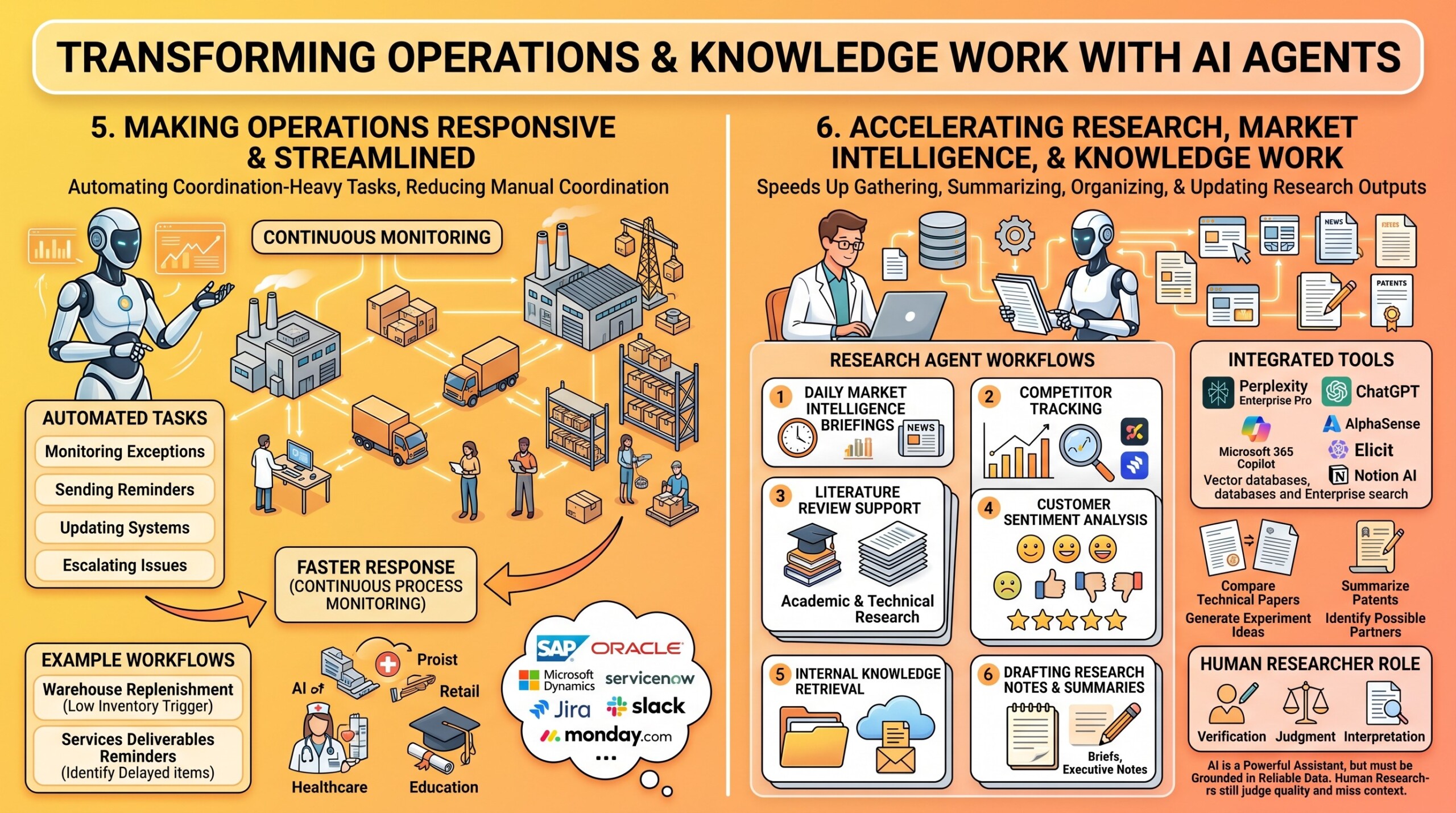
Agents become powerful when they can use tools. A tool may be a web search API, database query, Python environment, email system, calendar, CRM, ERP, ticketing system, document store, code repository, payment system, or workflow automation platform.
For example, a sales support agent team may use:
- Salesforce Agentforce or Salesforce CRM for customer records
- HubSpot for marketing and sales pipelines
- Zendesk or Intercom for customer support tickets
- Slack or Microsoft Teams for internal communication
- Google Workspace or Microsoft 365 for email, calendar, and documents
- ServiceNow for IT service workflows
- Jira or Linear for engineering tasks
- Snowflake, Databricks, BigQuery, or Redshift for analytics
- Zapier, Make, n8n, or UiPath for automation
Tool use raises the stakes. A chatbot that gives a bad answer is a risk. An agent that sends a wrong email, changes a database, refunds an order, or deletes a file is a much bigger risk. Therefore, multi-agent systems must include permissions, approvals, audit logs, sandboxing, and rollback mechanisms.
A common production pattern is “recommend first, act after approval.” The agents analyze the task, propose an action, and ask the human before executing sensitive steps. Over time, low-risk actions may be automated, while high-risk actions remain human-approved. Subscribe to our free AI newsletter now.
9. Governance, safety, and observability
Multi-agent systems need governance because they are harder to monitor than single assistants. When several agents interact, errors can emerge from the conversation between them, not just from one model output.
Important governance questions include:
- Which agent made a decision?
- What data did it use?
- Which tool did it call?
- Was the output checked?
- Was a human involved?
- Can the action be reversed?
- Did the system follow policy?
- How much did the workflow cost?
- Did the agents expose sensitive data?
- Did the agents behave differently from the approved design?
This is why observability is now a major theme in agent platforms. Developers need traces, logs, token usage, latency metrics, tool-call records, error reports, and evaluation results. LangSmith from LangChain, NVIDIA NeMo Agent Toolkit, CrewAI Control Plane, OpenAI tracing tools, Google Cloud observability, Microsoft enterprise telemetry, and IBM watsonx Orchestrate all reflect this trend.
Safety also requires role-based access control. A critic agent should not be able to execute payments. A research agent should not access confidential HR data. A coding agent should not deploy to production without review. A customer support agent should not promise refunds outside policy.
Multi-agent AI is not just an AI design problem. It is also a governance, risk, compliance, and operations problem.
10. Practical enterprise use cases
Multi-agent systems are becoming relevant across sectors because they match how organizations actually work. Work is divided among departments, specialists, systems, and approval layers. Agent collaboration can mirror this structure.
In education, a multi-agent tutor may include a concept explainer, quiz generator, misconception detector, motivational coach, and evaluator. In healthcare administration, agents may help with appointment scheduling, patient communication, claim review, and document summarization, while doctors retain final clinical authority. In finance, agents may perform research, risk scoring, compliance checks, portfolio analysis, and report generation. In manufacturing, agents may monitor sensors, predict maintenance needs, coordinate supply chain actions, and prepare exception reports.
In software development, tools such as GitHub Copilot, Cursor, Replit Agent, Devin-style coding agents, OpenAI Codex-style workflows, Google Gemini Code Assist, Amazon Q Developer, and JetBrains AI Assistant show how agents can help with coding, debugging, test generation, refactoring, and documentation. A multi-agent software team may include a product manager agent, architect agent, coder agent, test agent, security agent, and documentation agent.
In customer service, agents can classify tickets, retrieve policies, draft responses, escalate cases, and update CRM records. In legal and policy work, agents can compare documents, extract clauses, identify risks, summarize case law, and prepare first drafts for human review.
The strongest near-term use cases are not fully autonomous companies run by agents. The strongest use cases are human-supervised workflows where agents reduce repetitive work, improve speed, and provide structured decision support. Upgrade your AI-readiness with our masterclass.
Conclusion
Multi-agent systems represent the next major stage of applied AI. The shift is from individual chatbots to collaborative agent teams. These systems use role specialization, coordination, negotiation, debate, tool use, memory, and sometimes swarm intelligence to solve complex problems.
The future of AI will not be one giant assistant doing everything. It will be networks of agents, each with a defined function, working with humans, software tools, enterprise data, and other agents. Understanding agent teams, role specialization, negotiation, coordination, debate, and swarm intelligence is therefore essential for anyone studying modern AI.
The most realistic future is not humans versus agents. It is humans managing teams of agents. The winning organizations will be those that know how to design agent teams, assign responsibilities, monitor collaboration, and combine machine speed with human judgment.