AI Careers in Healthcare & Life Sciences – Clinical support, diagnostics, and ethics
Artificial intelligence is reshaping healthcare and life sciences more profoundly than almost any other sector. From clinical decision support and medical imaging to drug discovery, genomics, and population health, AI systems are increasingly embedded in how care is delivered, optimized, and scaled.
Yet healthcare is not a domain where AI can operate unchecked. Lives, dignity, safety, and trust are at stake. This reality has created a distinct and growing class of AI careers focused not just on building models, but on supporting clinicians, safeguarding patients, and governing ethical use. These roles sit at the intersection of medicine, data, regulation, and human judgment.
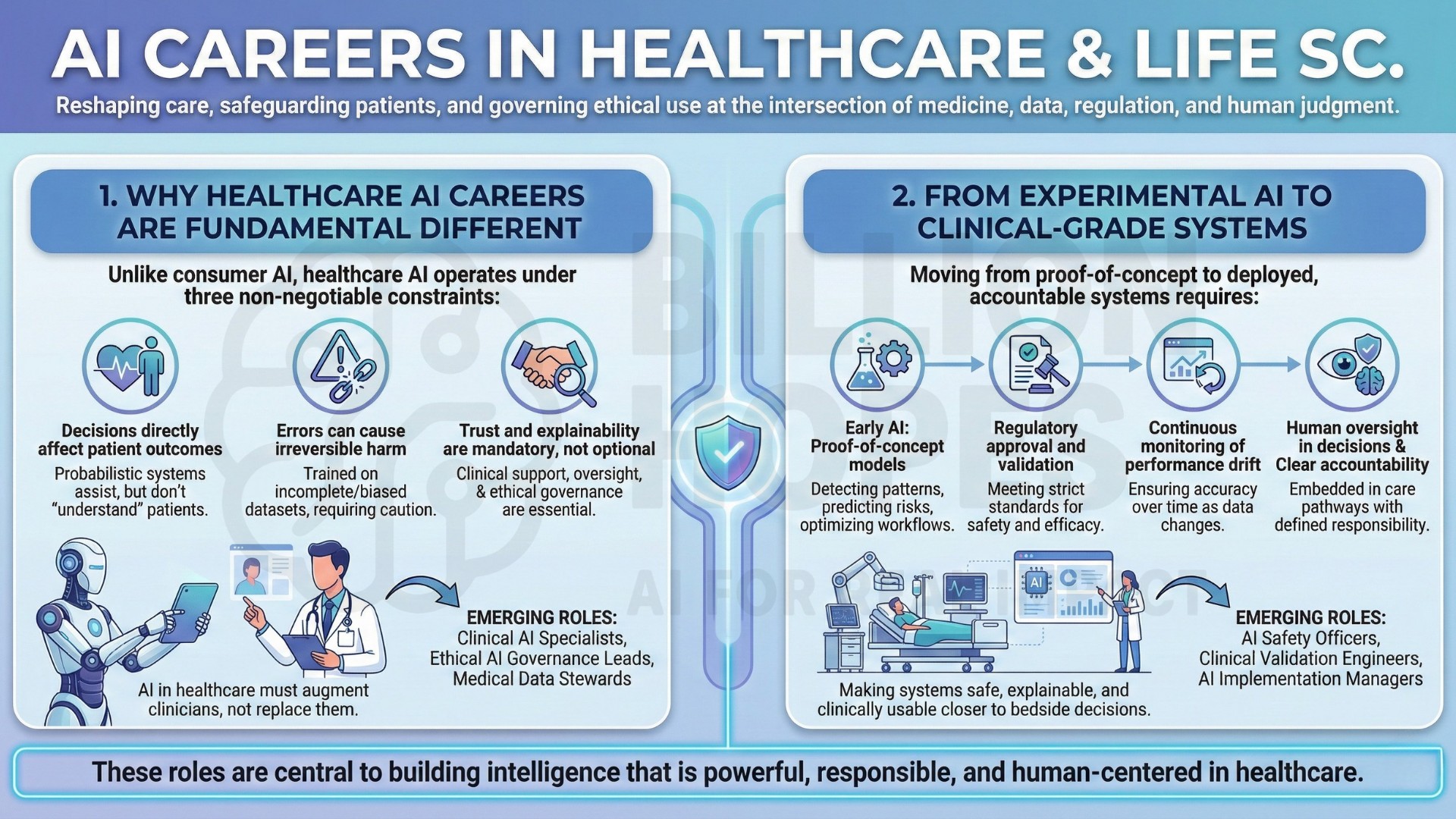
1. Why healthcare AI careers are fundamentally different
Unlike consumer or enterprise AI, healthcare AI operates under three non-negotiable constraints:
- Decisions directly affect patient outcomes
• Errors can cause irreversible harm
• Trust and explainability are mandatory, not optional
AI systems in healthcare are probabilistic, data-dependent, and often trained on incomplete or biased datasets. They assist with diagnosis, triage, risk scoring, and treatment recommendations – but they do not “understand” patients in the human sense.
This gap has made clinical support, oversight, and ethical governance roles essential. AI in healthcare must augment clinicians, not replace them.
2. From experimental AI to clinical-grade systems
Early healthcare AI projects focused on proof-of-concept models – detecting patterns in scans, predicting risks, or optimizing workflows. Today, organizations are moving toward clinical-grade AI, which requires:
- Regulatory approval and validation
• Continuous monitoring of performance drift
• Human oversight in diagnostic and treatment decisions
• Clear accountability when AI is used in care pathways
As AI systems move closer to bedside decisions, careers are emerging around making these systems safe, explainable, and clinically usable. An excellent collection of learning videos awaits you on our Youtube channel.
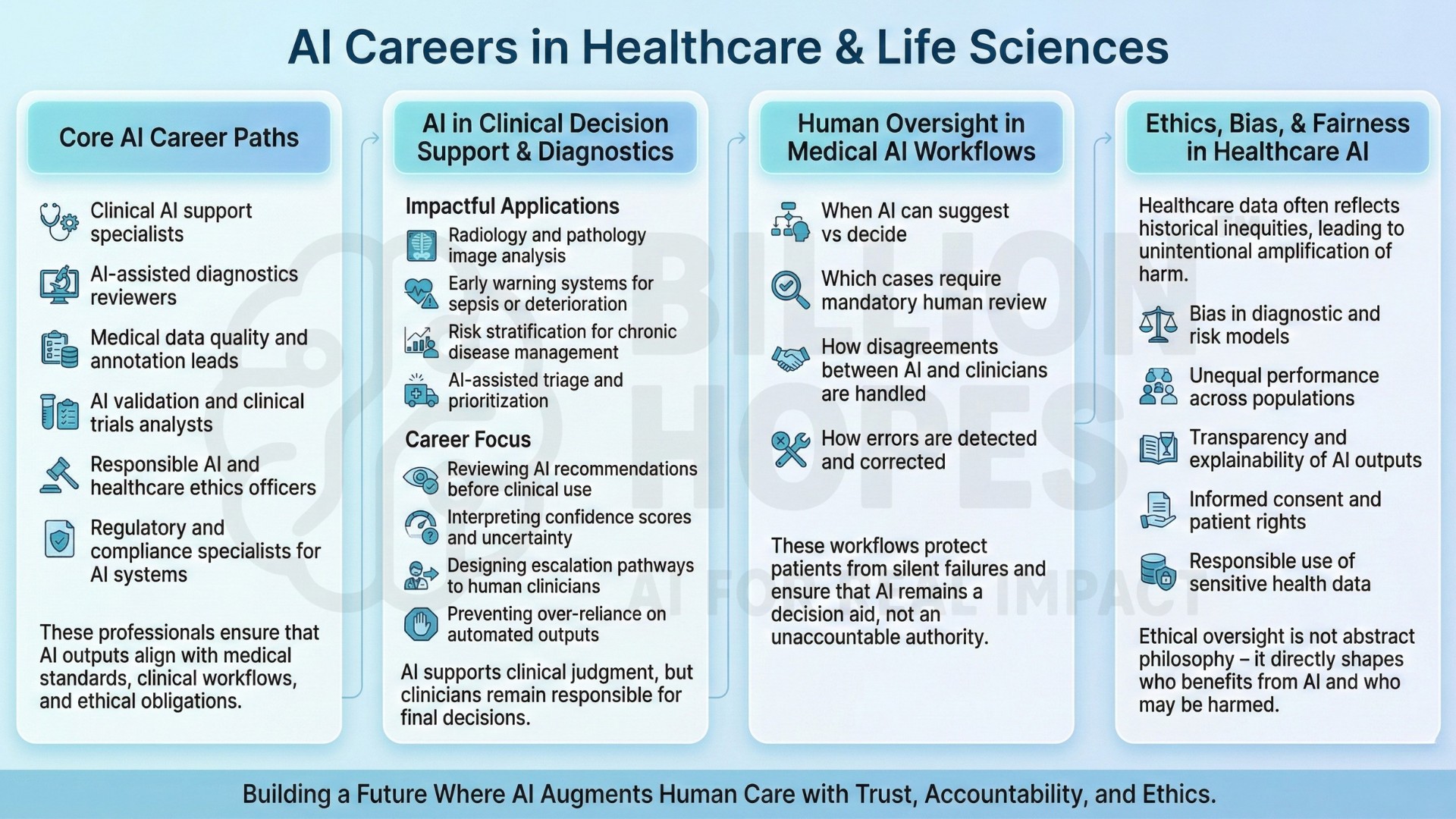
3. Core AI career paths in healthcare & life sciences
AI careers in healthcare extend far beyond data science. Key roles include:
- Clinical AI support specialists
• AI-assisted diagnostics reviewers
• Medical data quality and annotation leads
• AI validation and clinical trials analysts
• Responsible AI and healthcare ethics officers
• Regulatory and compliance specialists for AI systems
These professionals ensure that AI outputs align with medical standards, clinical workflows, and ethical obligations.
4. AI in clinical decision support and diagnostics
One of the most impactful applications of AI is clinical decision support—systems that assist doctors by highlighting risks, patterns, or anomalies.
Examples include:
• Radiology and pathology image analysis
• Early warning systems for sepsis or deterioration
• Risk stratification for chronic disease management
• AI-assisted triage and prioritization
Careers here focus on:
• Reviewing AI recommendations before clinical use
• Interpreting confidence scores and uncertainty
• Designing escalation pathways to human clinicians
• Preventing over-reliance on automated outputs
AI supports clinical judgment, but clinicians remain responsible for final decisions. A constantly updated Whatsapp channel awaits your participation.
5. Human oversight in medical AI workflows
Healthcare AI cannot rely on “set and forget” deployment. Oversight professionals design workflows that define:
- When AI can suggest vs decide
• Which cases require mandatory human review
• How disagreements between AI and clinicians are handled
• How errors are detected and corrected
These workflows protect patients from silent failures and ensure that AI remains a decision aid, not an unaccountable authority.
6. Ethics, bias, and fairness in healthcare AI
Healthcare data often reflects historical inequities – unequal access, underrepresentation, and systemic bias. AI systems trained on such data can unintentionally amplify harm.
Ethics-focused AI roles address:
• Bias in diagnostic and risk models
• Unequal performance across populations
• Transparency and explainability of AI outputs
• Informed consent and patient rights
• Responsible use of sensitive health data
Ethical oversight is not abstract philosophy – it directly shapes who benefits from AI and who may be harmed.
Excellent individualised mentoring programmes available.
7. Skills that define healthcare AI professionals
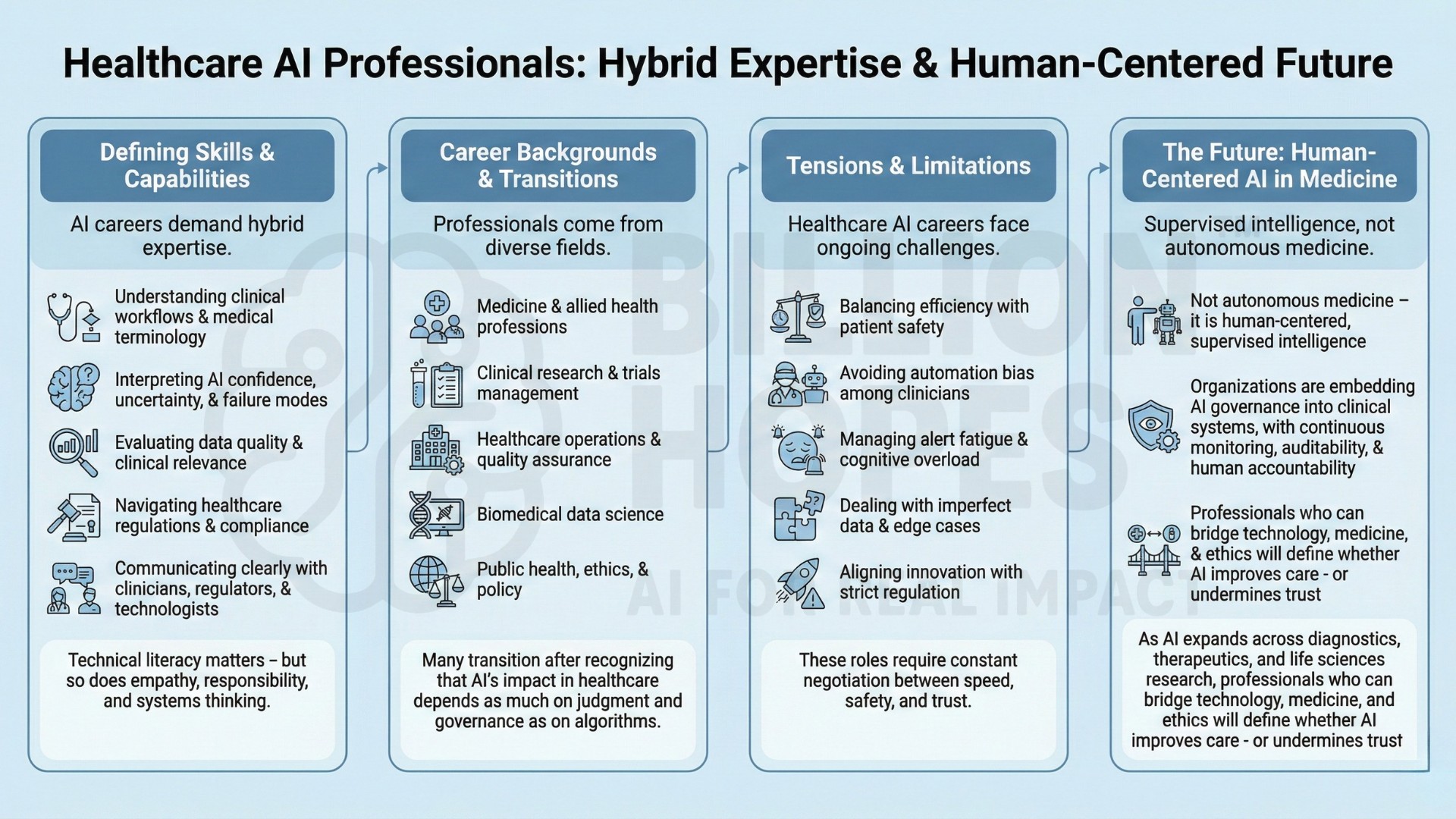
AI careers in healthcare demand hybrid expertise. Key capabilities include:
- Understanding clinical workflows and medical terminology
• Interpreting AI confidence, uncertainty, and failure modes
• Evaluating data quality and clinical relevance
• Navigating healthcare regulations and compliance
• Communicating clearly with clinicians, regulators, and technologists
Technical literacy matters – but so does empathy, responsibility, and systems thinking.
8. Backgrounds and career transitions
Professionals entering healthcare AI roles often come from:
• Medicine and allied health professions
• Clinical research and trials management
• Healthcare operations and quality assurance
• Biomedical data science
• Public health, ethics, and policy
Many transition after recognizing that AI’s impact in healthcare depends as much on judgment and governance as on algorithms.
Subscribe to our free AI newsletter now.
9. Tensions and limitations in healthcare AI work
Healthcare AI careers face ongoing challenges:
• Balancing efficiency with patient safety
• Avoiding automation bias among clinicians
• Managing alert fatigue and cognitive overload
• Dealing with imperfect data and edge cases
• Aligning innovation with strict regulation
These roles require constant negotiation between speed, safety, and trust.
10. The future: Human-centered AI in medicine
The future of healthcare AI is not autonomous medicine – it is human-centered, supervised intelligence. Organizations are embedding AI governance into clinical systems, with continuous monitoring, auditability, and human accountability.
As AI expands across diagnostics, therapeutics, and life sciences research, professionals who can bridge technology, medicine, and ethics will define whether AI improves care – or undermines trust. Upgrade your AI-readiness with our masterclass.
Billion Hopes summary
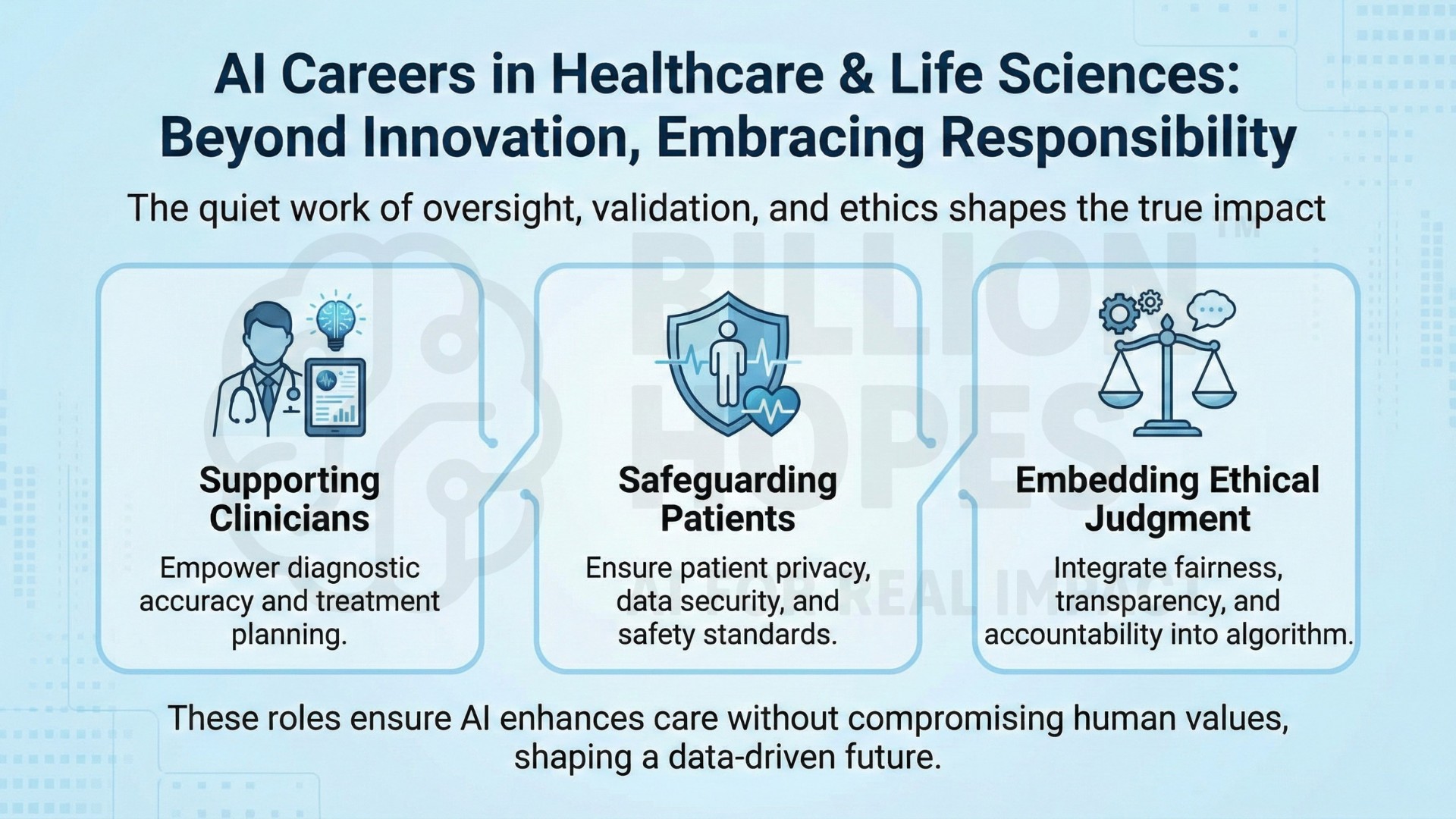
AI careers in healthcare and life sciences are about more than innovation – they are about responsibility. By supporting clinicians, safeguarding patients, and embedding ethical judgment into intelligent systems, these roles ensure that AI enhances care without compromising human values. As medicine becomes increasingly data-driven, the quiet work of oversight, validation, and ethics will shape the true impact of AI on human health.
Share this with the world
Related Articles