AI for SMBs, Creators & Solopreneurs
AI for SMBs, Creators & Solopreneurs
AI-powered small business models; Creator economy with AI leverage; One-person companies using AI stacks
Introduction
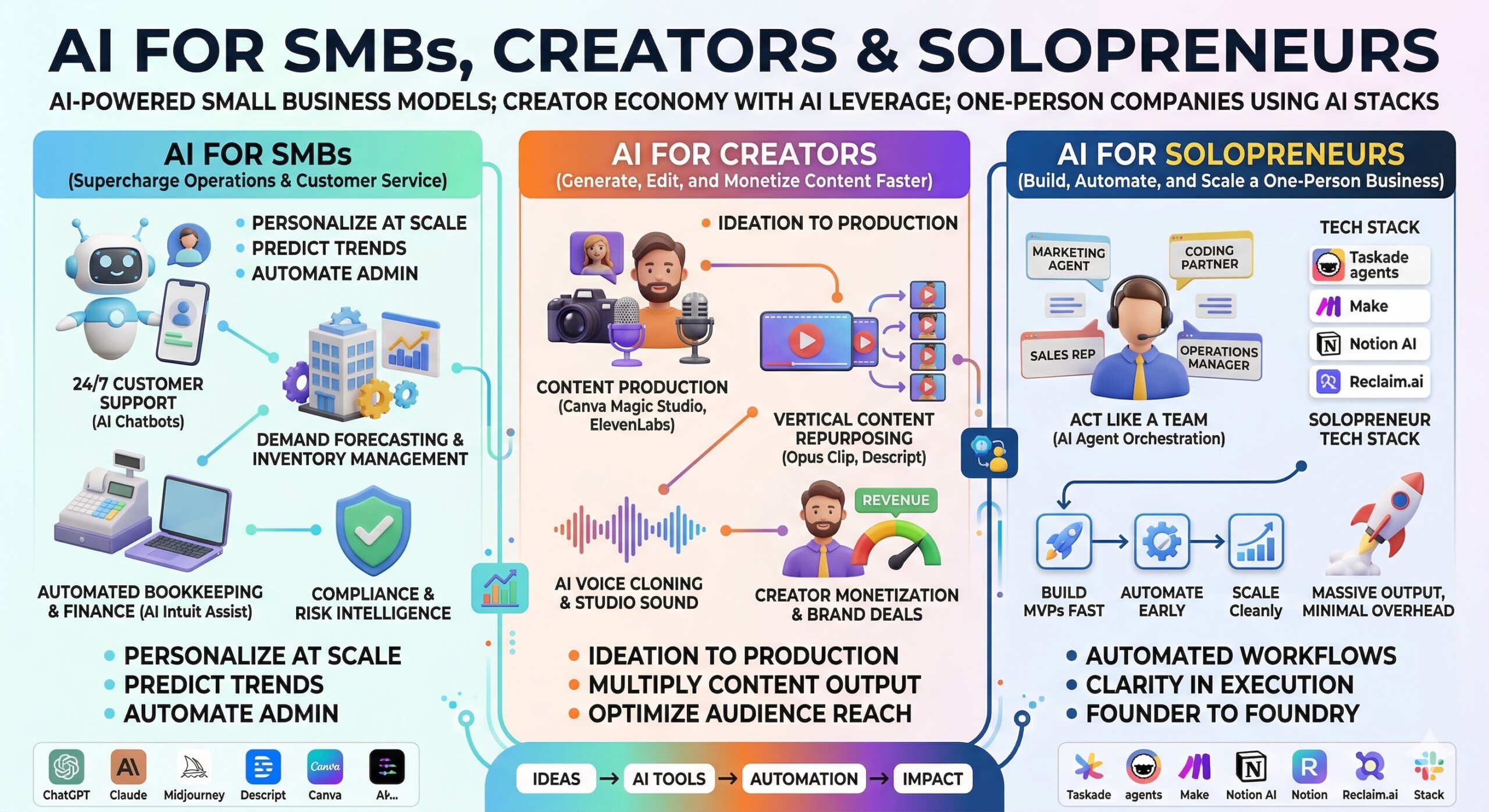
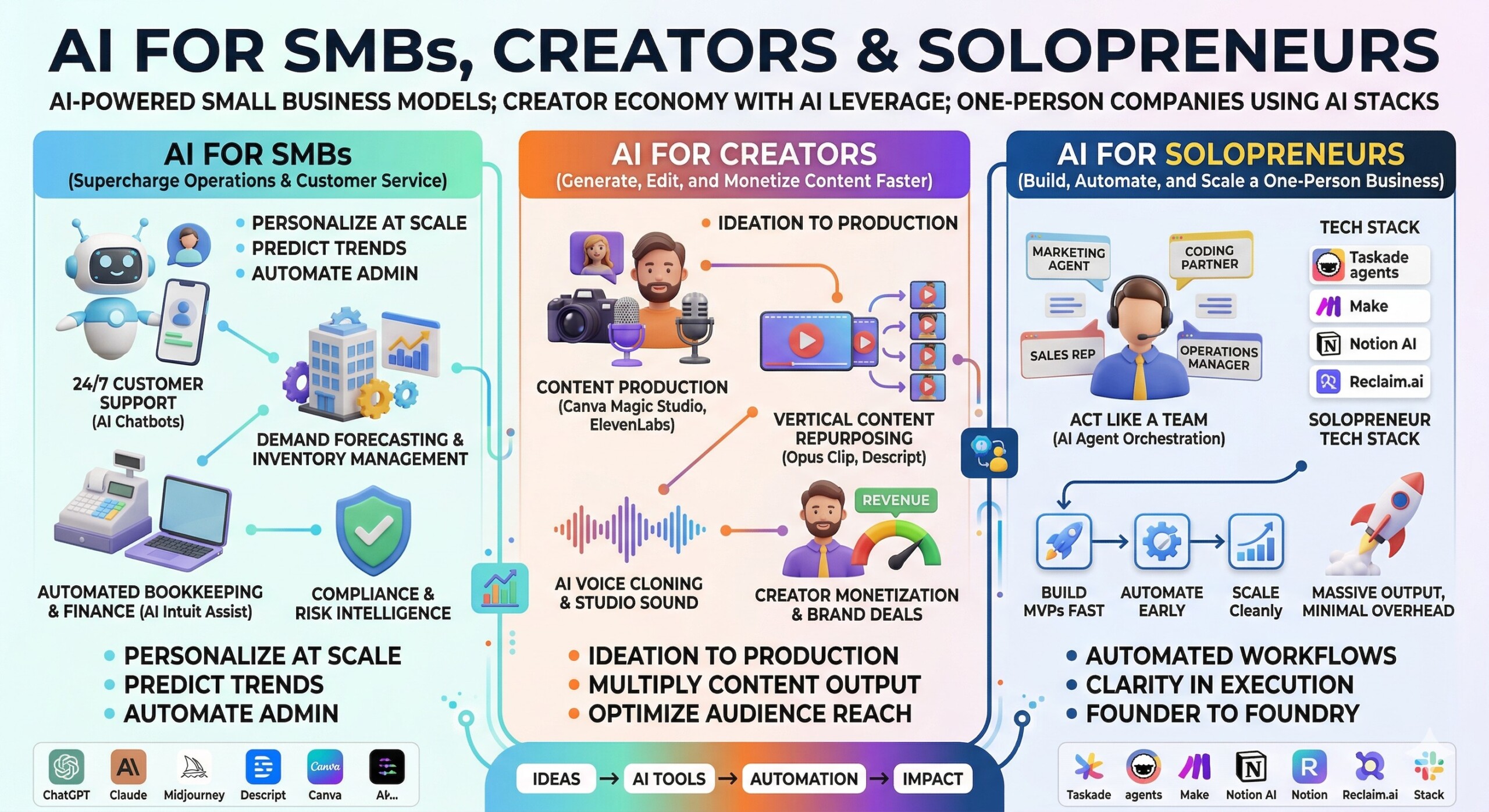
Artificial Intelligence is no longer a frontier technology reserved for large enterprises – it has become a foundational layer for small and medium businesses (SMBs), creators, and solopreneurs. By 2025, over 58% of small businesses were already using AI, more than doubling adoption in just two years, signaling a structural shift in how businesses are built and scaled. This democratization of AI has dramatically reduced barriers to entry, allowing individuals and small teams to operate with capabilities that previously required entire departments.
At the same time, the creator economy – now valued at over $250 billion globally – is being reshaped by AI-powered tools that enhance content creation, audience engagement, and monetization. From automated marketing to AI-generated products, the modern entrepreneur is increasingly leveraging AI not just as a tool, but as a co-founder. The rise of one-person companies powered by AI stacks represents a new paradigm where intelligence, automation, and scalability converge. An excellent collection of learning videos awaits you on our Youtube channel.
Let’s dive deep into the topic.
1. AI as a Core Operating Layer for SMBs
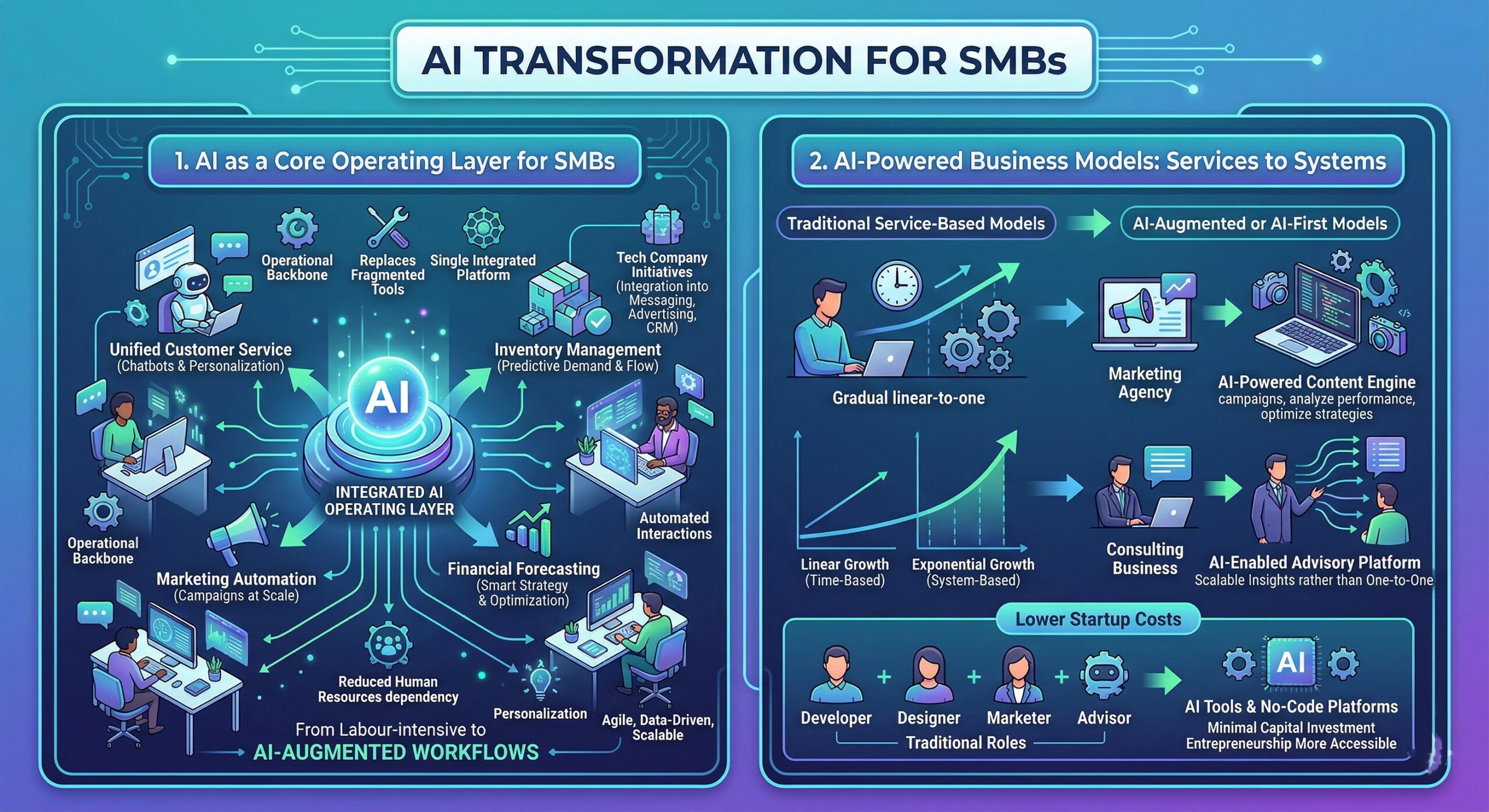
AI is rapidly becoming the operational backbone of small businesses, replacing fragmented tools with unified intelligent systems. Modern SMBs are using AI for customer service, inventory management, marketing automation, and financial forecasting – often within a single integrated platform. This shift is driven by the need for efficiency and cost reduction, especially in competitive markets.
Platforms from major tech companies are aggressively targeting SMBs. For example, initiatives integrating AI into everyday tools like messaging, advertising, and CRM systems are enabling small businesses to automate customer interactions and marketing campaigns at scale. This reduces dependency on human resources while improving responsiveness and personalization.
The result is a transformation from labour-intensive operations to AI-augmented workflows, where decision-making, execution, and optimization happen continuously. SMBs that adopt AI early are not just improving efficiency – they are redefining their business models to be more agile, data-driven, and scalable.
2. AI-Powered Business Models: From Services to Systems
AI is enabling entirely new types of business models, particularly for small businesses. Traditional service-based models are evolving into AI-augmented or AI-first models, where value is delivered through automation, personalization, and predictive insights.
For example, a marketing agency can now operate as an AI-powered content engine – generating campaigns, analyzing performance, and optimizing strategies in real time. Similarly, consulting businesses are evolving into AI-enabled advisory platforms, offering scalable insights rather than one-to-one services. This transition allows SMBs to move from linear growth (time-based) to exponential growth (system-based).
Moreover, AI dramatically lowers startup costs. What once required developers, designers, and marketers can now be executed using AI tools and no-code platforms. This shift has made entrepreneurship more accessible, enabling individuals to launch and scale businesses with minimal capital investment. A constantly updated Whatsapp channel awaits your participation.
3. Creator Economy: AI as a Force Multiplier
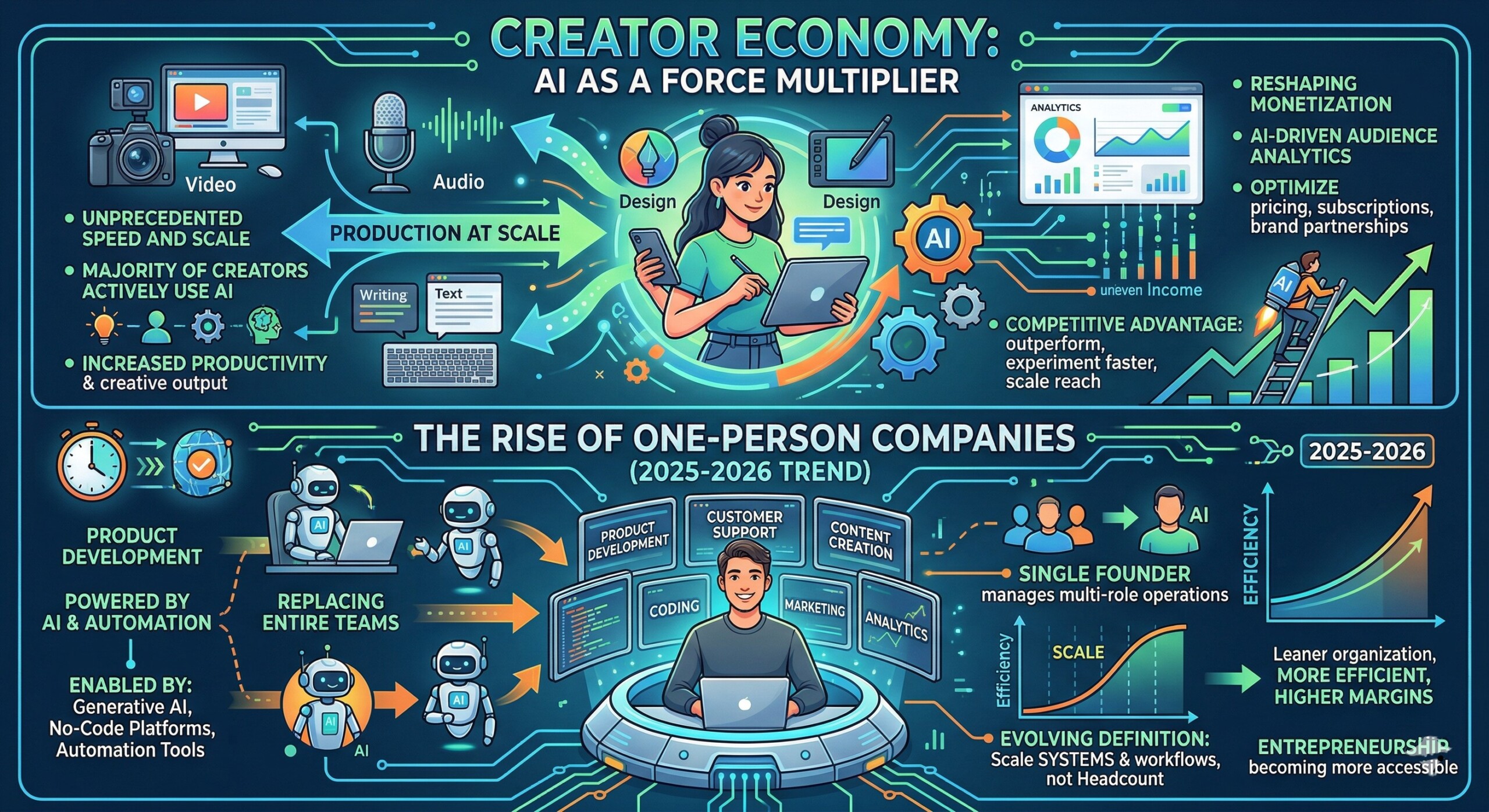
The creator economy is undergoing a profound transformation driven by AI. Tools for writing, video production, design, and audio generation are enabling creators to produce high-quality content at unprecedented speed and scale. In fact, a large majority of creators now actively use AI in their workflows, with many reporting increased productivity and creative output.
AI is also reshaping monetization. From personalized content recommendations to AI-driven audience analytics, creators can better understand and engage their audiences. New platforms are emerging that integrate AI directly into monetization strategies, helping creators optimize pricing, subscriptions, and brand partnerships.
However, the distribution of income remains uneven – only a small percentage of creators earn significant revenue. AI, therefore, becomes a competitive advantage: those who leverage it effectively can outperform peers by producing more, experimenting faster, and scaling their reach efficiently.
4. The Rise of One-Person Companies
One of the most significant trends in 2025–2026 is the emergence of one-person companies – businesses run entirely by a single individual, powered by AI and automation. These businesses leverage AI tools for everything from product development to customer support, effectively replacing entire teams.
This model is enabled by the convergence of generative AI, no-code platforms, and automation tools. Tasks such as content creation, coding, marketing, and analytics can now be handled by AI, allowing a single founder to manage operations that previously required multiple roles.
The implications are profound. Entrepreneurship is becoming more accessible, and the definition of a “company” is evolving. Instead of scaling headcount, founders are scaling systems and workflows, leading to leaner, more efficient organizations with higher margins. Excellent individualised mentoring programmes available.
5. AI Stacks: The New Digital Workforce
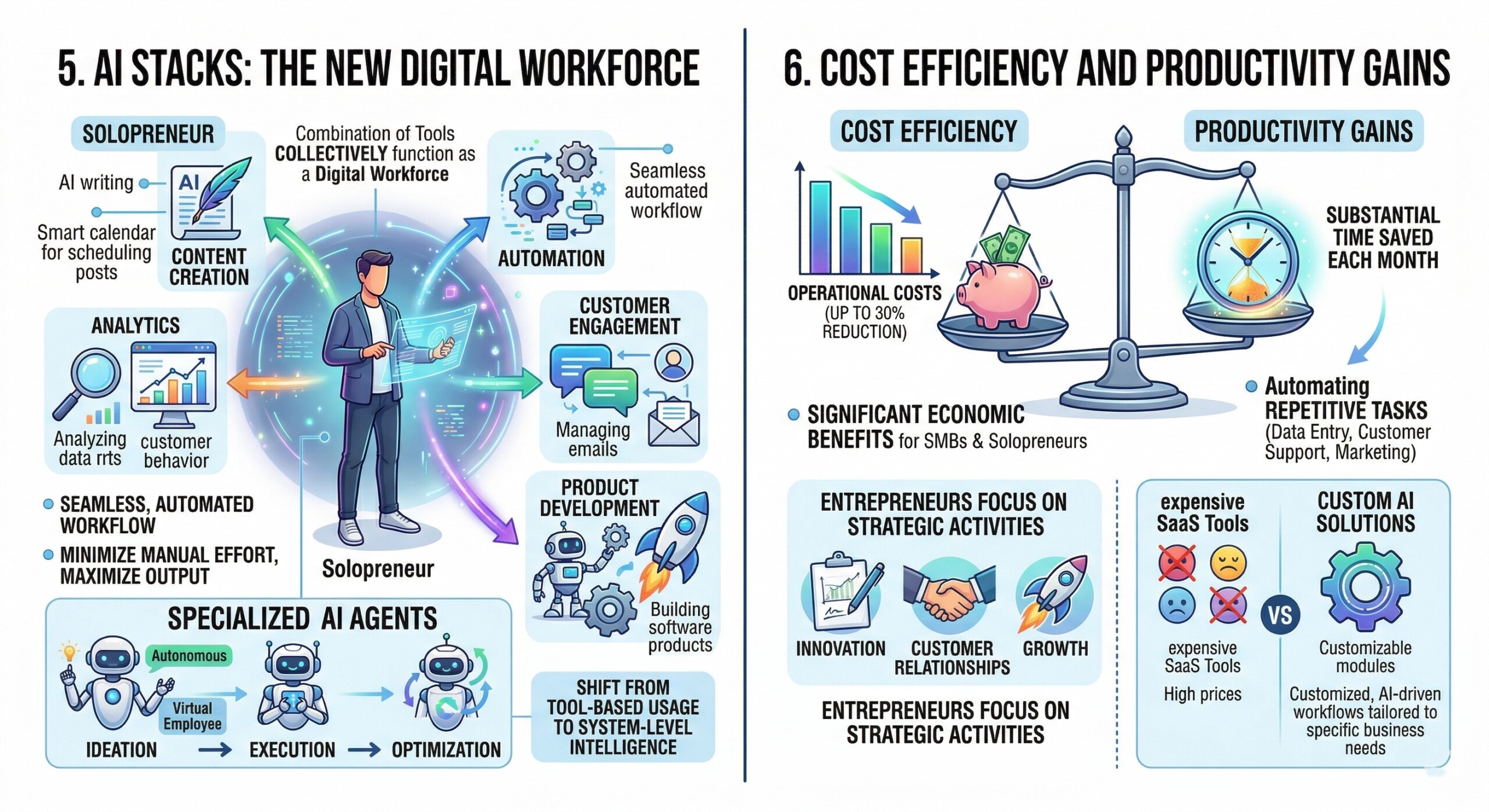
Modern solopreneurs are building AI stacks – a combination of tools that collectively function as a digital workforce. These stacks typically include tools for content creation, automation, analytics, customer engagement, and product development.
For example, a solopreneur might use AI for writing content, scheduling posts, managing emails, analyzing customer behaviour, and even building software products. These tools work together to create a seamless, automated workflow that minimizes manual effort while maximizing output.
Importantly, the concept of “AI agents” is gaining traction. These agents can perform multi-step tasks autonomously, acting as virtual employees that continuously learn and improve. This represents a shift from tool-based usage to system-level intelligence, where AI actively participates in business operations.
6. Cost Efficiency and Productivity Gains
AI is delivering significant economic benefits for SMBs and solopreneurs. Studies indicate that businesses using AI can reduce operational costs by up to 30% and save substantial time each month. This is particularly important for small businesses with limited resources.
Beyond cost savings, AI enhances productivity by automating repetitive tasks such as data entry, customer support, and marketing. This allows entrepreneurs to focus on strategic activities like innovation, customer relationships, and growth.
Real-world examples highlight how solopreneurs are replacing expensive SaaS tools with custom AI solutions, reducing costs while gaining flexibility. This trend reflects a broader shift toward customized, AI-driven workflows that are tailored to specific business needs. Subscribe to our free AI newsletter now.
7. AI-Driven Competitive Advantage and Market Speed
AI is not just improving efficiency – it is redefining competition. Businesses that leverage AI effectively can move faster, experiment more, and adapt quickly to market changes. This creates a significant competitive advantage, particularly in fast-moving industries.
AI enables rapid prototyping, real-time analytics, and continuous optimization. For example, marketing campaigns can be generated, tested, and refined within hours rather than weeks. This speed allows businesses to stay ahead of trends and respond proactively to customer needs.
Furthermore, AI is driving a surge in entrepreneurship. The number of new business applications has increased significantly in recent years, fueled in part by the accessibility of AI tools. As AI continues to evolve, it will further accelerate innovation, enabling more individuals to build scalable businesses and compete on a global stage.
Conclusion
AI is fundamentally reshaping the landscape of entrepreneurship. For SMBs, it is becoming an essential operating layer that enhances efficiency, reduces costs, and enables smarter decision-making. For creators, it acts as a force multiplier, unlocking new levels of productivity and monetization. And for solopreneurs, it is the foundation of a new business model – one where a single individual can build and scale a company with the support of AI systems.
This transformation is not just technological – it is structural. The traditional boundaries of business size, resources, and capability are dissolving. What matters now is not how many people you have, but how effectively you leverage AI. The rise of AI-powered stacks, digital workflows, and autonomous agents signals a shift toward a more decentralized, efficient, and innovative economy.
Looking ahead, the winners in this new era will be those who treat AI not as a tool, but as a strategic partner. Whether building a small business, growing a creator brand, or launching a solo venture, the ability to integrate AI deeply into workflows will define success. The future of entrepreneurship is lean, intelligent, and AI-driven—and it is already here. Upgrade your AI-readiness with our masterclass.
Share this with the world
Related Articles