AI in Defence – a strategic force-multiplier?
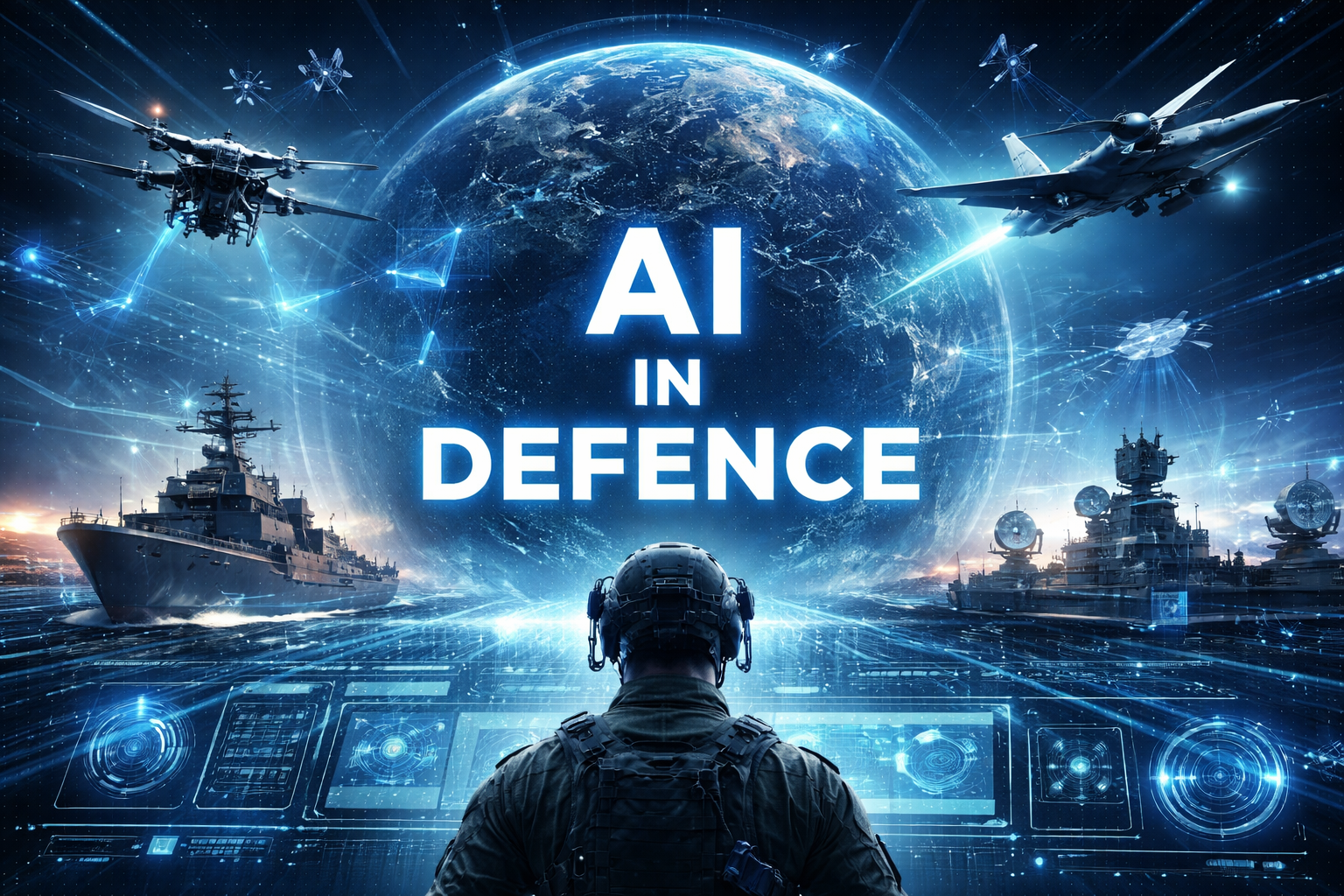
Artificial Intelligence is reshaping the defence landscape from traditional, manpower-intensive armed forces into highly data-driven, precision-oriented systems. Across the world, militaries, governments, start-ups, and defence contractors are deploying AI to enhance operational readiness, situational awareness, autonomous systems, cybersecurity, and decision-making under uncertainty. Despite several hiccups and questions raised around accountability, this tide is rising.
Below are 25 key developments shaping AI in defence today
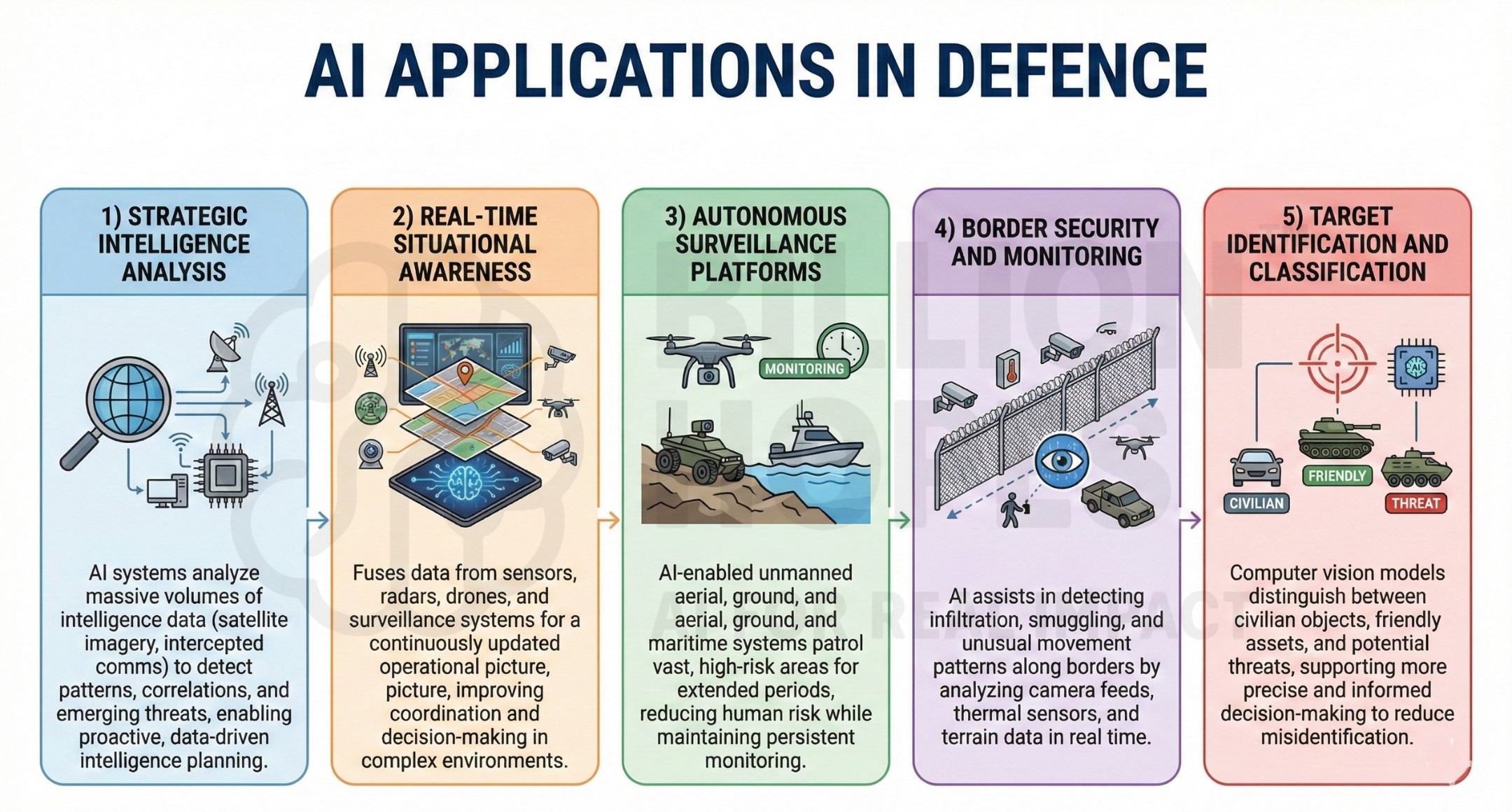
1. Strategic intelligence analysis
AI systems analyse massive volumes of intelligence data – from satellite imagery to intercepted communications – helping analysts detect patterns, correlations, and emerging threats that would otherwise remain hidden. This capability allows defence organizations to move from reactive assessments to proactive, data-driven intelligence planning.
2. Real-time situational awareness
By fusing data from sensors, radars, drones, and surveillance systems, AI provides a continuously updated operational picture, allowing commanders to understand complex environments at a glance. This shared, real-time view improves coordination, reduces uncertainty, and supports faster, more informed decisions during rapidly evolving situations.
3. Autonomous surveillance platforms
AI-enabled unmanned aerial, ground, and maritime systems can patrol vast areas for extended periods, reducing human risk while maintaining persistent monitoring capabilities. These platforms enable continuous coverage in remote or high-risk regions where sustained human presence would be difficult or dangerous.
4. Border security and monitoring
AI assists in detecting infiltration, smuggling, and unusual movement patterns along borders by analysing camera feeds, thermal sensors, and terrain data in real time. This strengthens border management by enabling earlier detection of potential threats and reducing reliance on manual surveillance alone.
5. Target identification and classification
Computer vision models help distinguish between civilian objects, friendly assets, and potential threats, supporting more precise and informed decision-making. This capability reduces misidentification risks and supports more controlled use of force in complex and crowded operational environments. An excellent collection of learning videos awaits you on our Youtube channel.
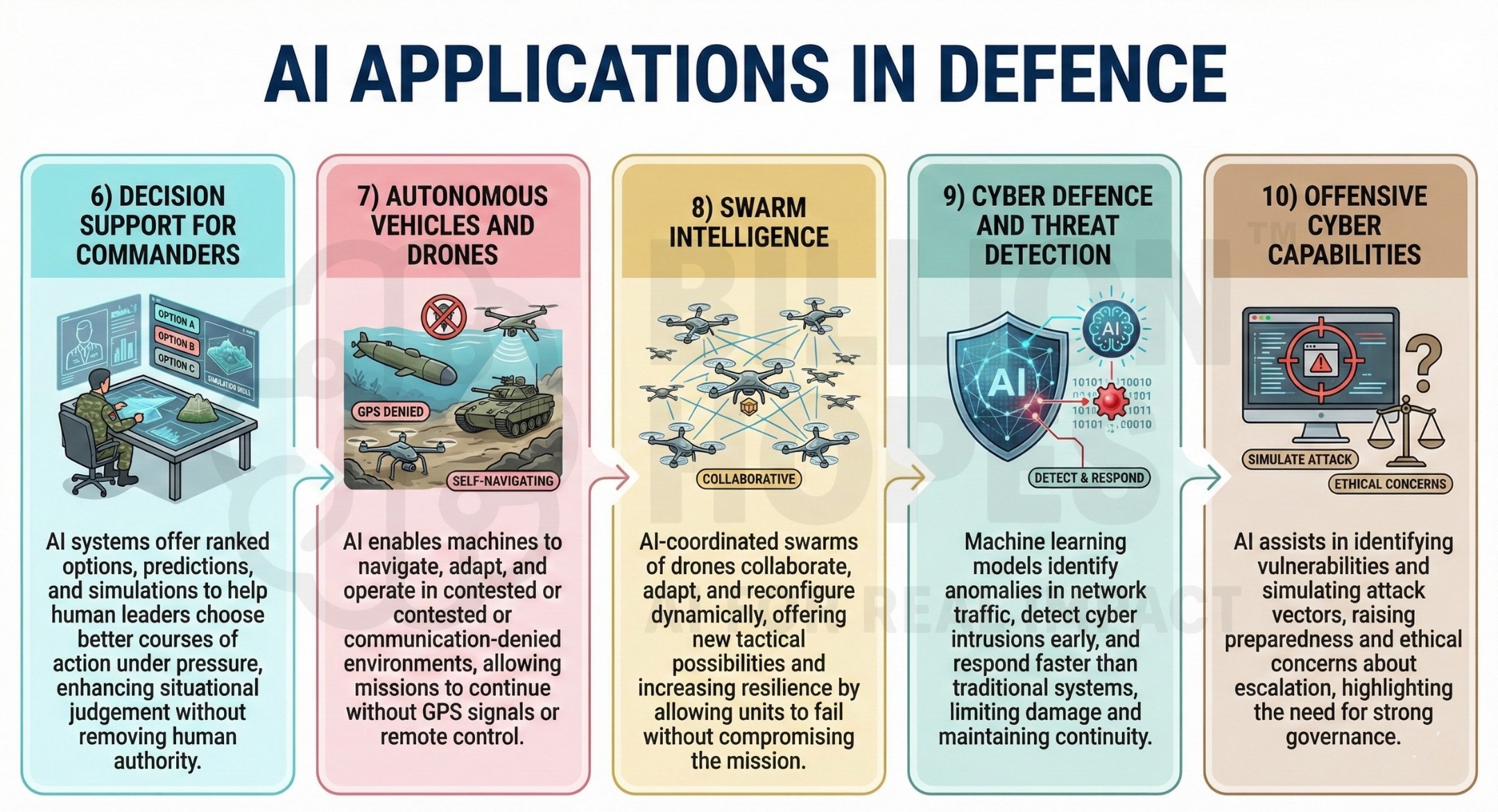
6. Decision support for commanders
Rather than making decisions autonomously, AI systems offer ranked options, predictions, and simulations that help human leaders choose better courses of action under pressure. By rapidly evaluating multiple scenarios, these systems enhance situational judgement without removing human authority from critical decisions.
7. Autonomous vehicles and drones
From reconnaissance drones to autonomous underwater vehicles, AI enables machines to navigate, adapt, and operate in contested or communication-denied environments. This autonomy allows missions to continue even when GPS signals or remote control links are disrupted or unavailable.
8. Swarm intelligence
AI-coordinated swarms of drones can collaborate, adapt, and reconfigure dynamically, offering new tactical possibilities while reducing dependence on centralized control. Such swarms increase resilience by allowing individual units to fail or be replaced without compromising the overall mission.
9. Cyber defence and threat detection
Machine learning models identify anomalies in network traffic, detect cyber intrusions early, and respond faster than traditional rule-based security systems. This early detection capability helps defence networks limit damage, contain breaches, and maintain operational continuity during cyber incidents.
10. Offensive cyber capabilities
AI assists in identifying system vulnerabilities and simulating attack vectors, raising both defensive preparedness and ethical concerns about escalation. This dual-use nature highlights the need for strong governance frameworks to manage risks while maintaining strategic deterrence. A constantly updated Whatsapp channel awaits your participation.
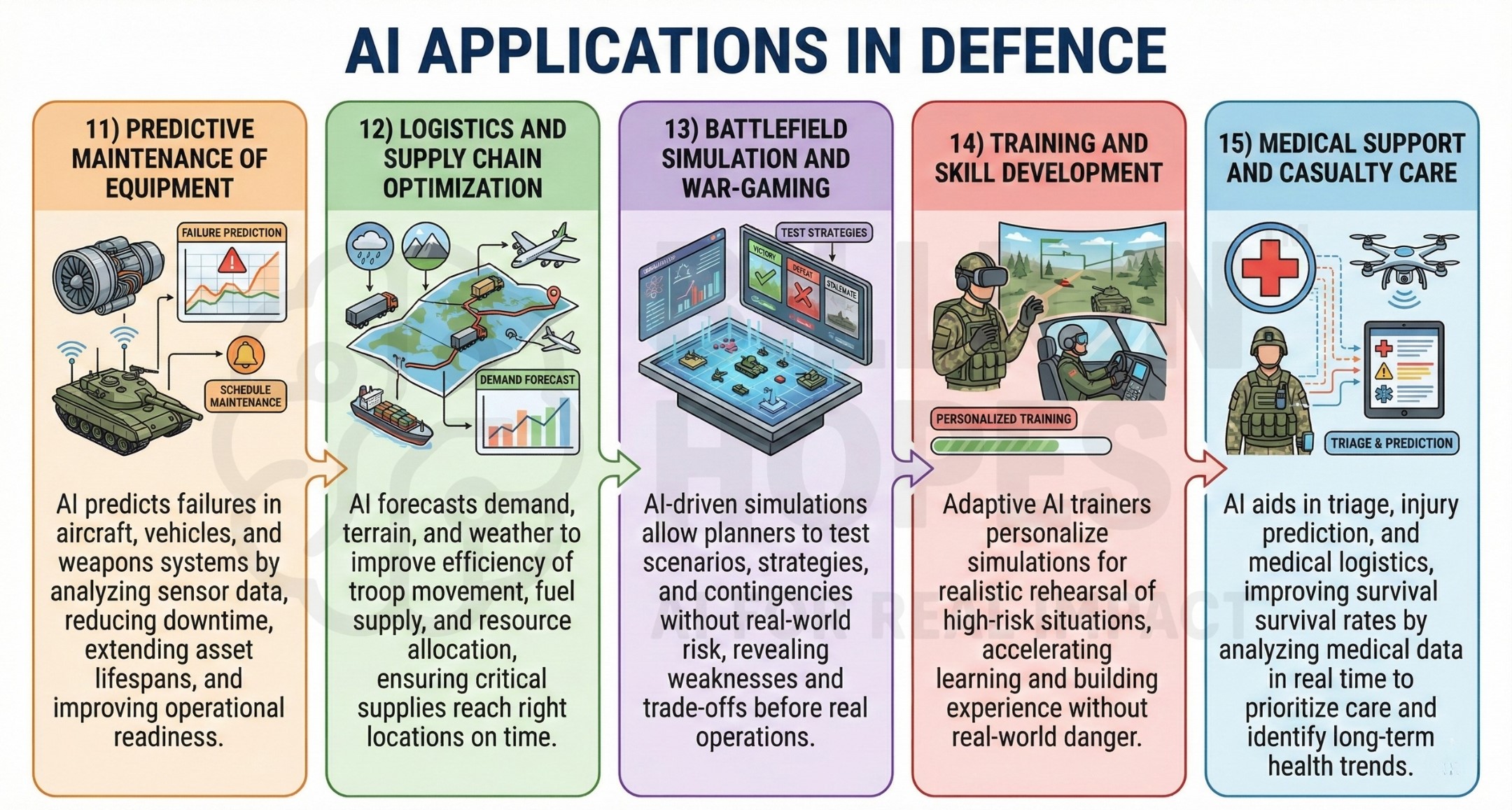
11. Predictive maintenance of equipment
AI predicts failures in aircraft, vehicles, and weapons systems by analysing sensor data, reducing downtime and extending asset lifespans. This proactive approach improves operational readiness while lowering maintenance costs and unexpected equipment failures.
12. Logistics and supply chain optimization
By forecasting demand, terrain constraints, and weather conditions, AI improves the efficiency of troop movement, fuel supply, and resource allocation. This ensures that critical supplies reach the right locations at the right time, even in complex and rapidly changing operational environments.
13. Battlefield simulation and war-gaming
AI-driven simulations allow defence planners to test scenarios, strategies, and contingencies repeatedly without real-world risk or cost. These simulations support better preparedness by revealing potential weaknesses and trade-offs before decisions are implemented in real operations.
14. Training and skill development
Adaptive AI trainers personalise simulations for soldiers and pilots, enabling realistic rehearsal of high-risk situations in controlled environments. This approach accelerates learning while allowing personnel to build experience and confidence without exposure to real-world danger. With some basic training, even non-AI natives can pick things fast.
15. Medical support and casualty care
AI aids in triage, injury prediction, and medical logistics, improving survival rates and readiness during and after combat operations. By analysing medical data in real time, these systems help prioritise care when resources are limited and decisions must be made quickly. They also support long-term planning by identifying health trends that affect troop readiness and recovery. Excellent individualised mentoring programmes available.
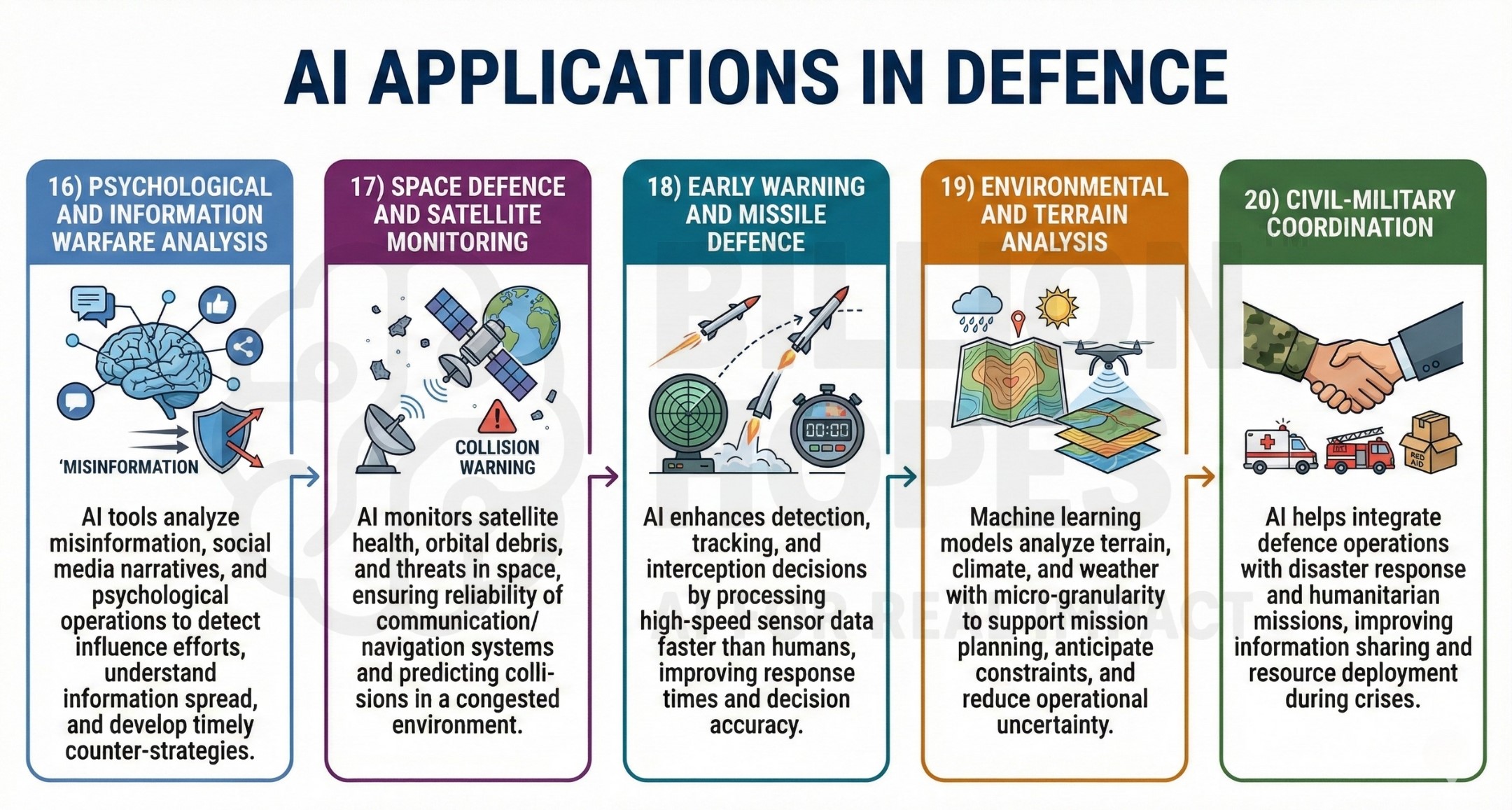
16. Psychological and information warfare analysis
AI tools analyse misinformation campaigns, social media narratives, and psychological operations to detect influence efforts and counter them effectively. This enables defence organizations to better understand how information spreads and influences public perception during conflicts. It also supports the development of timely counter-strategies to protect morale and maintain informational integrity.
17. Space defence and satellite monitoring
AI monitors satellite health, orbital debris, and potential threats in space, an increasingly critical domain for communication and navigation. This capability helps ensure the reliability of satellite-based communication, navigation, and reconnaissance systems. By predicting collisions or system failures, AI supports preventive action in an increasingly congested orbital environment. It also contributes to space situational awareness, which is essential as space becomes a contested strategic domain.
18. Early warning and missile defence
AI enhances detection, tracking, and interception decisions by processing high-speed sensor data faster than human operators alone. This improves response times and decision accuracy in scenarios where seconds can determine the effectiveness of defensive action. The Russia-Ukraine was that raged for several years starting early-2022 saw many of these applications.
19. Environmental and terrain analysis
Machine learning models analyse terrain, climate, and weather to support mission planning and reduce operational uncertainty. This allows forces to anticipate environmental constraints and adapt plans to changing conditions before operations begin. The micro-granularity possible is quite unmatched by other means.
20. Civil-military coordination
AI helps integrate defence operations with disaster response, humanitarian missions, and emergency management during crises. This coordination improves information sharing and resource deployment when military and civilian agencies must act together under time pressure. Subscribe to our free AI newsletter now.
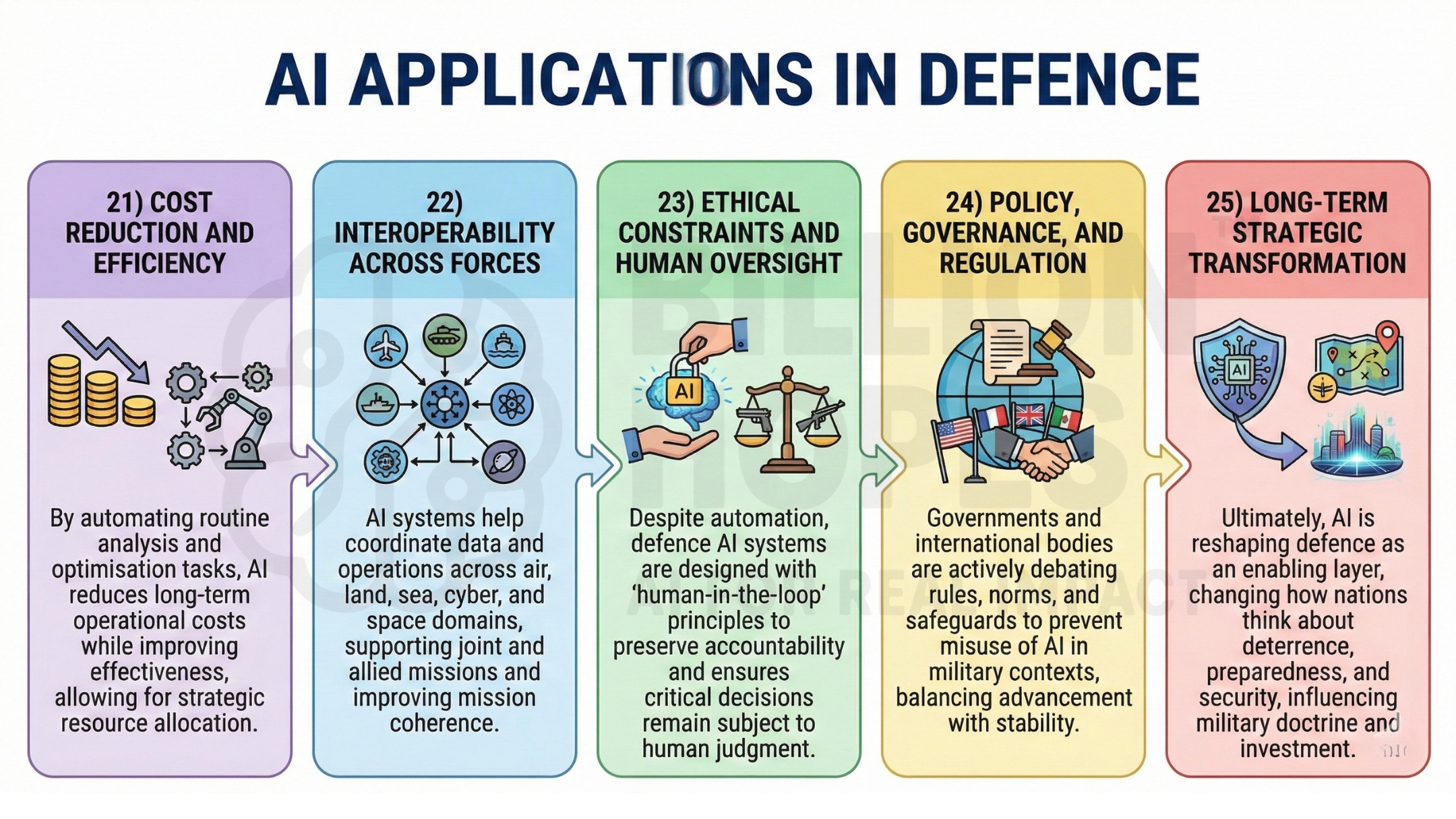
21. Cost reduction and efficiency
By automating routine analysis and optimisation tasks, AI reduces long-term operational costs while improving effectiveness. This allows defence organisations to allocate resources more strategically while maintaining capability levels in an environment of increasing technological complexity.
22. Interoperability across forces
AI systems help coordinate data and operations across air, land, sea, cyber, and space domains, supporting joint and allied missions. This integrated approach enhances collaboration among different forces and improves overall mission coherence across multiple operational domains.
23. Ethical constraints and human oversight
Despite automation, defence AI systems are increasingly designed with “human-in-the-loop” principles to preserve accountability and control.
24. Policy, governance, and regulation
Governments and international bodies are actively debating rules, norms, and safeguards to prevent misuse of AI in military contexts.
25. Long-term strategic transformation
Ultimately, AI is reshaping defence not as a single technology but as an enabling layer—changing how nations think about deterrence, preparedness, and security. Upgrade your AI-readiness with our masterclass.
Final reflection
Just as mechanisation and digitisation transformed defence in earlier eras, AI represents the next structural shift. Its value lies not in replacing humans, but in extending human capability—making defence systems faster, smarter, and more resilient in an increasingly complex world.
Share this with the world
Related Articles