AI in Marketing, Growth & Brand Intelligence Careers
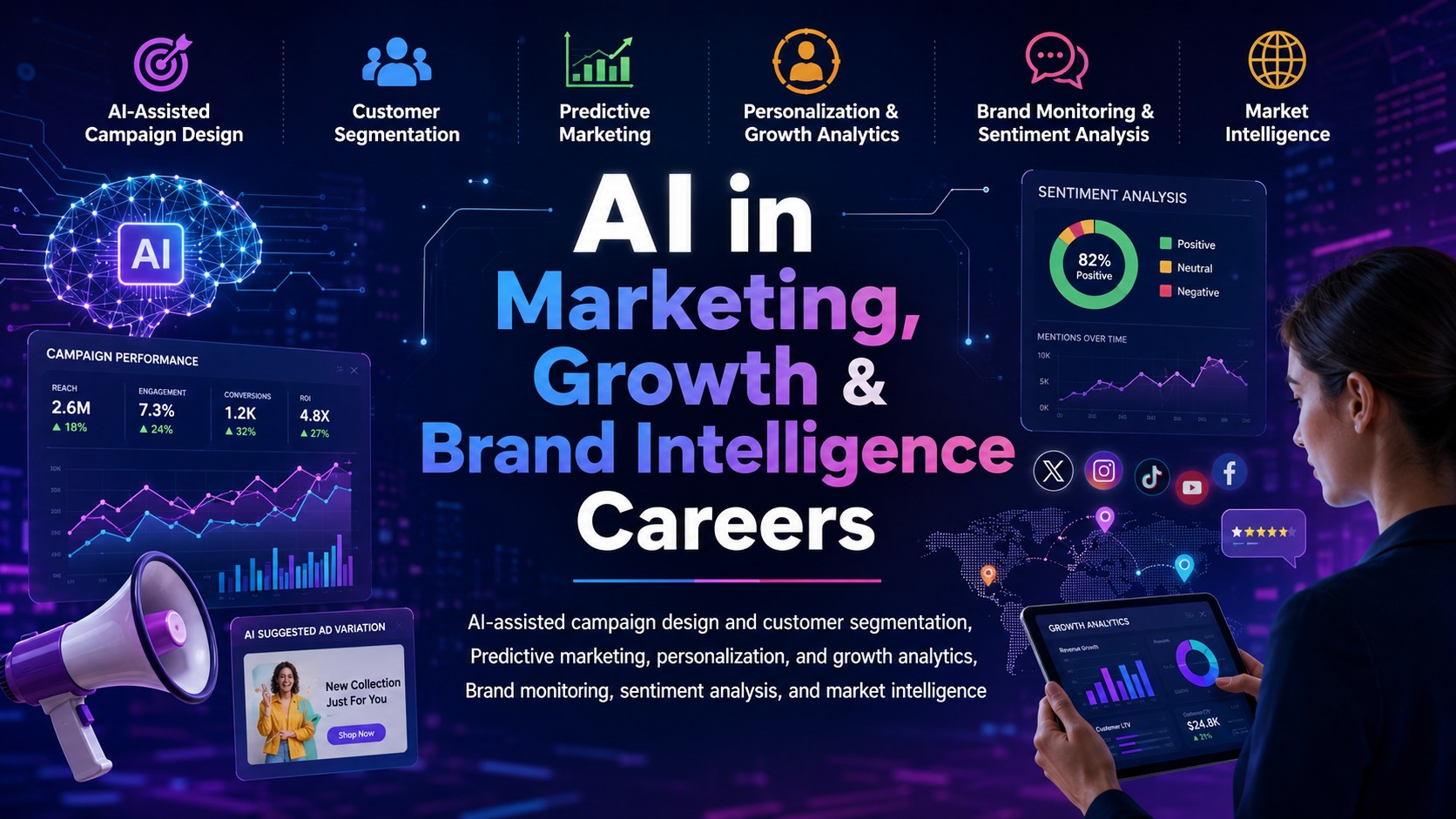
AI in Marketing, Growth & Brand Intelligence Careers
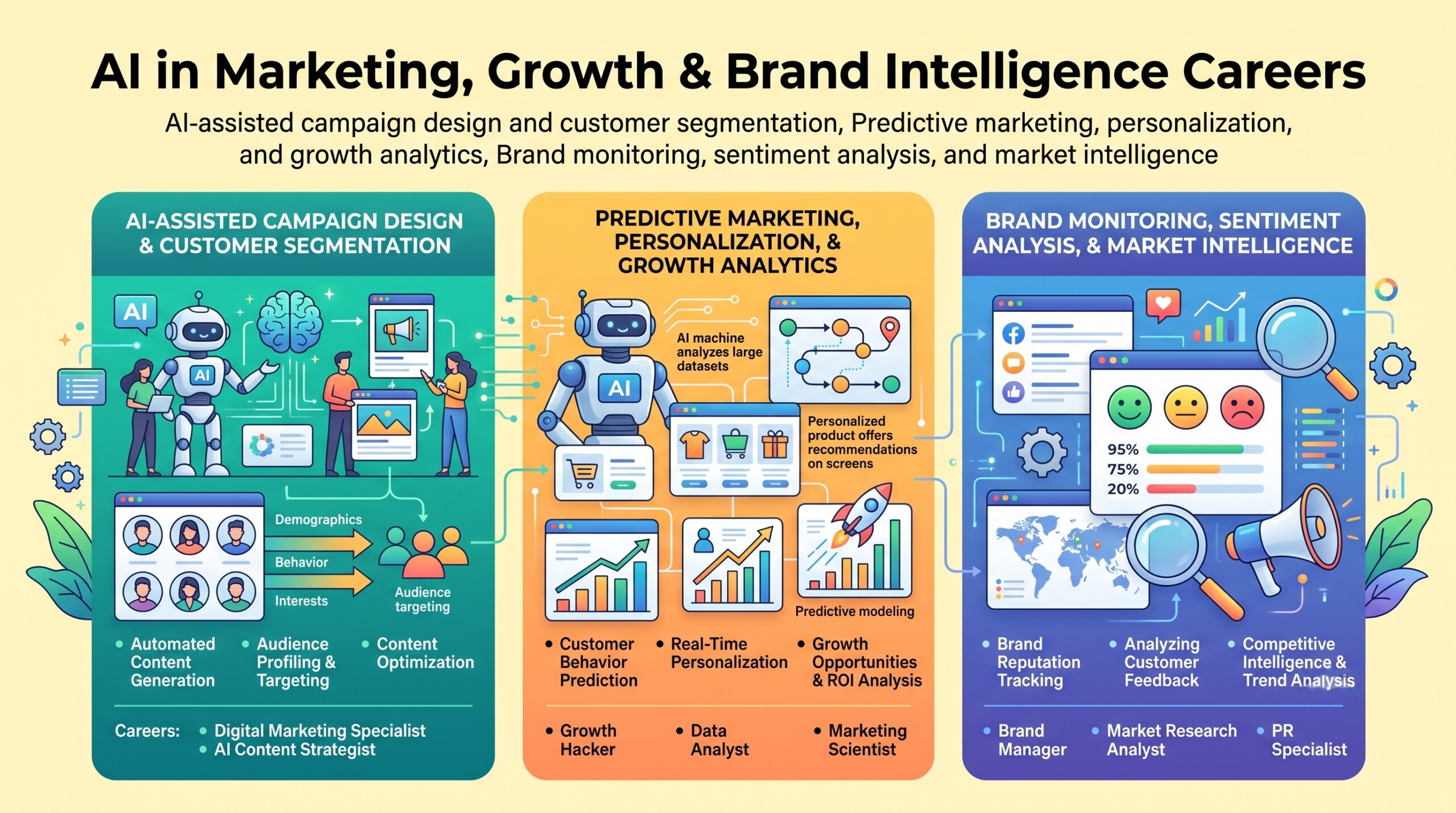
AI-assisted campaign design and customer segmentation, Predictive marketing, personalization, and growth analytics, Brand monitoring, sentiment analysis, and market intelligence
Introduction
Marketing has always depended on creativity, customer understanding, timing, persuasion, and measurement. What has changed by June 2026 is the speed and intelligence with which these activities can now be performed. Artificial intelligence is no longer limited to writing captions, generating images, or automating email subject lines. It is increasingly becoming part of the full marketing operating system: research, segmentation, campaign design, media planning, personalization, experimentation, customer journey orchestration, brand monitoring, sentiment analysis, and growth analytics.
This does not mean AI is replacing marketing professionals. The more accurate view is that AI is changing what good marketing talent must know. Marketers are expected to understand data, prompts, audience behaviour, automation, analytics, experimentation, brand risk, privacy, and customer experience. AI can generate options, detect patterns, forecast outcomes, and recommend actions, but humans still define the brand promise, ethical boundaries, emotional tone, business goals, and cultural relevance.
The career opportunity is therefore large. Marketing is becoming a hybrid field where creative judgement, commercial thinking, analytics, and AI fluency come together. Gartner reported in May 2026 that marketing leaders expect AI-driven automation of marketing work to more than double, from 16% in 2026 to 36% by 2028. McKinsey’s June 2026 view of the future of marketing identifies five AI-shaped pillars: insights, creativity, personalization, agentic commerce, and orchestration.
For students, working professionals, agencies, consultants, and entrepreneurs, this creates a new career category: AI-enabled marketing, growth, and brand intelligence. An excellent collection of learning videos awaits you on our Youtube channel.
Let’s dive deep into this.
1. AI-assisted campaign design is changing the creative workflow
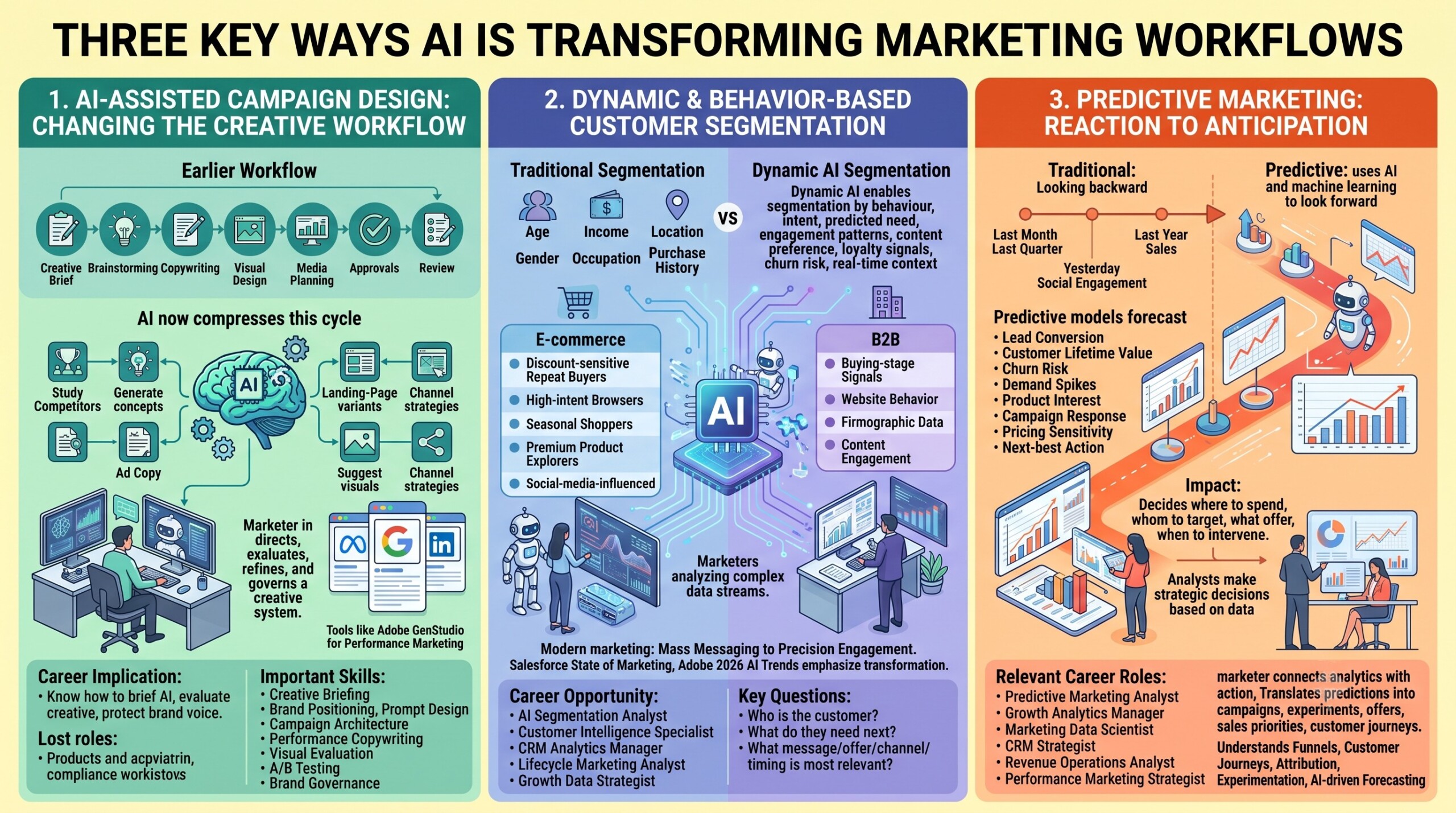
Earlier, campaign design often began with a creative brief, followed by brainstorming, copywriting, visual design, media planning, approvals, and performance review. AI now compresses many parts of this cycle. A marketer can use AI to study competitors, generate campaign concepts, create audience-specific messages, build landing-page variants, produce ad copy, suggest visuals, and recommend channel strategies.
This does not remove the need for human creativity. Instead, it changes the role of the marketer from “one who manually creates every asset” to “one who directs, evaluates, refines, and governs a creative system.” AI can generate a hundred campaign ideas, but the marketer must know which one fits the brand, audience, culture, product promise, and business objective.
Tools such as Adobe GenStudio for Performance Marketing are built around this shift. Adobe describes GenStudio as a platform for creating on-brand marketing content at scale, generating copy and creative variations for different channels and audiences while maintaining brand consistency and compliance. Adobe also announced AI-powered GenStudio capabilities in 2025 for video and display ad campaigns across platforms including Amazon Ads, Google Campaign Manager 360, LinkedIn, and Meta.
The career implication is clear: future campaign managers must know how to brief AI tools properly, evaluate AI-generated creative, protect brand voice, and connect creative output to measurable performance. Prompting is useful, but strategic judgement is more important. Important skills in this area include creative briefing, brand positioning, prompt design, campaign architecture, performance copywriting, visual evaluation, A/B testing, and brand governance.
2. Customer segmentation is becoming more dynamic and behaviour-based
Traditional customer segmentation often used broad categories such as age, income, location, gender, occupation, or purchase history. AI enables more dynamic segmentation based on behaviour, intent, predicted need, engagement patterns, content preference, loyalty signals, churn risk, and real-time context.
For example, an e-commerce brand may no longer treat all “young urban buyers” as one segment. AI can identify micro-segments such as discount-sensitive repeat buyers, high-intent browsers, seasonal shoppers, premium product explorers, likely churners, social-media-influenced buyers, and customers who need education before purchase. In B2B marketing, AI can segment accounts by buying-stage signals, website behaviour, firmographic data, content engagement, intent data, and likelihood to convert.
This matters because modern marketing is moving from mass messaging to precision engagement. Salesforce’s latest State of Marketing report is based on insights from nearly 4,500 marketers worldwide and focuses on AI, data, personalization, and the move toward agentic marketing. Adobe’s 2026 AI and Digital Trends report also emphasizes that generative and agentic AI are transforming the customer journey faster than many organizations can adapt.
The career opportunity here is the rise of roles such as AI segmentation analyst, customer intelligence specialist, CRM analytics manager, lifecycle marketing analyst, and growth data strategist. These professionals need to understand both marketing psychology and data modelling.
A strong segmentation professional should be able to answer three questions: Who is the customer? What is the customer likely to need next? What message, offer, channel, and timing will be most relevant without becoming intrusive? A constantly updated Whatsapp channel awaits your participation.

3. Predictive marketing is shifting teams from reaction to anticipation
Marketing teams have traditionally looked backward: last month’s campaign performance, last quarter’s leads, last year’s festive-season sales, or yesterday’s social-media engagement. Predictive marketing uses AI and machine learning to look forward. It estimates what customers are likely to do next and helps brands act before the opportunity is lost.
Predictive models can forecast lead conversion, customer lifetime value, churn risk, demand spikes, product interest, campaign response, pricing sensitivity, and next-best action. In growth marketing, this is extremely valuable because budgets are limited and attention is scarce. AI helps teams decide where to spend, whom to target, what offer to show, and when to intervene.
For careers, predictive marketing creates demand for people who can connect analytics with action. It is not enough to build dashboards. Professionals must translate predictions into campaigns, experiments, offers, sales priorities, and customer journeys.
Relevant career roles include predictive marketing analyst, growth analytics manager, marketing data scientist, CRM strategist, revenue operations analyst, and performance marketing strategist. A marketer who understands conversion funnels, customer journeys, attribution, experimentation, and AI-driven forecasting will be more valuable than one who only knows how to run ads manually.
4. Personalization is moving from “Dear customer” to real-time experience design
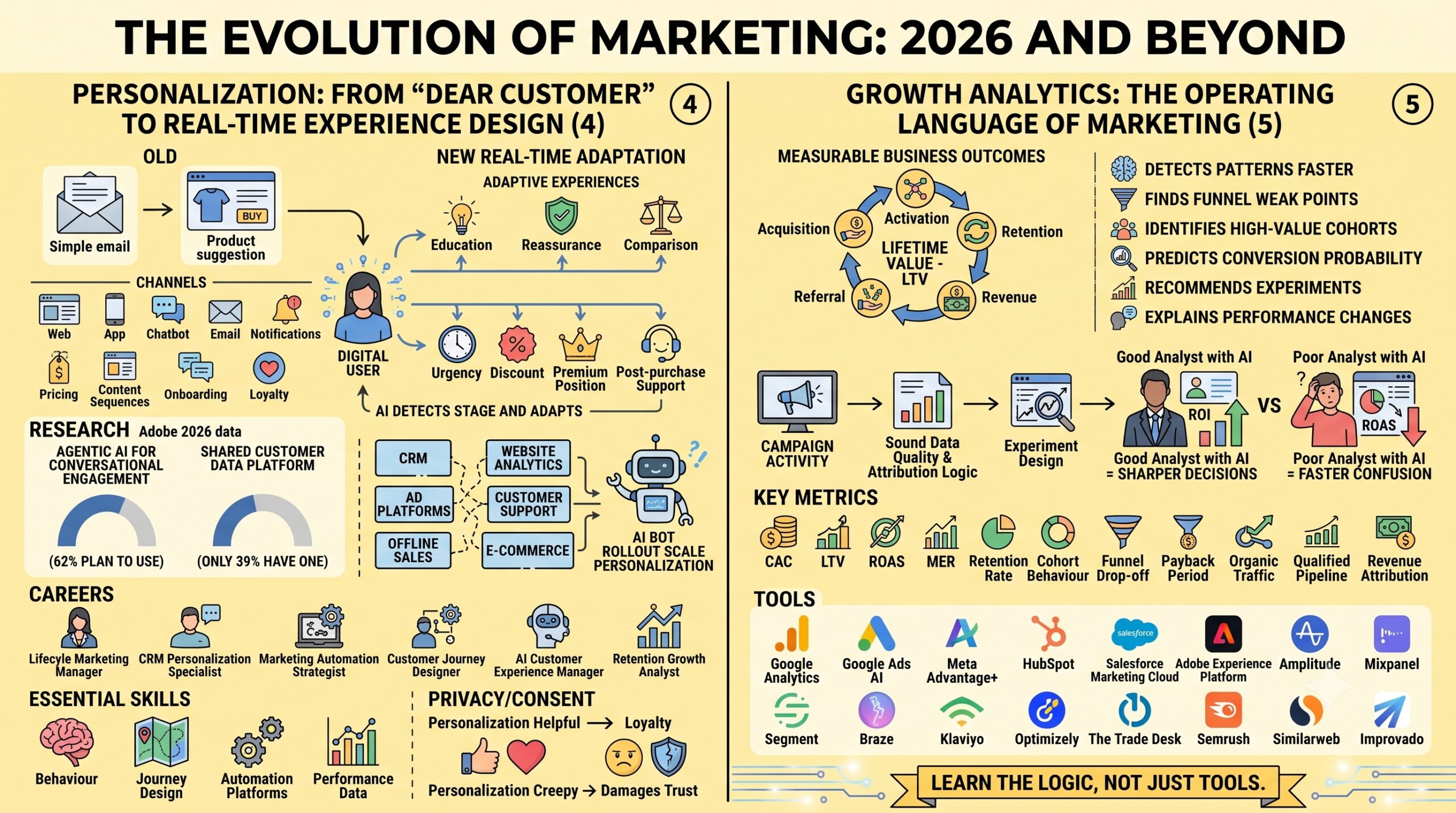
Personalization used to mean adding a customer’s name to an email or recommending products based on past purchases. In 2026, personalization is becoming broader and more real time. It includes personalized web experiences, product recommendations, email journeys, app notifications, chatbot responses, pricing offers, content sequences, onboarding flows, and loyalty experiences.
The goal is not merely to personalize content but to personalize relevance. A customer may need education, reassurance, comparison, urgency, discount, premium positioning, or post-purchase support depending on their current stage. AI helps detect that stage and adapt the experience.
Adobe’s 2026 customer engagement research says 62% of companies plan to use agentic AI for conversational customer engagement over the next 18 months, but only 39% have a shared customer data platform capable of supporting large-scale rollout. This gap is important. Personalization does not work well when customer data is fragmented across CRM, website analytics, ad platforms, customer support, offline sales, and e-commerce systems.
The careers connected to personalization include lifecycle marketing manager, CRM personalization specialist, marketing automation strategist, customer journey designer, AI customer experience manager, and retention growth analyst. The best professionals in this field combine four abilities: understanding customer behaviour, designing journeys, using automation platforms, and reading performance data. They also understand privacy and consent. Personalization that feels helpful builds loyalty; personalization that feels creepy damages trust. Excellent individualised mentoring programmes available.
5. Growth analytics is becoming the operating language of marketing
Growth marketing is about measurable business outcomes: acquisition, activation, retention, referral, revenue, and lifetime value. AI strengthens growth analytics by detecting patterns faster, finding weak points in funnels, identifying high-value cohorts, predicting conversion probability, recommending experiments, and explaining why performance changed.
This is important because marketing teams are under pressure to prove return on investment. AI can help connect campaign activity to business outcomes, but only if data quality, attribution logic, and experiment design are sound. A poor analyst with AI can create faster confusion. A good analyst with AI can create sharper decisions.
Growth analytics careers require comfort with metrics such as CAC, LTV, ROAS, MER, conversion rate, retention rate, churn, cohort behaviour, funnel drop-off, payback period, organic traffic, qualified pipeline, and revenue attribution. AI can help interpret these numbers, but professionals must understand what the numbers mean for business decisions.
Vendors and tools in this area include Google Analytics, Google Ads AI features, Meta Advantage+, HubSpot, Salesforce Marketing Cloud, Adobe Experience Platform, Amplitude, Mixpanel, Segment, Braze, Klaviyo, Optimizely, The Trade Desk, Semrush, Similarweb, and marketing data platforms such as Improvado. The career challenge is not learning every tool; it is learning the logic behind growth measurement.
6. Brand monitoring and sentiment analysis are becoming real-time intelligence functions
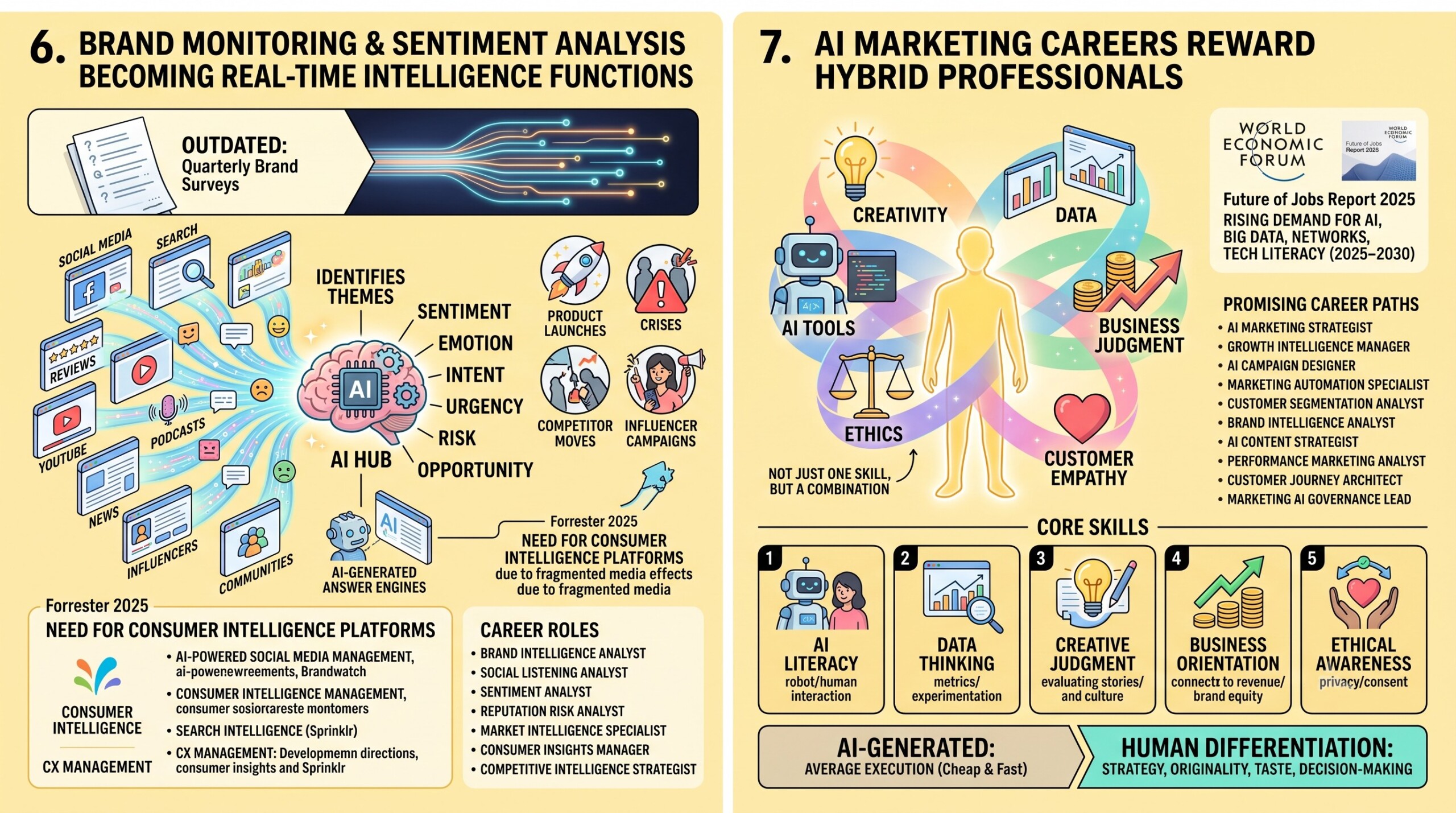
Brand intelligence is no longer just about quarterly brand surveys. Customers now express opinions continuously across social media, search, reviews, forums, YouTube, podcasts, news, influencers, app stores, communities, and AI-generated answer engines. Brands need to know what people are saying, how sentiment is changing, what topics are emerging, which complaints are spreading, and how competitors are being perceived.
AI helps by scanning large volumes of unstructured data and identifying themes, sentiment, emotion, intent, urgency, risk, and opportunity. This is especially useful during product launches, crises, political or cultural controversies, competitor moves, influencer campaigns, and customer-service failures.
Forrester wrote in late 2025 that fragmented media consumption and emerging formats are making it harder for marketers to track feedback, opinions, and sentiment across data sources in real time, increasing the need for consumer intelligence platforms. Brandwatch describes itself as an AI-powered social media management, consumer intelligence, influencer marketing, search intelligence, and GenAI monitoring suite. Sprinklr positions its platform as AI-native customer experience management across customer touchpoints.
Career roles in this area include brand intelligence analyst, social listening analyst, sentiment analyst, reputation risk analyst, market intelligence specialist, consumer insights manager, and competitive intelligence strategist. Subscribe to our free AI newsletter now.
7. AI marketing careers will reward hybrid professionals
The future marketing professional will not be only a copywriter, only a media buyer, only an analyst, or only a brand manager. The strongest careers will belong to hybrid professionals who can combine creativity, data, AI tools, business judgement, ethics, and customer empathy.
This is already visible in the labour market. The World Economic Forum’s Future of Jobs Report 2025 highlighted rising demand for technology-related skills such as AI, big data, networks, cybersecurity, and technological literacy across the 2025–2030 period. The promising career paths include AI marketing strategist, growth intelligence manager, AI campaign designer, marketing automation specialist, customer segmentation analyst, brand intelligence analyst, AI content strategist, performance marketing analyst, customer journey architect, and marketing AI governance lead.
The core skills for these careers include:
- AI literacy: knowing what AI can and cannot do, and how to use tools responsibly.
- Data thinking: understanding customer data, metrics, segmentation, and experimentation.
- Creative judgement: evaluating ideas, stories, visuals, tone, and cultural relevance.
- Business orientation: connecting campaigns to revenue, retention, market share, and brand equity.
- Ethical awareness: respecting privacy, consent, fairness, transparency, and brand trust.
The most important point is that AI will not make marketing easier for everyone. It will make average execution cheaper and faster. Therefore, human differentiation will come from strategy, originality, taste, interpretation, trust-building, and decision-making.
Conclusion
AI in marketing, growth, and brand intelligence is not a passing trend. By June 2026, it has become a structural change in how brands understand customers, design campaigns, personalize experiences, measure growth, and monitor reputation. The field is moving from manual campaign execution to intelligent orchestration; from broad segmentation to predictive micro-segmentation; from delayed reports to real-time growth analytics; and from occasional brand tracking to continuous market intelligence.
For careers, this is a major opportunity. AI will reduce the value of purely repetitive marketing tasks, but it will increase demand for professionals who can combine marketing sense with AI-enabled execution. The future belongs to marketers who can ask better questions, design better experiments, interpret richer data, protect brand trust, and convert intelligence into growth.
The best career strategy is not to become dependent on AI, nor to reject it. The best strategy is to become the kind of marketing professional who can lead AI: creatively, analytically, ethically, and commercially. In the coming years, brands will need people who understand both machines and markets, both data and desire, both automation and human emotion. That is where the strongest opportunities in AI marketing, growth, and brand intelligence careers will emerge. Upgrade your AI-readiness with our masterclass.