AI Value Measurement, ROI & Impact Careers
AI Value Measurement, ROI & Impact Careers
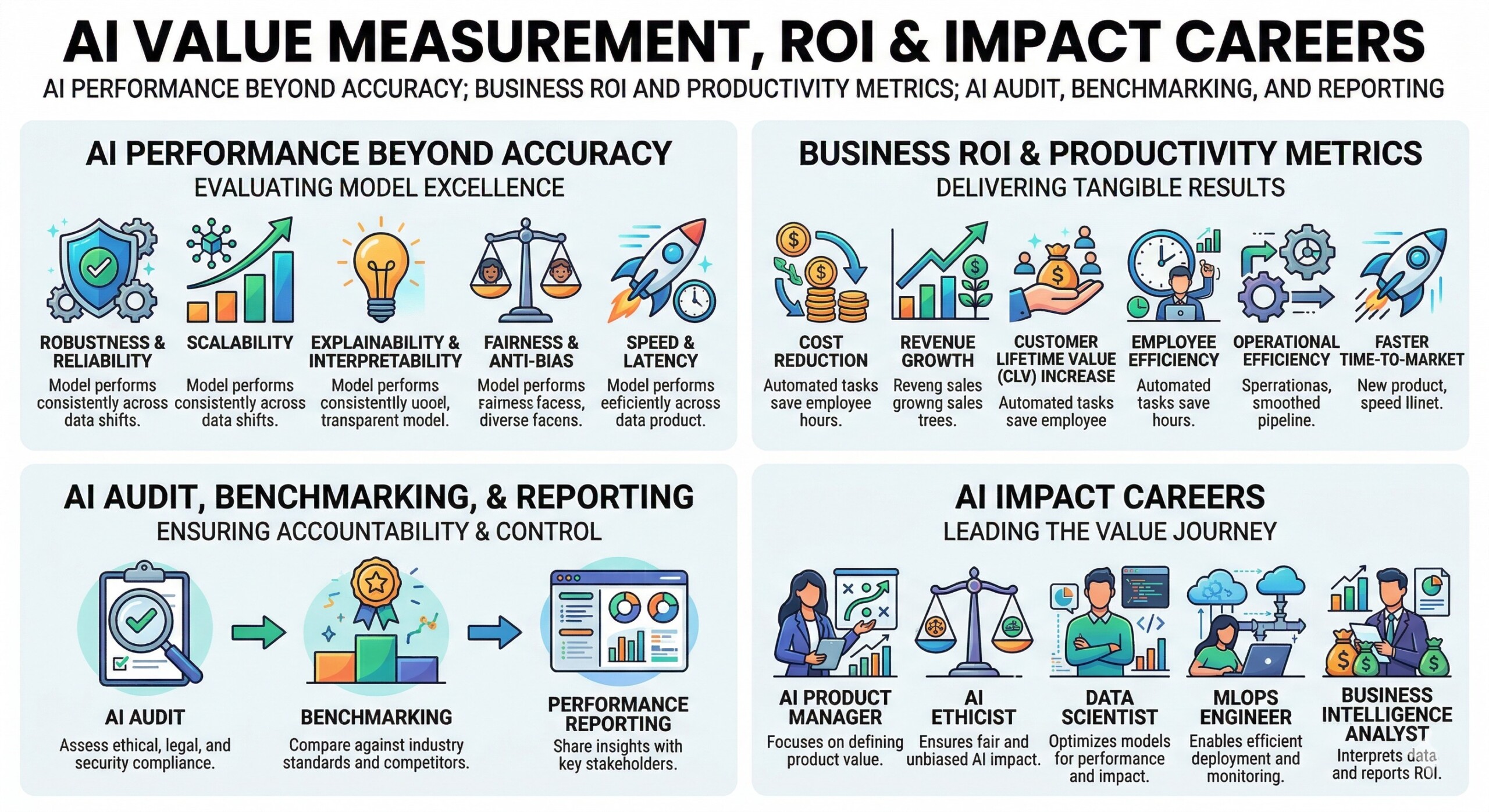
Measuring AI performance beyond accuracy; Business ROI and productivity metrics; AI audit, benchmarking, and reporting
Introduction
Artificial Intelligence is no longer an experimental technology confined to research labs. It is now deeply embedded in business operations, decision-making systems, and customer experiences. As organizations invest heavily in AI, a critical question emerges: How do we measure its true value?
Traditional evaluation methods in AI have focused primarily on technical metrics such as accuracy, precision, recall, and F1 score. While these metrics are important, they do not capture the full picture. A model can be highly accurate yet fail to generate meaningful business impact. Conversely, a moderately accurate system may drive significant cost savings or productivity improvements.
This shift in perspective has led to the emergence of a broader discipline that focuses on AI value measurement, return on investment (ROI), and real-world impact. Organizations now need frameworks that connect AI performance to business outcomes, operational efficiency, and strategic goals. At the same time, this evolution has created new career opportunities. Roles focused on AI auditing, benchmarking, reporting, and impact assessment are becoming increasingly important as companies seek accountability, transparency, and measurable value from their AI initiatives. An excellent collection of learning videos awaits you on our Youtube channel.
Let’s dive deep into the topic.
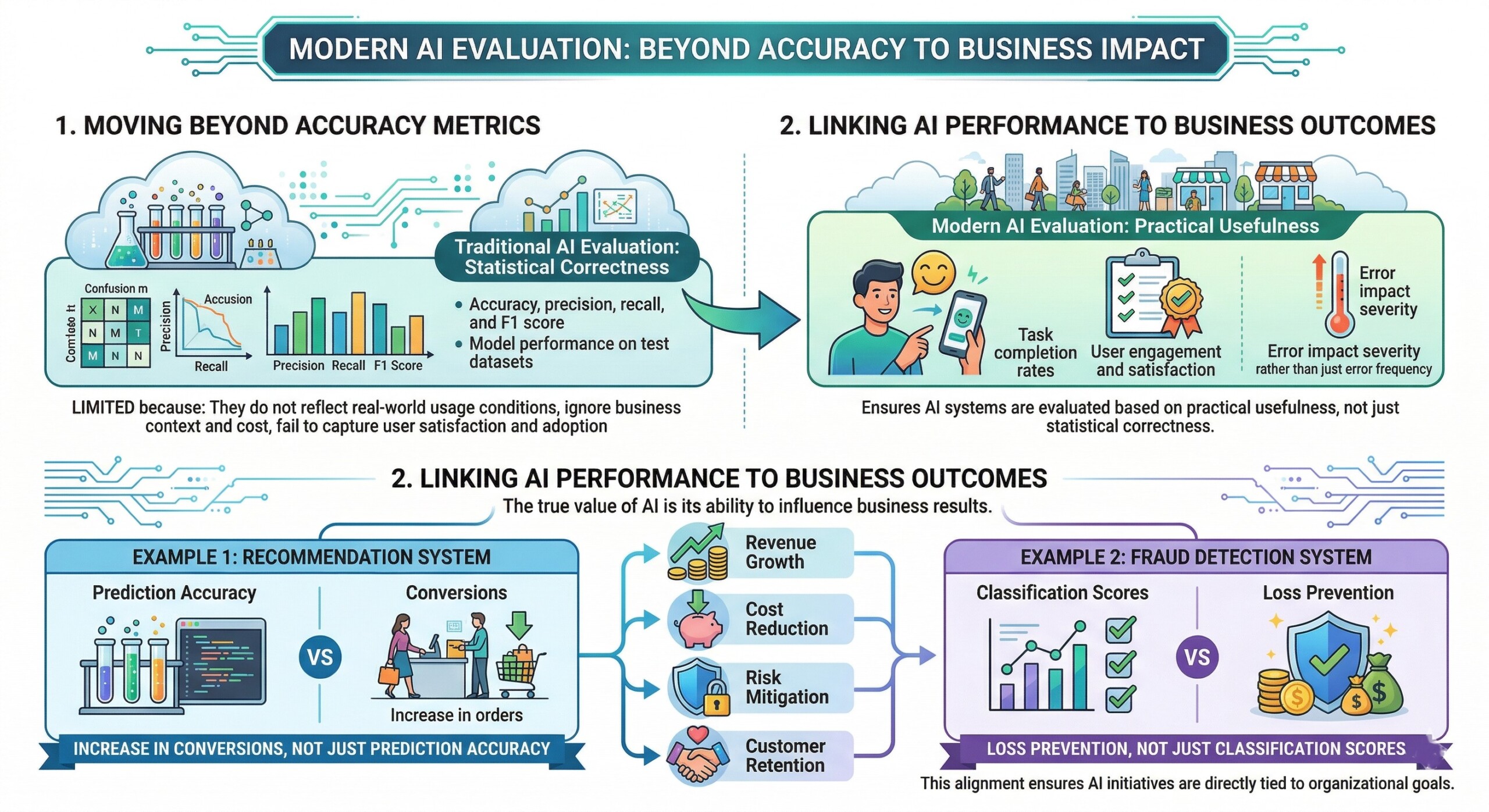
1. Moving beyond accuracy metrics
Traditional AI evaluation focuses on:
- Accuracy, precision, recall, and F1 score
- Model performance on test datasets
However, these metrics are limited because:
- They do not reflect real-world usage conditions
- They ignore business context and cost implications
- They fail to capture user satisfaction and adoption
Modern AI evaluation includes:
- Task completion rates
- User engagement and satisfaction
- Error impact severity rather than just error frequency
This shift ensures that AI systems are evaluated based on practical usefulness, not just statistical correctness.
2. Linking AI performance to Business Outcomes
The true value of AI lies in its ability to influence business results. This requires mapping model outputs to measurable outcomes such as:
- Revenue growth
- Cost reduction
- Risk mitigation
- Customer retention
For example:
- A recommendation system should be evaluated based on increase in conversions, not just prediction accuracy
- A fraud detection system should be assessed by loss prevention, not just classification scores
This alignment ensures AI initiatives are directly tied to organizational goals. A constantly updated Whatsapp channel awaits your participation.
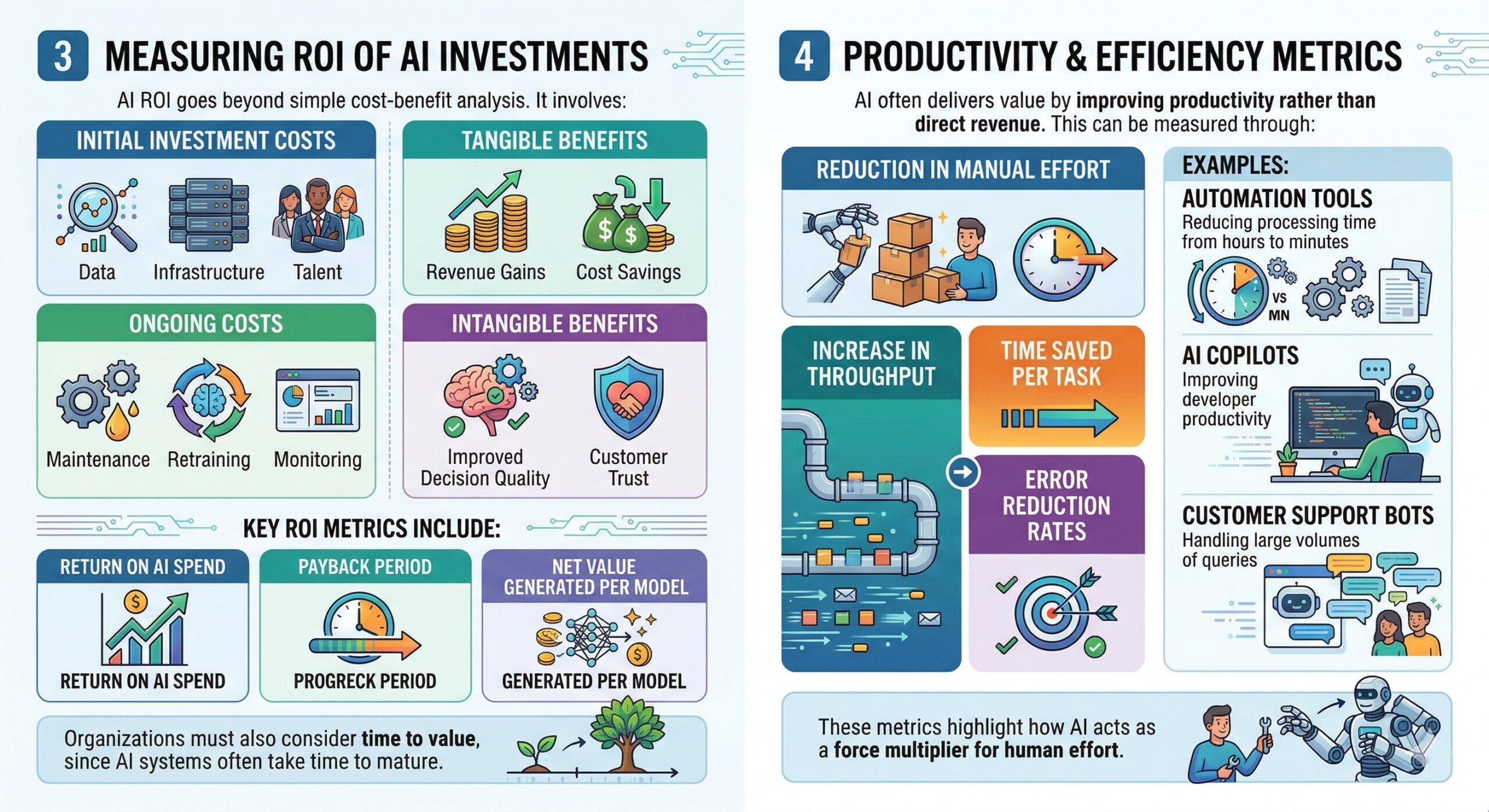
3. Measuring ROI of AI investments
AI ROI goes beyond simple cost-benefit analysis. It involves:
- Initial investment costs such as data, infrastructure, and talent
- Ongoing costs such as maintenance, retraining, and monitoring
- Tangible benefits such as revenue gains and cost savings
- Intangible benefits such as improved decision quality and customer trust
Key ROI metrics include:
- Return on AI spend
- Payback period
- Net value generated per model
Organizations must also consider time to value, since AI systems often take time to mature.
4. Productivity and Efficiency Metrics
AI often delivers value by improving productivity rather than direct revenue. This can be measured through:
- Reduction in manual effort
- Time saved per task
- Increase in throughput
- Error reduction rates
Examples:
- Automation tools reducing processing time from hours to minutes
- AI copilots improving developer productivity
- Customer support bots handling large volumes of queries
These metrics highlight how AI acts as a force multiplier for human effort. Excellent individualised mentoring programmes available.
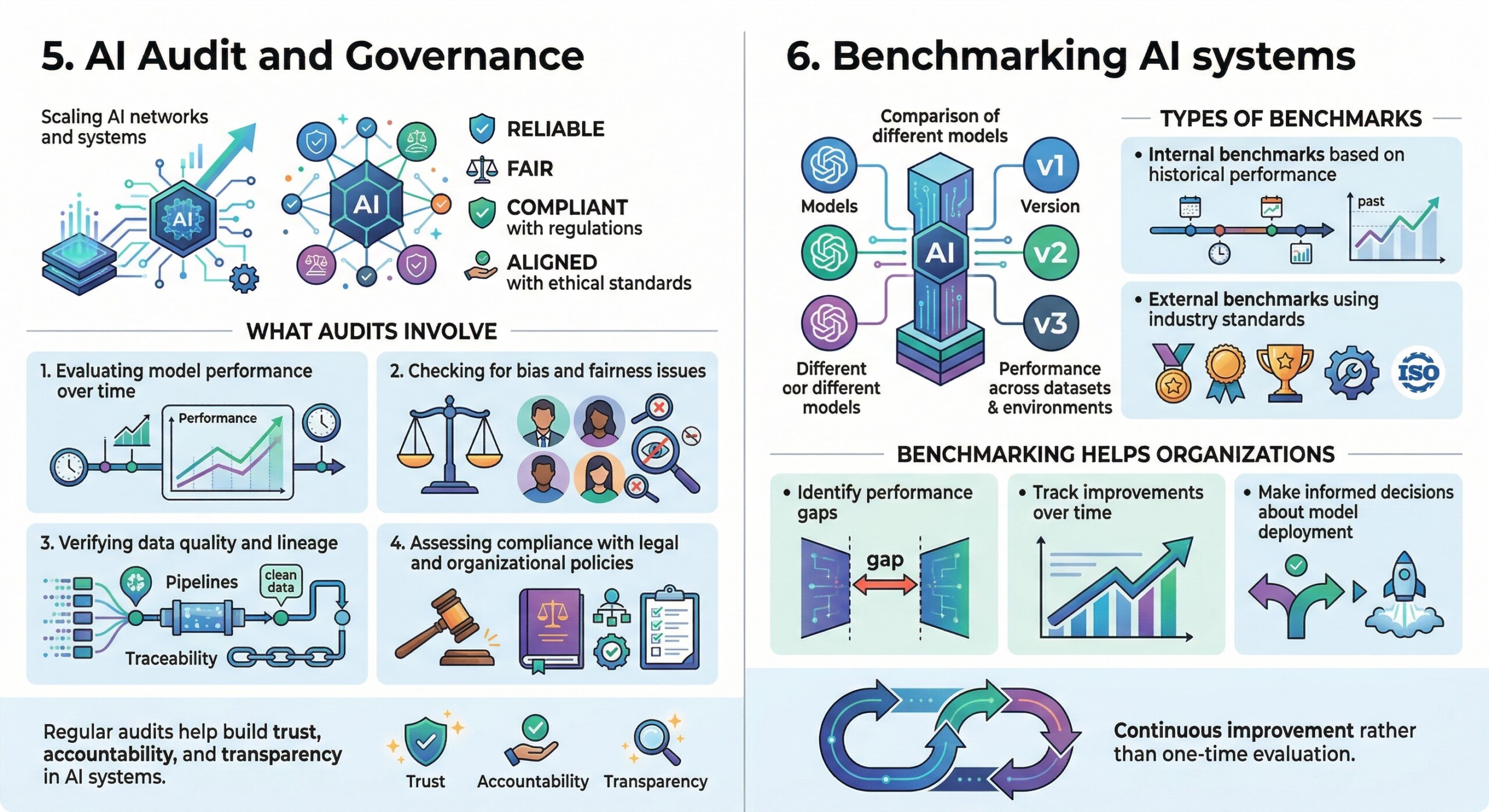
5. AI Audit and Governance
As AI systems scale, organizations must ensure they are:
- Reliable
- Fair
- Compliant with regulations
- Aligned with ethical standards
AI audits involve:
- Evaluating model performance over time
- Checking for bias and fairness issues
- Verifying data quality and lineage
- Assessing compliance with legal and organizational policies
Regular audits help build trust, accountability, and transparency in AI systems.
6. Benchmarking AI systems
Benchmarking provides a structured way to compare:
- Different models
- Different versions of the same model
- Performance across datasets or environments
It includes:
- Internal benchmarks based on historical performance
- External benchmarks using industry standards
Benchmarking helps organizations:
- Identify performance gaps
- Track improvements over time
- Make informed decisions about model deployment
It ensures continuous improvement rather than one-time evaluation. Subscribe to our free AI newsletter now.
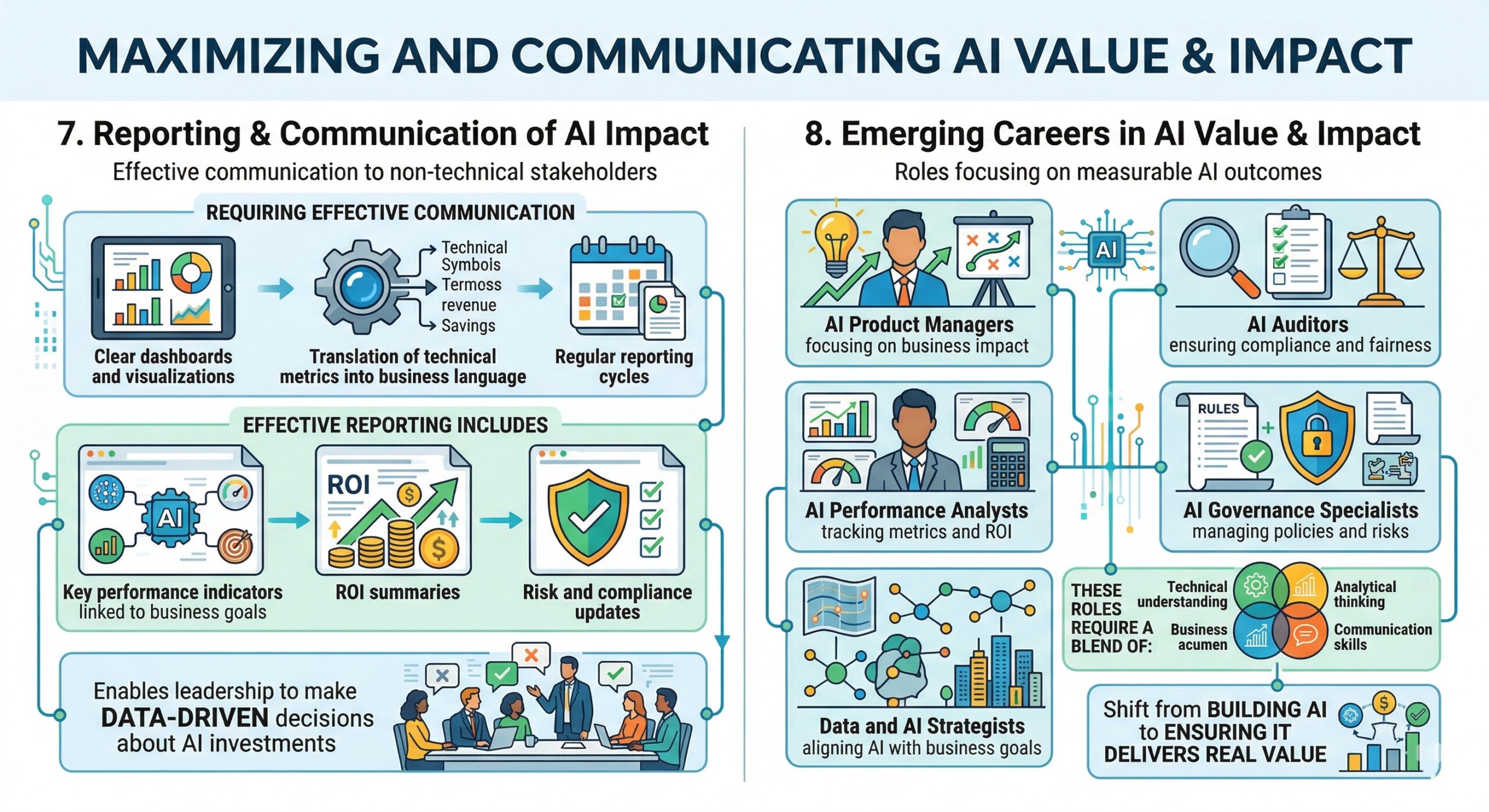
7. Reporting and Communication of AI Impact
AI value must be communicated effectively to stakeholders who may not have technical backgrounds. This requires:
- Clear dashboards and visualizations
- Translation of technical metrics into business language
- Regular reporting cycles
Effective reporting includes:
- Key performance indicators linked to business goals
- ROI summaries
- Risk and compliance updates
This enables leadership to make data-driven decisions about AI investments.
8. Emerging Careers in AI value and impact
As organizations prioritize measurable AI outcomes, new career roles are emerging:
- AI Product Managers focusing on business impact
- AI Auditors ensuring compliance and fairness
- AI Performance Analysts tracking metrics and ROI
- AI Governance Specialists managing policies and risks
- Data and AI Strategists aligning AI with business goals
These roles require a blend of:
- Technical understanding
- Business acumen
- Analytical thinking
- Communication skills
They represent a shift from building AI to ensuring it delivers real value. Upgrade your AI-readiness with our masterclass.
Conclusion
The evolution of AI from experimental technology to business-critical infrastructure has fundamentally changed how we evaluate its success. Accuracy alone is no longer sufficient. Organizations must adopt a broader perspective that includes business outcomes, productivity gains, and long-term impact.
Measuring AI value requires integrating technical performance with economic and operational metrics. It involves continuous auditing, benchmarking, and transparent reporting to ensure systems remain effective, fair, and aligned with strategic goals.
This shift has also created a new class of professionals who specialize in understanding, measuring, and communicating AI impact. These roles are essential for bridging the gap between technical innovation and real-world value.
Ultimately, the future of AI will not be defined by how sophisticated models are, but by how effectively they improve businesses, empower people, and deliver measurable outcomes.
Share this with the world
Related Articles