
Choosing the right AI model in 2027
Choosing the right AI model in 2027
Introduction
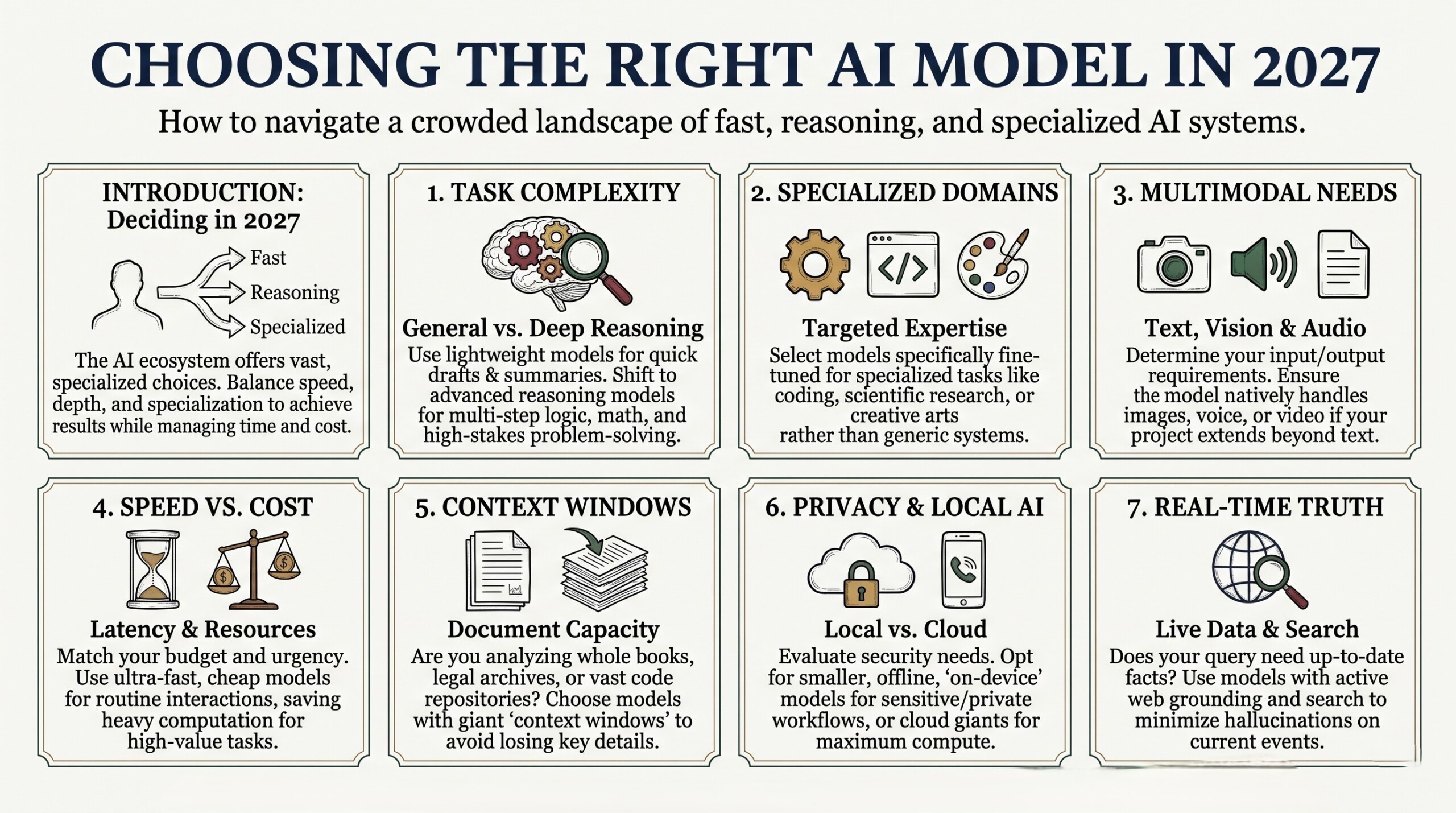
Imagine opening an AI application and discovering several models available for your next assignment. Some respond quickly, others devote additional computational effort to difficult problems, while specialised systems are designed for activities such as programming, image interpretation or scientific research. The growing range of choices can be confusing for beginners who simply want to complete their work effectively.
Understanding the differences between AI models can help users achieve better results while managing their time and expenditure. A model suitable for drafting an invitation may be quite different from one required to examine a business proposal or interpret a complicated scientific document. Seven practical principles can help learners make informed choices during 2027.
Let’s dive deep now!
1. Match the model to the difficulty of your assignment
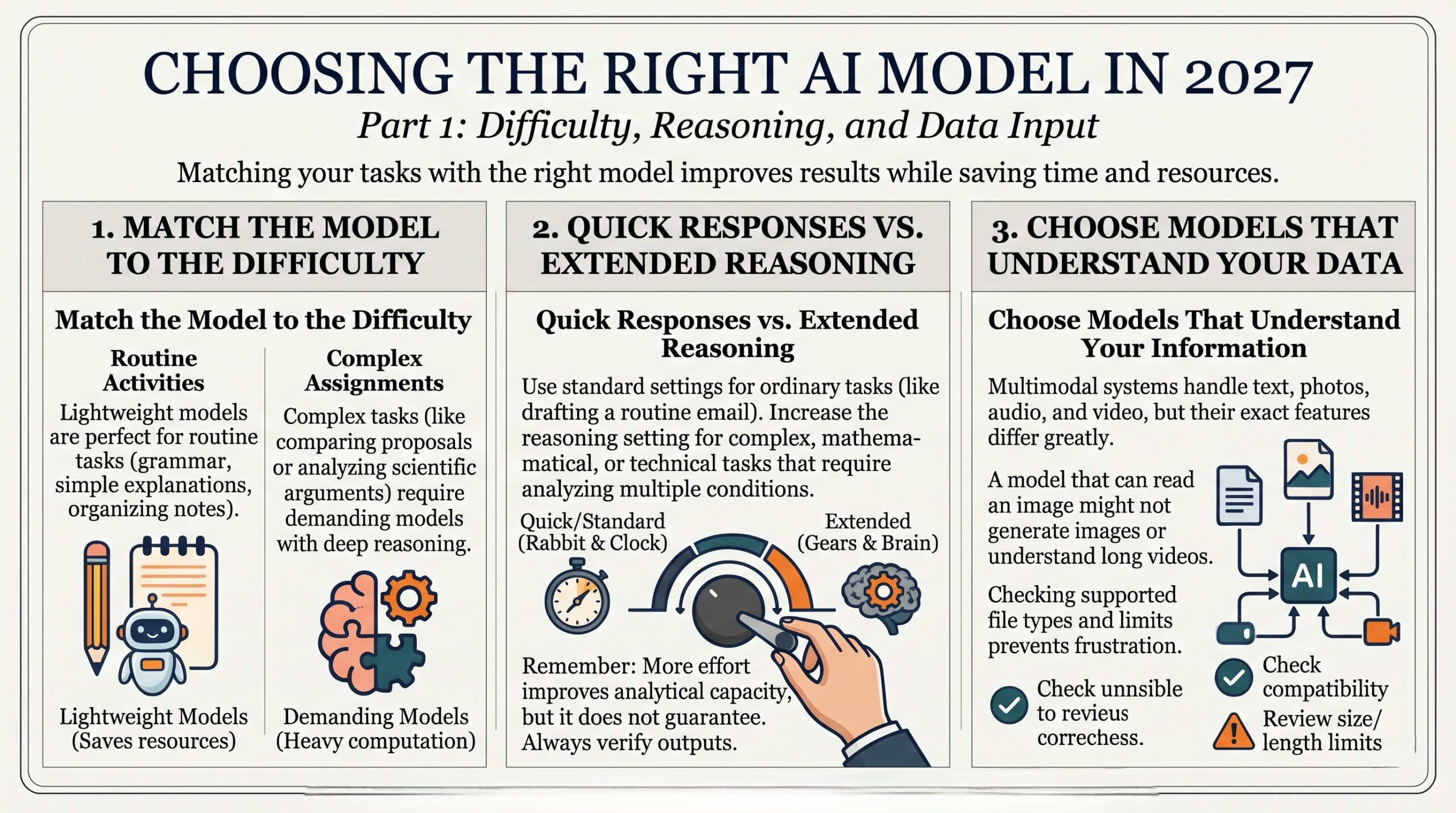
Routine activities such as correcting grammar, preparing simple explanations and organising notes can often be handled effectively by lightweight AI models. These assignments involve familiar patterns and relatively straightforward instructions. Using a more computationally expensive model may offer little additional value when the requirements are simple.
Complex assignments deserve a different approach. Comparing investment proposals, examining competing scientific arguments or identifying weaknesses in a business strategy may require extensive reasoning across several conditions. Models designed for more demanding tasks can be useful in such situations, accompanied by appropriate independent verification.
2. Understand quick responses and extended reasoning
Some AI applications allow users to adjust how much computational effort a model devotes to an assignment. Higher reasoning settings can help a system examine complicated relationships, consider alternatives and perform additional analytical steps. These capabilities may be particularly useful for mathematical, technical and professional activities.
Beginners can develop a simple habit of starting with a standard setting for ordinary work and increasing the reasoning effort when the assignment demands it. For example, drafting a routine sales email may require a quick response, while comparing several pricing strategies could justify deeper analysis. Additional processing can improve performance on selected tasks, although it cannot guarantee correctness.
3. Choose models that understand your information
Multimodal AI systems can work with more than one type of information, such as text, photographs, audio and video. Their supported inputs and outputs differ considerably, however. A model capable of understanding an image may not necessarily be designed to create images or interpret lengthy video recordings.
Consider a student examining a photograph of a physics diagram or a manager reviewing a scanned financial statement. Both need a model and application capable of interpreting visual information accurately. Checking supported file types, input limits and the quality of visual interpretation can prevent considerable frustration during professional assignments.
4. Look beyond the model to the complete AI application
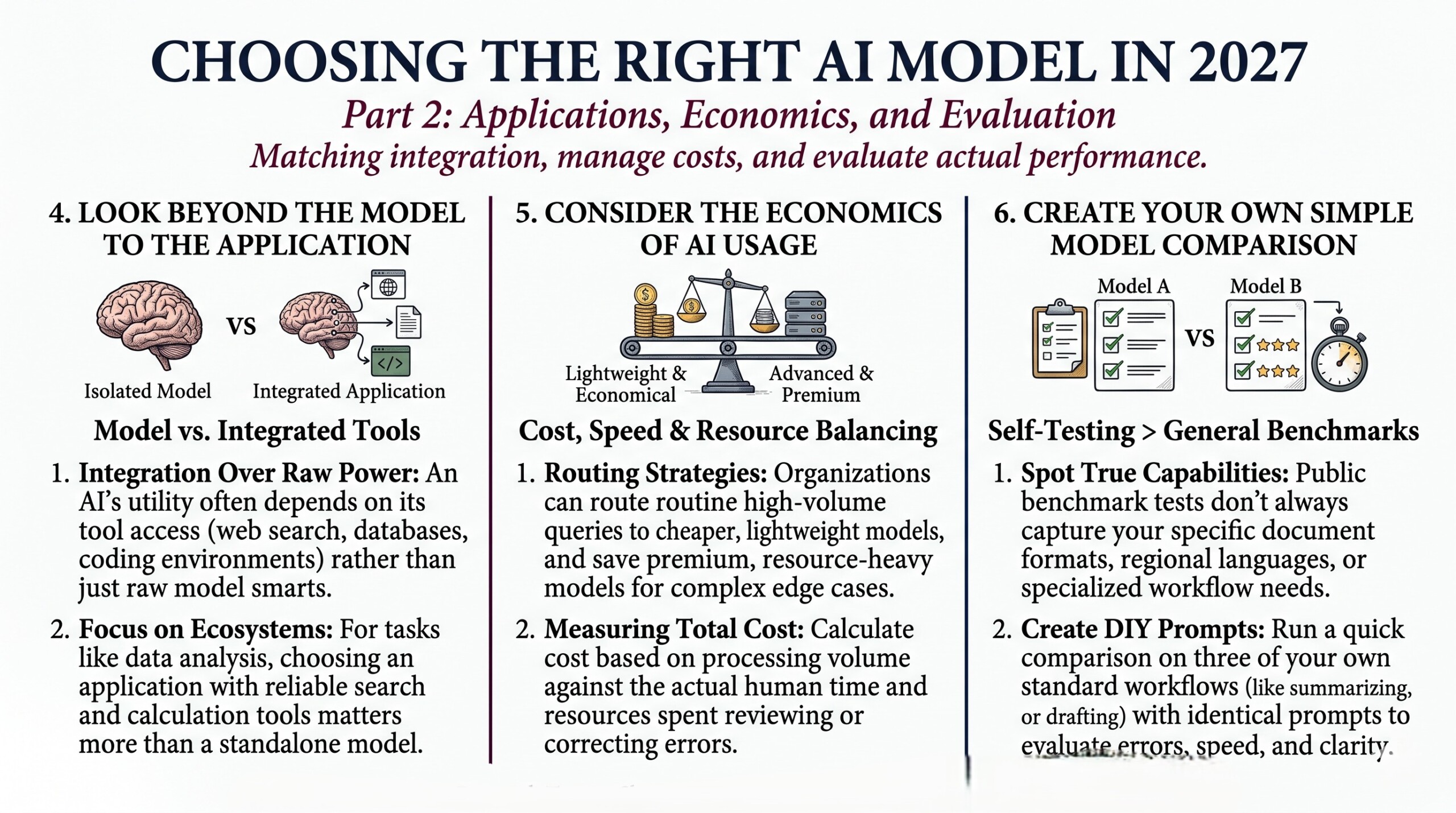
An AI model’s abilities and the tools available through its application are separate considerations. A capable model may lack access to current websites, specialised databases or a calculation environment. Conversely, an application equipped with reliable search and computational tools can support assignments that would otherwise be difficult to complete accurately.
Imagine analysing a company’s sales spreadsheet and comparing its performance with the latest economic developments. The assignment requires access to the spreadsheet, dependable calculations and current external information. Selecting an AI application with these capabilities may be more valuable than choosing solely according to a model’s advertised intelligence.
5. Consider the economics of AI usage
AI developers increasingly offer models designed around different combinations of intelligence, processing speed and resource consumption. Individual subscribers may encounter different usage allowances, while organisations using application programming interfaces, or APIs, may pay according to the volume of information processed and the services used.
A company handling thousands of customer enquiries could use an economical model for familiar requests and reserve more capable systems for complicated cases. This approach can help manage expenditure without unnecessarily sacrificing quality. The relevant measurement is the total cost of obtaining an acceptable result, including the time spent correcting errors.

6. Create your own simple model comparison
Public evaluations can provide useful information about model performance, but they cannot represent every professional situation. A model performing impressively on programming tests may struggle with a particular regional language, document format or specialised business procedure. Your own requirements provide the most relevant basis for comparison.
Choose three familiar assignments, such as summarising a document, interpreting a chart and drafting a professional recommendation. Give identical instructions and supporting material to two available models, then compare their accuracy, completeness, clarity, speed and correction requirements. Repeat the exercise whenever a new model offers potentially useful capabilities.
7. Examine privacy, reliability and the consequences of errors
AI applications have different arrangements concerning information retention, connected services, administrative controls and security. Before sharing confidential business material, users must establish whether their organisation permits the selected application to process that information. A highly capable model may still be unsuitable for sensitive work if the surrounding service does not satisfy the relevant requirements.
The consequences of incorrect results also influence model selection. Creative brainstorming permits considerable experimentation, while medical, legal, financial and engineering assignments may require specialised verification or qualified professional review. Beginners should consider the reliability requirements of the task alongside the capabilities of the technology.
Conclusion
The expanding selection of AI models available in 2027 offers considerable flexibility for students, professionals and businesses. Understanding task difficulty, reasoning settings, supported information, available tools, expenditure, practical performance and privacy requirements can help users make intelligent choices. With a little experimentation, beginners can develop a reliable model-selection approach suited to their own everyday and professional responsibilities.