How LLMs learn continuously, or not
How LLMs learn continuously, or not
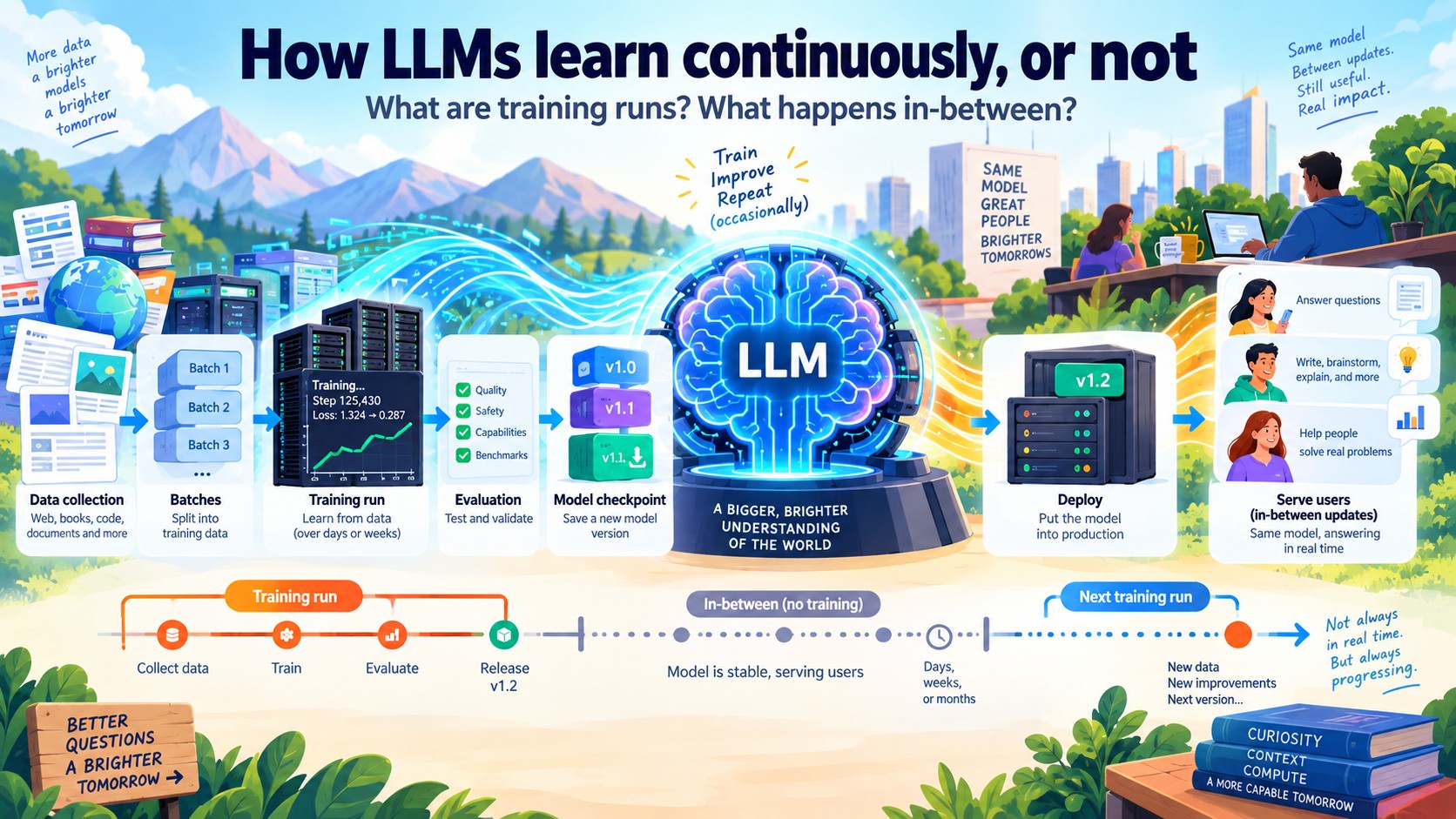
What are training runs? What happens in-between?
Introduction
Large language models create an unusually convincing illusion of continuous learning. Give an AI a new document and it can immediately answer questions about it, tell it your preferences and it may use them later, or connect it to web search and it can discuss an event that occurred after its original training. From the user’s perspective, all of these behaviours can feel like the machine has just learned something new.
Technically, several very different processes are involved. Training changes the numerical parameters, commonly called weights, inside the neural network, while context, retrieval, search, tools and product memory can change what information a deployed system can use without changing those weights. Understanding this distinction explains both the extraordinary flexibility of modern LLMs and some of their most confusing limitations.
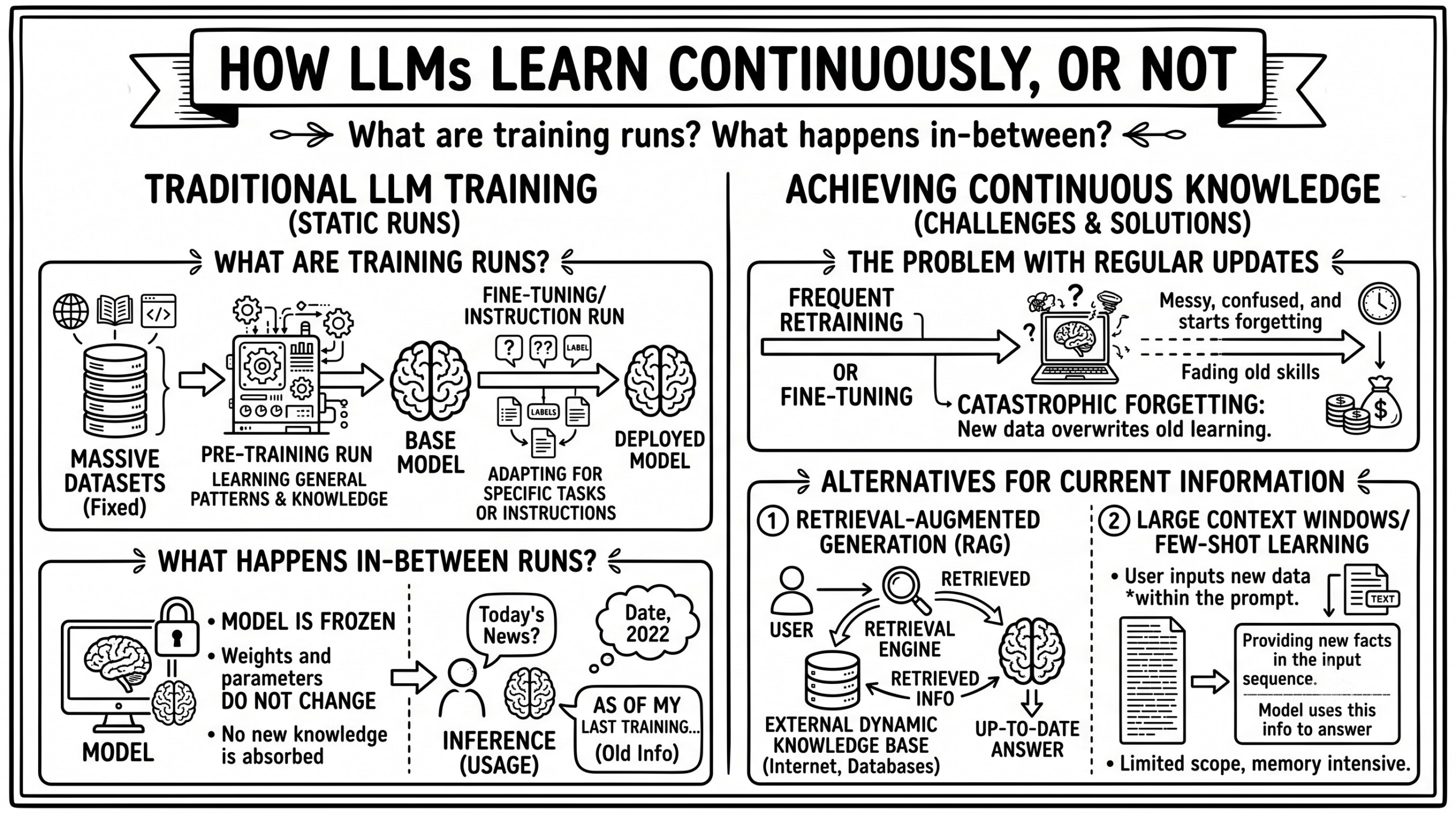
Let’s dive deep into it.
1. Training an LLM means changing its weights
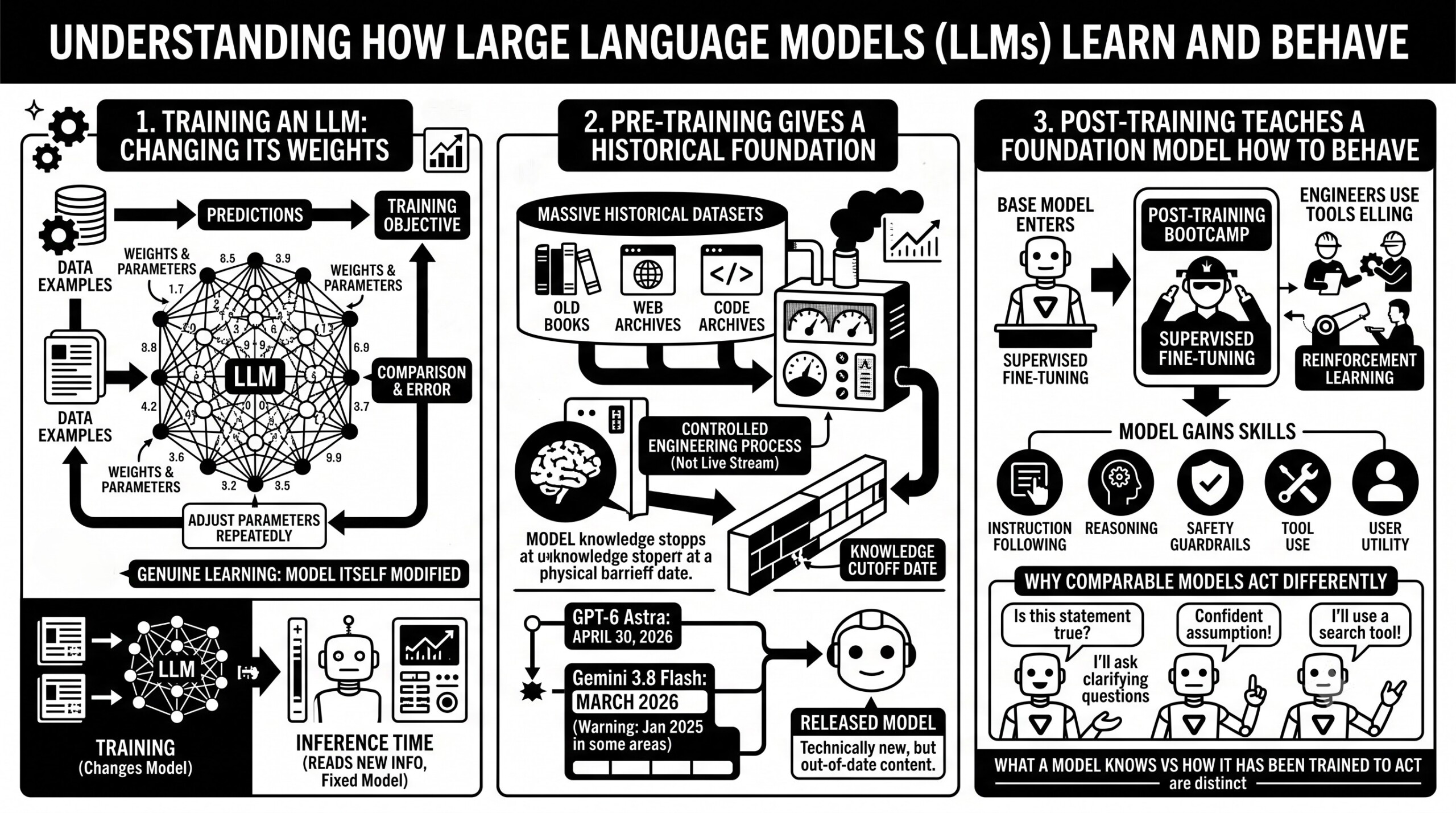
An LLM contains a very large collection of numerical parameters that shape how it responds to input. During training, examples are processed, predictions are compared with the desired training objective and the parameters are adjusted repeatedly. Over an enormous number of such updates, the model develops its ability to represent language, concepts, relationships and useful patterns.
This is genuine learning in the machine-learning sense because the internal model itself is being modified. Once a particular model version has been trained and deployed, however, it can process enormous amounts of new information without necessarily modifying those parameters. Reading new information at inference time and training on new information are therefore different operations.
2. Pre-training gives the model a historical foundation
Pre-training exposes a model to very large datasets so that it can develop broad general capabilities before it is turned into a consumer or enterprise assistant. The dataset is assembled over time and training occurs as a controlled engineering process rather than as a live stream of every event happening on the internet. A released model consequently possesses some form of historical boundary to its internal knowledge.
OpenAI makes that boundary unusually explicit for GPT-6 Astra, listing a knowledge cutoff of April 30, 2026. Google lists March 2026 as Gemini 3.8 Flash’s cutoff while warning that some domains may contain knowledge only through January 2025. A model released in September can therefore be technically new while some of the knowledge inside its weights is already months, or in some areas much longer, out of date. An excellent collection of learning videos awaits you on our Youtube channel.
3. Post-training teaches a foundation model how to behave
Pre-training alone does not automatically produce a reliable assistant. Developers perform additional training to improve instruction following, reasoning, safety, tool use and the model’s ability to respond in ways people find useful. Techniques include supervised fine-tuning, reinforcement learning and other methods that vary considerably between developers.
This helps explain why two LLMs with broadly comparable knowledge can behave very differently. One may ask clarifying questions, another may make a confident assumption, while a third may decide to use a search tool because their post-training and surrounding systems differ. What a model knows and how it has been trained to act are related but separate questions.
4. The conversation itself usually acts as context, not immediate retraining
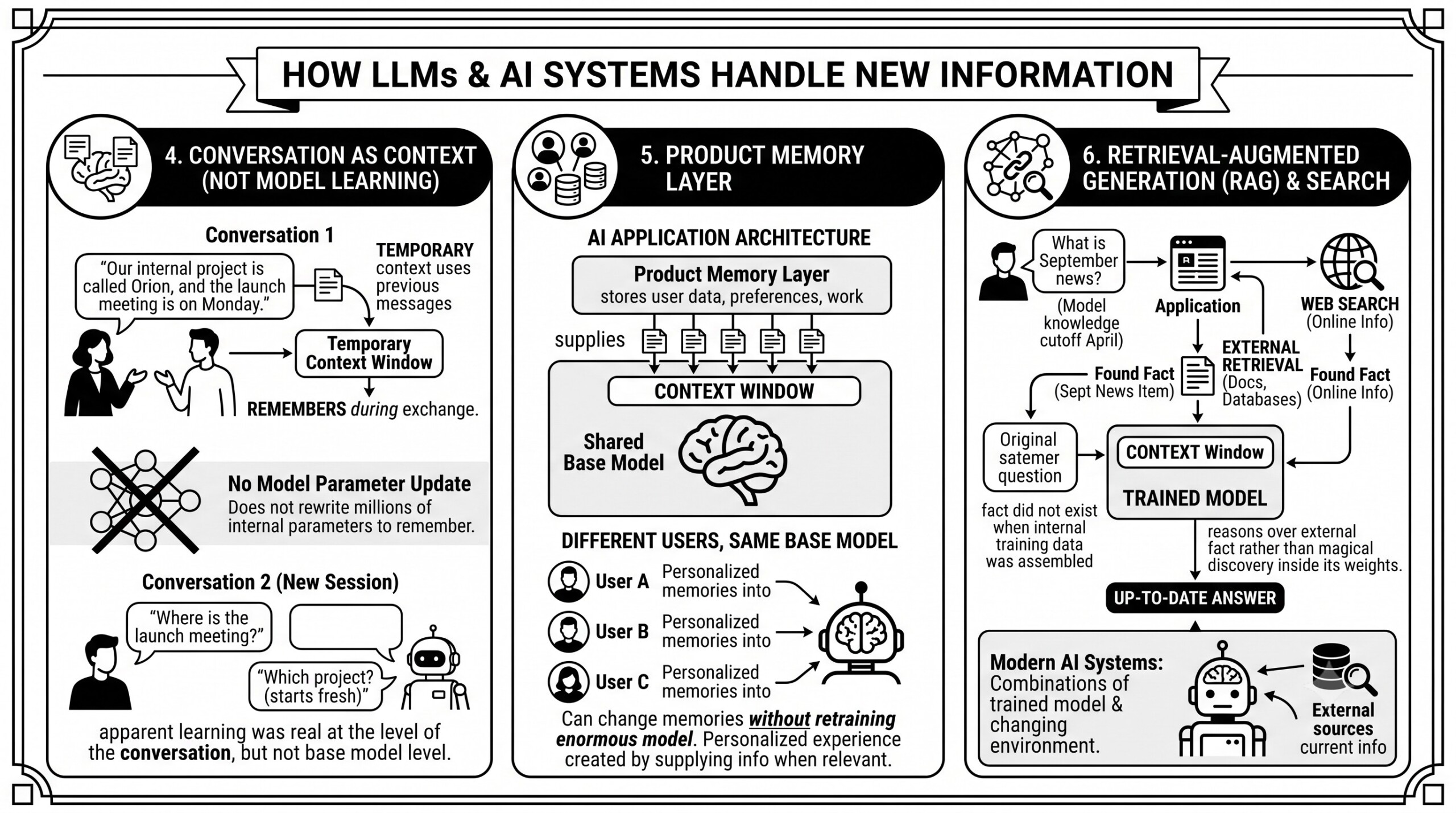
Imagine telling an AI, “Our internal project is called Orion, and the launch meeting is on Monday.” The model can use that information throughout the conversation because your message is included in the context available to it. It does not need to rewrite millions or billions of internal parameters to remember what Orion means during that exchange.
This distinction becomes clearer when the context disappears. Unless the surrounding product stores the information through a separate memory or history mechanism, a later session does not automatically contain everything discussed earlier. The apparent learning was real at the level of the conversation, but not necessarily at the level of the base model. A constantly updated Whatsapp channel awaits your participation.


5. Product memory is another layer around the model
Modern AI applications can store useful information about the user, their work or previous interactions and supply that information when it becomes relevant later. This creates a much more personalised experience because the assistant no longer has to start every conversation with no knowledge of the user’s preferences. The stored information can feel like part of the model’s mind even when it exists in a separate system.
That architecture has practical advantages. A product can add, change or remove memories without retraining an enormous foundation model, and different users can maintain different personalised information while using the same underlying model. The model appears to have learned continuously because the application around it has become better at providing the right information at the right time.
6. Retrieval and web search make an old model look current
Retrieval-augmented generation, usually called RAG, allows an application to search documents, databases or other knowledge sources and place relevant material into the model’s current context. Web search extends the same broad idea to information available online. The model can then analyse a fact that did not exist when its internal training data was assembled.
This is why a model with an April knowledge cutoff can still answer a question about September news when search is available. The current fact comes from an external source and the model reasons over it rather than magically discovering the information inside its old training weights. Modern AI systems are therefore better understood as combinations of a trained model and a changing information environment. Excellent individualised mentoring programmes available.
7. Models can genuinely be updated later
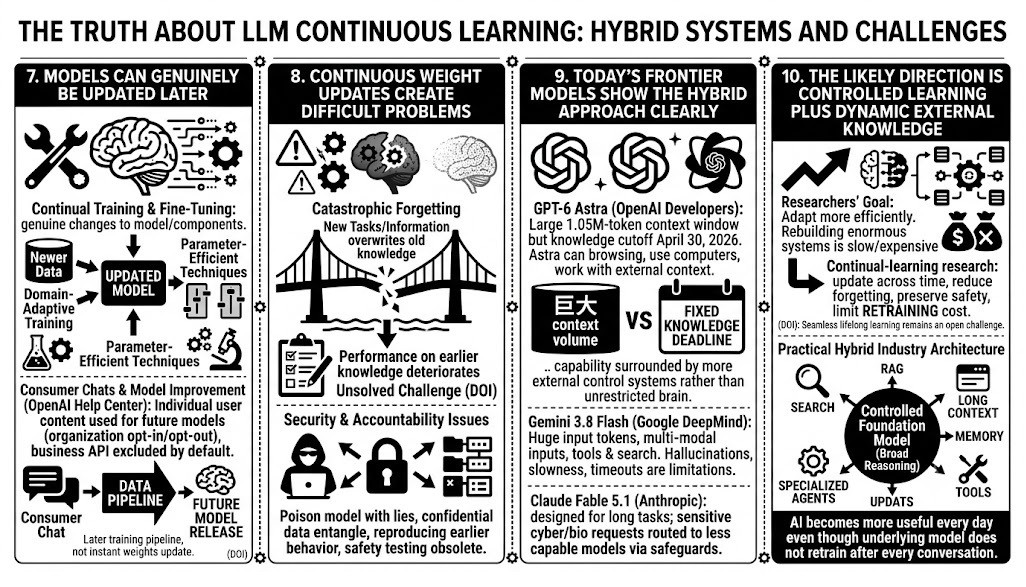
Developers can continue training an existing model on newer data, perform domain-adaptive training, fine-tune it for particular tasks or alter selected parts of the system using parameter-efficient techniques. These processes genuinely change the model or attached trainable components and can give it knowledge or behaviour that was absent from the previous version. Continual pre-training and continual fine-tuning are active areas of research for precisely this reason.
Consumer conversations can also contribute to later model improvement depending on the provider, product and user settings. OpenAI states that content from individual ChatGPT users may be used to improve future models unless the user opts out, while business products and the API are excluded from training by default unless an organisation explicitly opts in. That is still a later training pipeline, not the model privately updating its weights the moment an individual finishes a chat.
8. Continuous weight updates create difficult technical problems
The first problem is catastrophic forgetting. When a neural network is trained on new tasks or information, its performance on knowledge learned earlier can deteriorate, which is why continual-learning researchers study techniques for incorporating new knowledge without destroying old capabilities. Recent surveys continue to describe catastrophic forgetting as one of the central unsolved challenges in continual LLM learning.
Live self-updating models would also create security and accountability problems. Malicious users could try to poison the model with false information, confidential data could become entangled with training, engineers might struggle to reproduce earlier behaviour, and safety testing could become obsolete whenever the model changed. Controlled model releases make it much easier to evaluate what changed and investigate failures. Subscribe to our free AI newsletter now.
9. Today’s frontier models show the hybrid approach clearly
GPT-6 Astra illustrates the distinction particularly well. OpenAI lists a 1.05-million-token context window and 128,000-token maximum output, but its internal knowledge cutoff remains April 30, 2026; Astra can nevertheless browse, use computers and work with externally supplied context. OpenAI also uses additional monitoring that can pause or stop potentially unauthorised actions, demonstrating that increased capability is being surrounded by more external control systems rather than being treated as an unrestricted continuously learning brain.
Gemini 3.8 Flash supports up to one million input tokens, multimodal inputs, tool use and search, yet Google still lists hallucination, occasional slowness and timeout problems among its known limitations and provides an explicit historical knowledge cutoff. Anthropic’s Claude Fable 5.1 is designed for ambitious long-running coding and knowledge work, but sensitive cybersecurity and biology requests can be routed to less capable models through Anthropic’s safeguards. The newest models are becoming more capable at acquiring and using temporary information while still relying heavily on external systems, safety layers and periodic controlled training.
10. The likely direction is controlled learning plus dynamic external knowledge
Researchers would clearly like models to adapt more efficiently to changing information because repeatedly rebuilding enormous systems is expensive and slow. Continual-learning research therefore explores methods that update models across time while reducing forgetting, preserving safety and limiting the computational cost of retraining. Progress is substantial, but recent research surveys still describe seamless lifelong learning as an open challenge rather than a solved engineering feature.
Meanwhile, the practical industry architecture is increasingly hybrid. A relatively controlled foundation model provides broad reasoning ability, while search, RAG, long context, memory, tools, specialised agents and periodically updated model versions keep the overall system useful in a rapidly changing world. The AI can consequently become more useful every day even though the underlying model does not literally retrain itself after every conversation.
Conclusion
The simplest answer to “Do LLMs learn continuously?” is therefore “sometimes, but not in the way a user conversation makes it appear.” Models can genuinely learn through later pre-training, fine-tuning and other update techniques, while most day-to-day freshness comes from context, memory, retrieval, search and tools that operate around relatively stable model weights. The distinction matters because it explains why an AI can know something that happened this morning, remember how you prefer a report formatted and still possess an internal knowledge cutoff several months in the past.