New age dawns: Vibe-coding, Claude Opus 4.5, and Clawdbot
1. Introduction
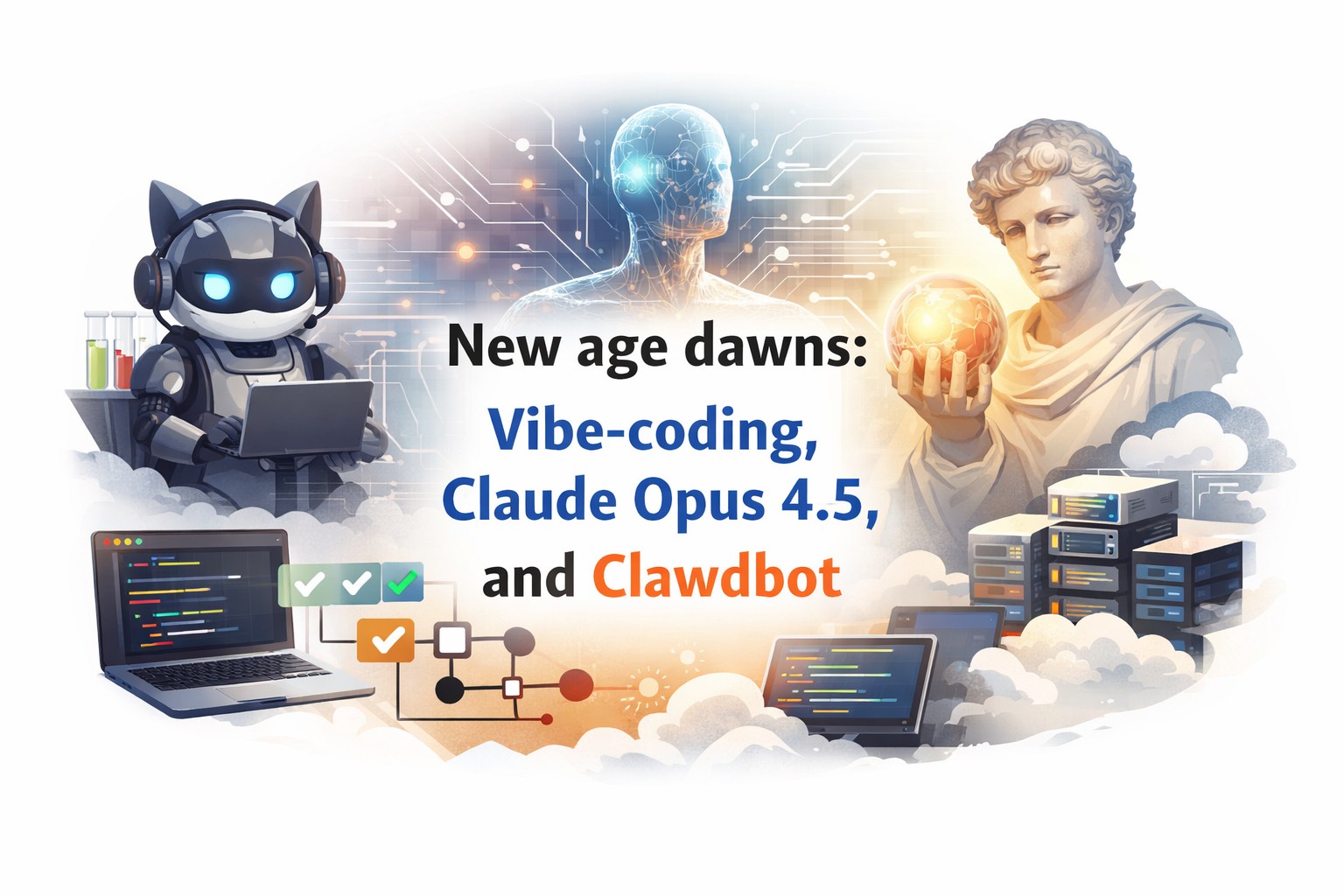
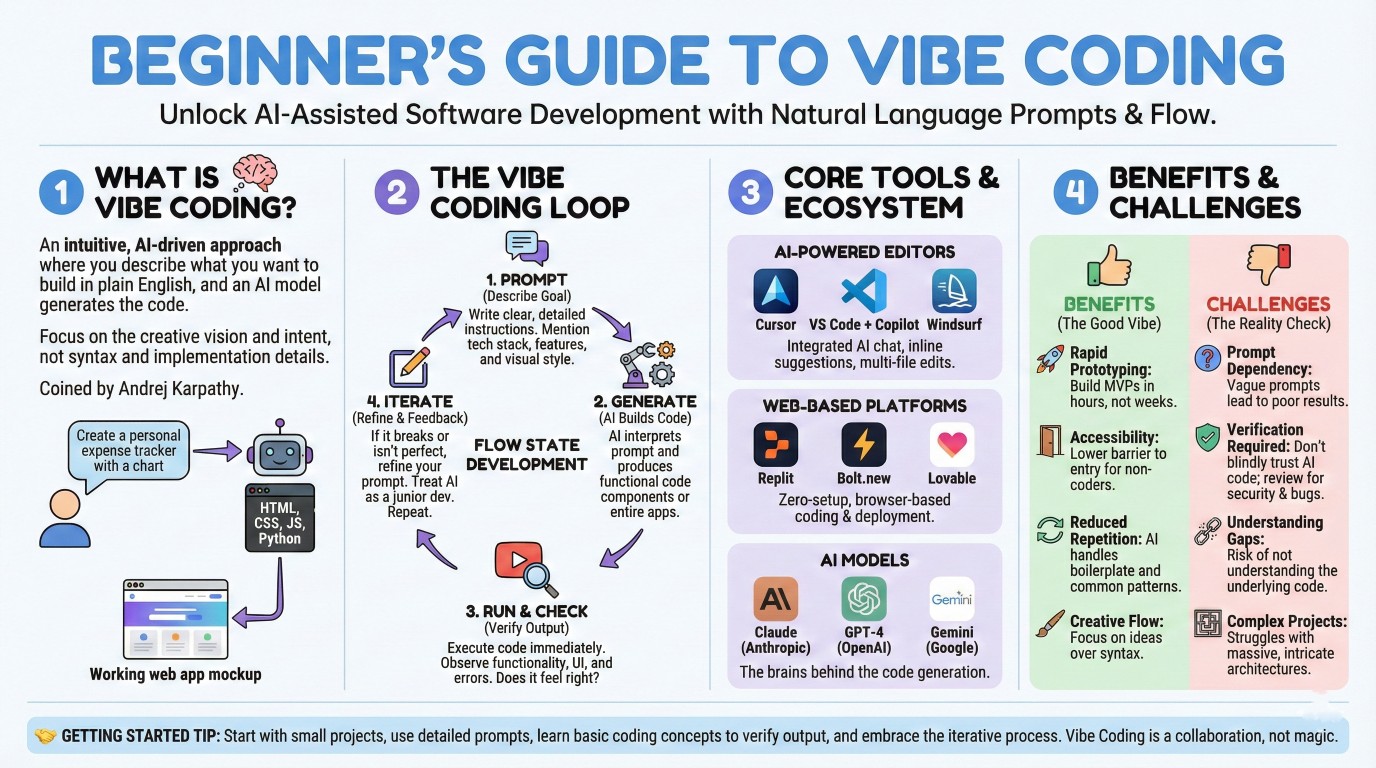
A new development style is taking shape where humans specify intent and constraints, and AI agents do a growing share of the implementation work. “Vibe coding” is the cultural shorthand for this: you describe what you want in natural language, accept large AI-generated changes, run/test, paste errors back, and iterate fast—often without line-by-line review. The term is widely credited to Andrej Karpathy (Feb 2025) and is now used to describe everything from rapid prototyping to risky “accept-all” workflows.
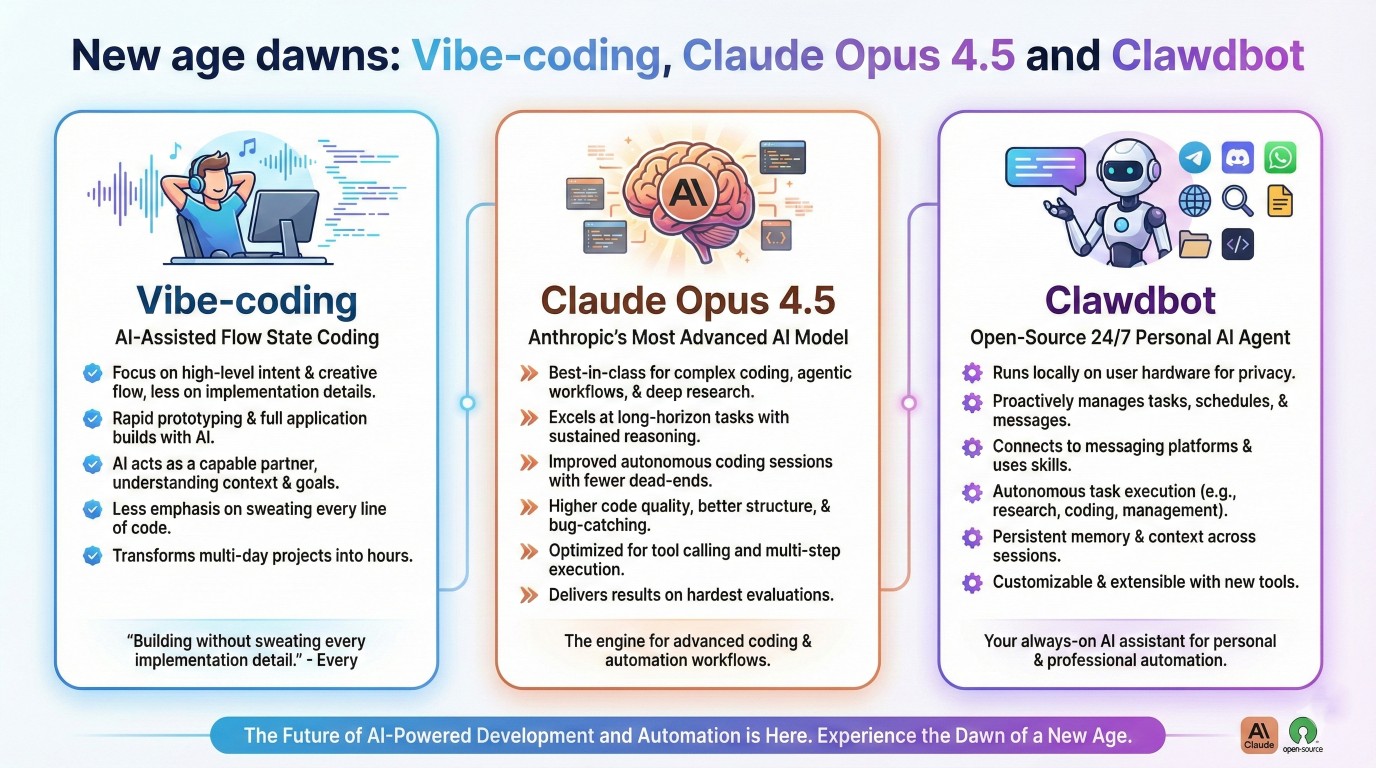
This shift is amplified by models tuned for agentic coding. Claude Opus 4.5 (released Nov 24, 2025) is positioned by Anthropic as a top-tier model for coding, agents, and computer use, with an accompanying system card describing evaluation and safety-related details.
Alongside the model layer, community-built agents are becoming “hands” for these workflows. Clawdbot is an open-source personal AI assistant on GitHub, created/maintained by Peter Steinberger (@steipete), and commonly framed as an agent that can do things rather than only chat, making it a natural fit for vibe-coding-style loops.
Ready to dive into this world of opportunities? Read on!
2. Definitions that matter
- Vibe coding: AI-assisted development driven by natural-language intent and rapid iteration; in its strongest form, it implies minimal code reading and heavy reliance on “run → observe → prompt → accept” loops.
- Claude Opus 4.5: Anthropic’s Claude Opus 4.5 model release (Nov 24, 2025), marketed for coding/agents/computer use.
- Clawdbot: An open-source, self-hostable AI assistant/agent project (GitHub: clawdbot/clawdbot), associated with Peter Steinberger (@steipete).
3. Technical aspect defining the “new age”
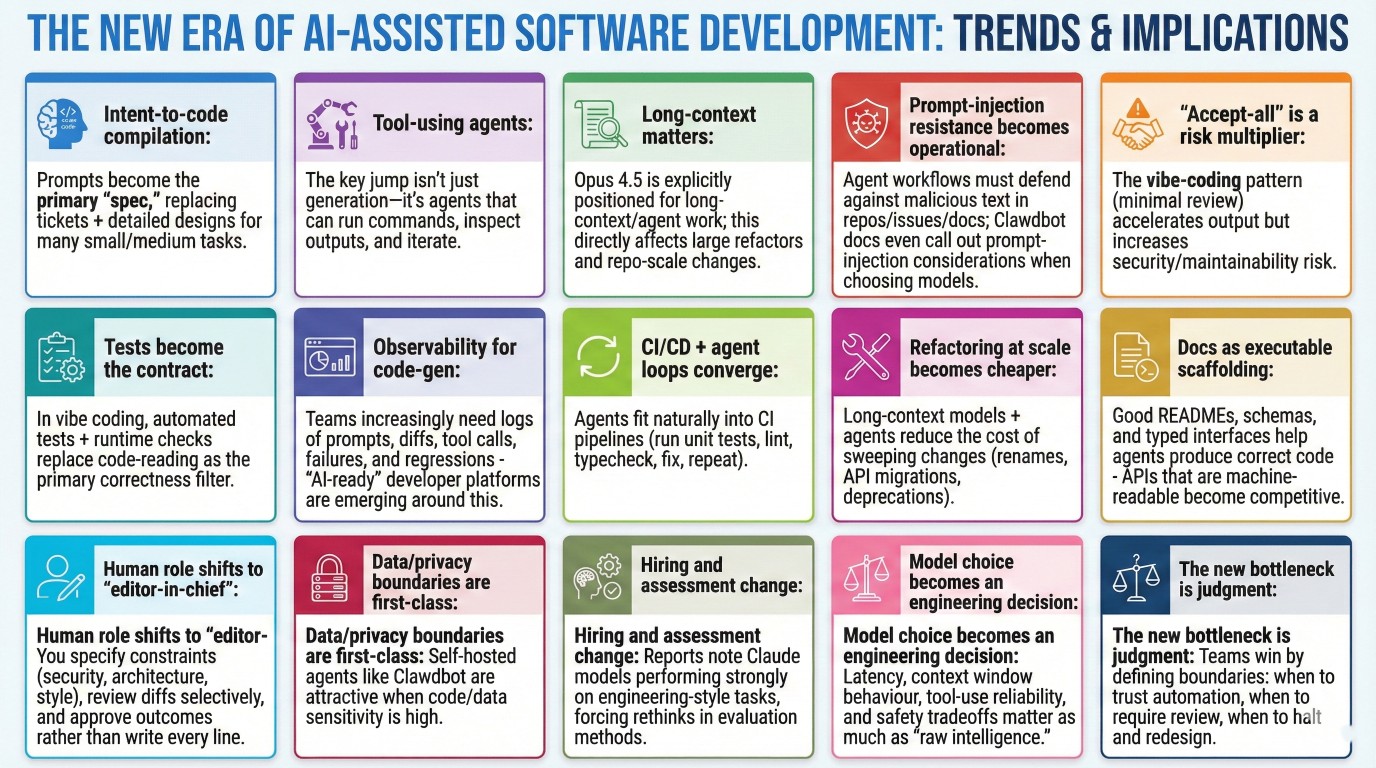
- Intent-to-code compilation: Prompts become the primary “spec,” replacing tickets + detailed designs for many small/medium tasks.
- Tool-using agents: The key jump isn’t just generation—it’s agents that can run commands, inspect outputs, and iterate.
- Long-context matters: Opus 4.5 is explicitly positioned for long-context/agent work; this directly affects large refactors and repo-scale changes.
- Prompt-injection resistance becomes operational: Agent workflows must defend against malicious text in repos/issues/docs; Clawdbot docs even call out prompt-injection considerations when choosing models.
- “Accept-all” is a risk multiplier: The vibe-coding pattern (minimal review) accelerates output but increases security/maintainability risk.
- Tests become the contract: In vibe coding, automated tests + runtime checks replace code-reading as the primary correctness filter.
- Observability for code-gen: Teams increasingly need logs of prompts, diffs, tool calls, failures, and regressions – “AI-ready” developer platforms are emerging around this.
- CI/CD + agent loops converge: Agents fit naturally into CI pipelines (run unit tests, lint, typecheck, fix, repeat).
- Refactoring at scale becomes cheaper: Long-context models + agents reduce the cost of sweeping changes (renames, API migrations, deprecations).
- Docs as executable scaffolding: Good READMEs, schemas, and typed interfaces help agents produce correct code – APIs that are machine-readable become competitive.
- Human role shifts to “editor-in-chief”: You specify constraints (security, architecture, style), review diffs selectively, and approve outcomes rather than write every line.
- Data/privacy boundaries are first-class: Self-hosted agents like Clawdbot are attractive when code/data sensitivity is high.
- Hiring and assessment change: Reports note Claude models performing strongly on engineering-style tasks, forcing rethinks in evaluation methods.
- Model choice becomes an engineering decision: Latency, context window behaviour, tool-use reliability, and safety tradeoffs matter as much as “raw intelligence.”
- The new bottleneck is judgment: Teams win by defining boundaries: when to trust automation, when to require review, when to halt and redesign.
4. Key people behind the movement
- Andrej Karpathy — widely credited with introducing the phrase “vibe coding” (Feb 2025) and popularizing the idea of “English as the interface” for building.
- Peter Steinberger (@steipete) — creator/maintainer associated with Clawdbot (GitHub profile lists Clawdbot as a current project; Clawdbot org + repo host the project).
- Anthropic — publisher of the official Claude Opus 4.5 release post and system card.
5. Use cases that actually benefit (and where it’s dangerous)
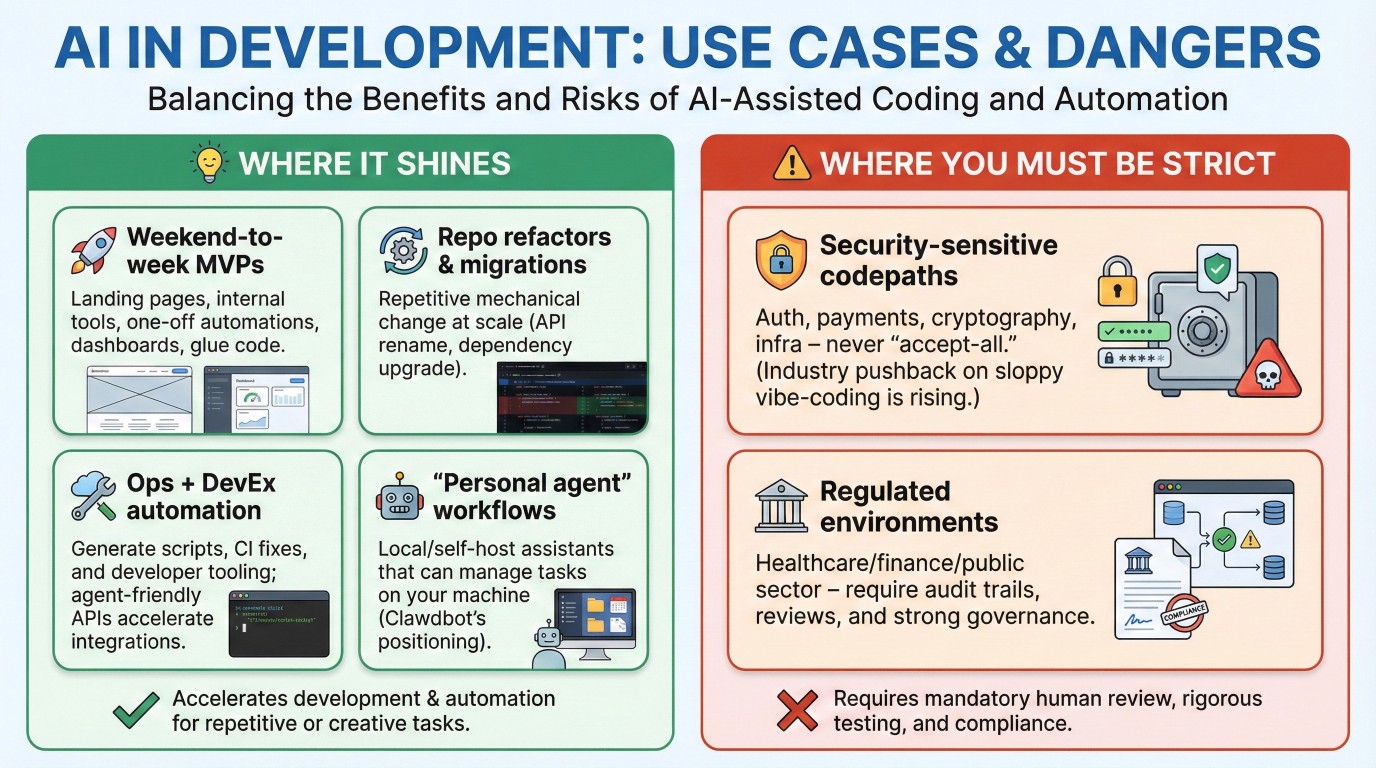
Where it shines
- Weekend-to-week MVPs: Landing pages, internal tools, one-off automations, dashboards, glue code.
- Repo refactors & migrations: Repetitive mechanical change at scale (API rename, dependency upgrade).
- Ops + DevEx automation: Generate scripts, CI fixes, and developer tooling; agent-friendly APIs accelerate integrations.
- “Personal agent” workflows: Local/self-host assistants that can manage tasks on your machine (Clawdbot’s positioning).
Where you must be strict
- Security-sensitive codepaths: Auth, payments, cryptography, infra – never “accept-all.” (Industry pushback on sloppy vibe-coding is rising.)
- Regulated environments: Healthcare/finance/public sector – require audit trails, reviews, and strong governance.
6. A motivational close (grounded, not hype)
The real “new age” isn’t that AI writes code, it’s that building becomes a conversation, and execution becomes a tight feedback loop between intent, tools, and tests. Done well, vibe coding + Opus-class models + agent frameworks like Clawdbot can compress weeks into days and turn more professionals into builders, without waiting for perfect engineering fluency. Done carelessly, it can also manufacture fragile systems at high speed. The winners will be the teams that combine the new power with old discipline: specs, tests, reviews, observability, and clear ownership.
Share this with the world
Related Articles