Voice AI revolution in India
1. Introduction
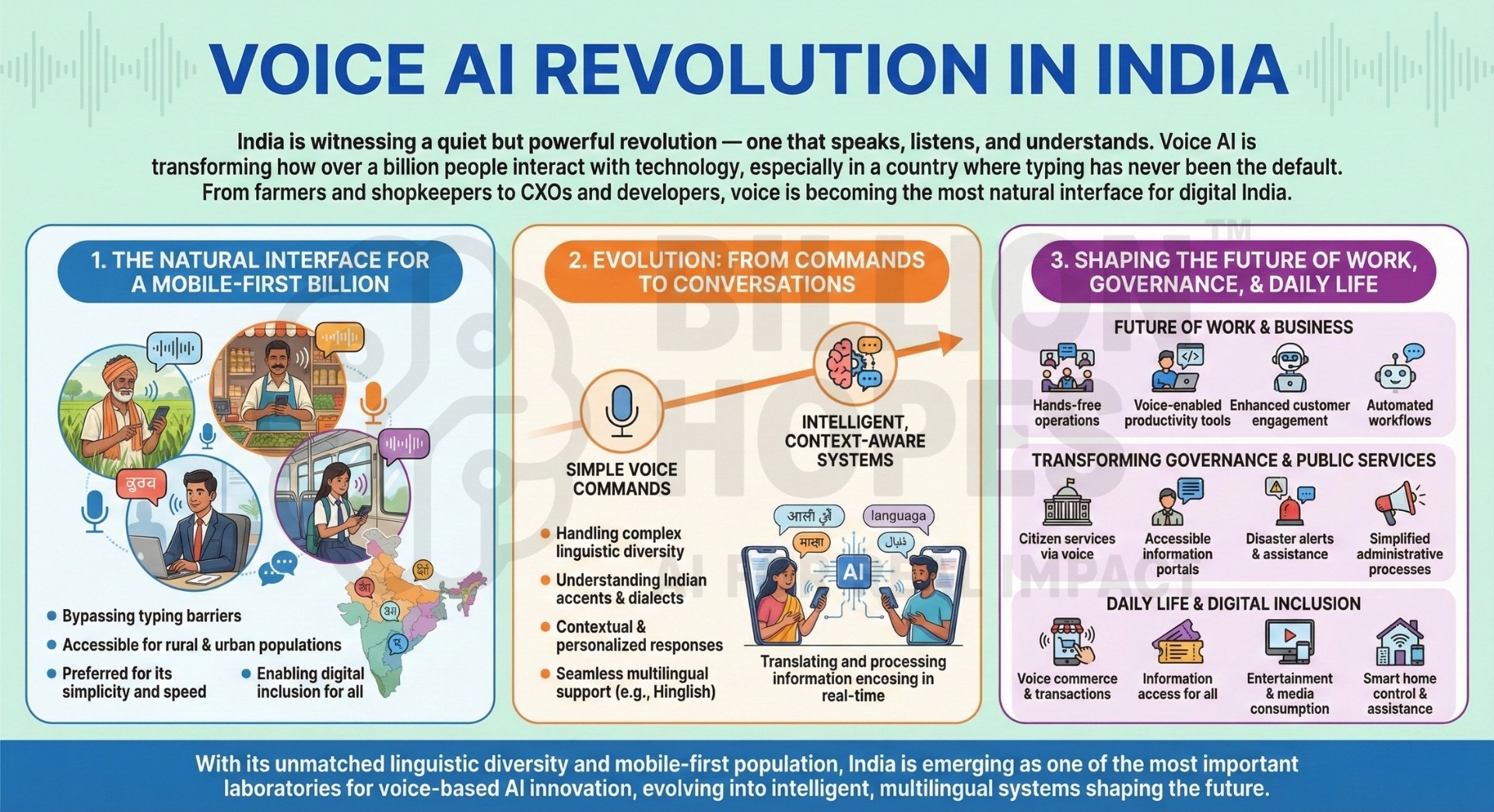
India is witnessing a quiet but powerful revolution – one that speaks, listens, and understands. Voice AI is transforming how over a billion people interact with technology, especially in a country where typing has never been the default. From farmers and shopkeepers to CXOs and developers, voice is becoming the most natural interface for digital India. With its unmatched linguistic diversity and mobile-first population, India is emerging as one of the most important laboratories for voice-based AI innovation. What began as simple voice commands is now evolving into intelligent, context-aware, multilingual systems shaping the future of work, governance, and daily life.
Ready to dive into this world of opportunities? Read on!
2. Why voice AI in India
A. Voice as India’s Most Natural Interface: India has always been a “spoken-first” society, where oral communication dominates daily life across education, commerce, and governance. Voice AI aligns naturally with this cultural reality, reducing friction for users who find typing difficult or unnatural. It enables participation from non-literate and semi-literate populations who were earlier excluded from digital systems. This makes voice not just a convenience feature, but a foundational layer for inclusive digital access. In India, voice is not an alternative interface – it is the primary one.
B. Multilingual Complexity as a Catalyst: India’s linguistic diversity forces Voice AI systems to go far beyond simple translation. Models must handle code-mixing (Hindi-English, Tamil-English), regional accents, slang, and context-dependent meanings. This complexity has accelerated innovation in speech models, pushing them to become more robust and adaptive. Unlike monolingual markets, India trains AI to understand variation, not uniformity. As a result, Voice AI built for India tends to be more resilient and globally relevant.
C. Smartphones + Cheap Data = Voice Explosion: The combination of affordable smartphones and some of the world’s lowest data costs has created perfect conditions for Voice AI adoption. Even first-time internet users can interact with apps using voice without navigating complex menus. This has driven explosive growth in voice search, voice messaging, and voice-enabled services. Rural users, in particular, benefit from hands-free, eyes-free interaction. Voice AI thrives in India because the infrastructure supports mass adoption, not elite usage.
3. Key aspects of the unfolding Voice Revolution in India
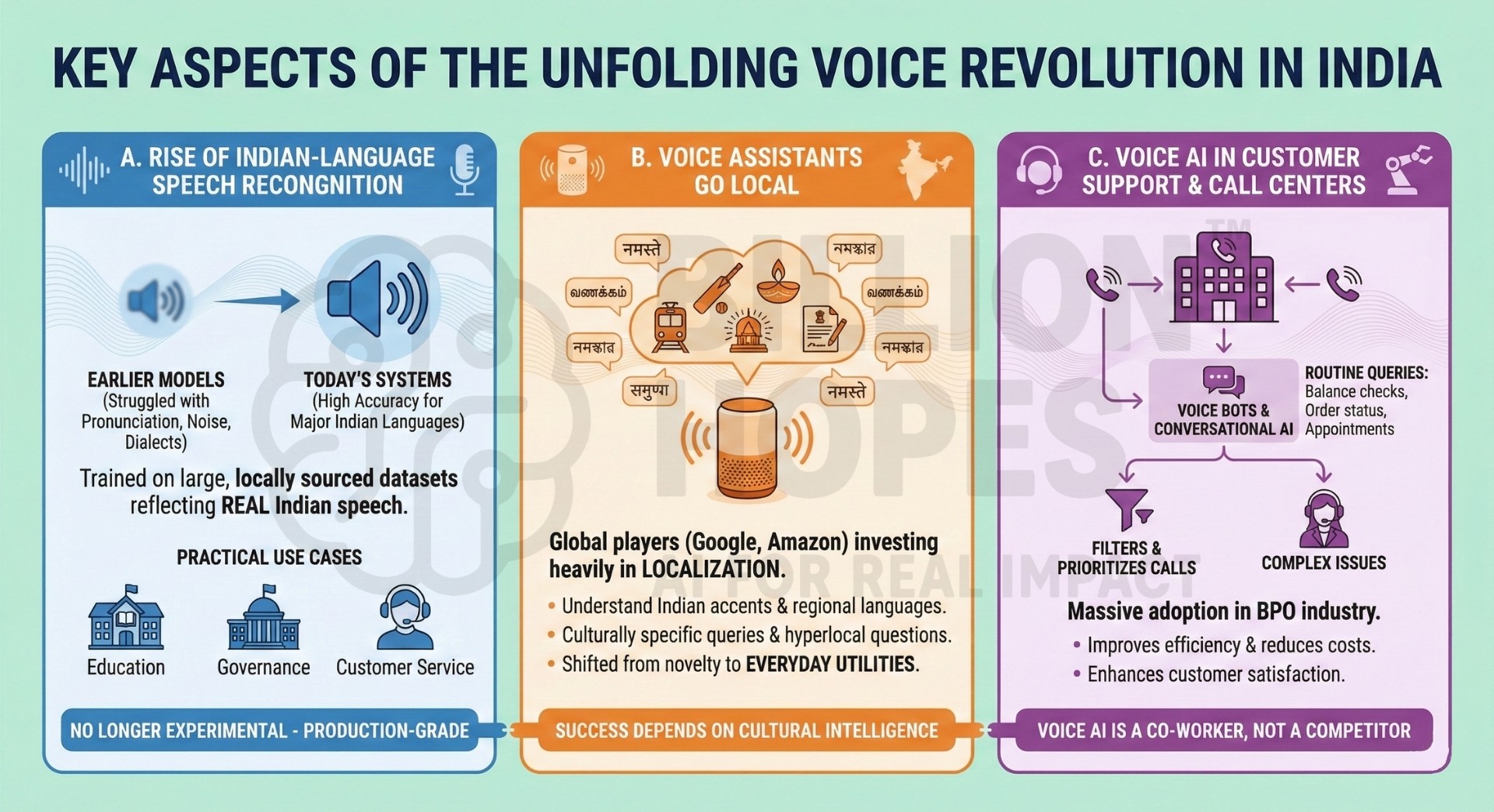
A. Rise of Indian-Language Speech Recognition: Speech recognition systems in India have rapidly improved in accuracy for major Indian languages. Earlier models struggled with pronunciation, background noise, and dialectal variation. Today, systems are trained on large, locally sourced datasets that reflect real Indian speech. This has unlocked practical use cases in education, governance, and customer service. Indian-language speech recognition is no longer experimental – it is production-grade.
B. Voice Assistants Go Local: Global players like Google and Amazon have invested heavily in localizing voice assistants for India. This includes understanding Indian accents, regional languages, and culturally specific queries. Users can now ask hyperlocal questions – about trains, festivals, cricket, or government schemes – and get relevant answers. Localization has shifted voice assistants from novelty gadgets to everyday utilities. The success of voice assistants in India depends more on cultural intelligence than technical sophistication alone.
C. Voice AI in Customer Support & Call Centers: India’s massive call center and BPO industry is rapidly adopting voice bots and conversational AI. These systems handle routine queries such as balance checks, order status, and appointment scheduling. Instead of replacing humans, Voice AI filters and prioritizes calls, allowing agents to focus on complex issues. This improves efficiency, reduces costs, and enhances customer satisfaction. Voice AI is becoming a co-worker, not a competitor, in India’s service economy.
4. How it touches citizen lives
A. Financial Inclusion Through Voice: Voice-enabled banking lowers barriers for millions who struggle with English interfaces or app navigation. Users can check balances, receive transaction alerts, and get loan information through simple voice commands. This is especially impactful in rural and semi-urban regions with low digital literacy. Voice also builds trust – people are more comfortable “talking” to a system than tapping through screens. Financial Voice AI is turning formal banking into a conversational experience.
B. Voice in Governance and Public Services: Governments are increasingly using Voice AI to scale citizen services across large populations. Voice-based helplines can answer queries about welfare schemes, documentation, and grievance redressal. This reduces dependency on physical offices and intermediaries. Voice systems also operate 24/7, making governance more accessible and responsive. In a country of India’s size, Voice AI acts as a force multiplier for public administration.
C. Education and Learning in Vernacular Voices: Voice AI is reshaping education by delivering content in local languages and conversational formats. Students can ask questions verbally and receive explanations without fear of judgment. Adult learners and first-generation students benefit enormously from voice-based guidance. This approach bridges gaps left by traditional, text-heavy digital learning platforms. Voice AI enables learning to feel more like mentorship than instruction.
5. In healthcare and e-commerce
A. Healthcare: Voice as a Digital Caregiver: In healthcare, Voice AI supports patients beyond hospital walls. Voice assistants can remind patients to take medication, explain prescriptions, and guide them through basic health checks. For mental health, voice-based companions offer non-judgmental listening and emotional support. This is crucial in regions with limited access to doctors and therapists. Voice AI extends care reach while respecting human oversight.
B. E-commerce and Voice Commerce (V-Commerce): Voice commerce allows users to search, compare, and order products using natural speech. This is particularly useful for users unfamiliar with typing or browsing catalogs. Voice-based recommendations feel more personal and conversational than traditional search. As trust increases, voice is becoming a viable transaction channel, not just a discovery tool. In India, V-commerce aligns perfectly with conversational buying habits.
6. Some technical aspects
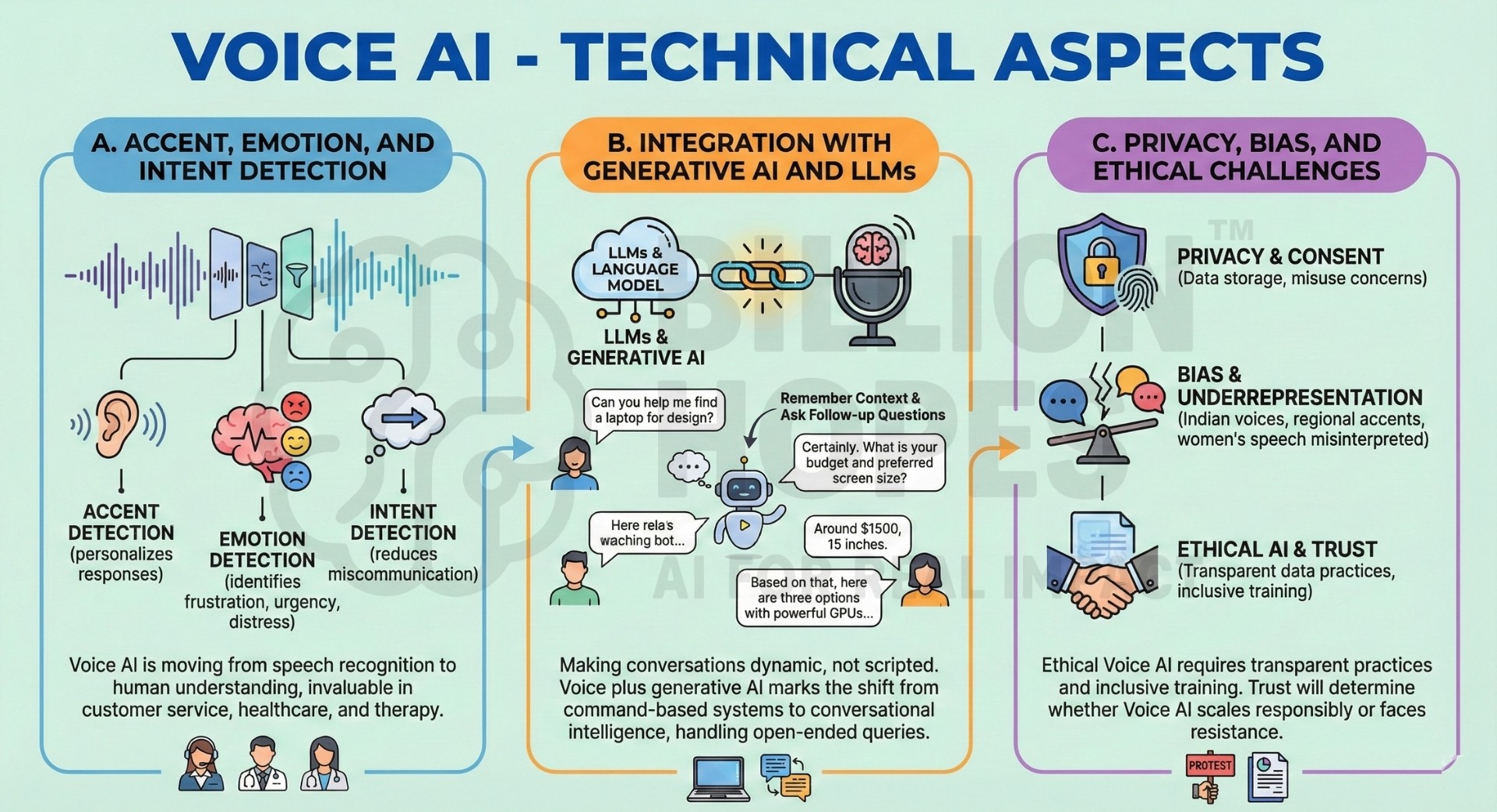
A. Accent, Emotion, and Intent Detection: Advanced Voice AI systems now go beyond words to analyze how something is said. Accent detection helps personalize responses, while emotion detection identifies frustration, urgency, or distress. This is invaluable in customer service, healthcare, and therapy-related applications. Understanding intent reduces miscommunication and improves outcomes. Voice AI is moving from speech recognition to human understanding.
B. Integration with Generative AI and LLMs: Modern Voice AI systems are powered by large language models, making conversations dynamic rather than scripted. They can remember context, ask follow-up questions, and generate nuanced responses. This creates experiences that feel closer to human dialogue. In India, this allows voice systems to handle open-ended, real-world queries. Voice plus generative AI marks the shift from command-based systems to conversational intelligence.
C. Privacy, Bias, and Ethical Challenges: Voice data is deeply personal, raising serious concerns about consent, storage, and misuse. Indian voices – especially regional accents and women’s speech – can be misinterpreted or underrepresented in datasets. This leads to bias and unequal performance. Ethical Voice AI requires transparent data practices and inclusive training. Trust will determine whether Voice AI scales responsibly or faces resistance.
7. Conclusion: India as a Global Voice AI Testbed
India’s diversity, scale, and unpredictability make it the toughest environment for Voice AI. Systems that succeed here are robust enough for global deployment. Startups and enterprises increasingly view India as a proving ground for voice technologies. The country contributes not just users, but innovation and insights. In many ways, India is shaping the future standards of Voice AI worldwide.
Share this with the world
Related Articles