World Models & Latent Space Planning
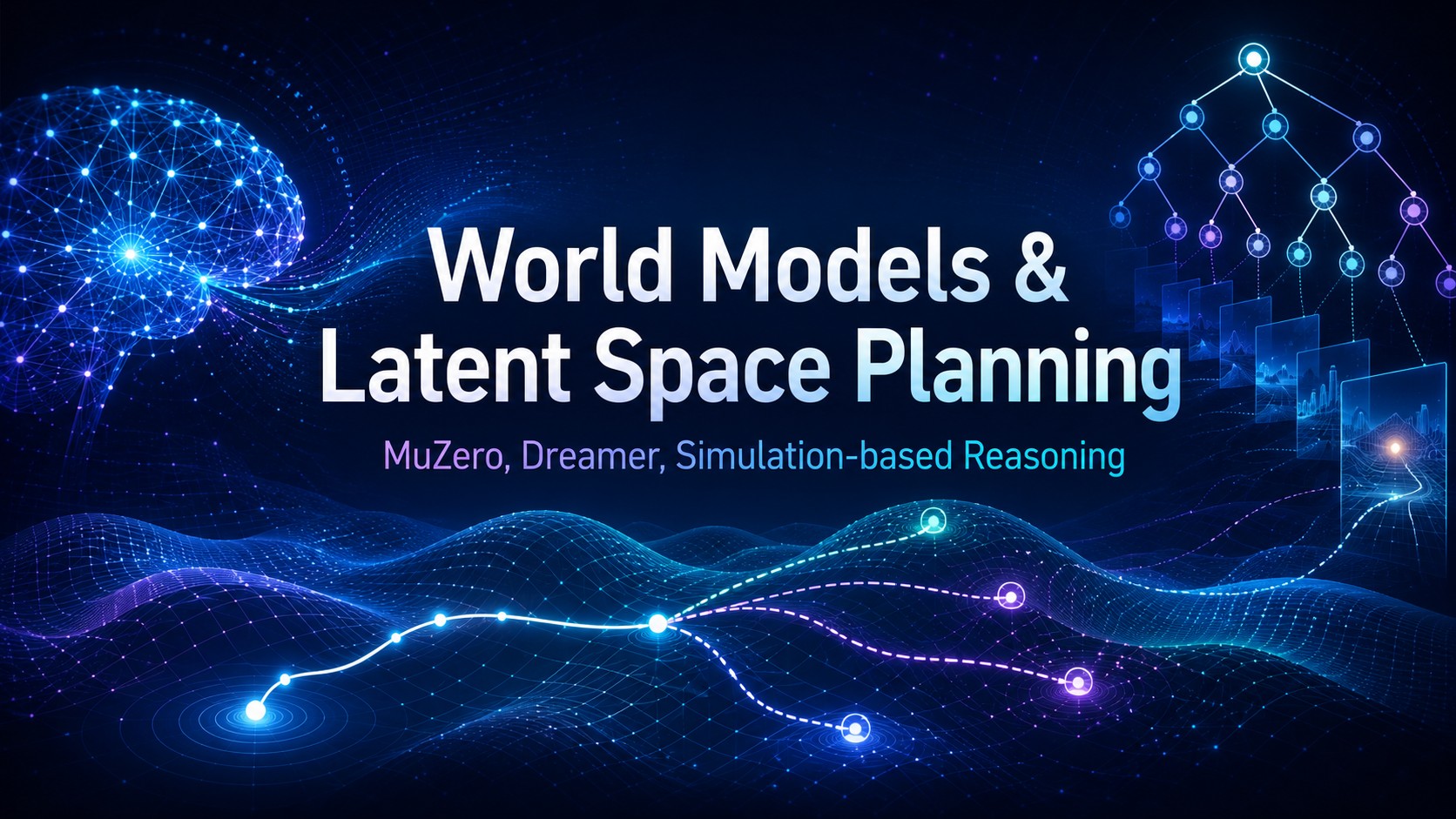
World Models & Latent Space Planning
MuZero, Dreamer, Simulation-based reasoning
Introduction
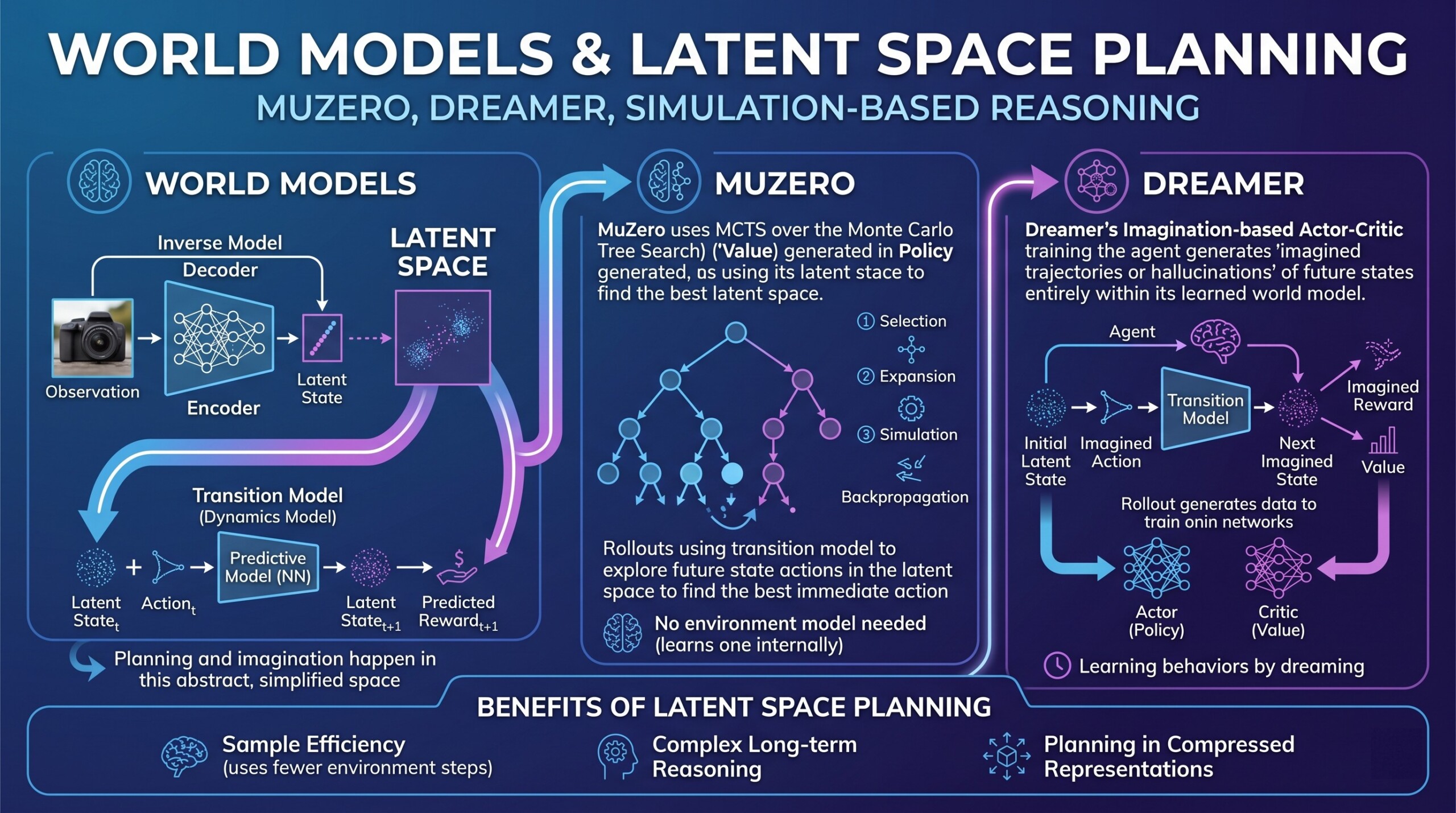
Artificial Intelligence becomes truly powerful when it can do more than react to the present. A strong AI system should be able to imagine possible futures, test different actions mentally, and choose the path that leads to the best result. This is the central idea behind world models and latent space planning.
A world model is an internal model of how the environment works. Instead of learning only “what action should I take now?”, the AI learns “what may happen next if I take this action?” This allows the system to reason, plan, and improve through simulation. Humans do this all the time. Before crossing a road, we imagine the speed of vehicles. Before making a business decision, we mentally simulate consequences. Before playing chess, we think several moves ahead. In AI, world models attempt to give machines a similar ability.
Latent space planning takes this one step further. Instead of planning directly in the raw world of pixels, sounds, or text, the AI compresses reality into a smaller internal representation called a latent space. In this compressed space, the system can reason more efficiently. Important systems such as MuZero and Dreamer demonstrate how AI can learn, imagine, and plan without always needing direct real-world interaction. These approaches are important for robotics, games, autonomous systems, business decision-making, scientific discovery, and future forms of general intelligence.
Let’s dive deep into the topic now.
1. What Is a World Model?
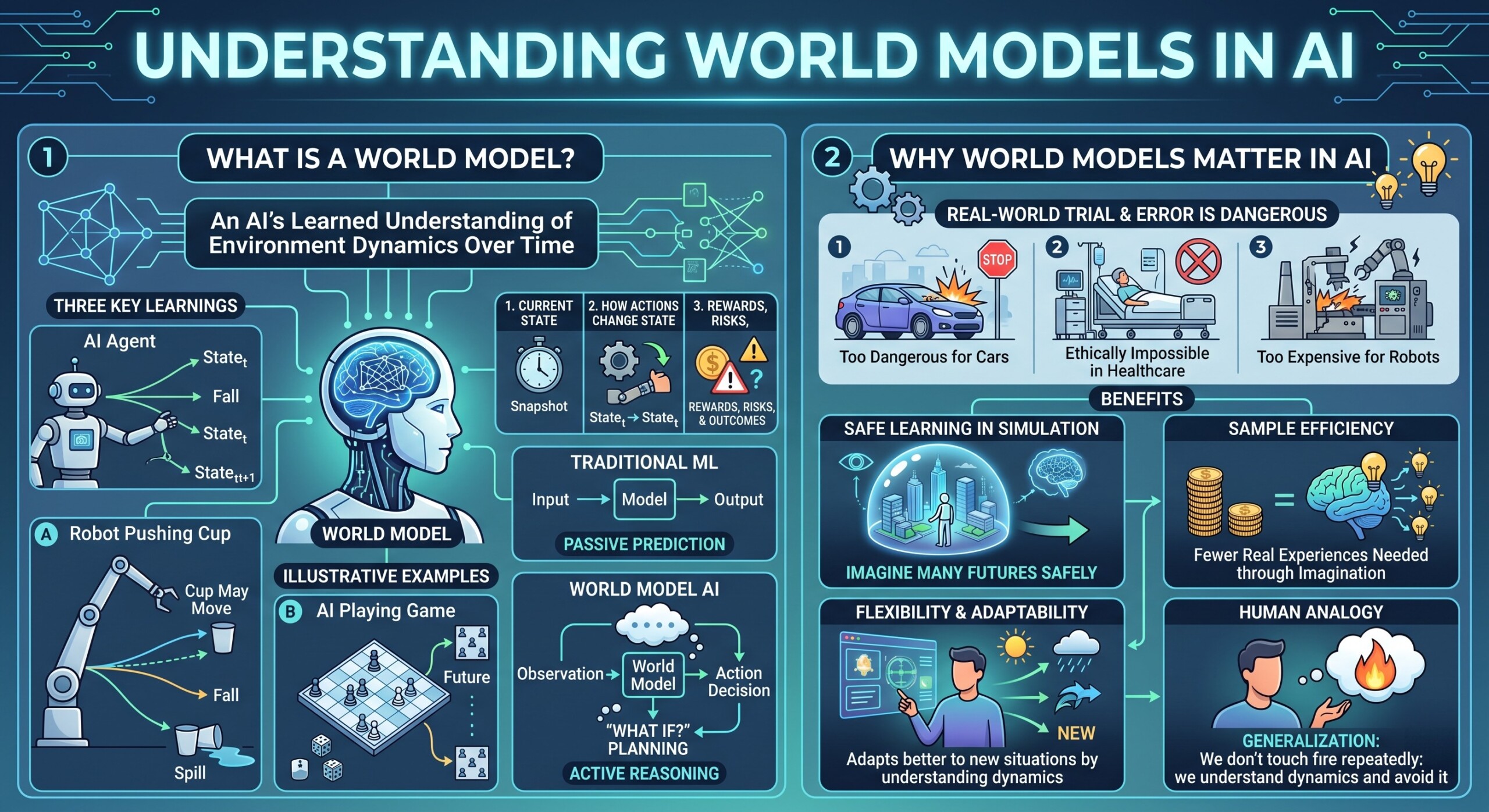
A world model is an AI system’s learned understanding of how the world changes over time.
For example, if a robot pushes a cup, its world model should predict that the cup may move, fall, or spill. If an AI agent is playing a game, its world model should estimate what the game state may look like after a move.
A world model usually tries to learn three things:
- The current state of the world.
- How actions change that state.
- What rewards, risks, or outcomes may follow.
In traditional machine learning, a model may simply map input to output. But in world-model-based AI, the system learns the structure of the environment itself. This allows it to ask “what if?” questions.
That “what if?” ability is crucial. It separates passive prediction from active reasoning.
2. Why World Models Matter in AI
World models matter because real-world trial and error can be expensive, slow, or dangerous.
A self-driving car cannot learn only by crashing thousands of times. A healthcare AI cannot test harmful treatment strategies on patients. A factory robot cannot damage equipment repeatedly while learning. In such cases, the AI needs a way to learn safely through simulation.
World models help AI systems become more sample-efficient. Instead of requiring millions of real-world experiences, the AI can use its internal model to imagine many possible futures.
This is similar to how humans learn. We do not touch fire repeatedly to understand danger. Once we understand the world, we can generalize.
World models also make AI more flexible. An AI that understands environment dynamics can adapt to new situations better than one trained only on fixed examples. An excellent collection of learning videos awaits you on our Youtube channel.
3. Latent Space: The Compressed Inner World
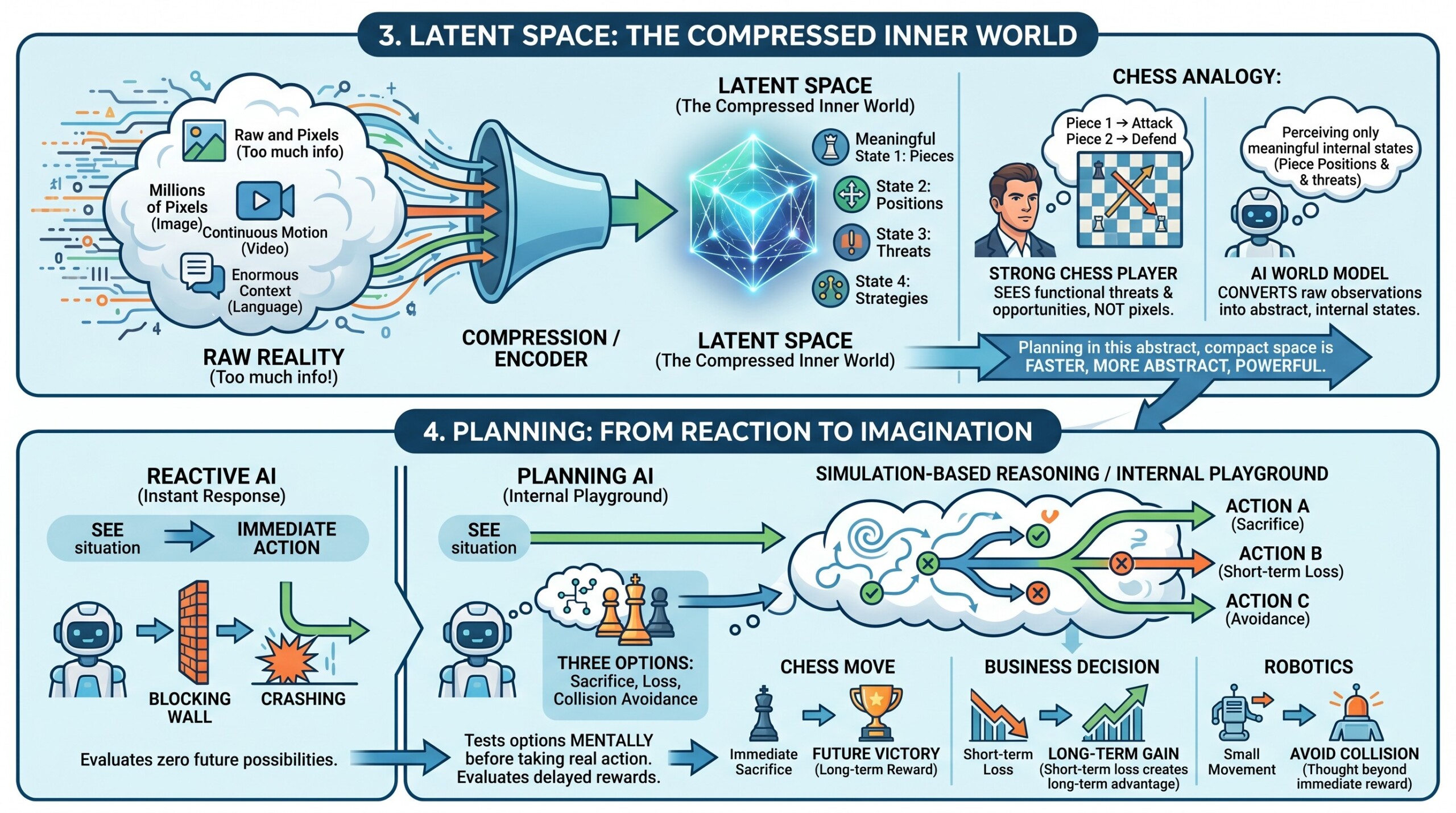
The real world contains too much information. Images have millions of pixels. Videos contain continuous motion. Language contains enormous context. Planning directly in raw data is computationally costly.
This is where latent space becomes important.
A latent space is a compressed representation of reality. It keeps the important information and removes unnecessary details.
For example, when looking at a chessboard, a strong player does not think in terms of every pixel of the board. The player thinks in terms of pieces, positions, threats, and strategies. Similarly, an AI system can convert raw observations into meaningful internal states.
Latent space planning means the AI does not simulate the full visible world. Instead, it simulates changes inside this compact internal representation.
This makes planning faster, more abstract, and often more powerful.
4. Planning: From Reaction to Imagination
Planning is the ability to evaluate possible actions before acting.
A reactive AI sees a situation and immediately chooses an action. A planning AI pauses internally and asks: “What may happen if I do this? What may happen if I do that?”
This is extremely important in complex environments.
For example, in a game, the best move may not give an immediate reward. It may prepare for a future victory. In business, a short-term loss may create long-term advantage. In robotics, a small movement may avoid a future collision.
Planning allows AI to think beyond immediate reward.
Simulation-based reasoning gives the AI an internal playground. It can test options mentally before taking action in the real world. A constantly updated Whatsapp channel awaits your participation.
5. MuZero: Learning Without Knowing the Rules
MuZero is one of the most important examples of world-model-based planning.
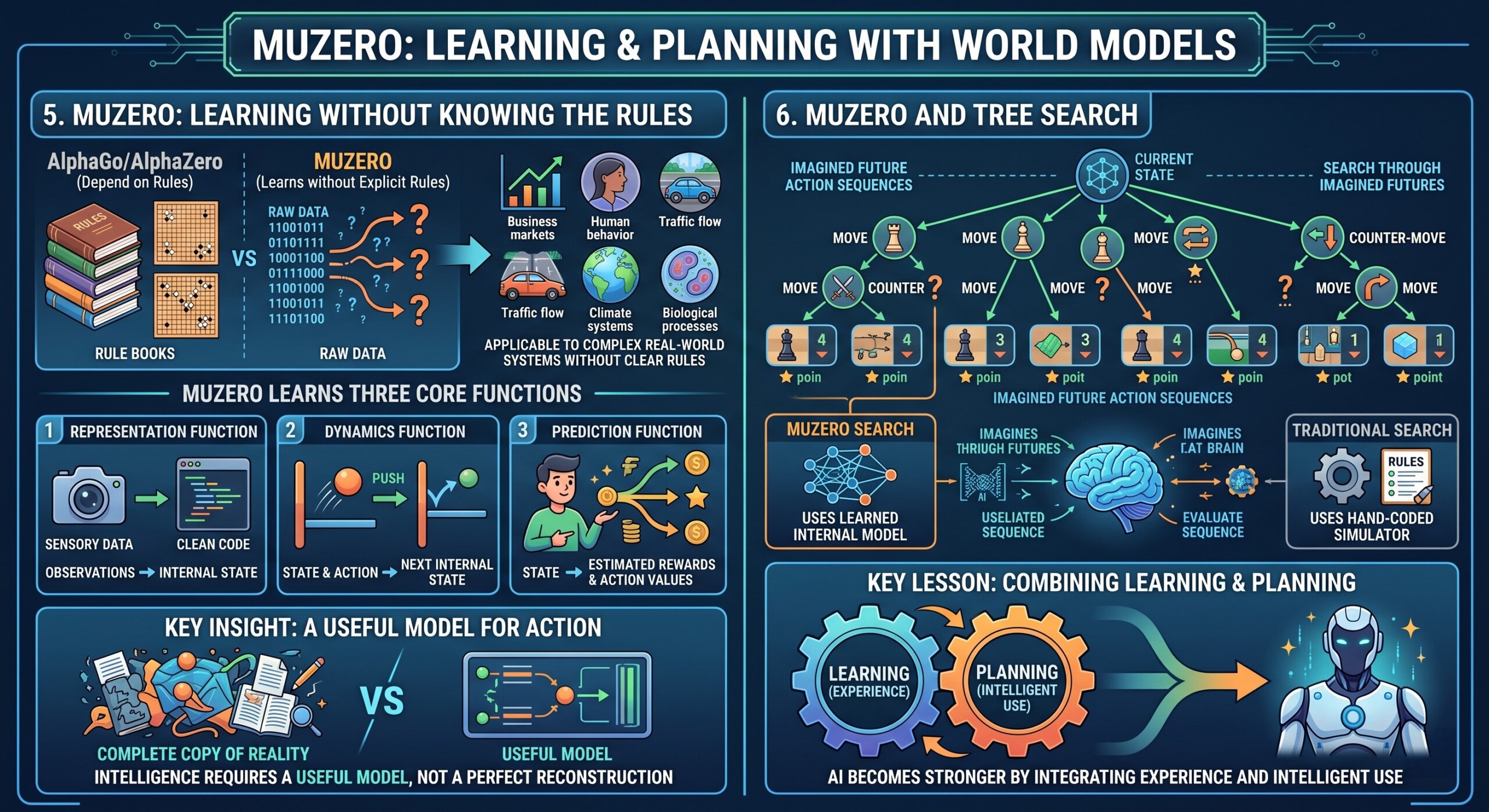
Earlier AI systems such as AlphaGo and AlphaZero achieved great success in games, but they usually depended on knowing the rules of the game. MuZero went further. It learned to plan successfully without being explicitly given the environment’s rules.
This is powerful because many real-world systems do not come with clear rules. Business markets, human behavior, traffic, climate systems, and biological processes are complex and uncertain.
MuZero learns three core functions:
- A representation function that converts observations into an internal state.
- A dynamics function that predicts the next internal state after an action.
- A prediction function that estimates future rewards and action values.
The key point is that MuZero does not need to reconstruct the full world perfectly. It only needs to learn the aspects of the world that are useful for decision-making.
This is a major insight: intelligence does not always require a complete copy of reality. It requires a useful model for action.
6. MuZero and Tree Search
MuZero combines learned world models with planning through search.
It uses a method inspired by Monte Carlo Tree Search, where the AI explores possible future action sequences. Each branch of the tree represents a possible action and its consequences.
For example, in a game, MuZero may consider many possible moves and counter-moves before selecting the best one. But unlike traditional search systems, MuZero does not need a hand-coded simulator. It uses its learned internal model.
This makes MuZero very interesting. It is not merely memorizing moves. It is learning how to imagine consequences and then search through those imagined futures.
The lesson from MuZero is that an AI system can become stronger when learning and planning are combined.
Learning gives the system experience. Planning allows it to use that experience intelligently. Excellent individualised mentoring programmes available.
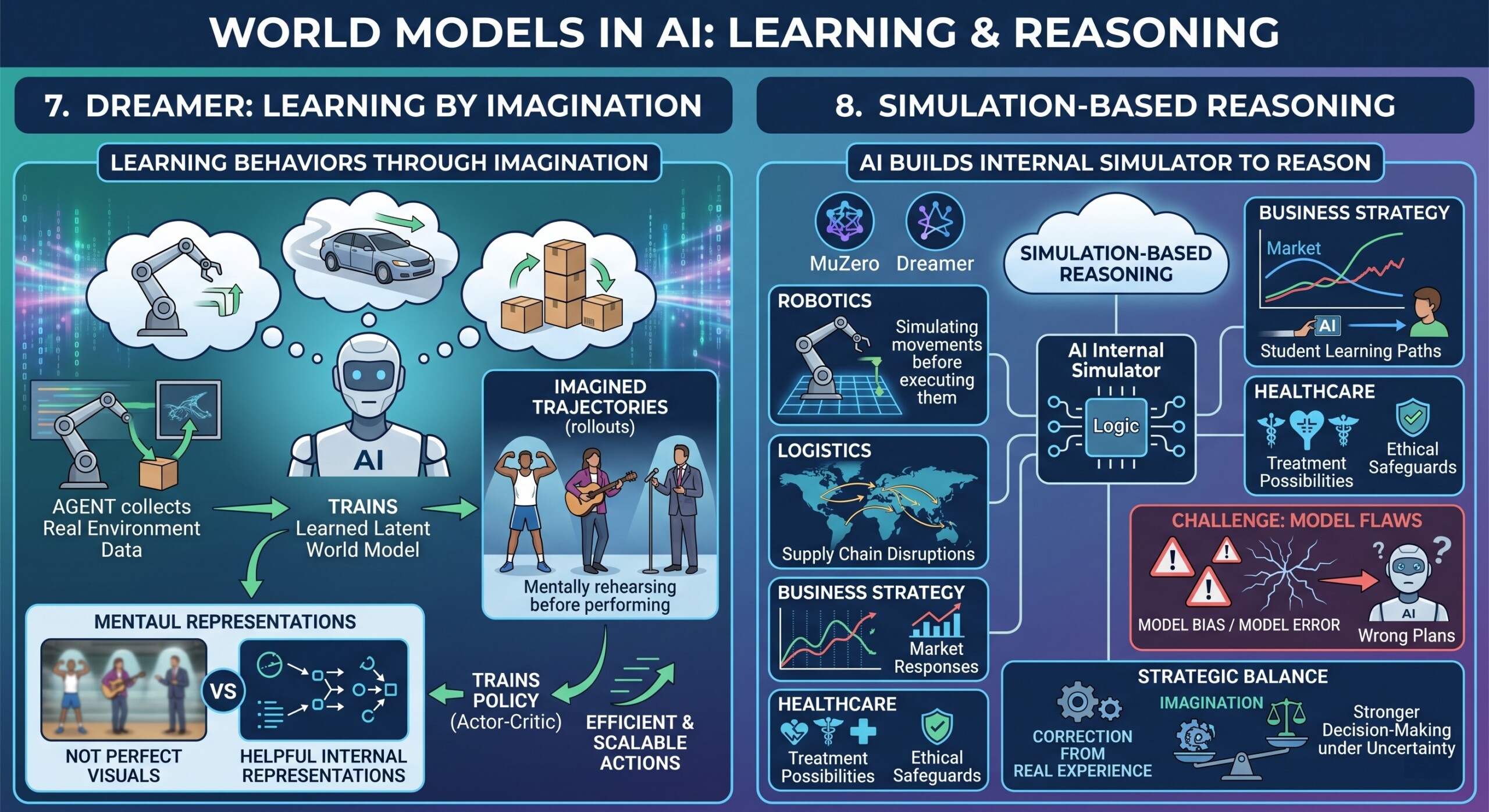
7. Dreamer: Learning by Imagination
Dreamer is another major approach to world models, especially important in reinforcement learning.
The central idea of Dreamer is that an AI agent can learn behaviors by imagining future trajectories inside a learned latent world model.
Instead of always acting in the real environment, Dreamer learns a compact model of the environment and then trains its policy using imagined rollouts. These imagined rollouts are like mental practice sessions.
This is similar to how athletes, musicians, or public speakers mentally rehearse before performing. They imagine the sequence, predict difficulties, and improve performance.
Dreamer is especially useful because it works in latent space. It does not need to generate perfect visual images of the future. It only needs internal representations that help the agent choose better actions.
This makes it efficient and scalable.
8. Simulation-Based Reasoning
Simulation-based reasoning is the broader idea behind both MuZero and Dreamer.
The AI builds an internal simulator and uses it to reason. This can be used in many areas beyond games.
For example:
- In robotics, a robot can simulate movements before acting.
- In logistics, an AI can simulate supply chain disruptions.
- In business strategy, AI can simulate market responses.
- In education, AI tutors can simulate student learning paths.
- In healthcare, AI can simulate treatment possibilities, with strong ethical safeguards.
Simulation-based reasoning is powerful because it supports decision-making under uncertainty.
However, simulations are only as good as the models behind them. If the world model is flawed, the AI may make wrong plans. This is called model bias or model error.
Therefore, strong AI systems must balance imagination with correction from real experience. Subscribe to our free AI newsletter now.
9. Benefits and Limitations of World Models
World models offer many benefits, but they also have limitations.
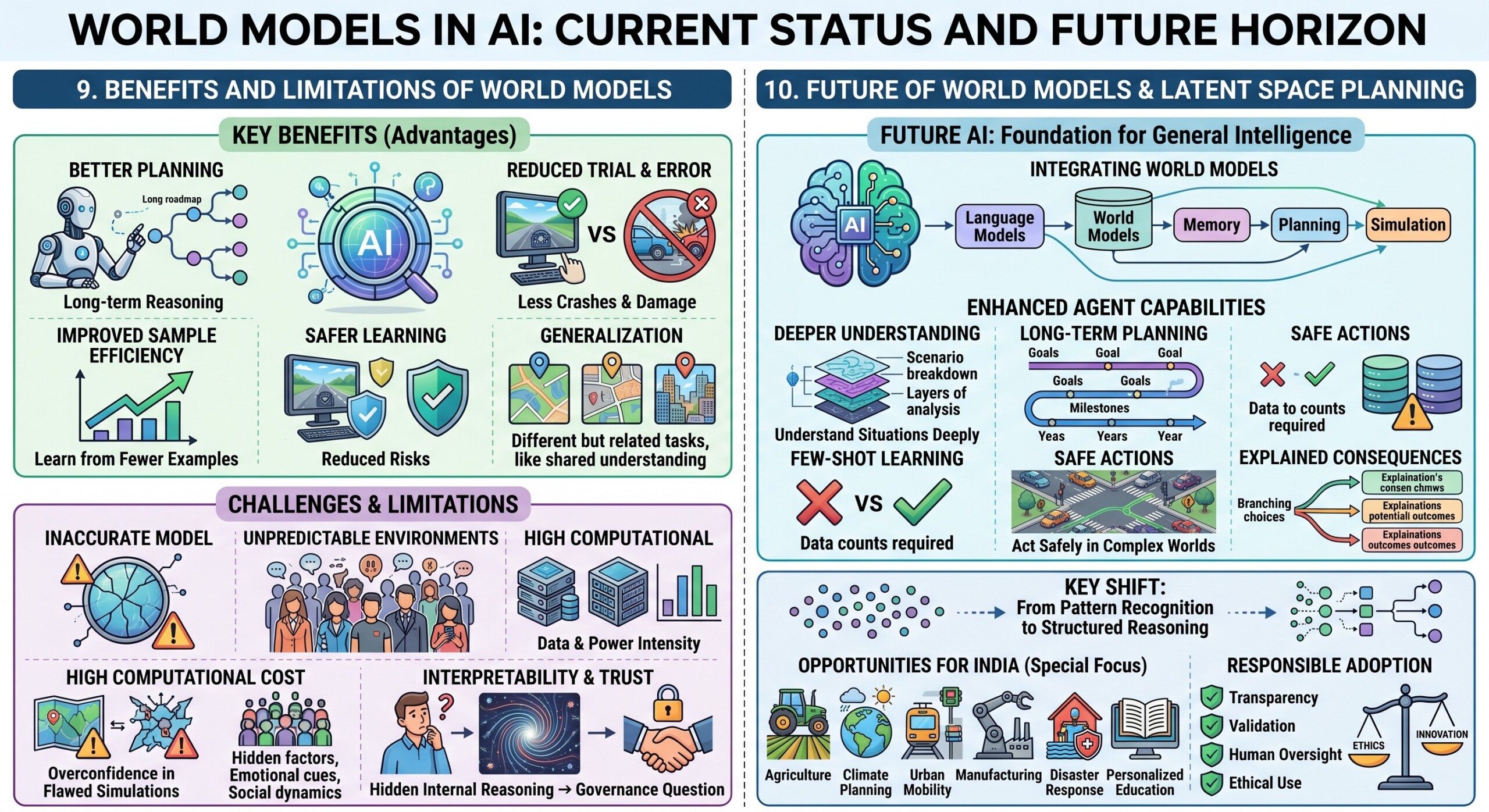
Their benefits include:
- Better planning and long-term reasoning.
- Reduced need for real-world trial and error.
- Improved sample efficiency.
- Safer learning in risky environments.
- Ability to generalize across related situations.
But there are challenges too.
A world model may learn an incomplete or inaccurate version of reality. The AI may become overconfident in its internal simulation. In complex human environments, many factors are hidden, emotional, social, or unpredictable.
Another limitation is computational cost. Training world models can require large amounts of data and computing power.
There is also the issue of interpretability. If an AI plans in latent space, humans may not easily understand what it is imagining.
This creates an important governance question: how do we trust an AI system that reasons inside a hidden internal world?
10. Future of World Models and Latent Space Planning
World models may become one of the foundations of more general AI systems.
Today’s large language models are powerful at generating text, but they do not always have reliable grounded models of the physical or social world. Future AI systems may combine language models with world models, memory, planning, and simulation.
This could lead to AI agents that can:
- Understand situations more deeply.
- Plan over longer time horizons.
- Learn from fewer real-world examples.
- Act safely in complex environments.
- Explain possible consequences before making decisions.
In the long run, world models may help AI move from pattern recognition to structured reasoning.
For India, businesses, education systems, and policymakers, this area is especially important. World-model-based AI can support agriculture, climate planning, urban mobility, manufacturing, disaster response, and personalized education.
But adoption must be responsible. Systems that simulate future outcomes can influence major decisions. Therefore, transparency, validation, human oversight, and ethical use are essential. Upgrade your AI-readiness with our masterclass.
Conclusion
World models and latent space planning represent a major shift in artificial intelligence. Instead of simply reacting to data, AI systems can learn internal models, imagine futures, and choose actions through simulation.
MuZero showed that an AI can learn to plan effectively without being given explicit rules. Dreamer showed that an agent can improve by practicing inside its own learned latent world. Together, these systems point toward a future where AI can reason more like an intelligent planner rather than a simple prediction machine.
The core idea is simple but profound: intelligence requires imagination.
A machine that can simulate possible futures can make better decisions in the present. But this power must be used carefully. The quality of the world model, the safety of the planning process, and the role of human judgment remain critical.
World models are not just a technical topic. They are a window into the future of AI: systems that do not merely answer questions, but understand situations, explore possibilities, and support thoughtful action.