AI Careers in Manufacturing, Supply Chain & IoT
AI Careers in Manufacturing,
Supply Chain & IoT
Predictive, optimization, and automation roles
Manufacturing is moving from “automation” to prediction + optimization + closed-loop control: machines stream sensor data, models forecast failures and demand, and software continuously adjusts schedules, inventory, and maintenance plans. This is the core of Industry 4.0/IIoT platforms – connecting machines, edge devices, and enterprise systems so AI can act on reality, not spreadsheets.
At the same time, enterprises are accelerating AI adoption (including GenAI), but the winners are the ones who can industrialize it: reliable data pipelines, measurable KPIs (OEE, scrap, OTIF), and governance in safety-critical environments.
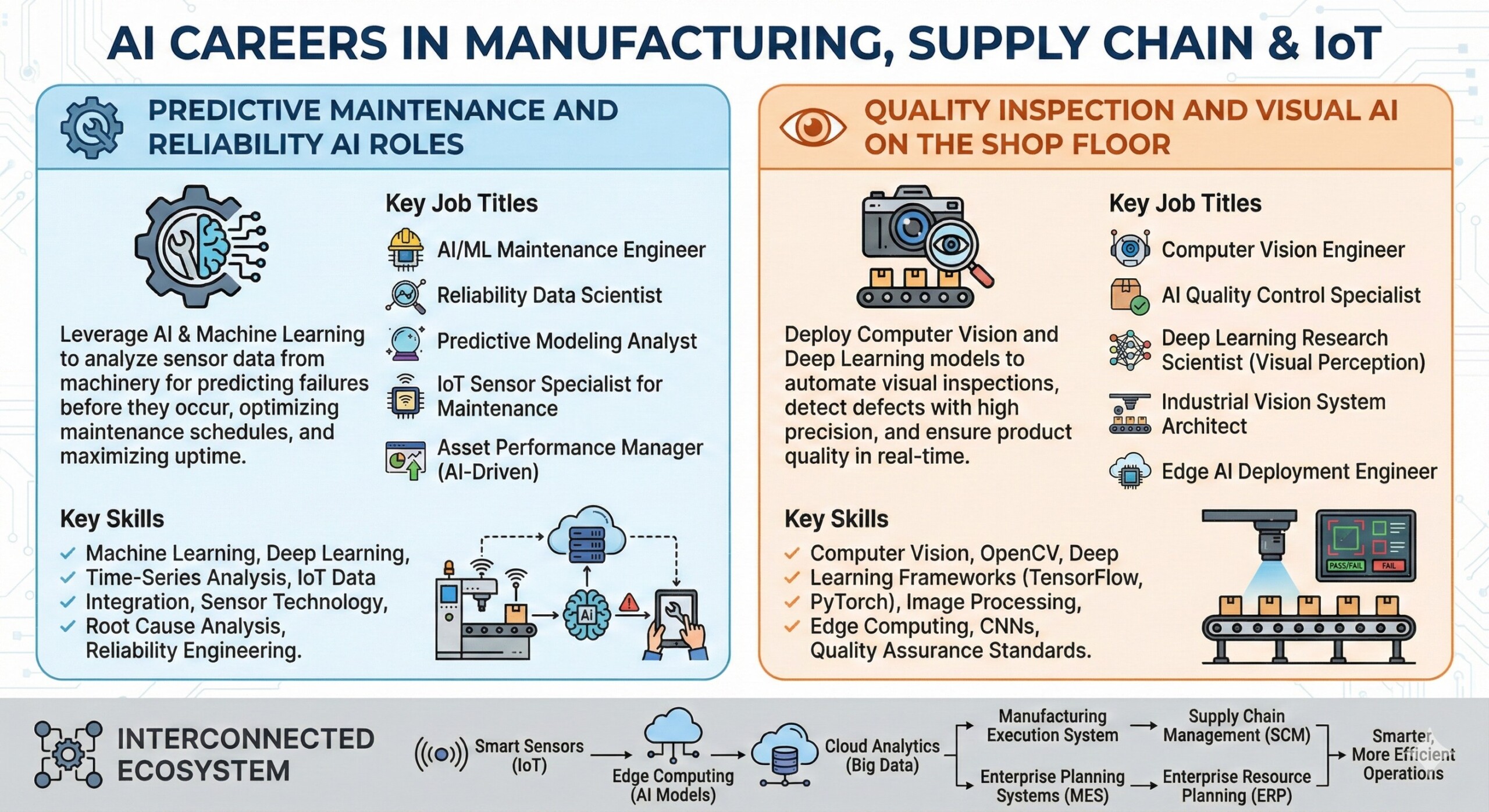
1. Predictive Maintenance and Reliability AI roles
These roles turn raw condition data into fewer breakdowns and better uptime.
Typical job titles
- Predictive Maintenance Data Scientist / Engineer
- Reliability Analytics Lead
- Asset Health Monitoring Engineer (AI)
What you actually build
- Time-series models for vibration/current/temperature (anomaly detection, RUL estimation)
- Failure-mode mapping (linking signals → root causes)
- Alerting systems with precision/recall targets (avoid “alarm fatigue”)
Tooling & skills
- Signal processing + ML (FFT/wavelets, feature learning), Python, edge deployment
- OT connectivity basics (PLC signals, historian data, SCADA context)
AIoT-style predictive maintenance increasingly blends IoT streaming with adaptive analytics.
2. Quality inspection and Visual AI on the shop floor
Factories are scaling camera-first QA: detecting defects faster than humans and earlier than end-of-line inspection.
Typical job titles
- Computer Vision Engineer (Industrial)
- Quality Analytics Scientist
- Defect Detection / Metrology ML Engineer
What you actually build
- Defect segmentation/classification (surface flaws, weld quality, PCB defects)
- “Golden sample” comparison + drift monitoring (new suppliers, lighting shifts)
- Human-in-the-loop labeling workflows for continuous improvement
Real-world constraints
- False positives are costly (unnecessary rework)
- Dataset shift is constant (new batches, tool wear), so monitoring is part of the job.
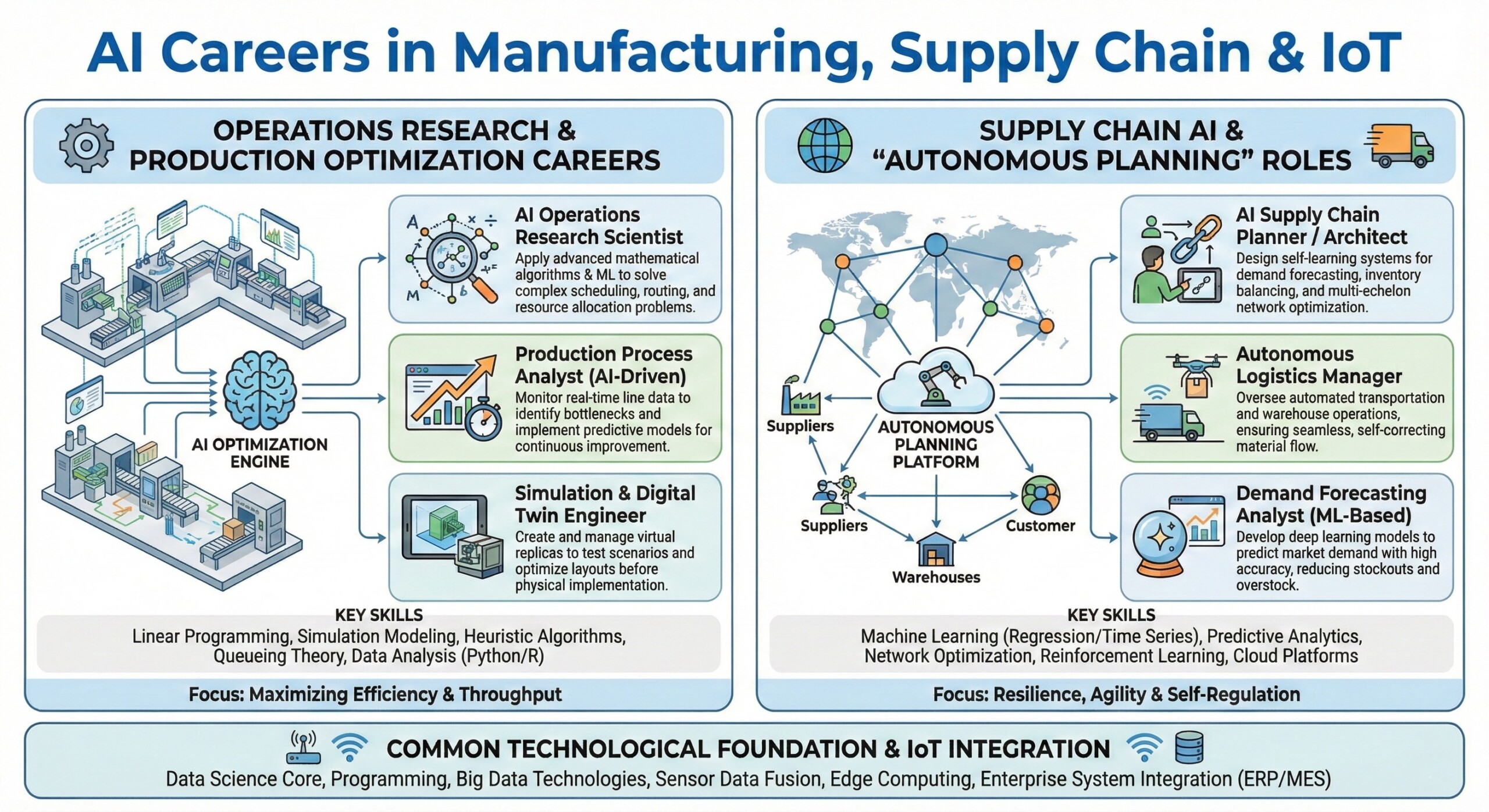
3. Operations Research and Production Optimization careers
This is the “math engine” behind higher throughput and lower cost – often more valuable than another model.
Typical job titles
- Optimization Scientist / OR Engineer
- Production Scheduling Analyst (AI/ML)
- Supply & Demand Optimization Lead
What you actually build
- Scheduling and sequencing (constraints: changeovers, labor, machine availability)
- Inventory optimization (service level vs holding cost)
- Network flow optimization (plants ↔ DCs ↔ last mile)
Tooling & skills
- MILP/CP-SAT, heuristics/metaheuristics, simulation, Pyomo/OR-Tools
- KPI grounding: OTIF, OEE, WIP, scrap, changeover minutes
4. Supply Chain AI and “Autonomous Planning” roles
Supply chain is embracing AI to reduce volatility—forecasting, replenishment, and planning automation are key.
Typical job titles
- Supply Chain Data Scientist
- Demand Forecasting Lead
- Autonomous Planning Product Owner
What you actually build
- Probabilistic forecasting (promotions, seasonality, substitution)
- Replenishment policies + exception management
- Scenario planning (what-if simulations for disruptions)
What’s current right now
- Gartner highlights trends like agentic AI and autonomous planning in supply-chain tech roadmaps—useful, but requires tight governance and clear ROI.
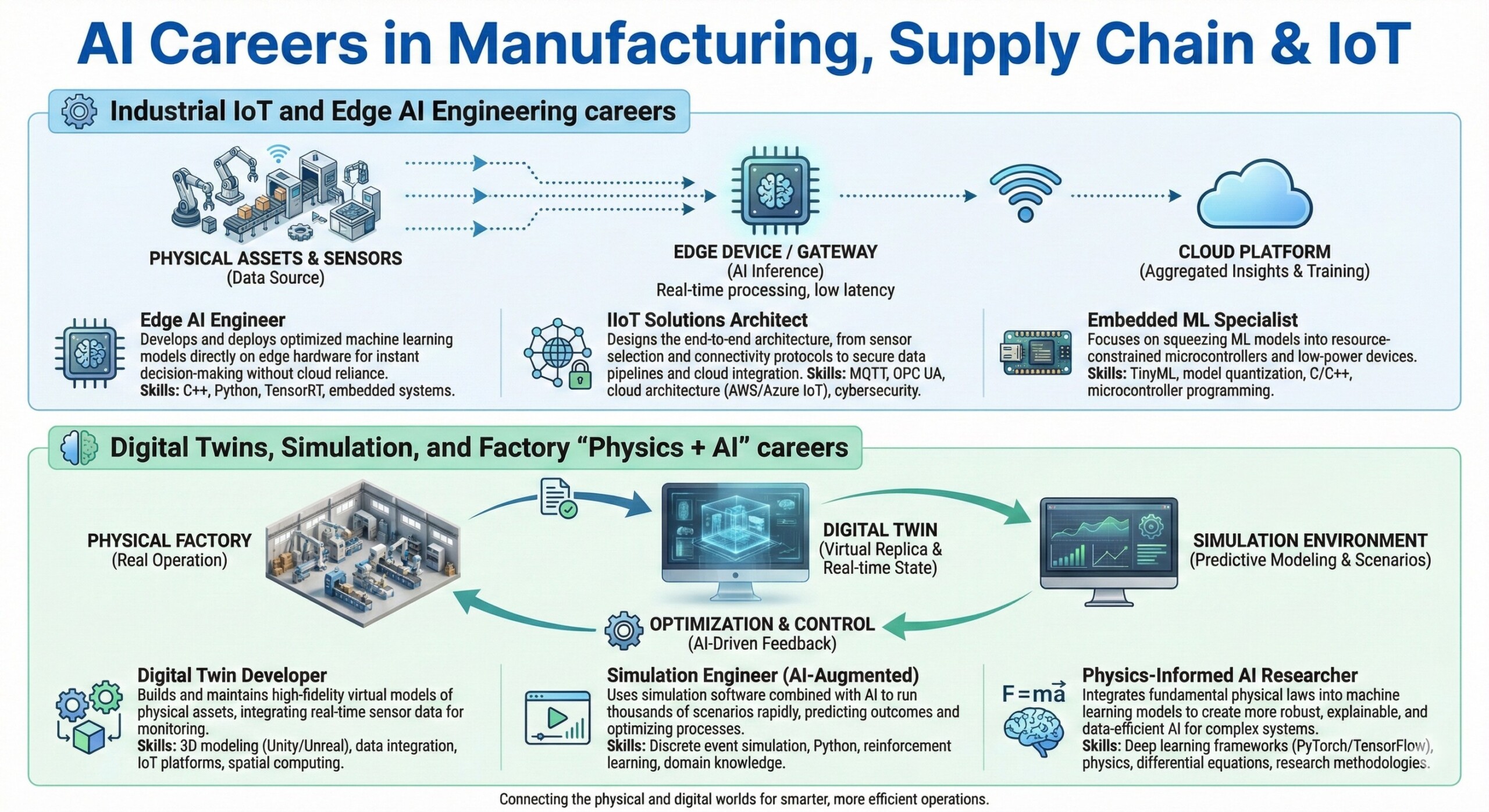
5. Industrial IoT and Edge AI Engineering careers
Many factories can’t send everything to the cloud (latency, cost, privacy). Edge AI is becoming central.
Typical job titles
- IIoT/Edge AI Engineer
- Industrial Data Engineer (OT/IT)
- Streaming & Sensor Analytics Engineer
What you actually build
- Sensor-to-model pipelines (MQTT/OPC UA → stream processing → inference)
- Edge deployment (model compression, quantization, offline reliability)
- Fleet management (thousands of devices, versioning, remote updates)
Why it matters
- IIoT platforms are the backbone of smart manufacturing because they integrate machines, edge devices, and distributed apps.
6. Digital Twins, Simulation, and Factory “Physics + AI” careers
Digital twins are increasingly used to plan factories/warehouses, test changes safely, and optimize layouts and flows.
Typical job titles
- Digital Twin Engineer
- Simulation Engineer (AI-enabled)
- Industrial AI Solutions Architect
What you actually build
- Hybrid models: physics + data-driven components
- Virtual commissioning (test controls before real deployment)
- Layout, throughput, and safety simulations
NVIDIA and partners position industrial digital twins as combining AI, physics, and real-time IoT data for factory planning and operations.
7. Automation, Robotics, and Closed-Loop Control roles
This is where AI becomes action: robots, PLC logic, and supervisory systems respond to predictions and optimization outputs.
Typical job titles
- Robotics/Automation Engineer (AI)
- Controls + AI Integration Engineer
- OT Cybersecurity + AI Governance Specialist
What you actually build
- Closed-loop workflows (predict → decide → execute → measure)
- Safe integration with OT systems (interlocks, fail-safes, audit trails)
- Governance: access control, model change management, incident playbooks
(Especially important as “agentic” automation expands – many orgs are tightening guardrails due to cost/ROI and risk concerns. )
Conclusion
AI careers in manufacturing, supply chain, and IoT reward people who can connect real-world systems to measurable outcomes: fewer failures, less scrap, faster throughput, better service levels, and safer operations. The most in-demand professionals are “hybrids” – they understand data and models, but also speak OT realities (machines, constraints, downtime economics). If you can build solutions that survive noise, drift, and messy plant life – not just demos – you’ll be valuable in every Industry 4.0 transformation happening right now.