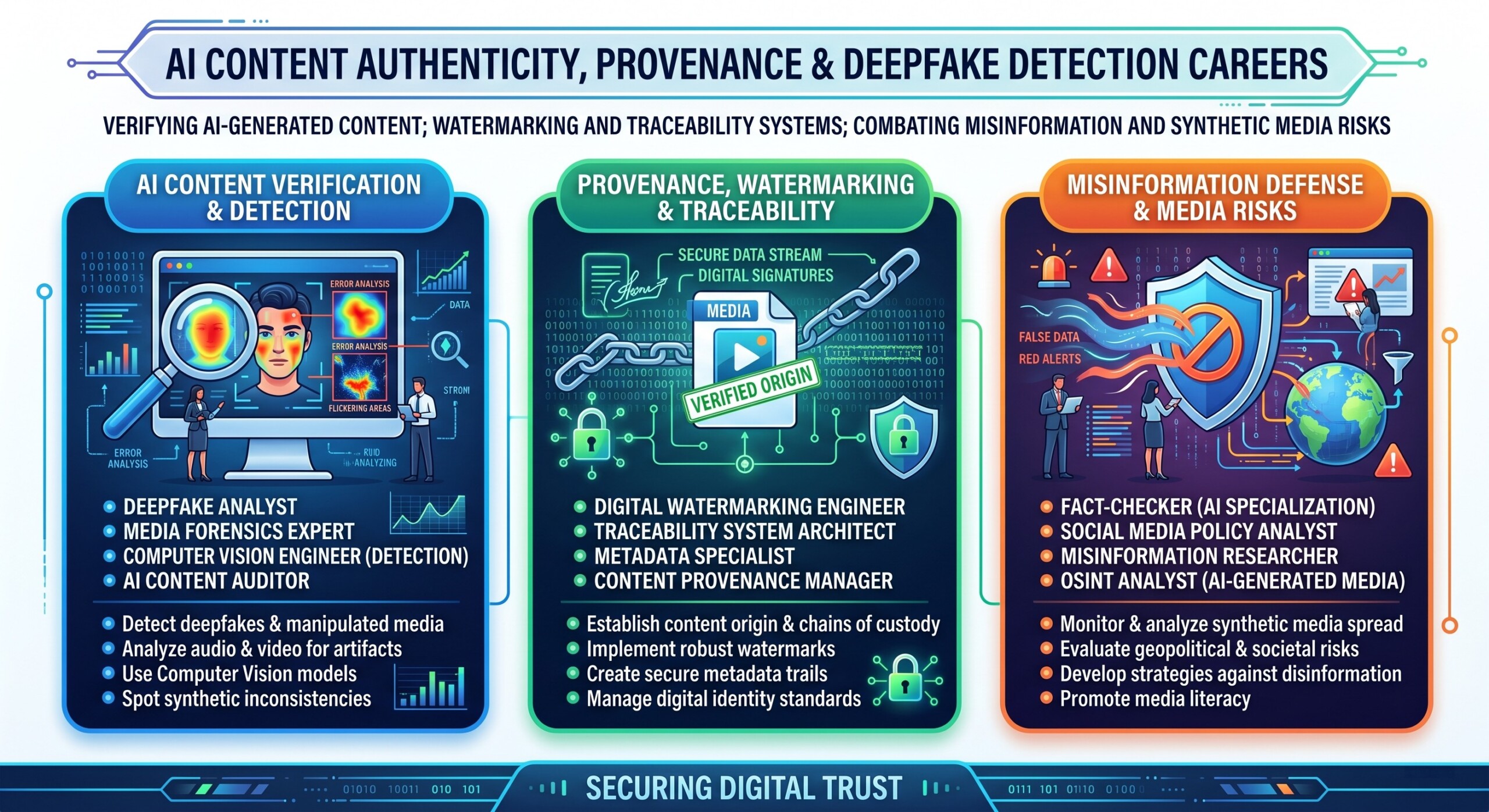
AI Content Authenticity, Provenance & Deepfake Detection Careers
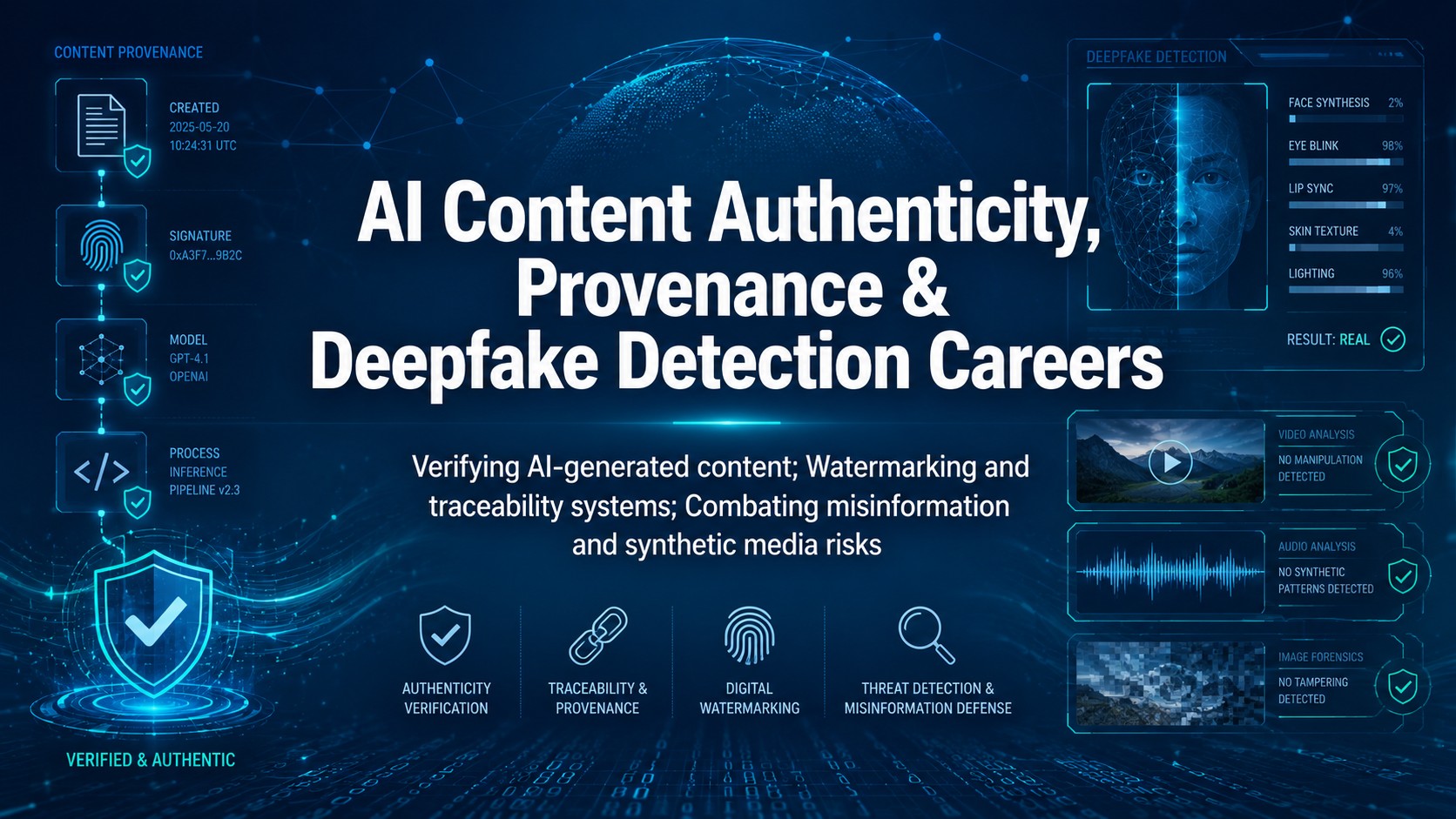
AI Content Authenticity, Provenance & Deepfake Detection Careers
Verifying AI-generated content; Watermarking and traceability systems; Combating misinformation and synthetic media risks
Introduction
AI-generated content is now part of everyday life. Images, videos, voices, documents, ads, political messages, product reviews, and social media posts can all be created or modified by AI. This has opened many creative and business opportunities, but it has also created a serious trust problem: how do we know whether a piece of content is real, edited, AI-generated, or deliberately fake?
This is where AI content authenticity, provenance, watermarking, and deepfake detection become important. Content authenticity focuses on proving whether content is genuine. Provenance means tracking the origin and history of a file, including who created it, what tools were used, and what edits were made. Watermarking adds hidden or visible signals to AI-generated content. Deepfake detection uses technical and investigative methods to identify manipulated images, videos, voices, or text.
This field is becoming a strong career area because governments, media companies, social platforms, courts, brands, cybersecurity teams, and AI companies all need ways to protect trust. The C2PA standard, for example, supports Content Credentials, which work like a “nutrition label” for digital content by showing information about a file’s origin and history. NIST has also identified provenance tracking, watermarking, synthetic content detection, testing, auditing, and prevention of harmful synthetic content as important technical areas for reducing risks from AI-generated media. An excellent collection of learning videos awaits you on our Youtube channel.
Let’s dive deep into this.
1. Why AI Content Authenticity Has Become a Major Career Field
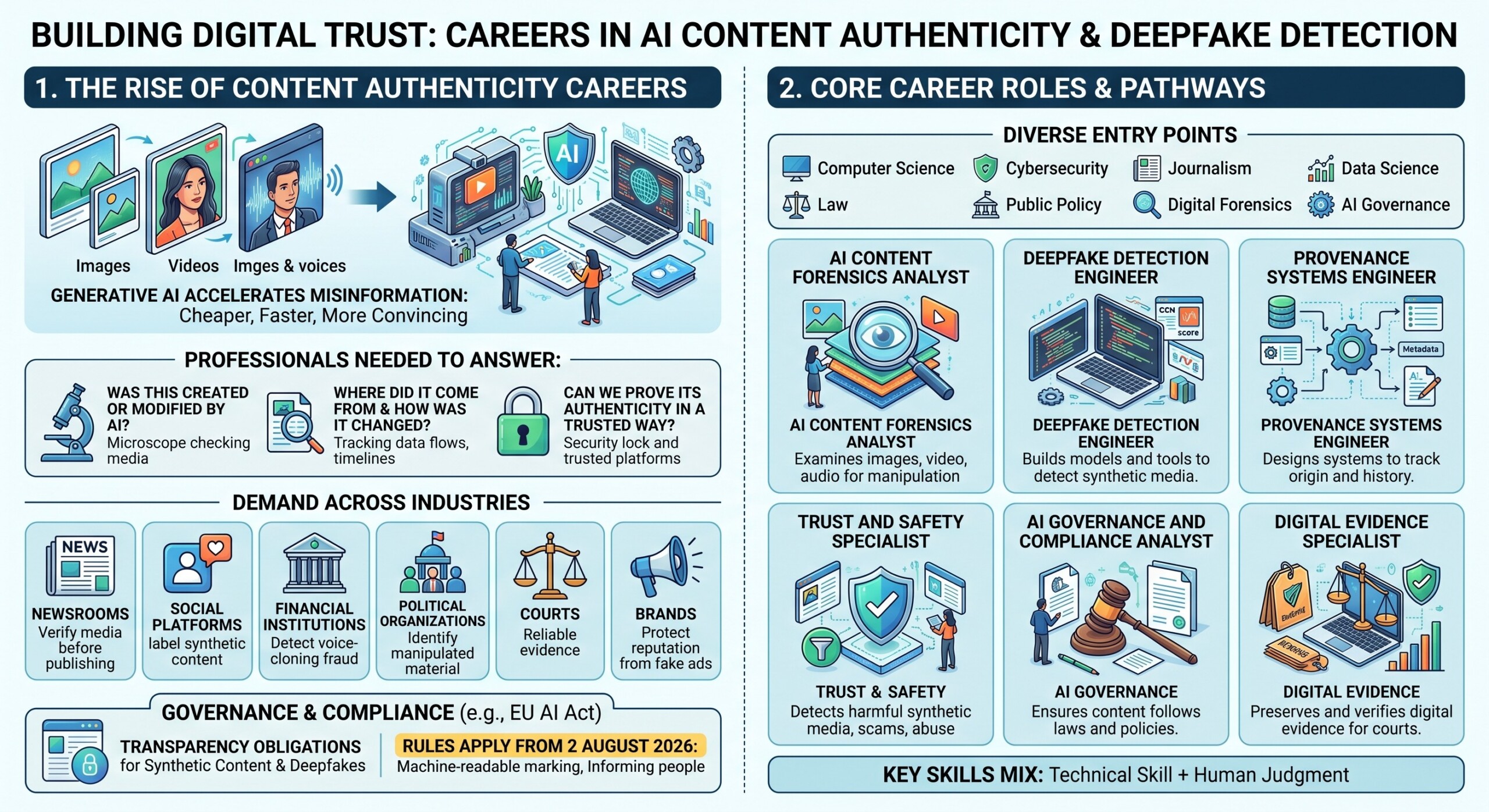
The internet has always had misinformation, but generative AI has made the problem faster, cheaper, and more convincing. Earlier, creating a realistic fake video, fake voice, or fake photograph required advanced technical skills. Today, many people can generate believable synthetic content using widely available AI tools.
This has created demand for professionals who can answer three practical questions:
- Was this content created or modified by AI?
- Where did it come from and how was it changed?
- Can we prove its authenticity in a way that platforms, courts, journalists, and users can trust?
Careers in this field are growing because the problem affects many industries. Newsrooms need to verify images and videos before publication. Social platforms need to label synthetic content. Financial institutions need to detect voice-cloning fraud. Political organizations need to identify manipulated campaign material. Courts and law enforcement need reliable evidence handling. Brands need to protect their reputation from fake ads, fake endorsements, and impersonation.
The European Union’s AI Act includes transparency obligations for synthetic content and deepfakes, and official EU guidance says rules on transparency will apply from 2 August 2026, including obligations around machine-readable marking and informing people when they are exposed to deepfakes or AI-generated public-interest content. This shows that content authenticity is no longer only a technical concern. It is becoming a compliance, governance, security, and public trust profession.
2. Core Career Roles in Content Authenticity and Deepfake Detection
This field is not limited to one job title. It includes technical, investigative, legal, product, and policy roles. A person can enter from computer science, cybersecurity, journalism, media studies, law, public policy, digital forensics, data science, or AI governance.
Some important career roles include:
- AI Content Forensics Analyst: Examines images, videos, audio, and documents for signs of manipulation or synthetic generation.
- Deepfake Detection Engineer: Builds models and tools to detect AI-generated or AI-manipulated media.
- Provenance Systems Engineer: Designs systems that track content origin, editing history, metadata, cryptographic signatures, and verification workflows.
- Watermarking Researcher: Develops visible and invisible watermarking methods for AI-generated content.
- Trust and Safety Specialist: Helps platforms detect harmful synthetic media, misinformation, impersonation, scams, and abuse.
- AI Governance and Compliance Analyst: Ensures that AI-generated content follows laws, disclosure rules, and platform policies.
- Digital Evidence Specialist: Works with law firms, courts, investigators, or corporate security teams to preserve and verify digital evidence.
These careers require a mix of technical skill and judgment. A deepfake detector may produce a probability score, but a human expert still needs to interpret the context. A watermark may help identify AI output, but it may not survive cropping, compression, screenshots, or deliberate removal. This is why the field needs people who understand both AI systems and real-world misuse. A constantly updated Whatsapp channel awaits your participation.
3. Provenance and Content Credentials: Tracking the History of Digital Content
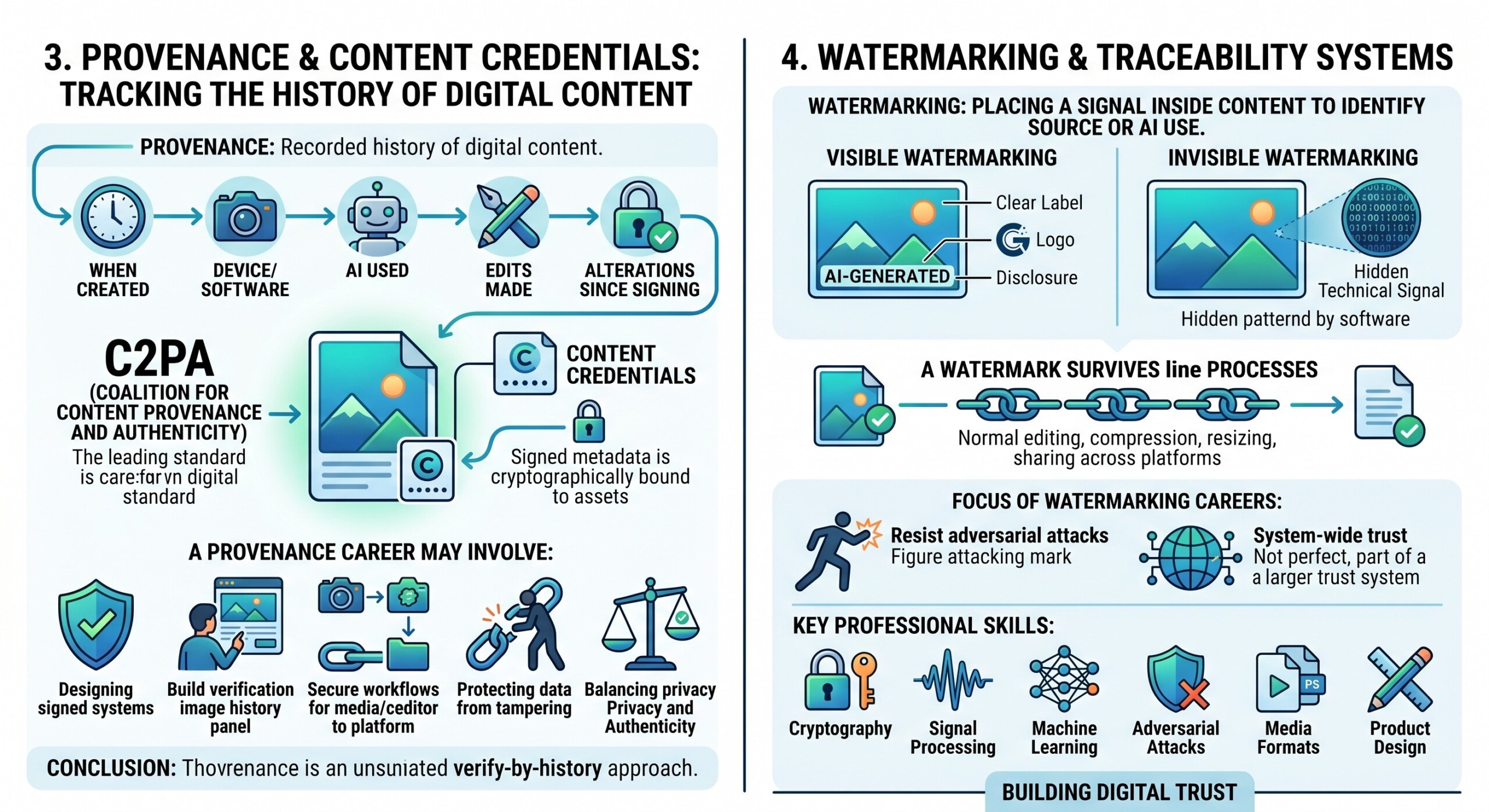
Provenance means the recorded history of a piece of digital content. It can include when the content was created, which device or software created it, whether AI was used, what edits were made, and whether the file has been altered since signing.
The most important current standard in this space is C2PA, the Coalition for Content Provenance and Authenticity. C2PA develops technical standards for certifying the source and history of media content. Its specifications support Content Credentials, which are cryptographically connected to digital assets and can show provenance information.
A provenance career may involve:
- Designing systems that attach signed metadata to images, videos, audio, or documents.
- Building verification tools that allow users to inspect content history.
- Creating secure workflows for media organizations, cameras, editing software, and publishing platforms.
- Protecting provenance data from tampering, stripping, or misuse.
- Balancing authenticity with privacy, because provenance systems must not expose unnecessary personal information.
This area is important because detection alone is not enough. A detector tries to guess whether something is synthetic. Provenance tries to show a trustworthy history of how the content was made. In the future, many organizations may prefer a verify-by-history approach rather than relying only on after-the-fact deepfake detection.
4. Watermarking and Traceability Systems
Watermarking means placing a signal inside content to identify its source or indicate that it was AI-generated. A watermark can be visible, like a label on an image, or invisible, like a hidden pattern inside pixels, audio waves, or generated text.
Watermarking careers focus on designing systems that are strong enough to survive normal editing, compression, resizing, format conversion, and sharing across platforms. They also involve testing how easily bad actors can remove or corrupt the watermark.
Two types of watermarking matter:
- Visible watermarking: A clear label, logo, or disclosure that tells users the content is AI-generated or modified.
- Invisible watermarking: A hidden technical signal that can be detected by software, even if the user cannot see it.
Watermarking is valuable, but it is not perfect. NIST’s work on synthetic content risk reduction explains that detection may involve provenance information, metadata, digital watermarks, or other characteristics of synthetic generation. However, watermarking systems can be attacked, removed, or bypassed, especially when adversaries are motivated. This means watermarking should be part of a larger trust system, not the only solution.
A good professional in this area must understand cryptography, signal processing, machine learning, adversarial attacks, media formats, and product design. The goal is not just to add a mark. The goal is to make content traceability practical across real platforms, real users, and real abuse cases. Excellent individualised mentoring programmes available.
5. Deepfake Detection: Skills, Methods, and Limitations
Deepfake detection is the process of identifying whether media has been artificially generated or manipulated. It applies to faces, voices, gestures, documents, videos, and even writing style.
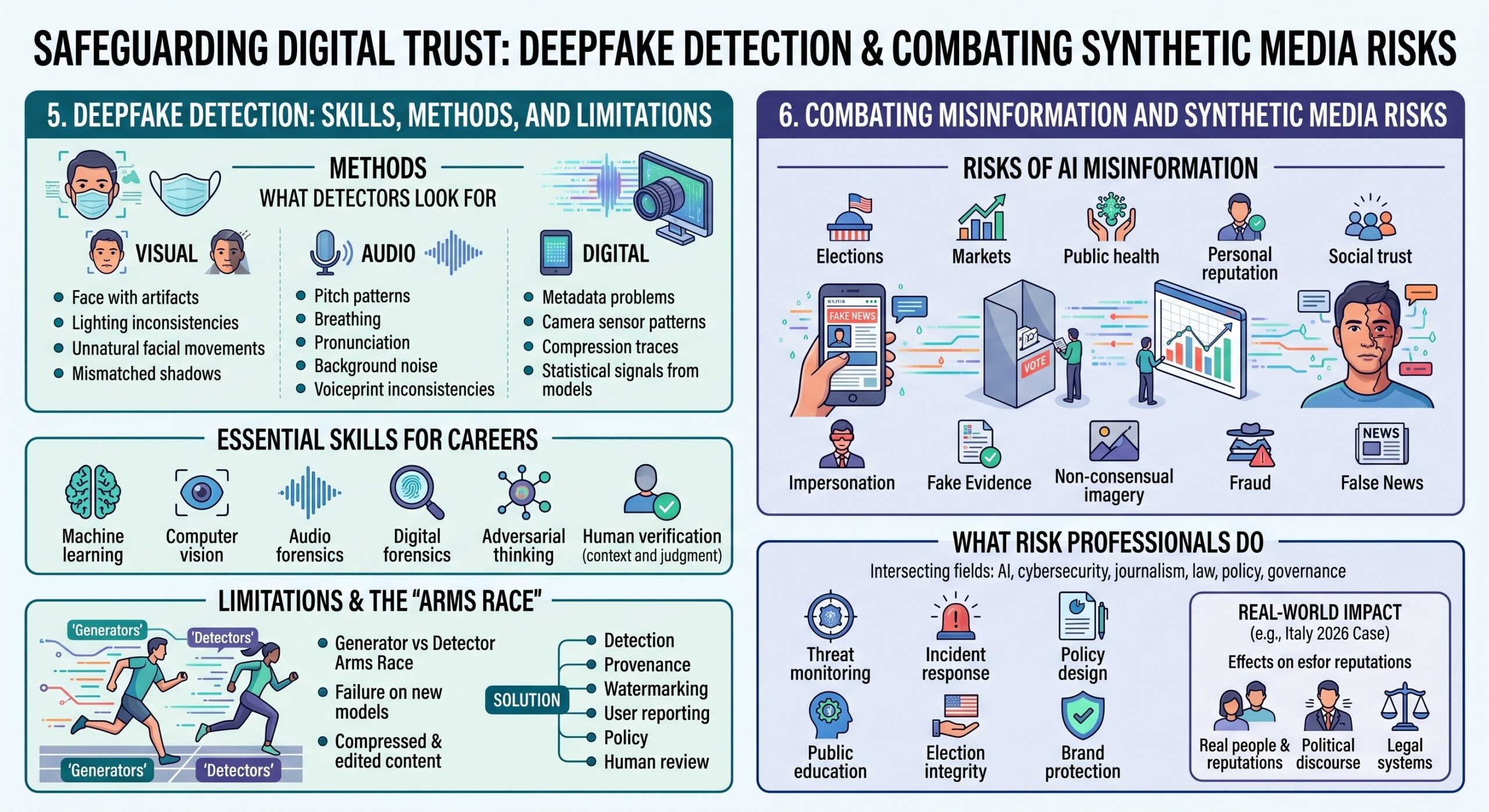
Detection systems may look for visual artifacts, lighting inconsistencies, unnatural facial movements, mismatched shadows, audio-visual mismatch, compression traces, camera sensor patterns, metadata problems, or statistical signals left by generative models. In audio, they may examine pitch patterns, breathing, pronunciation, background noise, and voiceprint inconsistencies.
Important skills for deepfake detection careers include:
- Machine learning: Training and evaluating classifiers for synthetic content.
- Computer vision: Detecting visual manipulation in images and videos.
- Audio forensics: Identifying cloned or manipulated voices.
- Digital forensics: Preserving evidence, checking metadata, and building a chain of custody.
- Adversarial thinking: Understanding how attackers try to bypass detectors.
- Human verification: Combining technical scores with context, source checking, and investigative judgment.
The biggest limitation is that deepfake detection is an arms race. As generators improve, detectors must also improve. A detector that works well on one model’s output may fail on another model’s output. Content may also be compressed, cropped, re-recorded, translated, or edited before analysis. This is why organizations increasingly combine detection, provenance, watermarking, user reporting, policy enforcement, and human review.
6. Combating Misinformation and Synthetic Media Risks
AI-generated misinformation can damage elections, markets, public health, personal reputation, and social trust. Deepfakes can impersonate leaders, create fake evidence, generate non-consensual intimate imagery, clone voices for fraud, or spread false news during emergencies.
This creates a growing need for professionals who can work at the intersection of AI, cybersecurity, journalism, law, public policy, and platform governance. The task is not just to detect fake content. It is to reduce harm.
A misinformation and synthetic media risk professional may work on:
- Threat monitoring: Tracking viral synthetic media and coordinated manipulation campaigns.
- Incident response: Helping organizations respond when fake content targets them.
- Policy design: Creating rules for labeling, takedown, escalation, and appeals.
- Public education: Teaching people how to verify content before sharing.
- Election integrity: Monitoring political deepfakes, fake speeches, fake endorsements, and manipulated media.
- Brand protection: Detecting fake celebrity endorsements, fake CEO messages, and scam advertisements.
Recent events show why this field matters. In 2026, AI-generated sexualized imagery involving a public political figure in Italy triggered public concern about cyberbullying, misinformation, and deepfake abuse. Such cases show that synthetic media risks are not abstract. They affect real people, reputations, political discourse, and legal systems. Subscribe to our free AI newsletter now.
7. How to Build a Career in This Field
A strong career path in AI content authenticity and deepfake detection should combine technical learning with practical verification skills. The field is still developing, so professionals who can understand both tools and policy will have an advantage.
A useful learning path includes:
- Start with AI and machine learning basics. Understand how generative AI models create images, video, audio, and text.
- Learn digital media formats. Study images, video codecs, audio files, metadata, compression, and editing workflows.
- Understand provenance standards. Learn about C2PA, Content Credentials, cryptographic signatures, and metadata verification.
- Study cybersecurity and digital forensics. Learn evidence handling, tamper detection, hashing, chain of custody, and adversarial attacks.
- Build detection projects. Try image manipulation detection, voice-clone detection, AI text classification, and metadata analysis.
- Follow regulation and platform policy. Keep track of AI Act obligations, platform labeling policies, and content moderation standards.
- Develop judgment and communication. Learn how to explain uncertainty, risk, and evidence clearly to non-technical decision-makers.
The best portfolio projects could include a small provenance verifier, a tool that checks image metadata and Content Credentials, a deepfake detection dashboard, an audio authenticity experiment, or a case study on misinformation response. For students and professionals, this is a promising area because it sits at the centre of AI trust, safety, media integrity, and digital governance.
Conclusion
AI content authenticity, provenance, watermarking, and deepfake detection are becoming essential parts of the modern digital world. As generative AI makes synthetic media easier to create, society needs better ways to know what is real, what is edited, and what is artificially generated.
This field offers strong career opportunities because the problem is technical, social, legal, and ethical at the same time. It needs engineers who can build detection systems, researchers who can design robust watermarks, forensic experts who can verify evidence, policy professionals who can shape disclosure rules, and trust and safety teams who can respond to misuse.
The most important idea is that there is no single perfect solution. Deepfake detection, provenance, watermarking, platform labelling, regulation, and human judgment must work together. Detection helps identify suspicious content. Provenance helps prove origin and editing history. Watermarking helps trace synthetic output. Policy and education help people respond responsibly.
For anyone looking for a future-facing AI career, this is a powerful area to enter. As AI-generated media becomes more realistic, the world will increasingly need professionals who can protect authenticity, preserve trust, and reduce the harms of synthetic misinformation. Upgrade your AI-readiness with our masterclass.