AI for Scientific Discovery & Research Acceleration Careers
AI for Scientific Discovery & Research Acceleration Careers
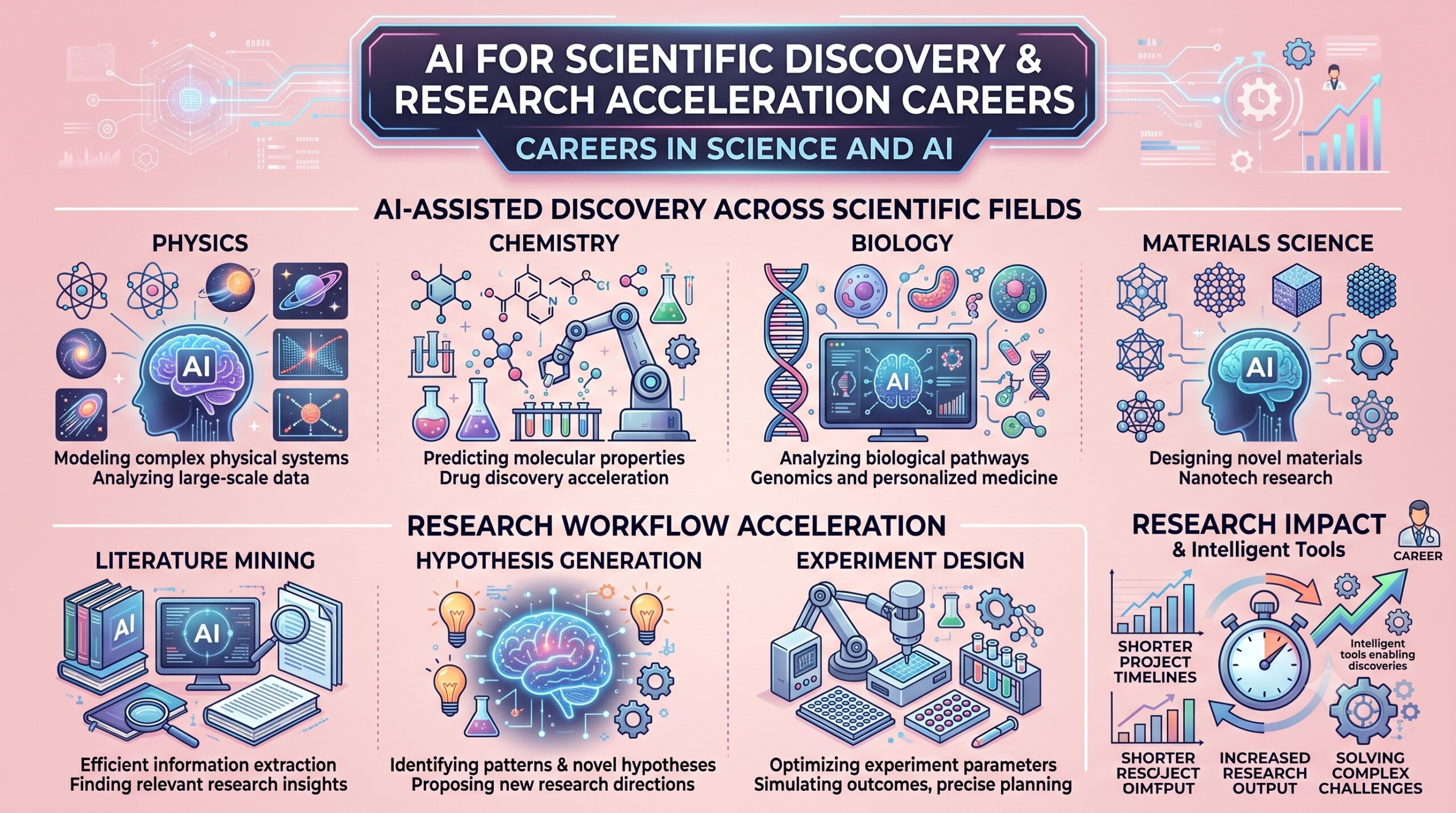
AI-assisted discovery in physics, chemistry, biology, and materials science; Literature mining, hypothesis generation, and experiment design, Accelerating research through intelligent tools
Introduction
For centuries, scientific discovery has depended on a difficult combination of curiosity, observation, experiment, theory, patience, and sometimes accident. A scientist reads earlier work, notices a gap, forms a hypothesis, designs an experiment, collects data, interprets results, and then repeats the process many times. This rhythm has produced vaccines, semiconductors, antibiotics, batteries, telescopes, climate models, new materials, and countless other advances that shape modern life.
Artificial intelligence is now entering this process in a powerful way. It is not replacing science, but it is changing how science is done. AI can scan thousands of research papers, detect hidden patterns in massive datasets, suggest promising molecules, predict protein structures, design experiments, analyze laboratory images, simulate physical systems, and help researchers decide which path is worth exploring next. DeepMind describes AlphaFold as being used by more than 3 million researchers, showing how AI tools can move from a narrow technical breakthrough into everyday scientific infrastructure.
This creates a new career frontier: AI for scientific discovery and research acceleration. These careers sit at the intersection of computer science, domain science, data engineering, research methodology, and human judgment. The people who succeed in this field will not only know how to use AI tools. They will understand how scientific knowledge is created, tested, challenged, verified, and translated into real-world progress.
Let’s dive deep into this.
1. A new career category is emerging between AI and science
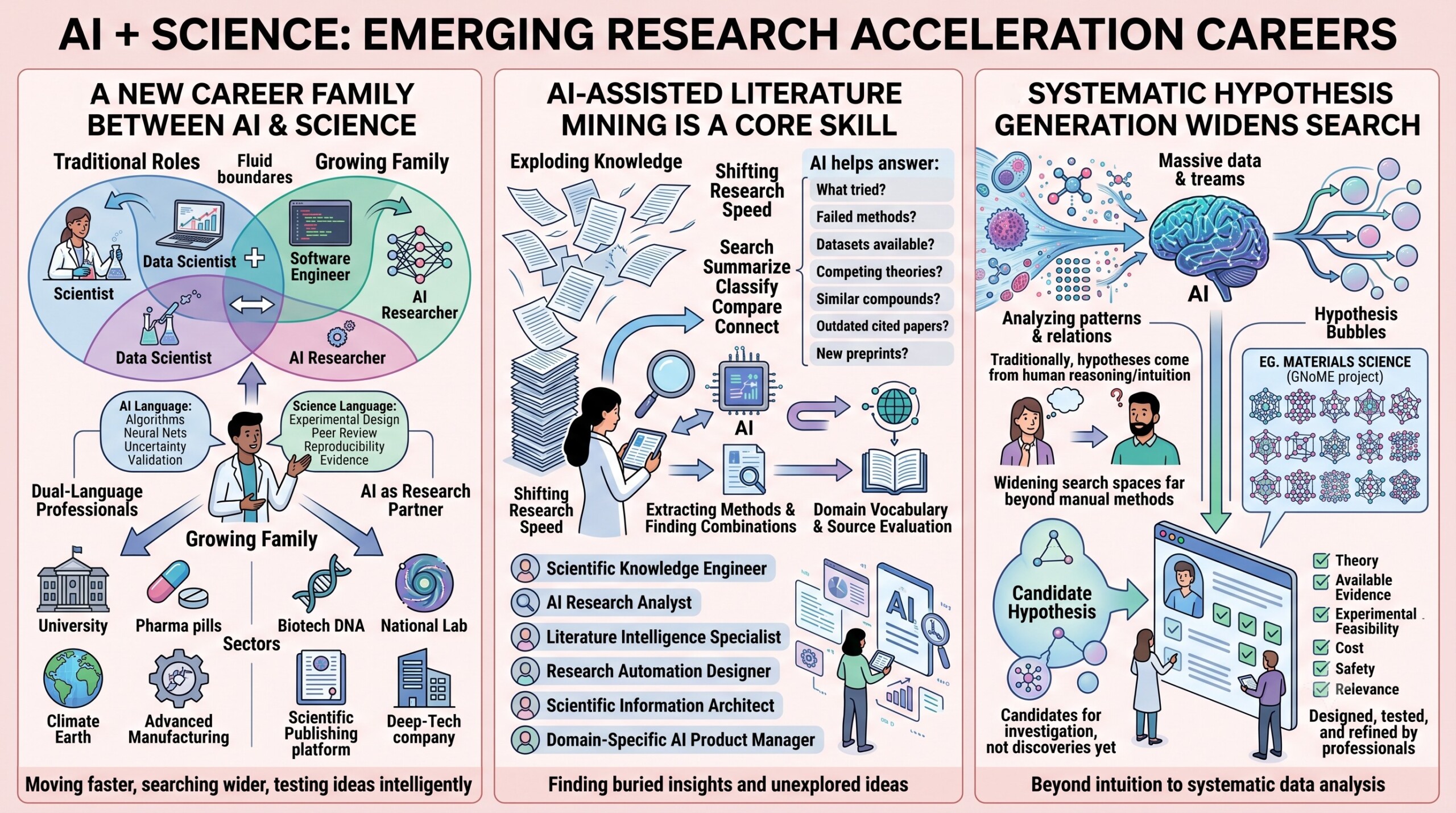
AI for scientific discovery is not one single job. It is a growing family of careers that help researchers move faster, search wider, and test ideas more intelligently. These roles may appear in universities, pharmaceutical companies, biotech startups, climate laboratories, advanced manufacturing firms, materials research centres, national laboratories, scientific publishing platforms, and deep-tech companies.
The old image of research was often divided into separate worlds. Scientists worked in laboratories. Data scientists worked on datasets. Software engineers built tools. AI researchers created models. Today, those boundaries are becoming more fluid. A biology lab may need machine learning experts. A materials science team may need graph neural network specialists. A physics group may need AI tools for simulation and anomaly detection. A chemistry company may need generative models to design new molecules.
This is why AI research acceleration careers are so important. They are not only about building better algorithms. They are about connecting algorithms to scientific questions. A model that looks impressive in a benchmark may be useless if it does not help scientists decide what to test, what to ignore, or what to trust. The real value lies in turning AI into a research partner that can support discovery without weakening scientific discipline. In practical terms, this field needs professionals who can speak two languages at once: the language of AI and the language of science. They must understand data, models, uncertainty, validation, and automation. At the same time, they must respect experimental design, peer review, reproducibility, domain constraints, and the slow discipline of evidence.
2. Literature mining is becoming a core research skill
Scientific knowledge is expanding faster than any human researcher can read. Every year, thousands of papers are published across biology, chemistry, physics, medicine, climate science, engineering, and materials science. Even a specialist may struggle to keep up with new findings in a narrow subfield. Important insights may remain buried in papers, supplementary data, patents, preprints, conference proceedings, or technical reports.
AI-assisted literature mining helps solve this problem. Instead of manually reading hundreds of papers one by one, researchers can use AI tools to search, summarize, classify, compare, and connect scientific literature. These systems can identify related experiments, extract key methods, detect contradictory findings, map research trends, and suggest unexplored combinations of ideas.
This is not just a convenience feature. It changes the speed of early-stage research. Before a scientist begins a project, AI can help answer important questions: What has already been tried? Which methods failed? Which datasets are available? Which theories are competing? Which lab has worked on similar compounds? Which papers are heavily cited but perhaps outdated? Which new preprints may change the direction of the field?
Careers in this area include scientific knowledge engineer, AI research analyst, literature intelligence specialist, research automation designer, scientific information architect, and domain-specific AI product manager. These roles require more than the ability to prompt a chatbot. They require careful reading, source evaluation, citation tracking, domain vocabulary, and the ability to separate genuine scientific evidence from weak claims. An excellent collection of learning videos awaits you on our Youtube channel.

3. Hypothesis generation is becoming more systematic
A hypothesis is a proposed explanation or prediction that can be tested. Traditionally, hypotheses came from human reasoning, prior knowledge, intuition, observation, and sometimes creative leaps. AI now adds another layer. By analyzing large bodies of data, models can suggest patterns that humans may not notice, propose relationships between variables, or identify unusual combinations worth testing.
In biology, AI may help identify possible links between genes, proteins, pathways, and diseases. In chemistry, it may suggest new molecular structures with desired properties. In materials science, it may predict compounds that could be stable, conductive, lightweight, heat resistant, or useful for batteries. In physics, it may help search for patterns in complex simulation or experimental data.
A major shift is happening here. AI does not merely speed up known workflows; it can widen the search space. For example, DeepMind’s GNoME project reported the discovery of hundreds of thousands of stable crystal candidates, illustrating how AI can help materials researchers explore possibilities far beyond what manual trial-and-error would allow. This creates career opportunities for people who can design, test, and refine AI-generated hypotheses. Such professionals need to understand uncertainty. An AI-generated hypothesis is not a discovery by itself. It is a candidate for investigation. It must be judged against theory, available evidence, experimental feasibility, cost, safety, and relevance.
4. AI-assisted experiment design will reshape laboratories
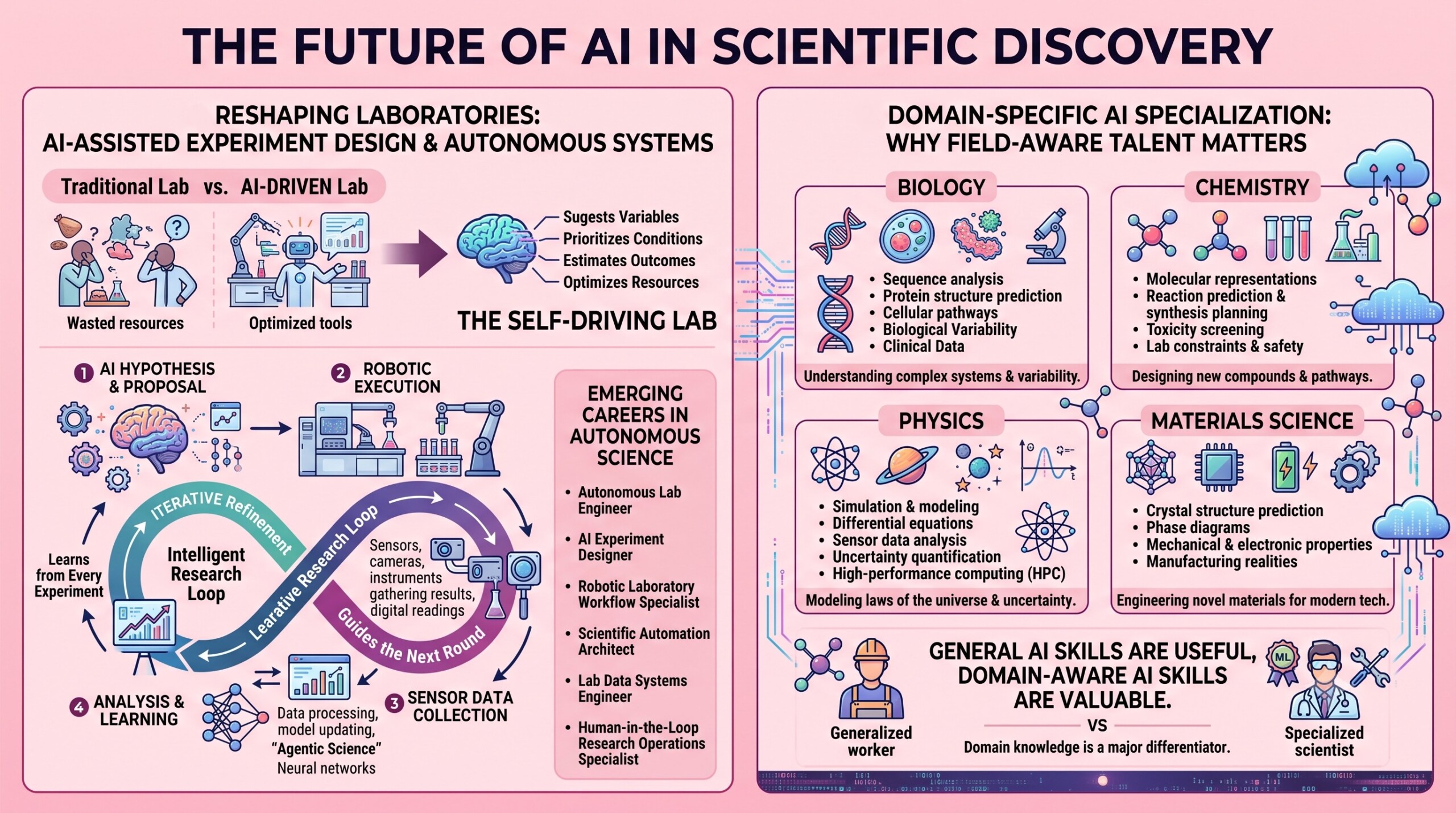
Experiment design is one of the most important parts of science. A poorly designed experiment can waste time, money, samples, equipment, and human effort. A well-designed experiment can answer a question clearly and open a new research direction. AI is beginning to help researchers design better experiments by suggesting variables, prioritizing test conditions, estimating likely outcomes, and optimizing the use of limited resources.
In chemistry and materials science, this is especially powerful because the number of possible compounds, reactions, temperatures, pressures, solvents, catalysts, and processing conditions can be enormous. It is impossible to test everything. AI can help narrow the search space and recommend the most informative experiments.
This has given rise to the idea of autonomous or self-driving laboratories. In such systems, AI models propose experiments, robotic systems perform them, sensors collect results, and the system uses the new data to plan the next round. A survey on agentic science describes the movement from partial AI assistance toward systems that can support hypothesis generation, experimental design, execution, analysis, and iterative refinement.
Career roles in this area may include autonomous lab engineer, AI experiment designer, robotic laboratory workflow specialist, scientific automation architect, lab data systems engineer, and human-in-the-loop research operations specialist. These professionals will need a blend of machine learning, laboratory process knowledge, instrumentation, data pipelines, safety protocols, and domain science.
The career opportunity is not only in building robots. It is in building intelligent research loops. The future laboratory will not simply collect data. It will learn from every experiment and use that learning to guide the next one. A constantly updated Whatsapp channel awaits your participation.
5. Biology, chemistry, physics, and materials science will each need specialized AI talent
AI for scientific discovery will not look the same in every field. Each scientific domain has its own data types, rules, constraints, and validation methods. A person working in AI for biology may need to understand sequences, proteins, cells, pathways, imaging, clinical data, and biological variability. A person working in AI for chemistry may need molecular representations, reaction prediction, synthesis planning, toxicity screening, and laboratory constraints. A person working in physics may need simulation, differential equations, sensors, uncertainty, and high-performance computing. A person working in materials science may need crystal structures, phase diagrams, mechanical properties, electronic properties, and manufacturing realities.
This domain specificity is crucial. AI cannot be treated as a generic magic layer placed on top of every scientific problem. The same algorithmic idea may need very different handling across domains. A prediction in drug discovery may require safety testing and biological validation. A prediction in materials science may require synthesis and characterization. A prediction in climate science may need long-term simulation and uncertainty analysis. A prediction in particle physics may require statistical significance under strict experimental standards.
The career implication is clear: domain knowledge will become a major advantage. General AI skills are useful, but domain-aware AI skills are more valuable. A machine learning engineer who understands molecular biology can work differently from one who does not. A data scientist who understands spectroscopy, microscopy, crystallography, or quantum simulation can ask better questions and build better tools.
6. The most important skill stack is interdisciplinary
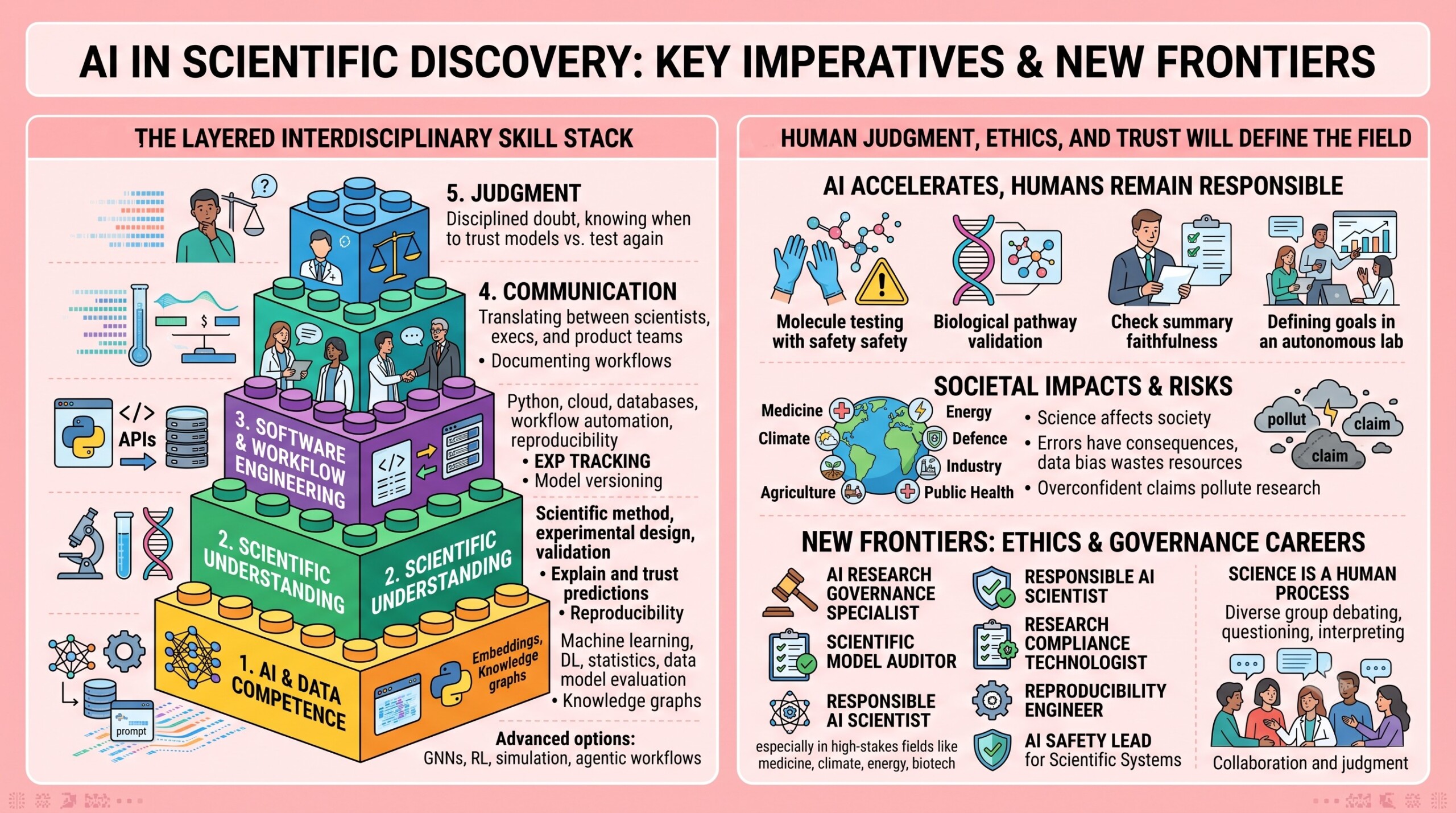
Careers in AI-driven scientific discovery require a layered skill stack.
The first layer is AI and data competence. This includes machine learning, deep learning, statistics, data cleaning, model evaluation, prompt engineering, embeddings, knowledge graphs, uncertainty estimation, and responsible AI practices. For advanced roles, it may also include generative models, graph neural networks, reinforcement learning, simulation, and agentic workflows.
The second layer is scientific understanding. A person does not need to be an expert in every field, but they must understand the scientific method, experimental design, reproducibility, measurement error, peer review, and domain-specific validation. In science, a model is not valuable merely because it predicts something. It is valuable when its prediction can be tested, explained, trusted, and used.
The third layer is software and workflow engineering. Research acceleration depends on reliable systems. Data must move from instruments to databases. Papers must be searchable. Models must be versioned. Experiments must be tracked. Results must be reproducible. Dashboards must help researchers make decisions. This requires Python, APIs, databases, cloud computing, data pipelines, notebooks, workflow automation, and sometimes high-performance computing.
The fourth layer is communication. AI-for-science professionals must translate between scientists, engineers, executives, regulators, and product teams. They must explain what a model can do, what it cannot do, how confident it is, and what evidence supports its outputs. They must also document workflows so that other researchers can reproduce and challenge the results.
The fifth layer is judgment. This may be the most important layer of all. AI tools can produce answers quickly, but scientific careers require disciplined doubt. A good research acceleration professional knows when to trust a model, when to test again, when to ask a domain expert, and when to slow down. Excellent individualised mentoring programmes available.
7. Human judgment, ethics, and trust will define the field
AI can accelerate science, but it cannot remove responsibility from science. A model may recommend a molecule, but humans must test its safety. A system may suggest a biological pathway, but researchers must validate it. An AI tool may summarize papers, but scientists must check whether the summary is faithful. An autonomous lab may run experiments, but human teams must define the goals, boundaries, and safety rules.
This is especially important because science affects society. AI-assisted research may influence medicine, climate policy, agriculture, energy, defence, public health, and industrial development. Errors can have consequences. Bias in scientific data can lead to misleading conclusions. Poorly validated models can waste resources. Overconfident AI-generated claims can pollute the research ecosystem.
There is also a philosophical point. Science is not only data processing. It is a human process of questioning, debating, interpreting, testing, and building meaning. Recent commentary on AI and science has emphasized that AI can streamline parts of research, but it still depends on human-curated knowledge, theoretical grounding, collaboration, and scientific judgment.
This creates another set of careers: AI research governance specialist, scientific model auditor, responsible AI scientist, research compliance technologist, reproducibility engineer, and AI safety lead for scientific systems. These roles may become as important as model-building roles, especially in high-stakes fields such as medicine, climate, energy, and biotechnology.
Conclusion
AI for scientific discovery and research acceleration is one of the most exciting career frontiers of the coming decade. It brings together the ambition of science and the power of intelligent tools. It can help researchers read faster, search wider, generate hypotheses, design experiments, analyze complex data, and discover patterns that might otherwise remain hidden.
But the real promise is not speed alone. Faster research is useful only when it remains reliable. AI must be connected to evidence, experiment, theory, domain expertise, and responsible governance. A model can suggest. A scientist must still question. A tool can accelerate. A research community must still validate. For students, researchers, engineers, and professionals, this field offers a rare opportunity. Those who combine AI skills with scientific depth can help shape the next generation of discovery. They may work on new medicines, better batteries, climate solutions, advanced materials, quantum systems, agricultural resilience, or safer industrial processes. They may build the tools that help scientists see what was previously invisible.
The central lesson is simple: AI will not make human curiosity obsolete. It will give curiosity new instruments. The careers of the future will belong to those who can use these instruments wisely, critically, and creatively. In the age of AI-assisted science, the best researchers will not be replaced by machines. They will be amplified by them. Subscribe to our free AI newsletter now.