AI Consulting & Transformation Careers – Helping enterprises adopt and scale AI
Artificial intelligence is no longer confined to research labs or pilot projects. It is becoming a core driver of enterprise strategy, operational efficiency, and competitive advantage. Across industries, organizations are under pressure to move from experimentation to large-scale, value-generating AI deployment.
As enterprises struggle to translate AI potential into measurable outcomes, a distinct class of careers has emerged focused on AI consulting and transformation. These roles are not about building models in isolation, but about reshaping processes, decision-making, culture, and governance so AI can be adopted responsibly and at scale. Understanding these careers is essential for organizations that want AI to create durable business impact rather than fragmented technology pilots.
1. Why AI consulting and transformation roles now matter
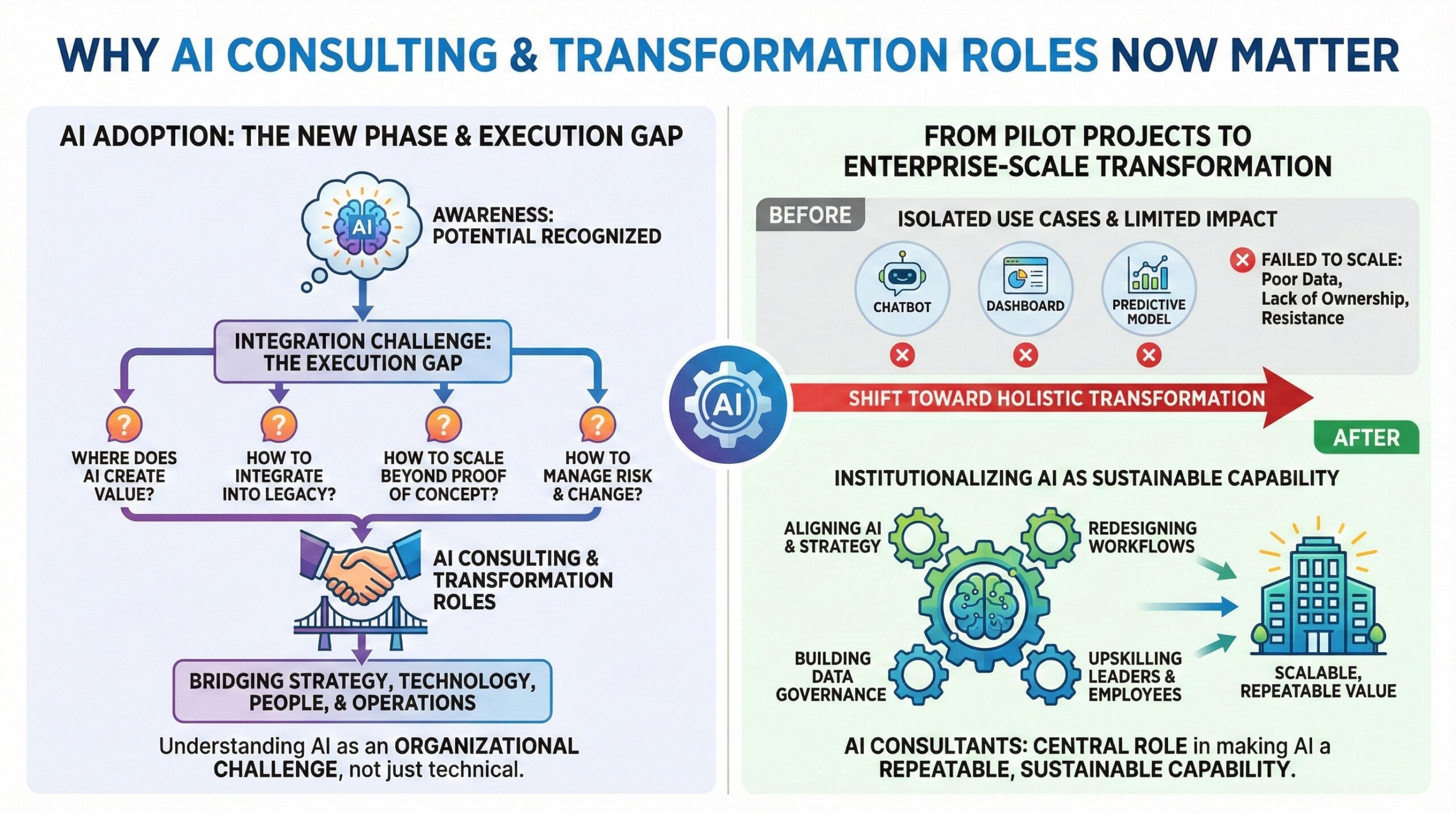
AI adoption has entered a new phase. Most enterprises are aware of AI’s potential, but far fewer know how to integrate it into existing systems, workflows, and organizational structures. The challenge is no longer “Can we build AI?” but: Where does AI actually create business value? How do we integrate AI into legacy processes? How do we scale AI beyond proofs of concept? How do we manage risk, change, and accountability?
This gap between capability and execution has created strong demand for professionals who understand AI as an organizational transformation challenge rather than a purely technical one. AI consulting and transformation careers exist to bridge strategy, technology, people, and operations.
2. From pilot projects to enterprise-scale transformation
Early AI initiatives inside companies often focused on isolated use cases – chatbots, dashboards, or predictive models. Many failed to scale due to poor data foundations, lack of ownership, or resistance to change.
Today, enterprises are shifting toward holistic AI transformation. This involves: Aligning AI initiatives with business strategy, redesigning workflows around AI-assisted decision-making, building data and model governance structures, and upskilling leaders and employees.
AI consultants play a central role in this shift. Their work is less about novelty and more about institutionalizing AI so it becomes a repeatable, sustainable capability rather than a one-off experiment.
An excellent collection of learning videos awaits you on our Youtube channel.
3. Core AI consulting roles within enterprises
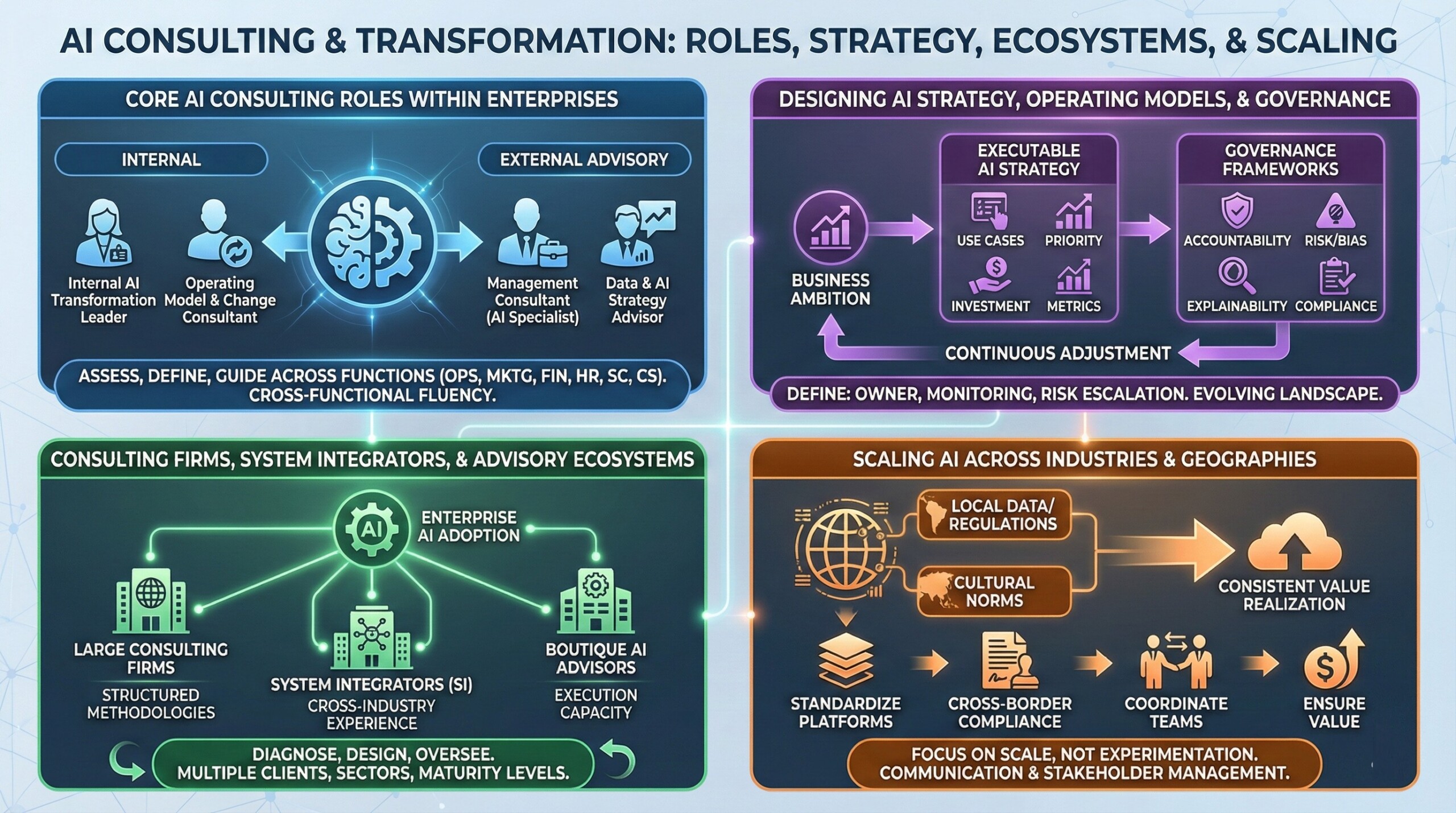
AI consulting and transformation professionals operate across internal teams and external advisory firms. They assess readiness, define roadmaps, and guide execution across functions such as operations, marketing, finance, HR, supply chain, and customer service.
They may work as:
- Internal AI transformation leaders
- Management consultants specializing in AI
- Data and AI strategy advisors
- Operating model and change consultants
Unlike technical specialists, these roles require cross-functional fluency. Success depends on aligning executives, technologists, and frontline teams around shared goals—often amid ambiguity and competing priorities.
4. Designing AI strategy, operating models, and governance
A central responsibility in AI consulting is translating business ambition into executable AI strategy. This includes defining use case portfolios, prioritization frameworks, investment models, and success metrics. Equally important is governance. As AI systems influence core decisions, enterprises must address accountability, risk, bias, explainability, and compliance.
Consultants help design operating models that clarify:
- Who owns AI decisions
- How models are monitored and updated
- How risks are escalated and managed
AI transformation is not static. These roles require continuous adjustment as technologies, regulations, and market expectations evolve.
A constantly updated Whatsapp channel awaits your participation.
5. Consulting firms, system integrators, and advisory ecosystems
Much of enterprise AI adoption is driven by consulting firms, system integrators, and boutique AI advisory organizations. These firms bring structured methodologies, cross-industry experience, and execution capacity that many enterprises lack internally.
Professionals in these environments work across multiple clients, sectors, and maturity levels. They diagnose problems, design solutions, and often oversee implementation alongside internal teams.
Large consulting firms, specialized AI boutiques, and technology partners all shape how AI is adopted in practice – often influencing enterprise decisions more than vendors or researchers.
6. Scaling AI across industries and geographies
AI transformation is increasingly global. Multinational enterprises must deploy AI consistently across regions while adapting to local data conditions, regulations, and cultural norms. Consultants working at this level focus on scale rather than experimentation.
Their challenges include:
- Standardizing platforms and tools
- Managing cross-border data and compliance
- Coordinating distributed teams
- Ensuring consistent value realization
These roles demand strong communication, stakeholder management, and the ability to operate across organizational and cultural boundaries.
Excellent individualised mentoring programmes available.
7. Skills that define AI consulting professionals
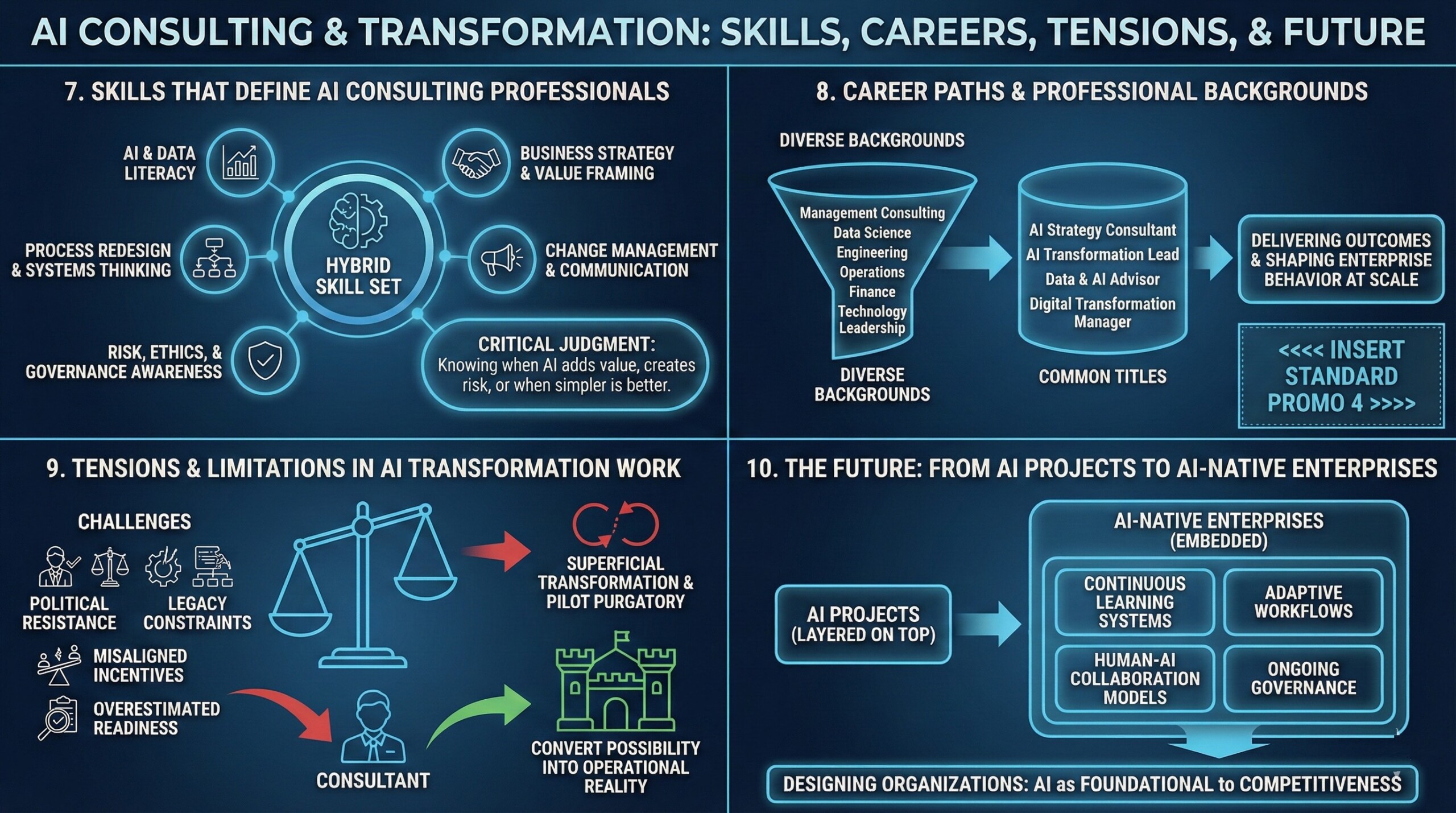
AI consulting careers require a hybrid skill set. Technical literacy is essential, but depth in coding is rarely the differentiator.
Key capabilities include:
- AI and data literacy
- Business strategy and value framing
- Process redesign and systems thinking
- Change management and communication
- Risk, ethics, and governance awareness
Perhaps most critical is judgment—knowing when AI adds value, when it creates risk, and when simpler solutions are better. These decisions are often made under time pressure and executive scrutiny.
8. Career paths and professional backgrounds
AI consulting professionals come from diverse backgrounds: management consulting, data science, engineering, operations, finance, and technology leadership.
Common titles include AI Strategy Consultant, AI Transformation Lead, Data & AI Advisor, or Digital Transformation Manager. Career progression depends less on technical novelty and more on the ability to deliver outcomes across complex organizations.
These roles shape enterprise behaviour indirectly – but at scale, across many organizations.
Subscribe to our free AI newsletter now.
9. Tensions and limitations in AI transformation work
AI consulting is not without friction. Organizations often overestimate readiness, underestimate change costs, or expect rapid returns. Consultants must navigate political resistance, legacy constraints, and misaligned incentives.
There is also a risk of superficial transformation – AI initiatives that look impressive but fail to change core decision-making. Yet without structured intervention, many enterprises remain stuck in pilot purgatory. AI consulting careers exist to convert possibility into operational reality.
10. The future: From AI projects to AI-native enterprises
The future of AI consulting lies in helping organizations become AI-native – where data-driven intelligence is embedded into everyday operations rather than layered on top. This includes continuous learning systems, adaptive workflows, human–AI collaboration models, and ongoing governance.
As AI becomes foundational to enterprise competitiveness, consulting and transformation professionals will increasingly define not just how AI is deployed, but how organizations themselves are designed.
Upgrade your AI-readiness with our masterclass.
Billion Hopes summary
AI Consulting & Transformation careers are about turning AI potential into sustained enterprise value. They align strategy, technology, people, and governance so AI becomes a core organizational capability rather than a collection of disconnected tools. As enterprises race to operationalize AI at scale, these roles will determine who succeeds in transforming ambition into impact—and who remains trapped in perpetual experimentation.
Share this with the world
Related Articles