AI Implementation & Execution Careers
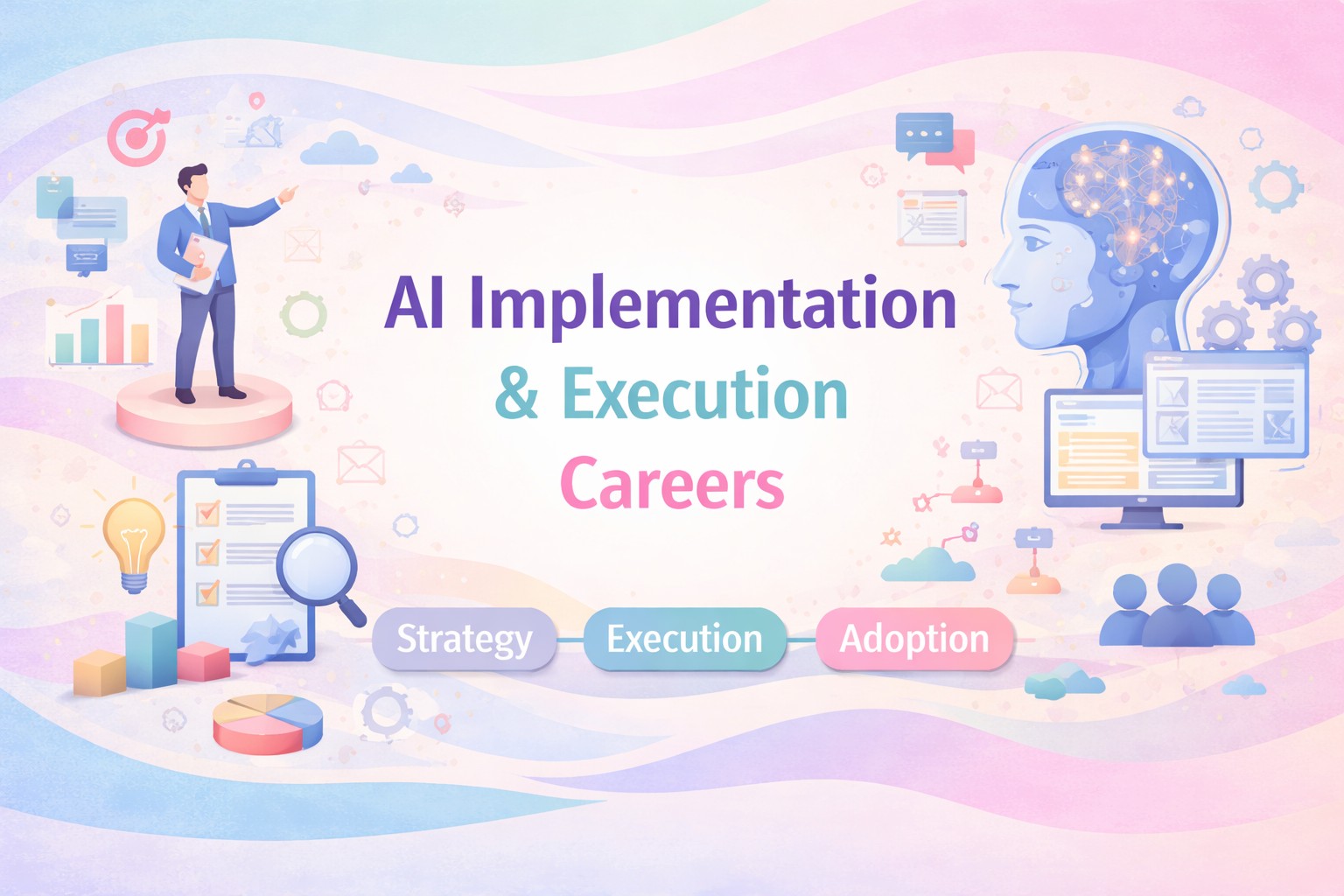
AI Implementation & Execution Careers
Deploying AI in real-world business environments; Bridging strategy → execution gap; Managing failure, iteration, and adoption challenges
Introduction
Over the past decade, artificial intelligence has moved from research labs into boardrooms. Organizations across industries are investing heavily in AI strategies, yet a large percentage of these initiatives fail to deliver measurable business value. The gap is not in ideas, but in execution. This is where AI implementation and execution careers emerge as critical roles: professionals who translate ambition into operational reality.
While breakthroughs in models built on the Transformer architecture and advances in fields like Machine Learning have enabled powerful capabilities, deploying these systems in real-world environments requires a very different skill set. It involves integrating AI into workflows, aligning stakeholders, managing risks, and continuously iterating based on feedback. AI execution professionals sit at the intersection of technology, business, and human behaviour.
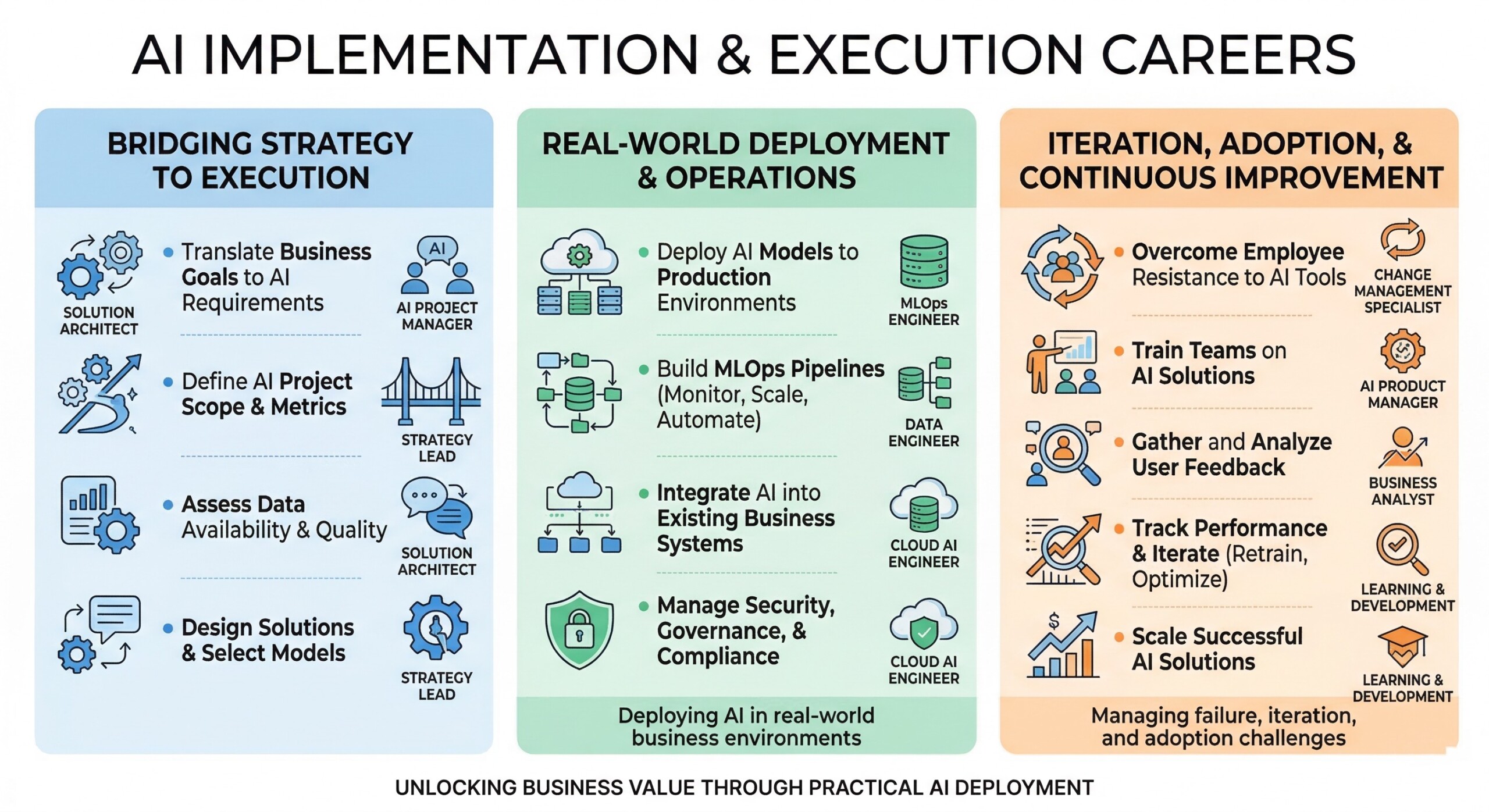
Let’s dive deep.
1. From Strategy to Execution: The missing middle layer
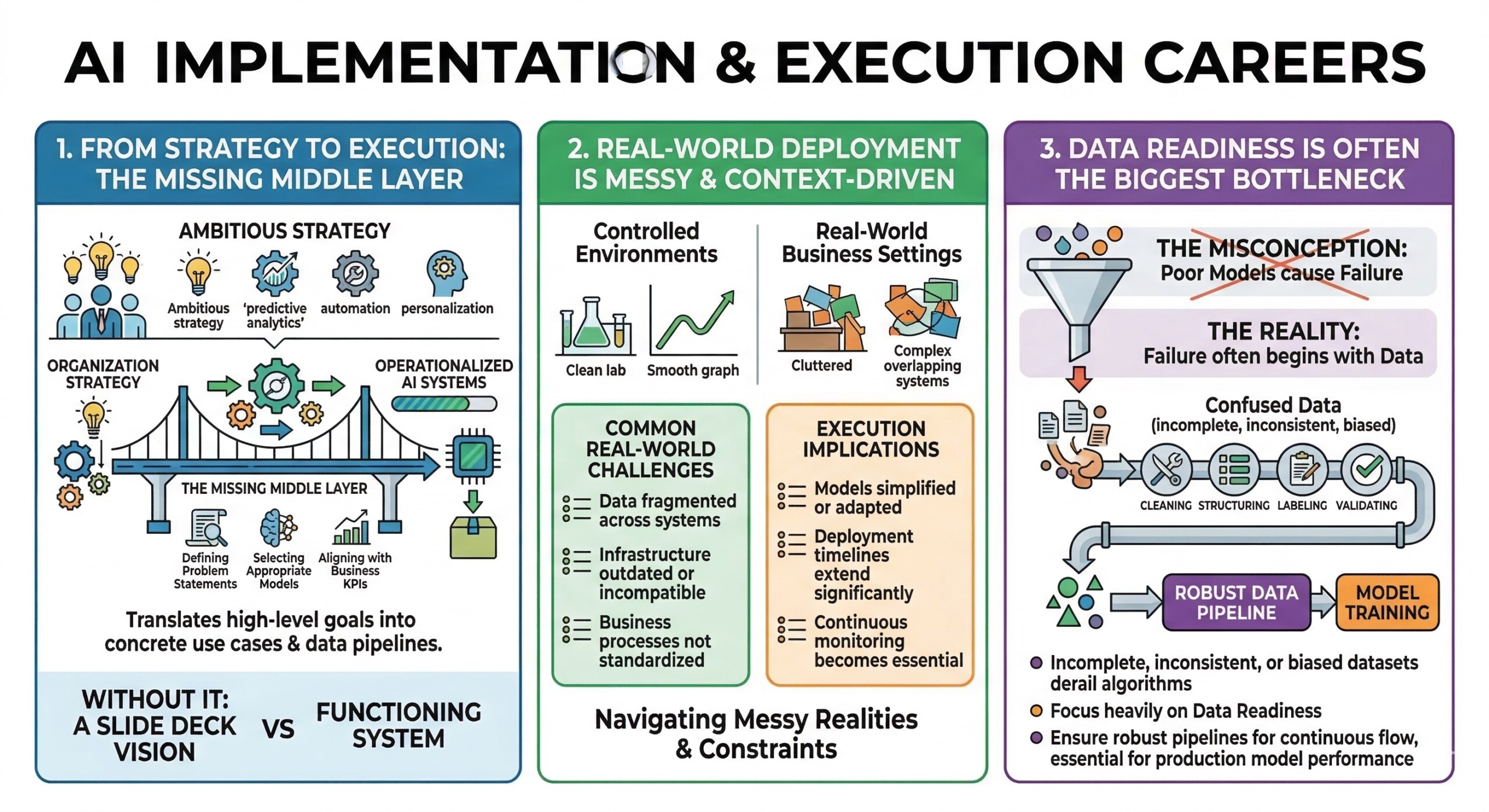
Many organizations begin with ambitious AI strategies – predictive analytics, automation, personalization – but struggle to operationalize them. The challenge lies in translating high-level goals into concrete use cases, data pipelines, and deployable systems.
AI implementation professionals act as the “missing middle layer.” They break down strategy into executable components: defining problem statements, selecting appropriate models, and aligning with business KPIs. Without this translation layer, AI remains a slide deck vision rather than a functioning system. An excellent collection of learning videos awaits you on our Youtube channel.
2. Real-World deployment is messy and context-driven
Unlike controlled environments, real-world business settings involve incomplete data, legacy systems, and unpredictable user behaviour. Deploying AI means dealing with constraints that are rarely discussed in academic settings.
- Common real-world challenges
- Data is fragmented across systems
- Infrastructure is outdated or incompatible
- Business processes are not standardized
- Execution implications
- Models must be simplified or adapted
- Deployment timelines extend significantly
- Continuous monitoring becomes essential
AI execution careers require the ability to navigate these messy realities while maintaining performance and reliability.
3. Data Readiness is often the biggest bottleneck
A common misconception is that AI projects fail due to poor models. In reality, failure often begins much earlier – with data. Incomplete, inconsistent, or biased datasets can derail even the most sophisticated algorithms.
AI implementation professionals focus heavily on data readiness: cleaning, structuring, labeling, and validating data before model training. They also ensure pipelines are robust enough for continuous data flow, which is essential for maintaining model performance in production. A constantly updated Whatsapp channel awaits your participation.
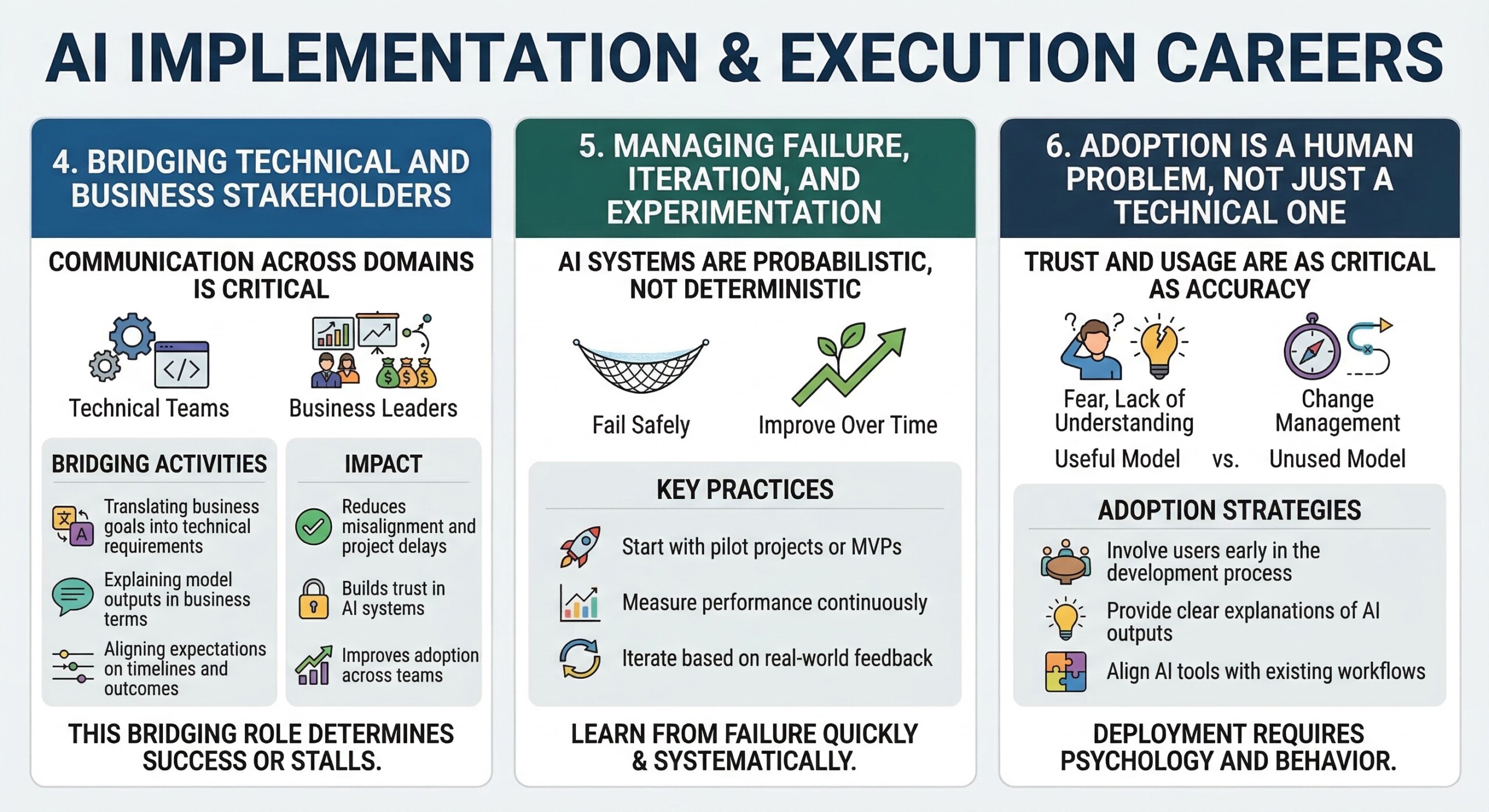
4. Bridging technical and business stakeholders
One of the most valuable skills in AI execution is the ability to communicate across domains. Technical teams speak in terms of models, metrics, and architectures, while business leaders focus on ROI, efficiency, and risk.
- Bridging activities
- Translating business goals into technical requirements
- Explaining model outputs in business terms
- Aligning expectations on timelines and outcomes
- Impact
- Reduces misalignment and project delays
- Builds trust in AI systems
- Improves adoption across teams
This bridging role is often what determines whether an AI initiative succeeds or stalls.
5. Managing failure, iteration, and experimentation
AI systems are inherently probabilistic. Unlike traditional software, they do not guarantee deterministic outputs, which means failure and iteration are part of the process.
Execution professionals design systems that can fail safely and improve over time. This involves setting up experimentation frameworks, A/B testing, and feedback loops.
- Key practices
- Start with pilot projects or MVPs
- Measure performance continuously
- Iterate based on real-world feedback
Managing failure is not about avoiding it—it’s about learning from it quickly and systematically. Excellent individualised mentoring programmes available.
6. Adoption is a human problem, Not just a technical one
Even the most accurate AI model is useless if people do not trust or use it. Adoption challenges often stem from fear, lack of understanding, or disruption to existing workflows.
AI implementation roles focus on change management as much as technology. This includes training users, designing intuitive interfaces, and ensuring transparency in model decisions.
- Adoption strategies
- Involve users early in the development process
- Provide clear explanations of AI outputs
- Align AI tools with existing workflows
Successful AI deployment is as much about psychology and behaviour as it is about algorithms.
7. Scaling AI requires systems thinking
Building a single AI model is one thing; scaling it across an organization is another. Scaling involves infrastructure, governance, monitoring, and continuous improvement.
Execution professionals adopt a systems-thinking approach – considering how models interact with data pipelines, APIs, user interfaces, and business processes.
- Scaling considerations
- Model monitoring and drift detection
- Integration with enterprise systems
- Governance, compliance, and ethics
Without this holistic view, AI projects remain isolated experiments rather than enterprise capabilities. Subscribe to our free AI newsletter now.
Conclusion
AI implementation and execution careers represent the backbone of real-world AI success. While research and model development often receive the spotlight, it is the execution layer that determines whether AI delivers tangible value. These roles demand a unique blend of technical knowledge, business understanding, and human insight.
As organizations continue to invest in AI, the demand for professionals who can bridge strategy and execution will only grow. The future of AI is not just about building smarter models—it is about deploying them effectively, managing their lifecycle, and ensuring they create meaningful impact in complex, real-world environments. Upgrade your AI-readiness with our masterclass.
Share this with the world
Related Articles