AI in Geopolitics, Defense & Global Power
AI in Geopolitics, Defense & Global Power
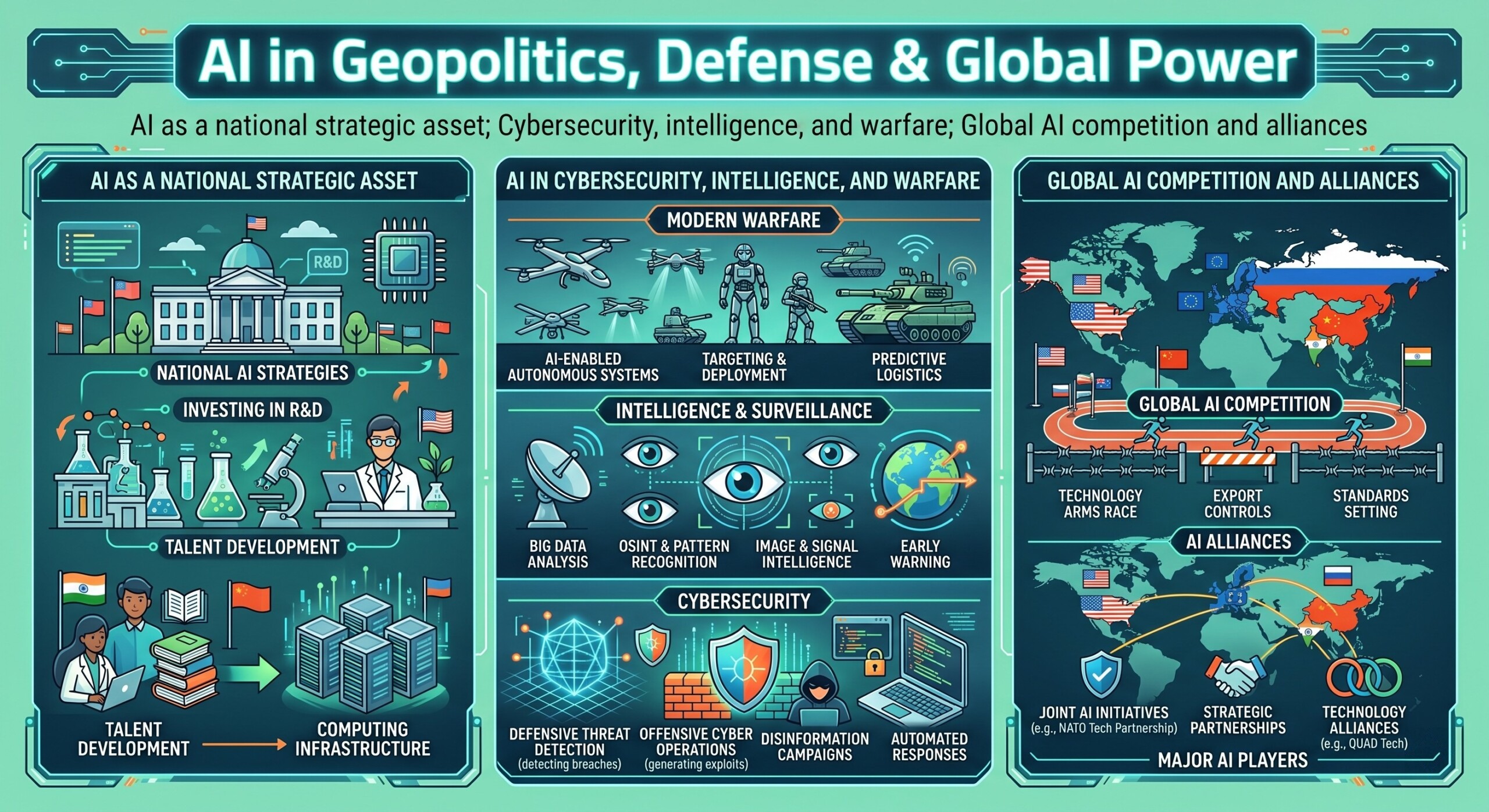
AI as a national strategic asset; Cybersecurity, intelligence, and warfare; Global AI competition and alliances
Introduction
Artificial Intelligence has moved far beyond the domain of research labs and consumer applications. It is now a central pillar of geopolitical strategy and national power. Just as nuclear capability defined the global balance of power in the 20th century, AI is rapidly emerging as a decisive factor in shaping the 21st-century world order. Nations are investing heavily in AI not only for economic growth but also for defense, intelligence, and strategic dominance. The race is no longer about who builds better products, but who builds more intelligent systems capable of influencing global outcomes.
In this evolving landscape, AI intersects with military doctrines, cybersecurity frameworks, intelligence gathering, and diplomatic alliances. Countries like United States and China are leading a high-stakes competition, while others like India, United Kingdom, and Russia are carving their own strategic paths. Understanding AI in geopolitics is therefore not just about technology. It is about power, influence, and the future of global stability. An excellent collection of learning videos awaits you on our Youtube channel.
Let’s dive deep into the topic.
1. AI as a National Strategic Asset
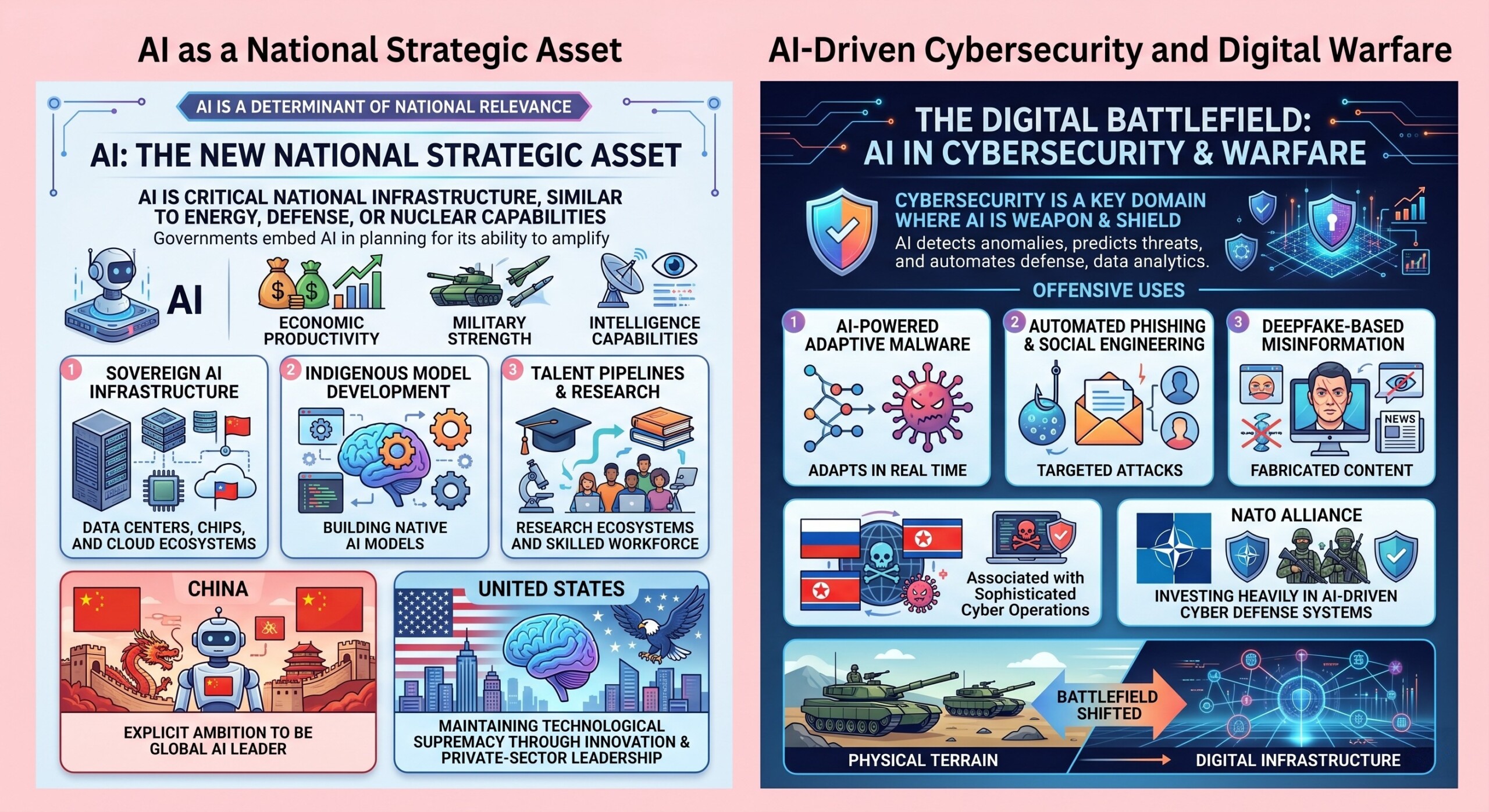
AI is increasingly viewed as critical national infrastructure, similar to energy, defense, or nuclear capabilities. Governments are embedding AI into long-term strategic planning, recognizing its ability to amplify economic productivity, military strength, and intelligence capabilities simultaneously.
National AI strategies now include:
- Sovereign AI infrastructure such as data centers, chips, and cloud ecosystems
- Indigenous model development
- Talent pipelines and research ecosystems
For example, China has explicitly declared its ambition to become the global AI leader, while the United States focuses on maintaining technological supremacy through innovation and private-sector leadership. AI is no longer optional. It is a determinant of national relevance.
2. AI-Driven Cybersecurity and Digital Warfare
Cybersecurity has become one of the most critical domains where AI is both a weapon and a shield. AI systems can detect anomalies, predict threats, and automate defensive responses at speeds far beyond human capability.
However, the same technology is used offensively:
- AI-powered malware that adapts in real time
- Automated phishing and social engineering attacks
- Deepfake-based misinformation campaigns
Countries like Russia and North Korea have been associated with sophisticated cyber operations, while the NATO alliance is investing heavily in AI-driven cyber defense systems. The battlefield has shifted from physical terrain to digital infrastructure. A constantly updated Whatsapp channel awaits your participation.
3. Intelligence, Surveillance, and Data Dominance
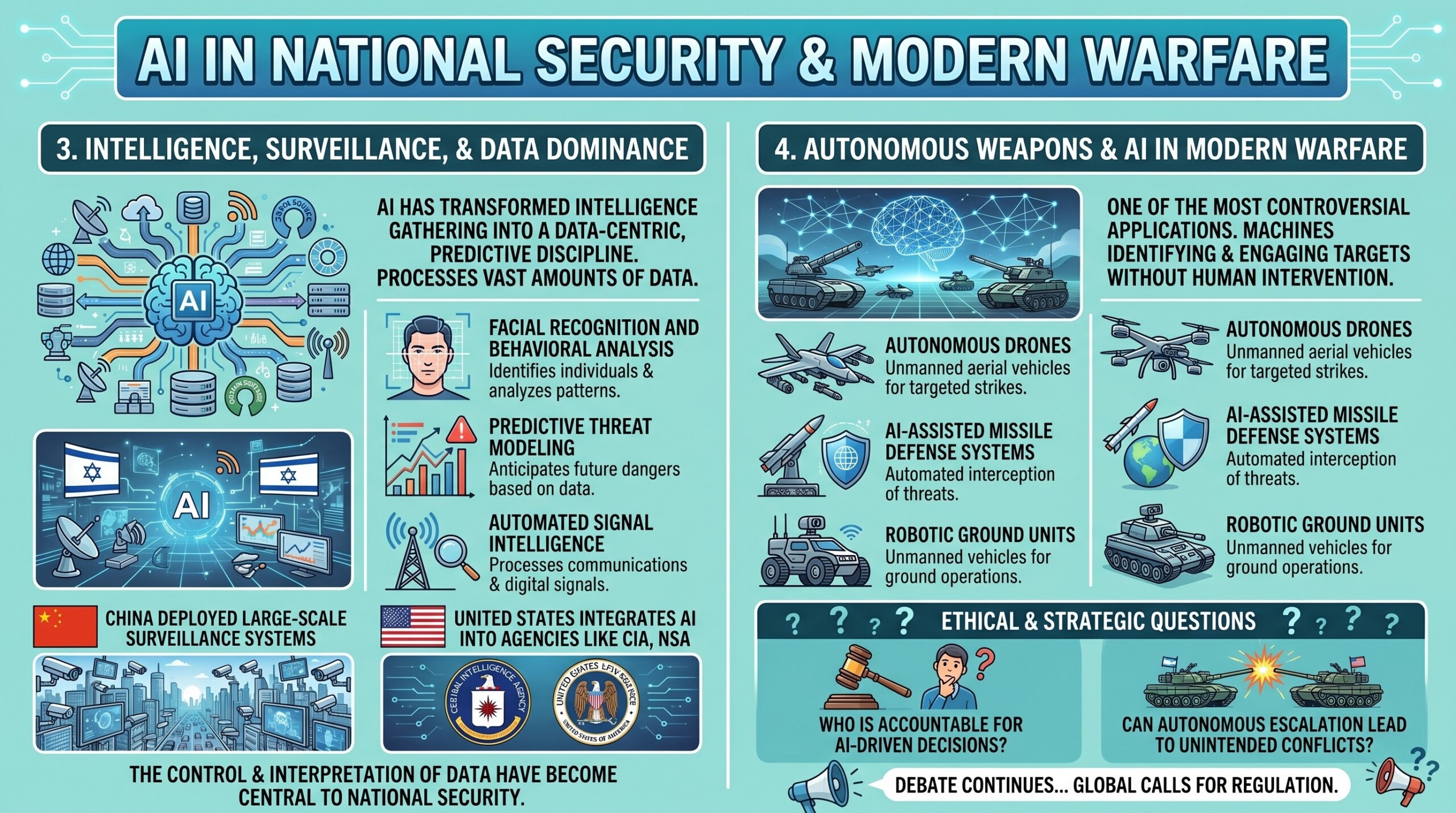
AI has transformed intelligence gathering into a data-centric, predictive discipline. Instead of relying solely on human agents, intelligence agencies now use AI to process vast amounts of data from satellites, communications, and open sources.
Key applications include:
- Facial recognition and behavioral analysis
- Predictive threat modeling
- Automated signal intelligence
China has deployed large-scale surveillance systems powered by AI, while the United States integrates AI into agencies like CIA and NSA. The control and interpretation of data have become central to national security.
4. Autonomous Weapons and AI in Modern Warfare
One of the most controversial applications of AI is in autonomous weapons systems. These are machines capable of identifying and engaging targets without human intervention.
These include:
- Autonomous drones
- AI-assisted missile defense systems
- Robotic ground units
Countries such as Israel and United States are at the forefront of developing such technologies. However, this raises critical ethical and strategic questions:
- Who is accountable for AI-driven decisions
- Can autonomous escalation lead to unintended conflicts
The debate around autonomous weapons continues, with global calls for regulation. Excellent individualised mentoring programmes available.
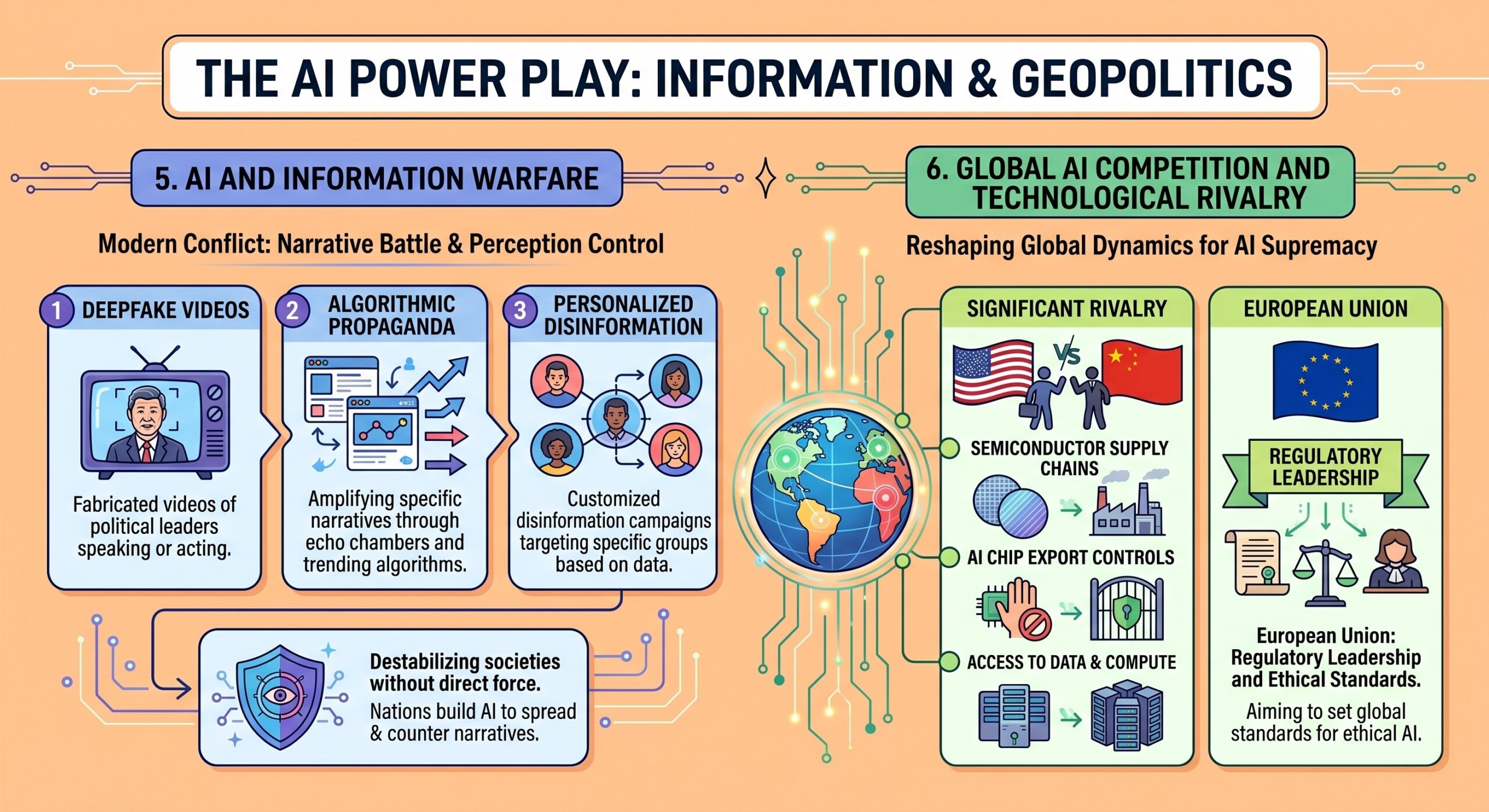
5. AI and Information Warfare
Modern warfare increasingly includes the battle for perception and narrative control. AI enables highly sophisticated information warfare tactics:
- Deepfake videos of political leaders
- Algorithmic amplification of propaganda
- Personalized disinformation campaigns
During geopolitical tensions, AI-driven misinformation can destabilize societies without direct military engagement. Nations are now building AI tools not only to spread narratives but also to detect and counter them.
6. Global AI Competition and Technological Rivalry
The competition for AI dominance is reshaping global alliances and rivalries. The rivalry between United States and China is particularly significant, involving:
- Semiconductor supply chains
- AI chip export controls
- Access to data and compute infrastructure
Meanwhile, regions like the European Union are focusing on regulatory leadership, aiming to set global standards for ethical AI. This creates a multi-polar AI world where influence is distributed across competing blocs. Subscribe to our free AI newsletter now.
7. AI Alliances and Strategic Partnerships
As AI becomes central to global power, alliances are evolving around technology sharing, joint research, and strategic coordination.
Examples include:
- Defense collaborations between the United States and United Kingdom
- Technology partnerships within the European Union
- Emerging AI cooperation frameworks involving India and other nations
These alliances are not just military. They include data sharing agreements, joint AI labs, and coordinated policy frameworks. Countries are increasingly realizing that collaboration can be as important as competition in shaping the AI-driven future.
Conclusion
AI is rapidly redefining the foundations of global power. It is no longer confined to innovation or economic growth. It now influences military capabilities, intelligence systems, cybersecurity defenses, and even the narratives that shape public perception. Nations that successfully integrate AI into their strategic frameworks will hold significant advantages in the coming decades.
At the same time, the rise of AI in geopolitics introduces new risks. These include autonomous conflict escalation, cyber vulnerabilities, and information manipulation at unprecedented scales. The challenge for the global community lies in balancing competition with cooperation, ensuring that AI serves as a stabilizing force rather than a source of instability. In this new era, AI is not just a technology. It is a defining element of global power and geopolitical strategy. Upgrade your AI-readiness with our masterclass.