AI Platforms, Marketplaces & Ecosystem Careers
AI Platforms, Marketplaces & Ecosystem Careers
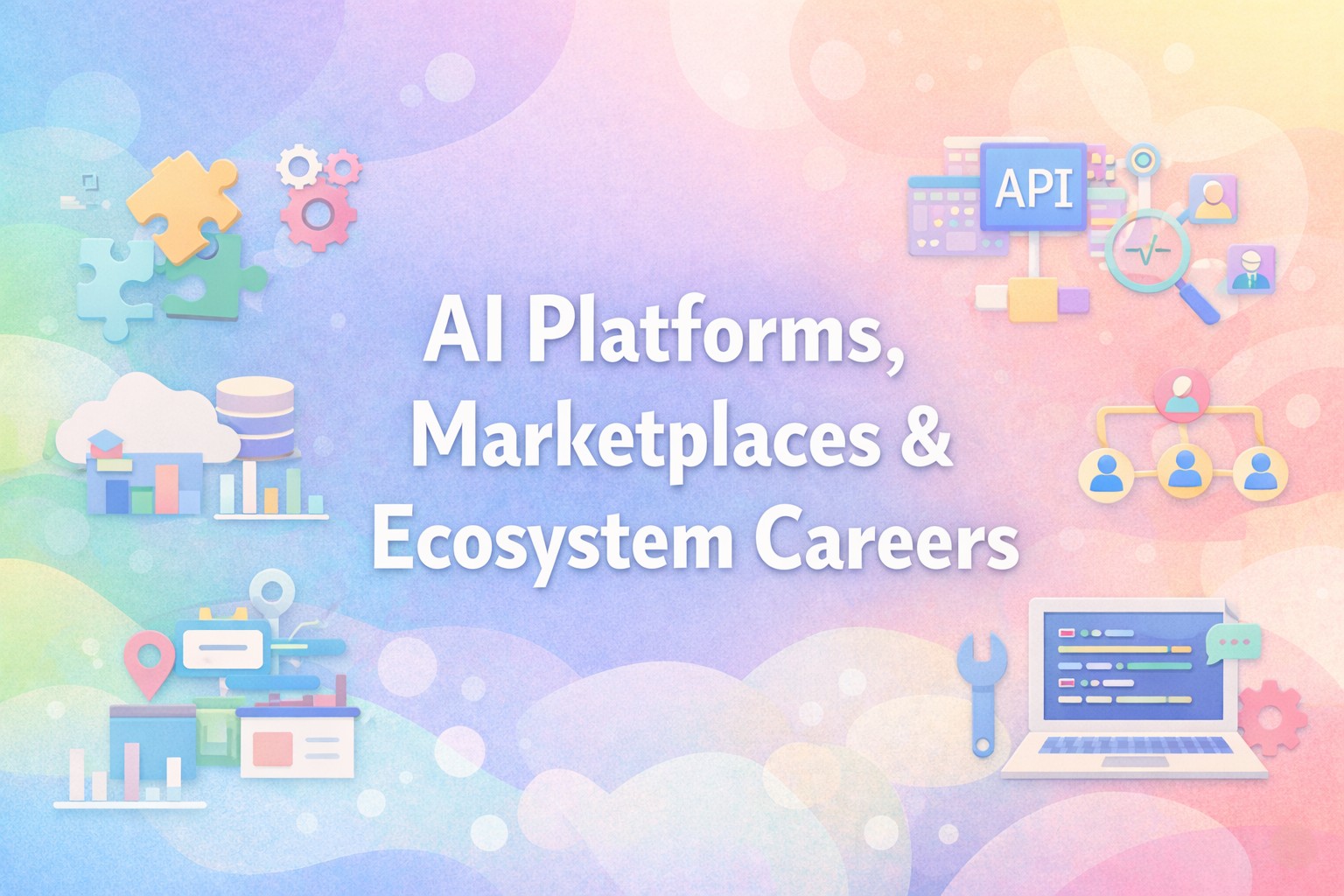
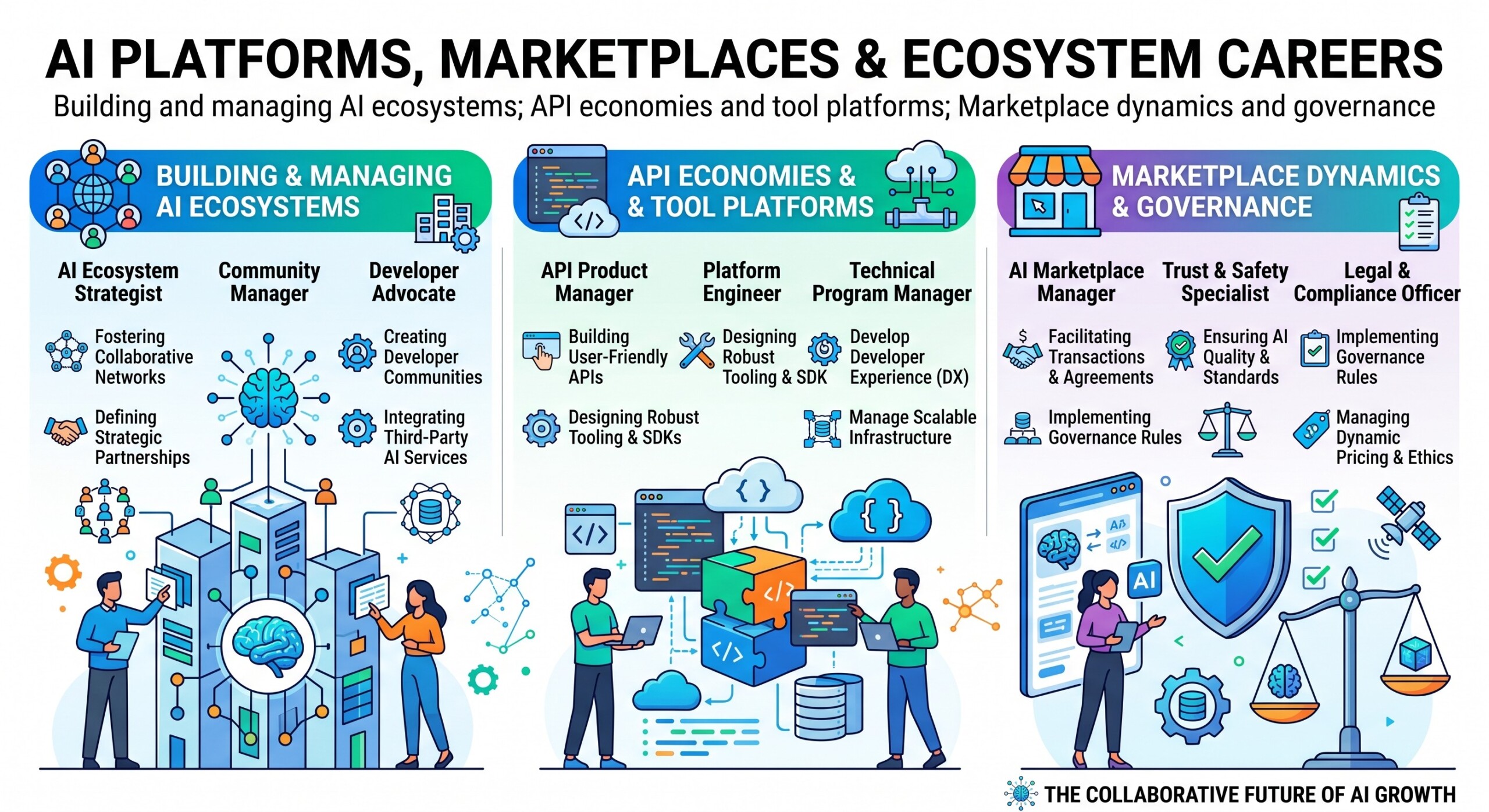
Building and managing AI ecosystems; API economies and tool platforms; Marketplace dynamics and governance
Introduction
The evolution of Artificial Intelligence is no longer confined to standalone models or isolated applications. Today, AI thrives within platforms and ecosystems, which are interconnected environments where developers, businesses, data providers, and users co-create value. These ecosystems are powered by APIs, toolchains, marketplaces, and infrastructure layers that enable rapid innovation and scalable deployment.
As organizations increasingly adopt AI, the focus has shifted from “building a model” to building an ecosystem. Companies like OpenAI, Google, and Microsoft are not just developing AI. They are creating platforms where thousands of developers build applications, integrate services, and monetize solutions. This shift has also created a new class of careers centered around ecosystem design, governance, and growth. An excellent collection of learning videos awaits you on our Youtube channel.
Let’s dive deep into the topic.
1. The rise of AI Platforms as infrastructure layers
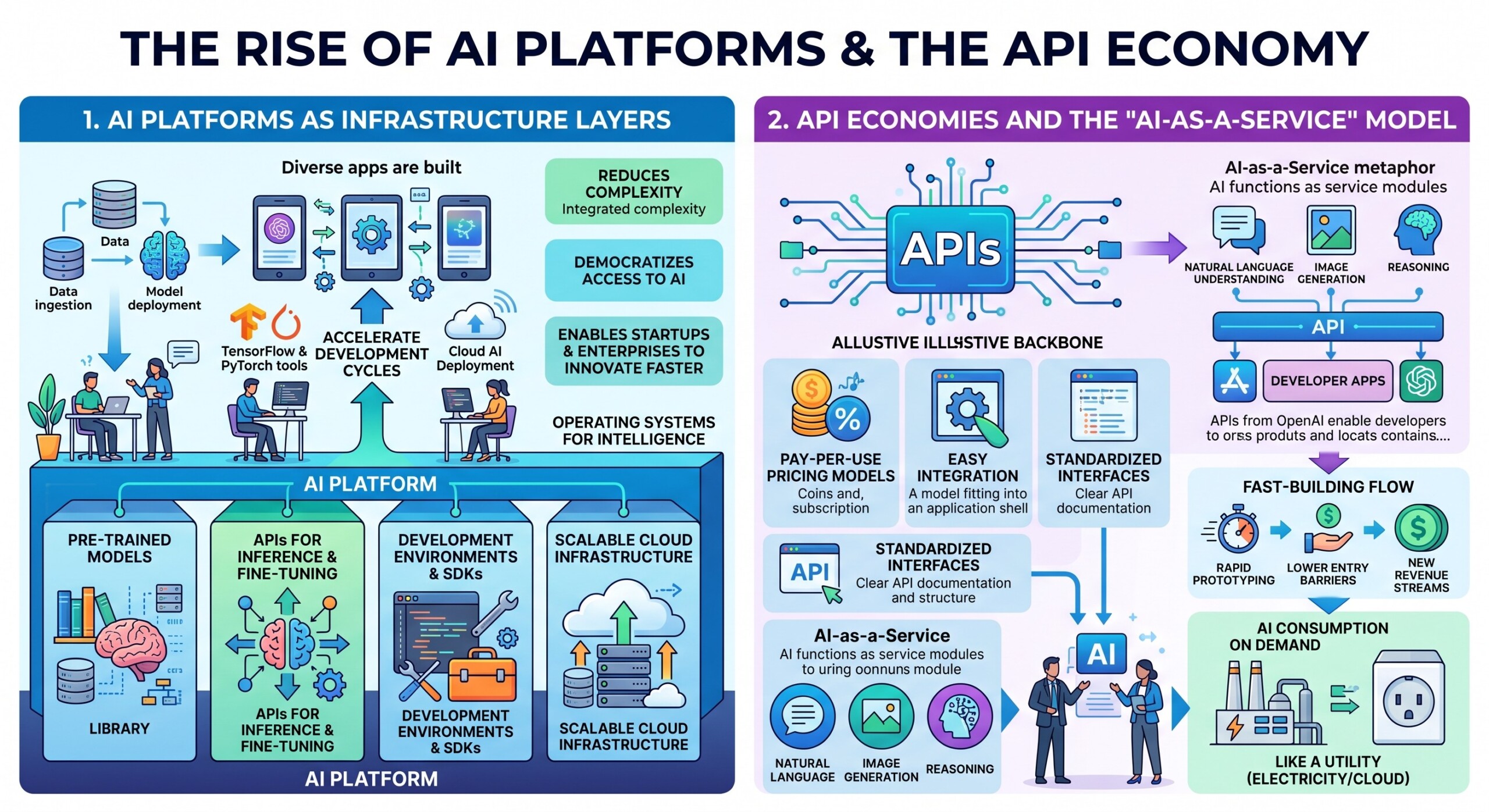
AI platforms have become the foundational layer for modern digital systems. These platforms provide:
- Pre-trained models
- APIs for inference and fine-tuning
- Development environments and SDKs
- Scalable cloud infrastructure
Instead of building AI systems from scratch, developers can leverage platforms to accelerate development cycles.
For example, platforms like TensorFlow and PyTorch provide the tools to build models, while cloud-based AI services provide deployment capabilities.
This abstraction reduces technical complexity, democratizes access to AI and enables startups and enterprises alike to innovate faster
AI platforms are increasingly becoming operating systems for intelligence, where everything from data ingestion to model deployment happens within a unified ecosystem.
2. API economies and the “AI-as-a-Service” model
APIs are the backbone of AI ecosystems. They allow developers to access complex AI capabilities through simple interfaces.
Key features of the API economy:
- Pay-per-use pricing models
- Easy integration into applications
- Standardized interfaces
For instance, APIs from OpenAI enable developers to integrate natural language understanding, image generation, and reasoning into apps without building models from scratch.
This leads to: Rapid prototyping, Lower entry barriers and New revenue streams
The API economy has transformed AI into a utility service, similar to electricity or cloud computing, where businesses consume intelligence on demand. A constantly updated Whatsapp channel awaits your participation.
3. AI Marketplaces: Platforms for distribution and monetization
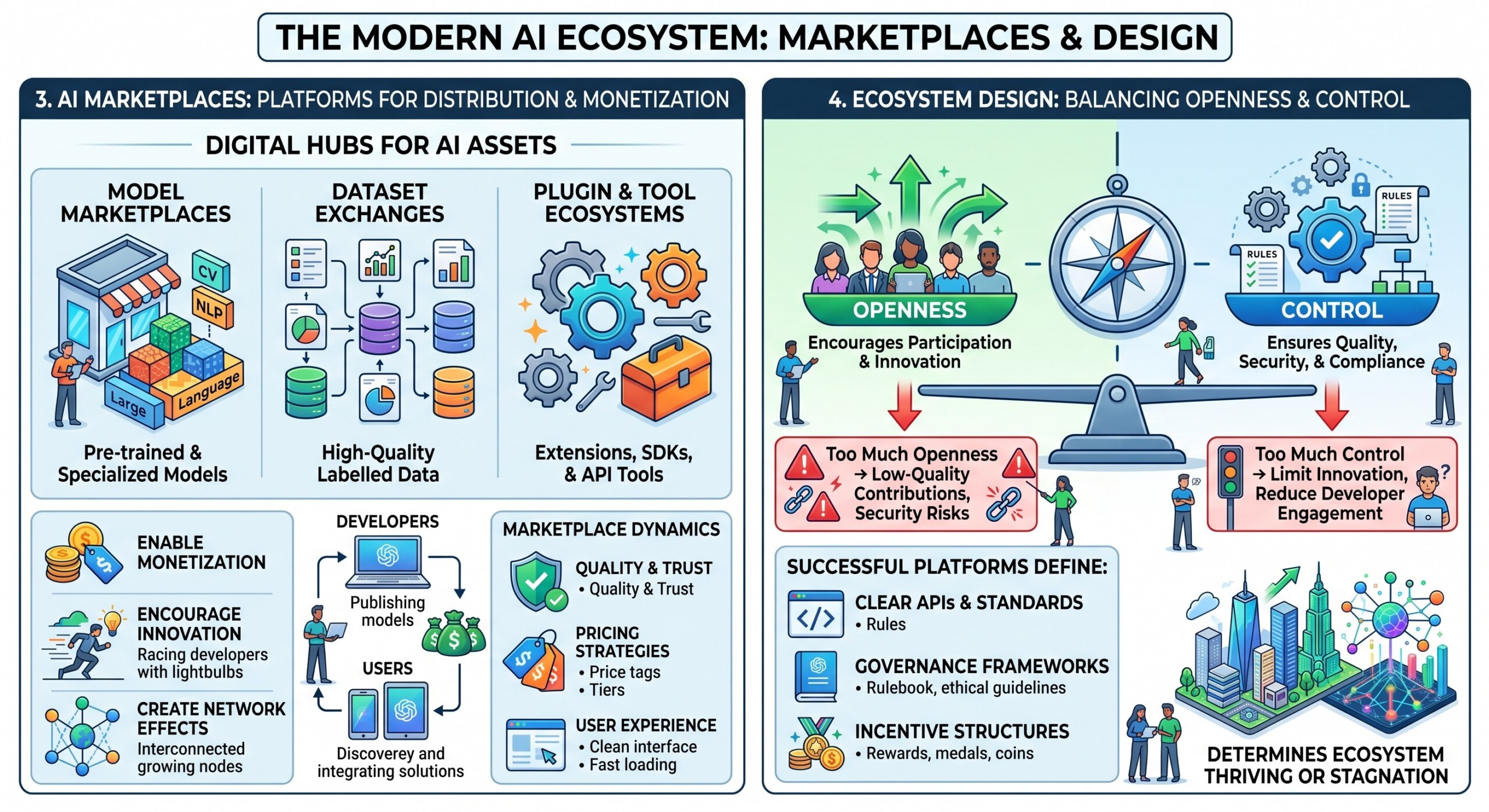
AI marketplaces are digital hubs where models, datasets, and tools are bought, sold, and shared.
Examples include:
- Model marketplaces
- Dataset exchanges
- Plugin and tool ecosystems
These marketplaces:
- Enable monetization of AI assets
- Encourage innovation through competition
- Create network effects
Developers can publish their models or tools and earn revenue, while users can discover and integrate solutions quickly.
Marketplace dynamics depend on:
- Quality and trust
- Pricing strategies
- User experience
As ecosystems mature, marketplaces become central to value creation and distribution.
4. Ecosystem Design: Balancing openness and control
Designing an AI ecosystem requires a careful balance between:
- Openness, which encourages participation and innovation
- Control, which ensures quality, security, and compliance
Too much openness can lead to – low-quality contributions, security risks
Too much control can – limit innovation, reduce developer engagement
Successful platforms define:
- Clear APIs and standards
- Governance frameworks
- Incentive structures
This balance determines whether an ecosystem thrives or stagnates. Excellent individualised mentoring programmes available.
5. Governance, ethics, and trust in AI ecosystems
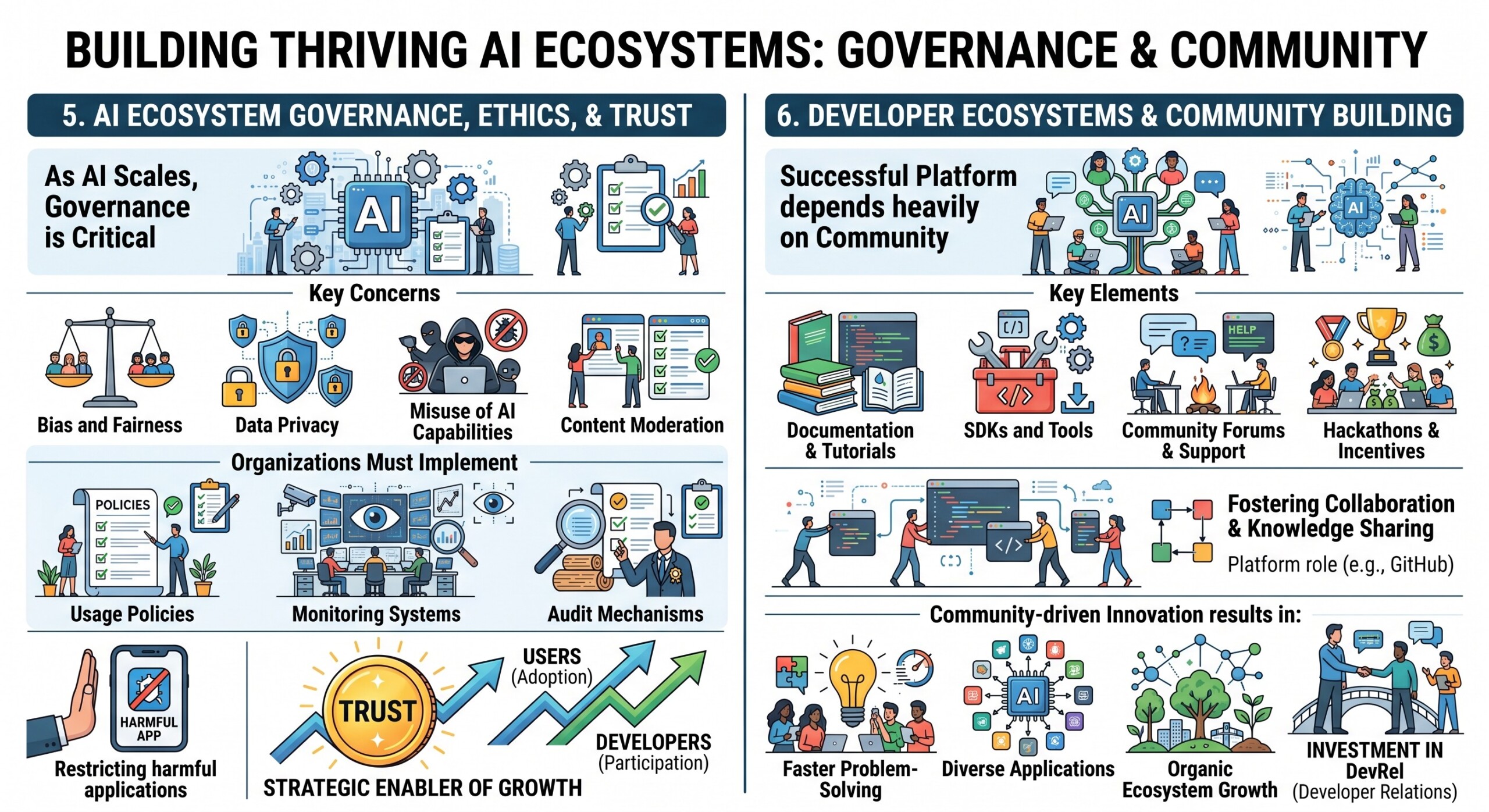
As AI ecosystems scale, governance becomes critical.
Key concerns include:
- Bias and fairness
- Data privacy
- Misuse of AI capabilities
- Content moderation
Organizations must implement:
- Usage policies
- Monitoring systems
- Audit mechanisms
For example, platforms often enforce guidelines on how models can be used and restrict harmful applications.
Trust is a key currency in AI ecosystems. Without it:
- Users hesitate to adopt
- Developers avoid participation
Thus, governance is not just compliance. It is a strategic enabler of growth.
6. Developer ecosystems and community building
A successful AI platform depends heavily on its developer community.
Key elements of strong developer ecosystems:
- Documentation and tutorials
- SDKs and tools
- Community forums and support
- Hackathons and incentives
Platforms like GitHub play a crucial role in fostering collaboration and knowledge sharing.
Community-driven innovation leads to:
- Faster problem-solving
- Diverse applications
- Organic ecosystem growth
Companies invest heavily in developer relations, often called DevRel, to nurture and expand their ecosystems. Subscribe to our free AI newsletter now.
7. Emerging career roles in AI ecosystems
The rise of AI platforms has created entirely new career paths beyond traditional data science roles.
Key roles include:
- AI Product Manager, who defines platform features and roadmap
- AI Platform Engineer, who builds and maintains infrastructure
- Ecosystem Manager, who grows partnerships and developer engagement
- AI Governance Specialist, who ensures compliance and ethical use
- API Product Designer, who designs intuitive and scalable interfaces
These roles require a mix of:
- Technical understanding
- Business strategy
- Community engagement
As AI ecosystems expand, these careers will become increasingly central to organizational success.
Conclusion
AI is no longer just about algorithms. It is about ecosystems. Platforms, APIs, and marketplaces are redefining how AI is built, distributed, and consumed. Organizations that succeed in this new landscape are those that can orchestrate complex ecosystems while maintaining trust, governance, and innovation.
The convergence of platform thinking and AI capabilities is creating a new digital economy, one where intelligence is modular, accessible, and continuously evolving. For professionals, this shift opens up exciting opportunities to work not just in AI, but around AI ecosystems, shaping the infrastructure, communities, and markets that will define the future of technology. Upgrade your AI-readiness with our masterclass.