AI Legal Technology & Judicial Innovation Careers
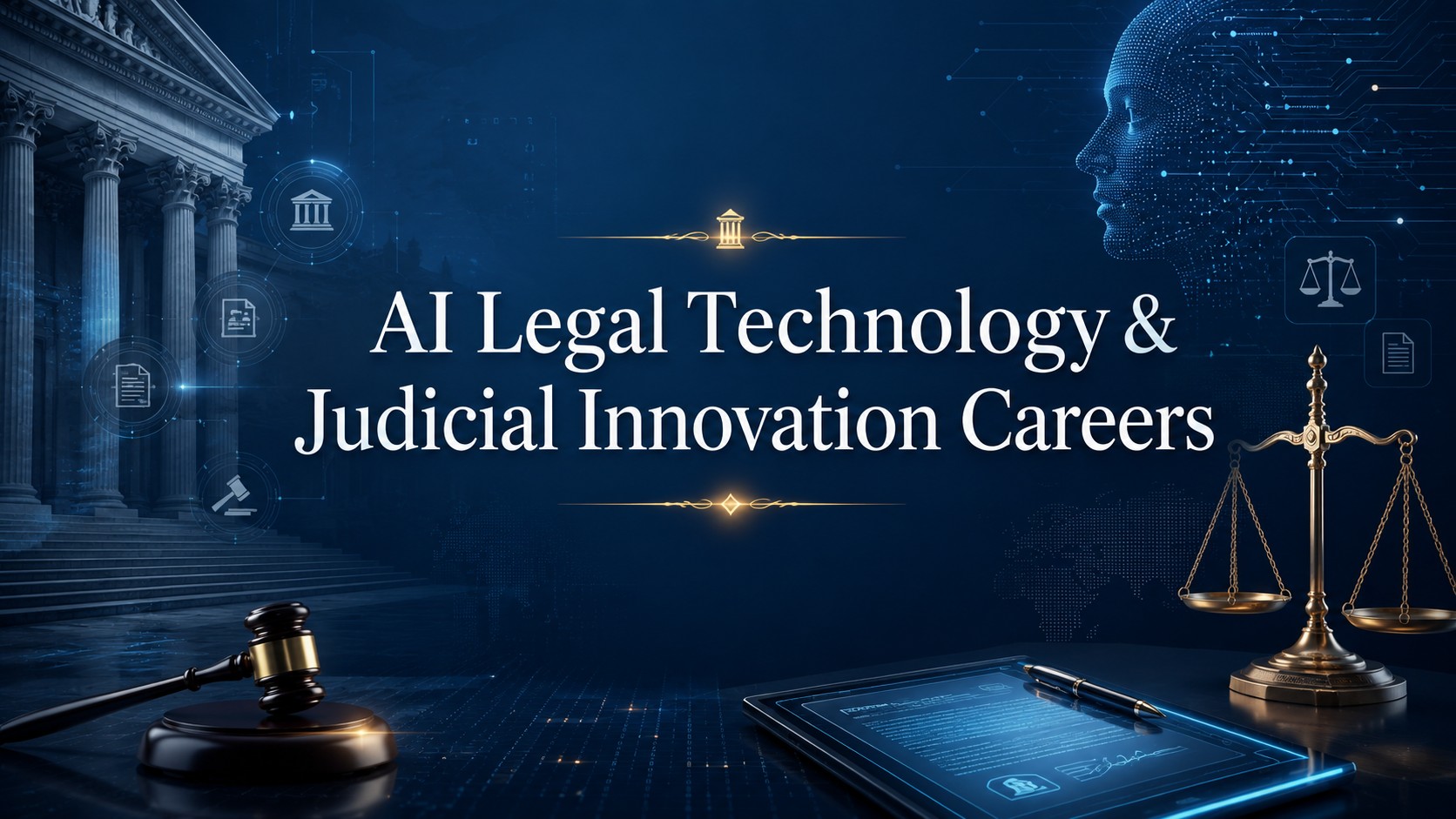
AI Legal Technology & Judicial Innovation Careers
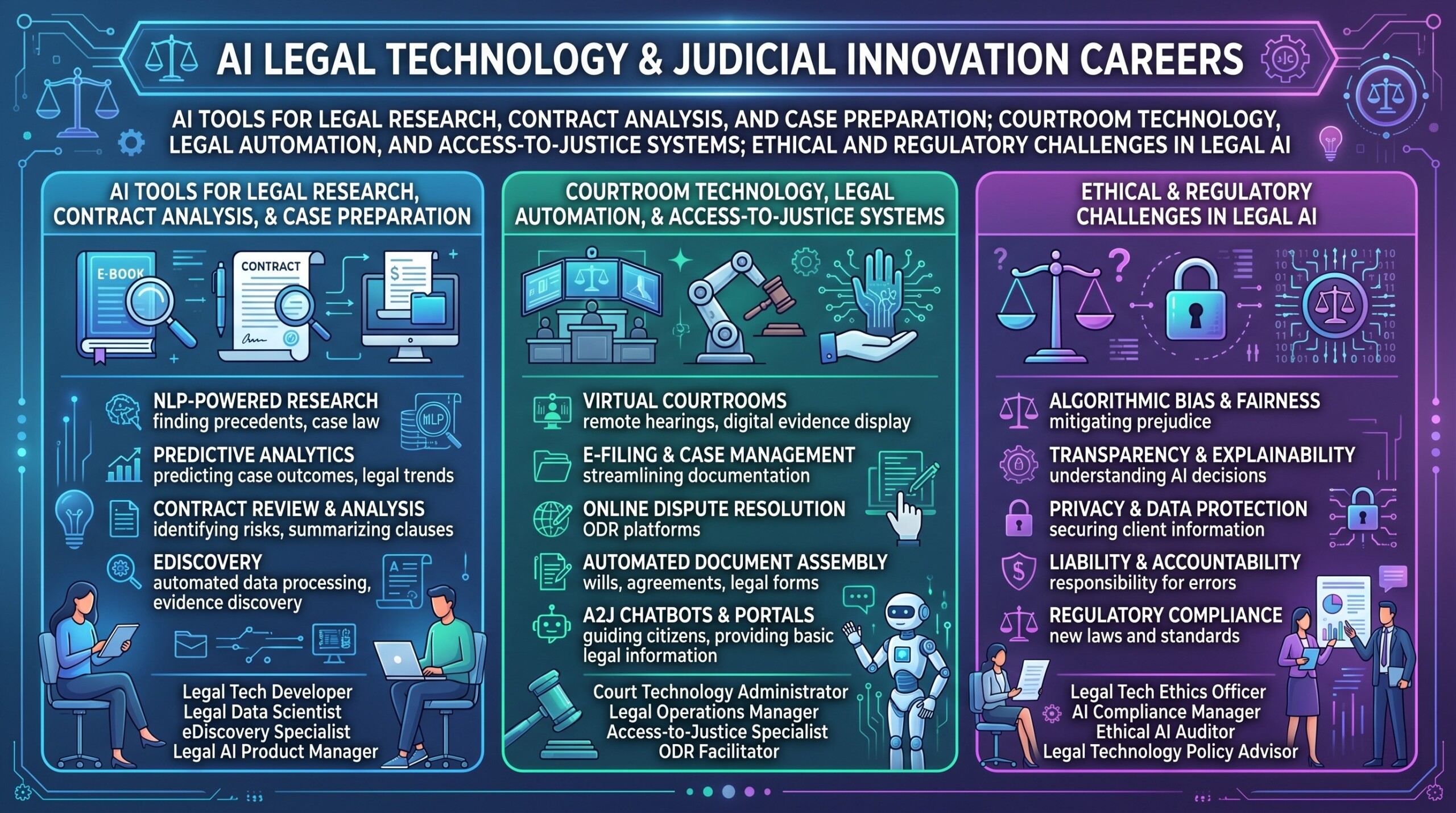
AI tools for legal research, contract analysis, and case preparation; Courtroom technology, legal automation, and access-to-justice systems; Ethical and regulatory challenges in legal AI
Introduction
Law has always depended on information: statutes, precedents, contracts, evidence, pleadings, regulations, arguments, and judgments. Traditionally, legal professionals spent enormous time searching, reading, comparing, drafting, reviewing, and preparing. Artificial intelligence is now changing this work at speed. AI tools can search large legal databases, summarize judgments, compare clauses, identify risks in contracts, organize case facts, support litigation strategy, automate routine legal documents, and help courts manage heavy caseloads.
This does not mean that AI will replace lawyers, judges, paralegals, court officials, or legal researchers. In fact, the opposite is more likely: AI is creating a new generation of legal careers where people who understand both law and technology will be in high demand. The future legal professional may not only know statutes and case law but also understand prompts, data quality, model limitations, bias, privacy, cybersecurity, explainability, and digital evidence. An excellent collection of learning videos awaits you on our Youtube channel.
Let’s dive deep into this.
1. AI-Powered legal research: From manual search to intelligent legal discovery
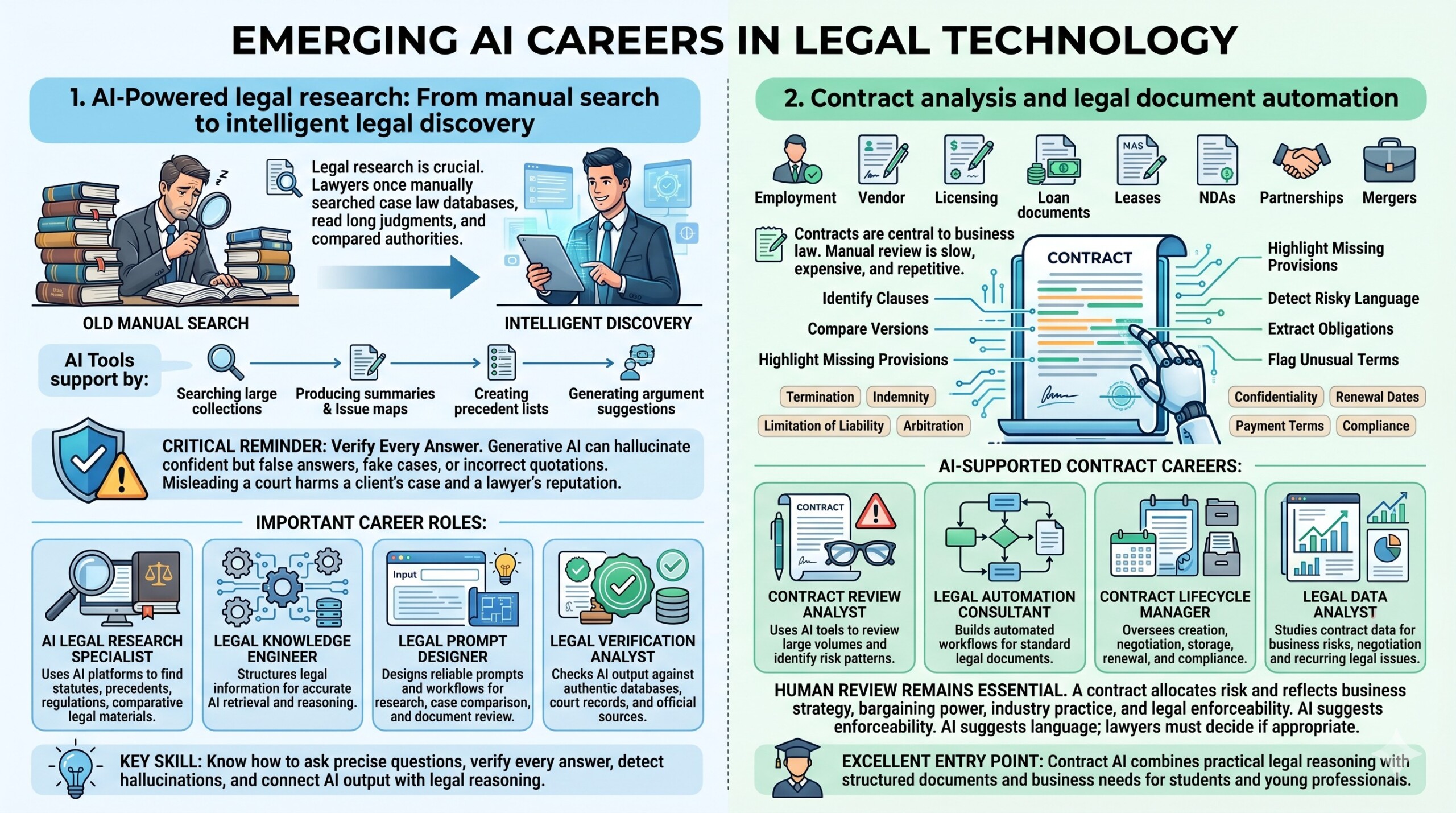
Legal research is one of the most important areas where AI is transforming the profession. Earlier, lawyers and researchers had to manually search through case law databases, read long judgments, compare authorities, and identify relevant legal principles. AI tools can now support this process by searching across large collections of legal material and producing summaries, issue maps, precedent lists, and argument suggestions.
AI legal research tools can help professionals identify relevant judgments, compare similar fact patterns, understand how courts have interpreted a statute, and discover whether a case has been followed, distinguished, overruled, or criticized. This can save time and improve the depth of legal preparation.
However, AI research must never be treated as final truth. Generative AI systems can produce confident but false answers, including fake cases or incorrect quotations. In legal work, such mistakes can damage a client’s case, mislead a court, and harm a lawyer’s professional reputation. Therefore, the future legal researcher must know how to use AI as an assistant, not as an authority.
Important career roles in this area include:
- AI Legal Research Specialist: Uses AI platforms to find statutes, precedents, regulations, and comparative legal materials.
- Legal Knowledge Engineer: Structures legal information so that AI systems can retrieve and reason over it more accurately.
- Legal Prompt Designer: Designs reliable prompts and workflows for legal research, case comparison, and document review.
- Legal Verification Analyst: Checks AI-generated outputs against authentic legal databases, court records, and official sources.
The key skill here is not simply typing a question into an AI tool. It is knowing how to ask precise legal questions, verify every answer, detect hallucinations, and connect AI output with legal reasoning.
2. Contract analysis and legal document automation
Contracts are at the heart of business law. Companies sign employment agreements, vendor contracts, licensing agreements, loan documents, leases, non-disclosure agreements, partnership agreements, merger documents, and many other legal instruments. Reviewing these documents manually can be slow, expensive, and repetitive.
AI can assist by identifying clauses, comparing versions, highlighting missing provisions, detecting risky language, extracting obligations, and flagging unusual terms. For example, an AI contract tool may identify termination clauses, indemnity obligations, limitation of liability provisions, arbitration clauses, confidentiality duties, renewal dates, payment terms, or compliance requirements.
This creates strong career opportunities in legal operations, contract lifecycle management, corporate law, compliance, and legal-tech product development.
AI-supported contract careers may involve:
- Contract Review Analyst: Uses AI tools to review large volumes of contracts and identify risk patterns.
- Legal Automation Consultant: Builds automated workflows for standard legal documents.
- Contract Lifecycle Manager: Oversees digital contract creation, negotiation, storage, renewal, and compliance.
- Legal Data Analyst: Studies contract data to identify business risks, negotiation trends, and recurring legal issues.
AI can also help generate first drafts of standard agreements. But human review remains essential. A contract is not just a document; it is a risk allocation mechanism. It reflects business strategy, bargaining power, industry practice, legal enforceability, and future dispute possibilities. AI can suggest language, but lawyers must decide whether that language is appropriate.
For students and young professionals, contract AI is an excellent entry point into legal technology because it combines practical legal reasoning with structured documents and business needs. A constantly updated Whatsapp channel awaits your participation.
3. AI in Case Preparation and litigation strategy
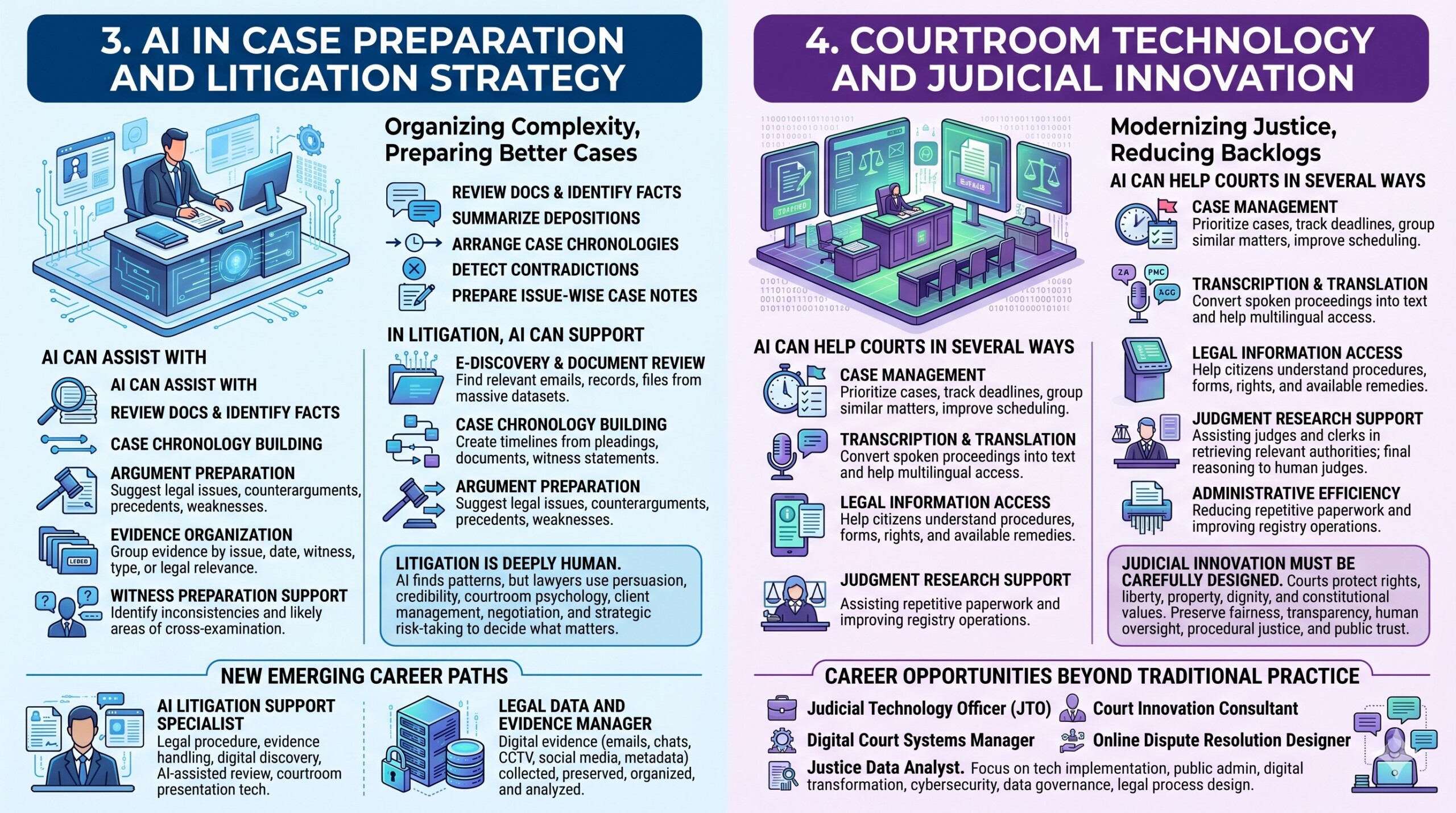
Litigation involves facts, evidence, legal issues, witnesses, timelines, pleadings, procedural rules, and arguments. AI can help organize this complexity. It can review large document sets, identify relevant facts, summarize depositions, arrange timelines, detect contradictions, and help prepare issue-wise case notes.
In litigation, AI can support:
- Document review and e-discovery: Finding relevant emails, records, messages, files, and evidence from massive datasets.
- Case chronology building: Creating timelines from pleadings, documents, correspondence, and witness statements.
- Argument preparation: Suggesting possible legal issues, counterarguments, precedent categories, and factual weaknesses.
- Evidence organization: Grouping evidence by issue, date, witness, document type, or legal relevance.
- Witness preparation support: Identifying inconsistencies and likely areas of cross-examination.
This does not mean that AI can replace the judgment of an experienced litigator. Litigation is deeply human. It involves persuasion, credibility, timing, courtroom psychology, client management, negotiation, and strategic risk-taking. AI may identify patterns, but a lawyer must decide what matters.
A new career path is emerging: the AI Litigation Support Specialist. This professional understands legal procedure, evidence handling, digital discovery, AI-assisted review, and courtroom presentation technology. Law firms and corporate legal departments increasingly need people who can bridge the gap between lawyers, technologists, and case teams.
Another important role is the Legal Data and Evidence Manager, who ensures that digital evidence is collected, preserved, organized, and analyzed properly. As courts deal with emails, chats, CCTV, social media, metadata, financial records, and digital transactions, such roles will become more important.
4. Courtroom technology and judicial innovation
Courts across the world are under pressure. Many justice systems face heavy case backlogs, delayed hearings, limited infrastructure, shortage of judges, and rising public expectations. Judicial innovation uses technology to make courts more efficient, transparent, and accessible.
Courtroom technology may include e-filing systems, virtual hearings, digital case management, electronic evidence presentation, automated transcription, translation tools, scheduling systems, online dispute resolution platforms, and AI-assisted administrative support.
AI can help courts in several ways:
- Case management: Prioritizing cases, tracking deadlines, grouping similar matters, and improving scheduling.
- Transcription and translation: Converting spoken proceedings into text and helping multilingual access.
- Legal information access: Helping citizens understand procedures, forms, rights, and available remedies.
- Judgment research support: Assisting judges and clerks in retrieving relevant authorities, while leaving final reasoning to human judges.
- Administrative efficiency: Reducing repetitive paperwork and improving registry operations.
This creates career opportunities beyond traditional law practice. Courts need people who understand technology implementation, public administration, digital transformation, cybersecurity, data governance, and legal process design.
Possible careers include Judicial Technology Officer, Court Innovation Consultant, Digital Court Systems Manager, Online Dispute Resolution Designer, and Justice Data Analyst.
Judicial innovation must be carefully designed. Courts are not ordinary service platforms. They protect rights, liberty, property, dignity, and constitutional values. Any AI system used in courts must preserve fairness, transparency, human oversight, procedural justice, and public trust. Excellent individualised mentoring programmes available.
5. Legal automation and changing role of law firms
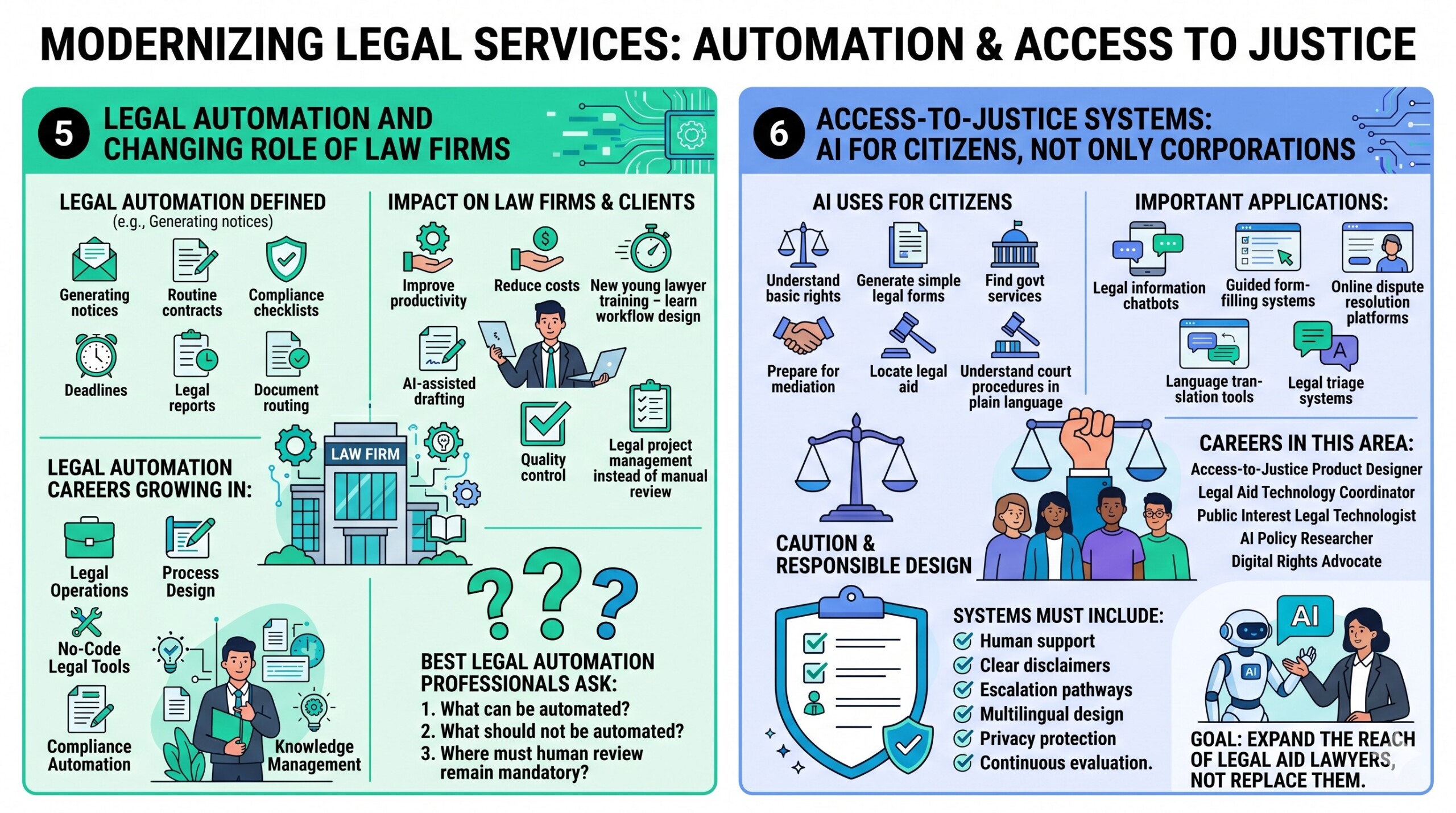
Legal automation refers to using technology to perform repetitive legal tasks more efficiently. This may include generating standard notices, drafting routine contracts, preparing compliance checklists, managing due diligence, tracking deadlines, creating legal reports, and routing documents for approval.
For law firms, automation can improve productivity and reduce time spent on low-value repetitive work. For clients, it can reduce cost and improve speed. For young lawyers, it changes the nature of early-career training. Instead of spending years only on manual document review, they may need to learn workflow design, AI-assisted drafting, quality control, and legal project management.
Legal automation careers are growing in areas such as:
- Legal Operations: Improving the efficiency of legal departments.
- Process Design: Mapping legal workflows and identifying automation opportunities.
- No-Code Legal Tools: Building legal applications without deep programming knowledge.
- Compliance Automation: Creating systems that monitor regulatory obligations.
- Knowledge Management: Organizing legal templates, playbooks, clauses, and precedents.
The modern law firm may increasingly resemble a hybrid organization: part professional service firm, part knowledge company, part technology platform. This does not reduce the importance of legal expertise. Instead, it rewards lawyers who can combine legal judgment with systems thinking.
The best legal automation professionals ask three questions: What can be automated? What should not be automated? And where must human review remain mandatory?

6. Access-to-Justice Systems: AI for Citizens, Not Only Corporations
One of the most meaningful uses of legal AI is improving access to justice. Many people cannot afford lawyers. Many do not understand legal language. Many are unaware of their rights. Many struggle with forms, procedures, deadlines, and court systems. AI can help bridge this gap if designed responsibly.
Access-to-justice AI systems may help citizens understand basic legal rights, generate simple legal forms, find relevant government services, prepare for mediation, locate legal aid, or understand court procedures in plain language.
Important applications include:
- Legal information chatbots: Explain legal procedures in simple language.
- Guided form-filling systems: Help users complete applications, complaints, notices, or benefit claims.
- Online dispute resolution platforms: Resolve small disputes without expensive court processes.
- Language translation tools: Help people access legal information in local languages.
- Legal triage systems: Direct users to the right forum, lawyer, government office, or legal aid service.
Careers in this area are ideal for people interested in law, technology, public policy, and social impact. Roles may include Access-to-Justice Product Designer, Legal Aid Technology Coordinator, Public Interest Legal Technologist, AI Policy Researcher, and Digital Rights Advocate.
However, access-to-justice AI must be designed with caution. Poor people, rural citizens, migrants, women, workers, tenants, prisoners, and marginalized communities may be harmed if automated tools give wrong advice or exclude complex human realities. Therefore, such systems must include human support, clear disclaimers, escalation pathways, multilingual design, privacy protection, and continuous evaluation.
The goal should not be to replace legal aid lawyers. The goal should be to expand their reach. Subscribe to our free AI newsletter now.
7. Ethical and regulatory challenges in legal AI
Legal AI raises serious ethical and regulatory questions. Law is not merely about efficiency; it is about justice. A faster legal system is not necessarily a fairer legal system. AI must therefore be governed by strong professional, institutional, and legal safeguards.
The most important ethical challenges include accuracy, confidentiality, bias, explainability, accountability, unauthorized practice of law, client consent, data security, and professional responsibility.
For lawyers, the duty of competence now includes understanding the benefits and risks of AI tools. A lawyer using AI must know whether the tool is suitable for the task, whether client data is protected, whether the output has been verified, and whether the client should be informed. Lawyers cannot blame AI for professional errors.
For courts, the stakes are even higher. If AI is used in judicial administration, bail decisions, sentencing support, case allocation, risk scoring, or legal aid eligibility, the system must be transparent, auditable, fair, and subject to human oversight. No person should be denied justice because of an opaque algorithm.
Regulators around the world are beginning to classify some AI systems used in justice, law enforcement, public administration, and rights-sensitive areas as high-risk. This means legal AI professionals will need to understand not only law and technology but also compliance frameworks, audit requirements, risk management, documentation, and governance.
This creates new career opportunities such as AI Ethics Officer for Legal Systems, Legal AI Compliance Specialist, Algorithmic Accountability Auditor, Data Protection Counsel, and AI Governance Consultant.
The future of legal AI will depend on trust. If AI tools become associated with fake citations, biased recommendations, privacy violations, or unfair outcomes, courts and clients will reject them. But if they are carefully designed, transparently governed, and responsibly used, they can strengthen the legal system.
Conclusion
AI legal technology and judicial innovation are opening a powerful new career landscape. The legal profession is no longer limited to courtroom advocacy, corporate drafting, or academic research. It now includes legal automation, AI-assisted research, contract analytics, litigation technology, court digitization, access-to-justice design, legal data governance, and AI ethics.
For students, lawyers, engineers, policymakers, and entrepreneurs, this is a historic opportunity. A person with legal knowledge can learn technology. A technologist can learn legal process. A policy thinker can guide regulation. A social entrepreneur can build access-to-justice tools. A judge or court administrator can help modernize institutions. A law firm can become more efficient. A citizen can receive clearer legal information.
Yet the central principle must remain clear: AI should support justice, not replace it. It should assist lawyers, not excuse negligence. It should help judges, not undermine judicial independence. It should empower citizens, not confuse or exploit them. It should reduce barriers, not create new forms of digital inequality.
The careers of the future will belong to professionals who combine legal reasoning, technological fluency, ethical judgment, and public responsibility. Upgrade your AI-readiness with our masterclass.