Career Transition Paths into AI
Career Transition Paths into AI
From IT, management, humanities, and science
Introduction
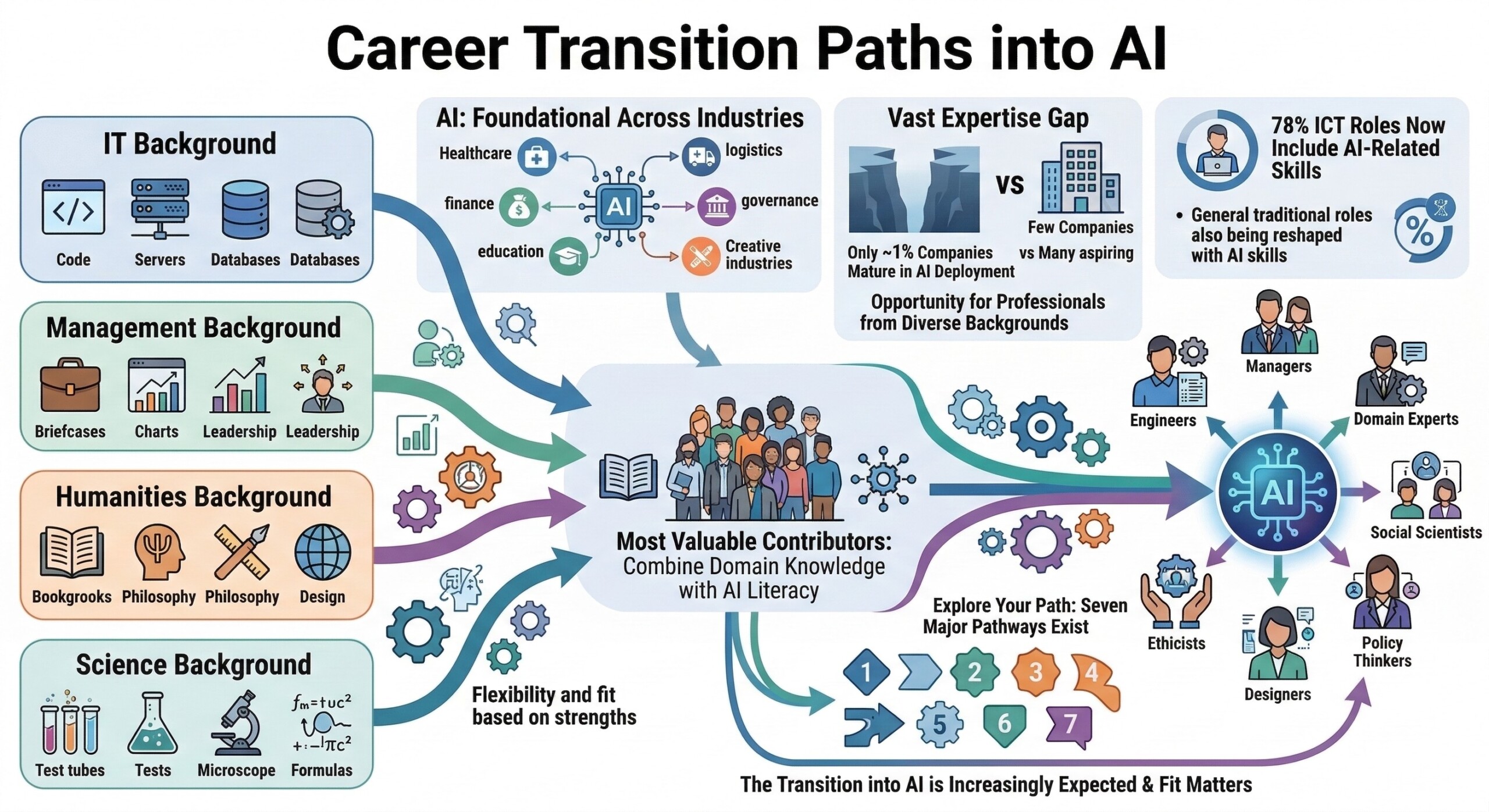
Artificial Intelligence is no longer a niche discipline reserved only for mathematicians or computer scientists. It is rapidly becoming a foundational capability across industries – from healthcare and finance to education, logistics, governance, and creative industries. Organizations across the world are increasing investments in AI, yet only about 1% of companies consider themselves mature in AI deployment, indicating a vast gap between ambition and available expertise.
This gap is creating a powerful opportunity for professionals from diverse backgrounds to transition into AI-related careers. At the same time, the labor market is evolving quickly: 78% of ICT roles now include AI-related skills, and many traditional roles are being reshaped by AI technologies.
The important insight is that AI careers are not limited to programming. AI needs engineers, but it also needs managers, domain experts, social scientists, ethicists, designers, and policy thinkers. In many cases, professionals who combine domain knowledge with AI literacy are the most valuable contributors.
For people from IT, management, humanities, or science backgrounds, the transition into AI is therefore not only possible – it is increasingly expected. The real question is not whether one can move into AI, but which path best fits one’s existing strengths and experience.
Below are seven major pathways through which professionals can transition into the AI ecosystem. An excellent collection of learning videos awaits you on our Youtube channel.
1. The Technical Path: From IT and software roles into AI engineering
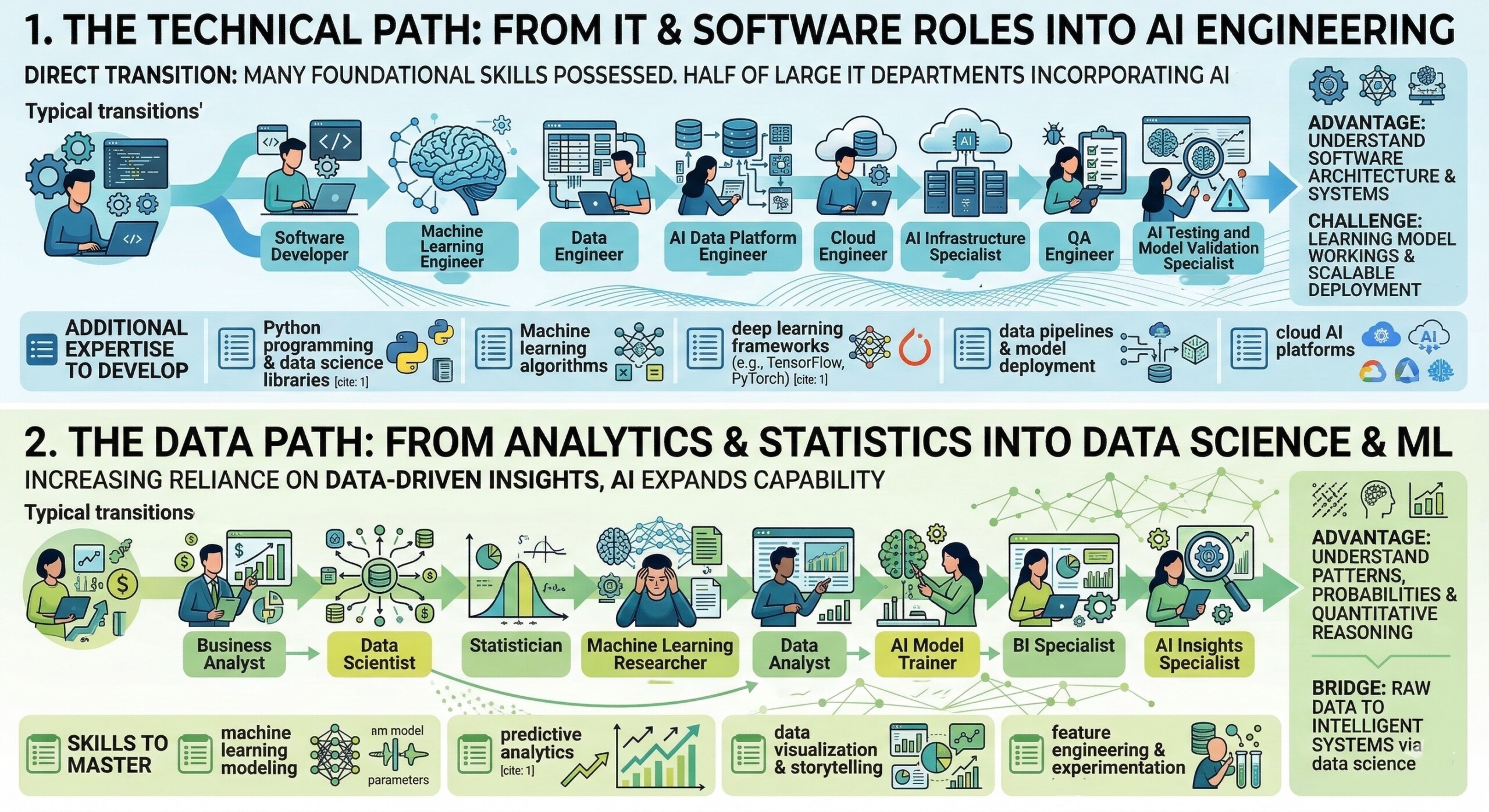
The most direct transition into AI comes from traditional IT and software roles. Software engineers, data engineers, system architects, and cloud professionals already possess many foundational skills required in AI.
Nearly half of IT departments in large organizations are already incorporating AI technologies into their systems and workflows.
Typical transitions include:
- Software Developer → Machine Learning Engineer
- Data Engineer → AI Data Platform Engineer
- Cloud Engineer → AI Infrastructure Specialist
- QA Engineer → AI Testing and Model Validation Specialist
To make this transition, professionals typically need to develop additional expertise in:
- Python programming and data science libraries
- Machine learning algorithms
- deep learning frameworks such as TensorFlow or PyTorch
- data pipelines and model deployment
- cloud AI platforms
The advantage for IT professionals is that they already understand software architecture and production systems. Their challenge is not entering AI but learning how models work and how to deploy them at scale.
2. The Data Path: from analytics and statistics into data science and ML
Professionals with backgrounds in statistics, analytics, economics, mathematics, or operations research often move into AI through data science.
Organizations increasingly rely on data-driven insights, and AI expands this capability dramatically.
Common transitions include:
- Business Analyst → Data Scientist
- Statistician → Machine Learning Researcher
- Data Analyst → AI Model Trainer
- BI Specialist → AI Insights Specialist
Data professionals already understand patterns, probabilities, and quantitative reasoning. Their transition into AI typically involves learning:
- machine learning modeling
- predictive analytics
- data visualization and storytelling
- feature engineering and experimentation
Because many AI models rely on high-quality data, data scientists often become the bridge between raw data and intelligent systems. A constantly updated Whatsapp channel awaits your participation.
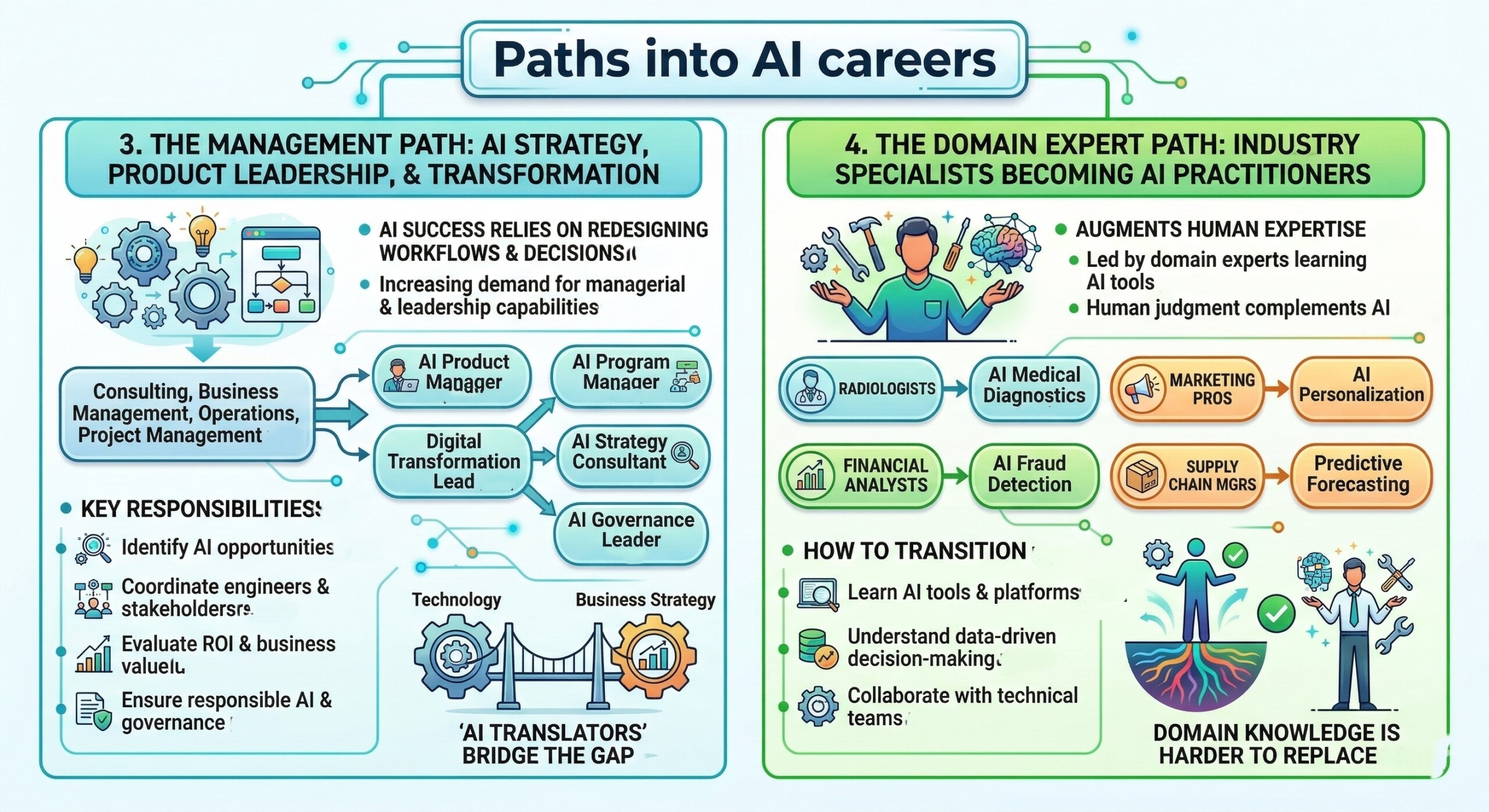
3. The Management Path: AI strategy, product leadership, and transformation
AI does not succeed purely because of technology. It succeeds because organizations redesign workflows, products, and decision-making processes around intelligent systems.
This is where management professionals enter the AI ecosystem.
AI adoption is actually increasing the demand for managerial and leadership capabilities because human judgment remains essential in complex decision environments.
Professionals from consulting, business management, operations, and project management can transition into roles such as:
- AI Product Manager
- AI Program Manager
- Digital Transformation Lead
- AI Strategy Consultant
- AI Governance Leader
Their responsibilities typically include:
- identifying AI opportunities within business processes
- coordinating engineers, domain experts, and stakeholders
- evaluating ROI and business value of AI projects
- ensuring responsible AI use and governance
Many companies now seek “AI translators”—people who understand both technology and business strategy and can bridge the gap between them.
4. The Domain Expert Path: Industry specialists becoming AI practitioners
Many successful AI implementations are led not by technologists but by domain experts who learn AI tools.
Doctors, financial analysts, supply chain experts, marketing specialists, and educators increasingly use AI in their work.
Examples include:
- Radiologists using AI for medical diagnostics
- Marketing professionals using AI for personalization
- Financial analysts applying AI for fraud detection
- Supply chain managers using predictive forecasting
AI augments human expertise rather than replacing it. Workers in many industries are shifting toward roles where human judgment complements AI capabilities.
For domain experts, the path to AI typically involves:
- learning AI tools and platforms
- understanding data-driven decision-making
- collaborating with technical teams
This path is particularly powerful because domain knowledge is often harder to replace than technical skills. Excellent individualised mentoring programmes available.
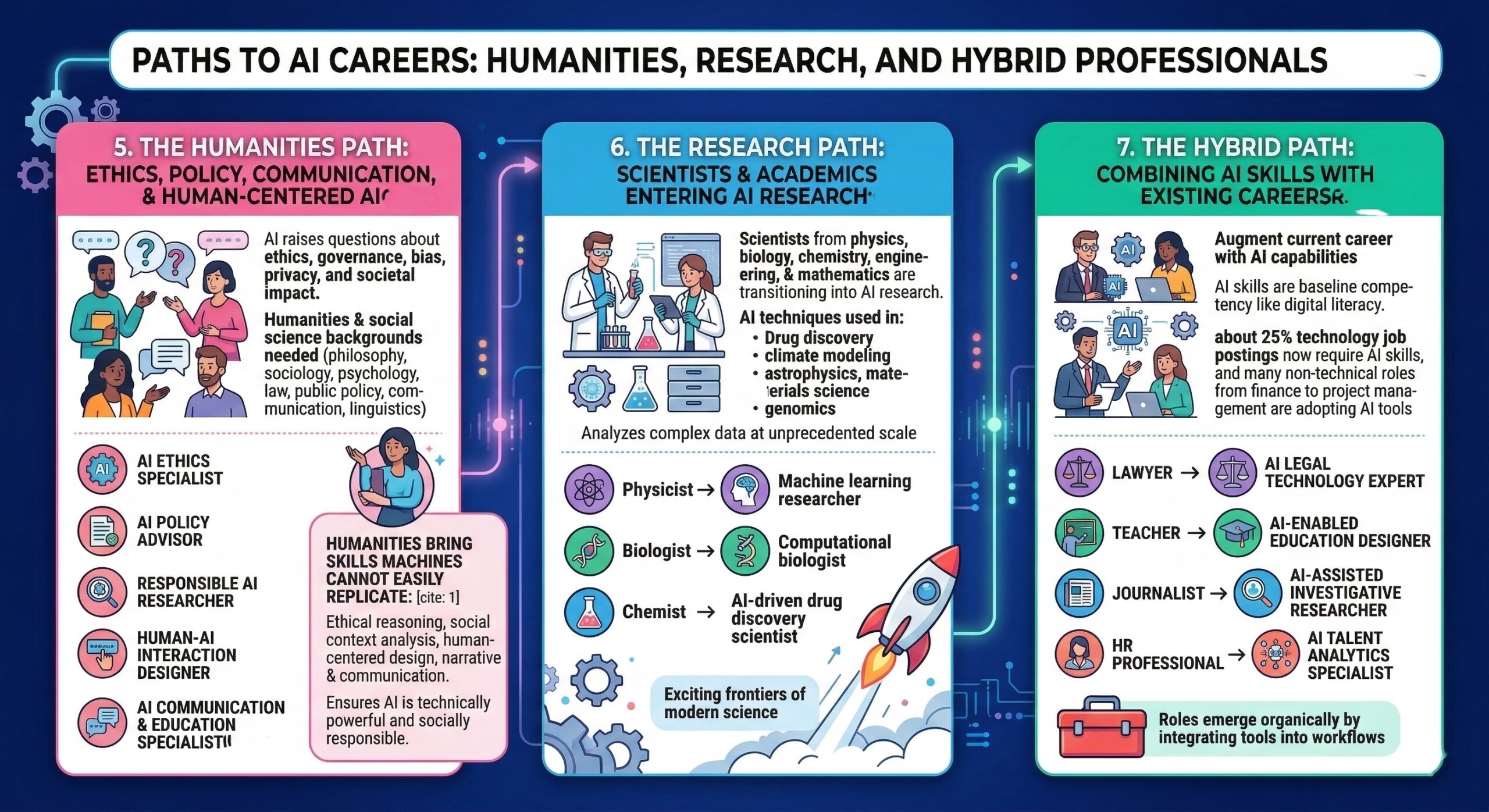
5. The Humanities Path: Ethics, policy, communication, and human-centered AI
Artificial intelligence raises profound questions about ethics, governance, bias, privacy, and societal impact.
Professionals from humanities and social science backgrounds – philosophy, sociology, psychology, law, public policy, communication, and linguistics – are therefore increasingly needed in AI.
Emerging roles include:
- AI Ethics Specialist
- AI Policy Advisor
- Responsible AI Researcher
- Human–AI Interaction Designer
- AI Communication and Education Specialist
Companies and governments are facing critical shortages in areas such as AI ethics, governance, and security expertise.
Humanities professionals bring skills that machines cannot easily replicate:
- ethical reasoning
- social context analysis
- human-centered design
- narrative and communication
These capabilities ensure that AI systems are not only technically powerful but also socially responsible.
6. The Research Path: Scientists and academics entering AI research
Scientists from physics, biology, chemistry, engineering, and mathematics are increasingly transitioning into AI research.
AI techniques are now used in fields such as:
- drug discovery
- climate modeling
- astrophysics
- materials science
- genomics
Researchers often adopt AI because it allows them to analyze complex data at unprecedented scale.
Common transitions include:
- physicist → machine learning researcher
- biologist → computational biologist
- chemist → AI-driven drug discovery scientist
These interdisciplinary careers represent one of the most exciting frontiers of modern science. Subscribe to our free AI newsletter now.
7. The Hybrid Path: Combining AI skills with existing careers
Perhaps the most realistic path for many professionals is not abandoning their current career but augmenting it with AI capabilities.
AI skills are increasingly becoming a baseline competency similar to digital literacy.
In fact:
- about 25% of technology job postings now require AI skills, and
- many non-technical roles – from finance to project management – are adopting AI tools.
Examples of hybrid careers include:
- Lawyer → AI legal technology expert
- Teacher → AI-enabled education designer
- Journalist → AI-assisted investigative researcher
- HR professional → AI talent analytics specialist
These hybrid roles often emerge organically as professionals begin integrating AI tools into their existing workflows.
Conclusion
The rise of artificial intelligence is transforming the structure of careers, but it is not creating a single narrow pathway into the future. Instead, AI is opening multiple entry points for professionals from diverse backgrounds.
IT professionals may move into machine learning engineering. Data analysts may evolve into data scientists. Managers may lead AI transformation initiatives. Domain experts may become AI-enabled decision makers. Humanities scholars may guide ethical governance. Scientists may use AI to accelerate discovery.
At the same time, the most powerful trend is the emergence of hybrid professionals – individuals who combine AI literacy with deep expertise in a specific field.
The lesson for the modern workforce is clear: entering AI does not necessarily mean becoming a programmer. It means learning how intelligent systems work, understanding their possibilities and limitations, and applying them thoughtfully within one’s own domain.
In that sense, the future of AI careers is not purely technical. It is deeply human – built on curiosity, learning, responsibility, and the willingness to adapt in an era of intelligent machines. Upgrade your AI-readiness with our masterclass.
Share this with the world
Related Articles