Decision Intelligence & AI-Driven Leadership Careers
Decision Intelligence & AI-Driven Leadership Careers
AI-assisted executive decision systems; Scenario simulation and forecasting; Data-to-decision pipelines
Introduction
In today’s complex and rapidly evolving business environment, decision-making has become both more critical and more challenging. Leaders are no longer operating in stable, predictable conditions – they face uncertainty driven by global markets, technological disruption, and data overload. Traditional decision-making, based on intuition and static reports, is increasingly insufficient. This is where Decision Intelligence (DI) emerges as a transformative discipline, combining artificial intelligence, data science, and behavioral insights to enhance how decisions are made.
At the same time, leadership itself is being redefined. The modern executive is not just a strategist but a data-informed decision architect, capable of leveraging AI systems to simulate futures, assess risks, and optimize outcomes. AI-driven leadership careers are therefore not about replacing human judgment but augmenting it – enabling leaders to make faster, smarter, and more accountable decisions. This article explores how decision intelligence is shaping leadership and the career pathways emerging from this shift. An excellent collection of learning videos awaits you on our Youtube channel.
Let’s dive deep.
1. Decision Intelligence as a new discipline
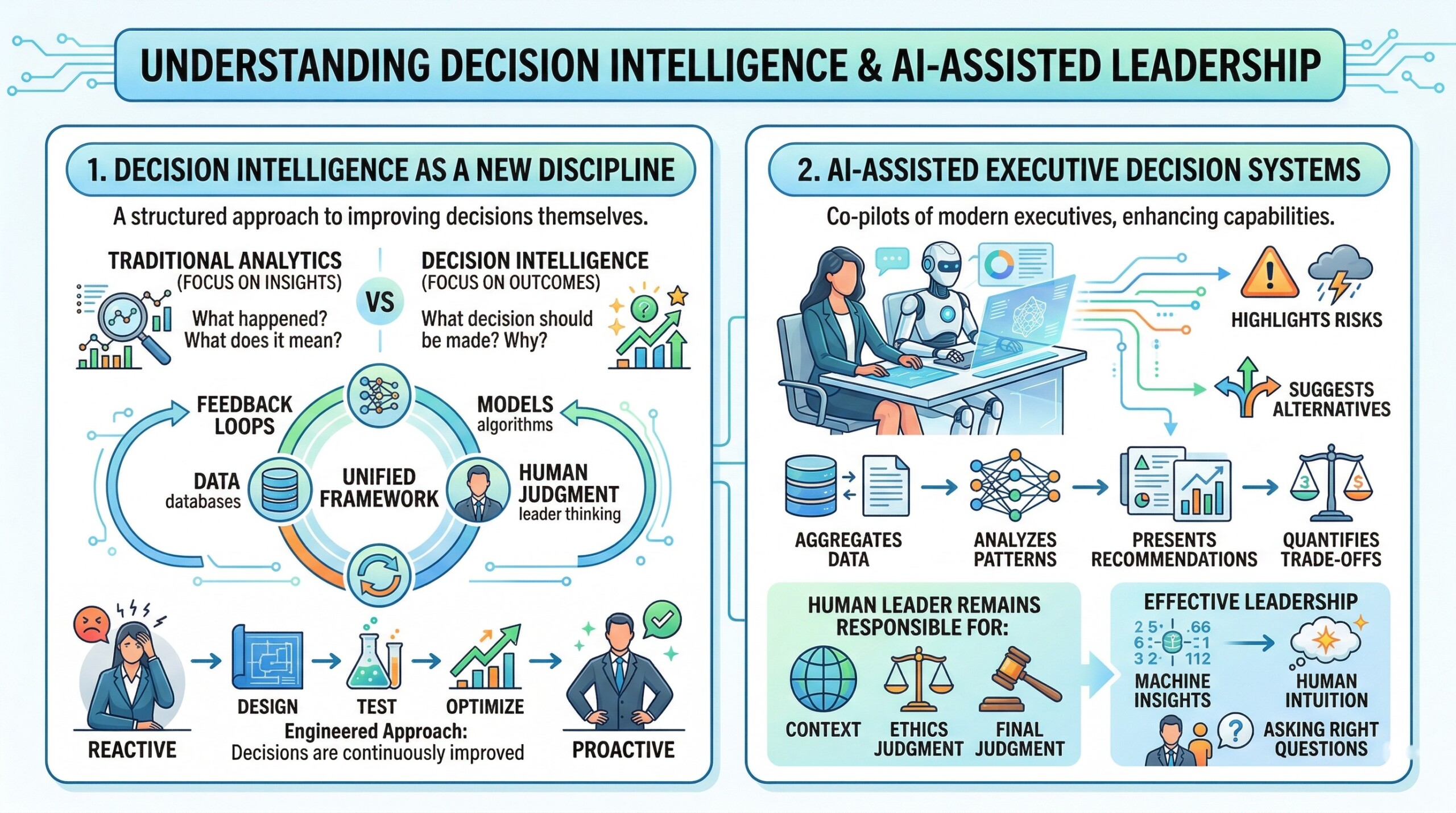
Decision Intelligence is not just an extension of analytics – it is a structured approach to improving decisions themselves. It integrates data, models, human judgment, and feedback loops into a unified framework. Unlike traditional analytics, which focuses on insights, DI focuses on outcomes – what decision should be made and why.
This discipline brings together fields like machine learning, systems thinking, and cognitive science to create decision-centric systems. It treats decisions as objects that can be designed, tested, and optimized. For leaders, this means moving from reactive decision-making to a proactive, engineered approach where decisions are continuously improved over time.
2. AI-Assisted executive decision systems
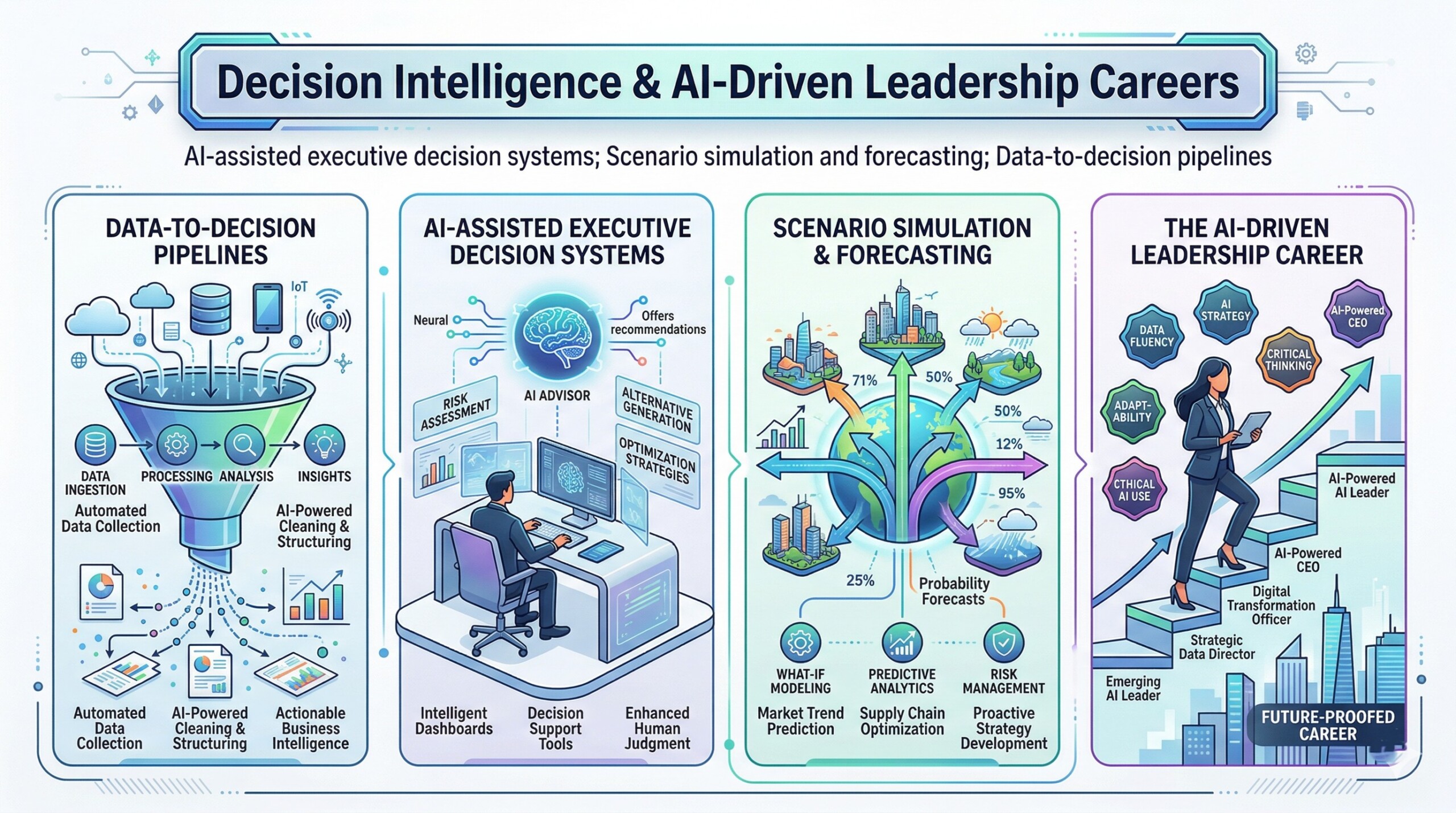
AI-assisted decision systems are becoming the co-pilots of modern executives. These systems aggregate vast amounts of structured and unstructured data, analyze patterns, and present actionable recommendations. They can highlight risks, suggest alternatives, and even quantify trade-offs between different strategies.
However, these systems do not replace executives – they enhance their capabilities. The human leader remains responsible for context, ethics, and final judgment. The most effective leaders are those who can collaborate with AI, asking the right questions, interpreting outputs critically, and integrating machine insights with human intuition. A constantly updated Whatsapp channel awaits your participation.
3. Scenario simulation and strategic foresight
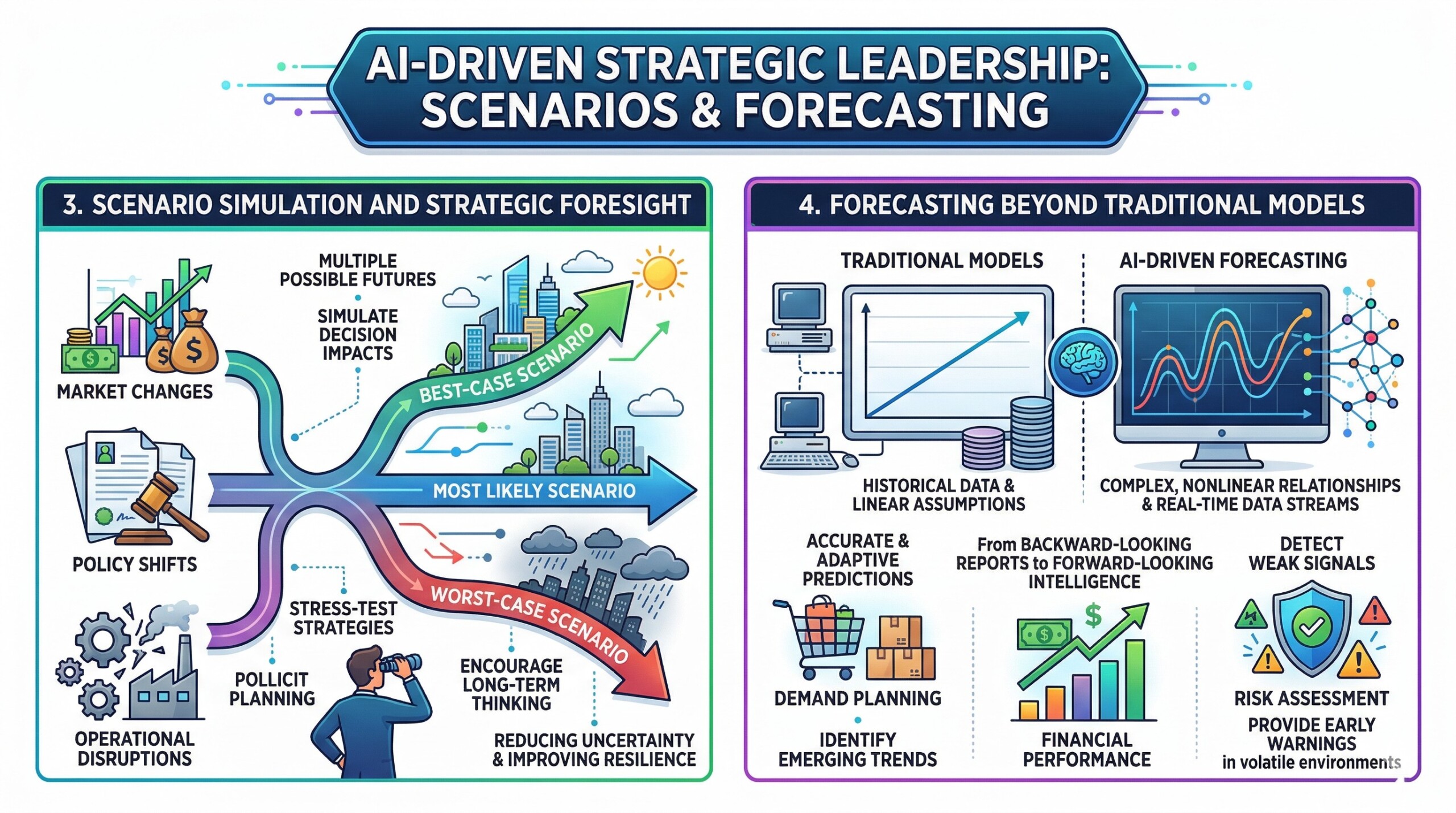
One of the most powerful capabilities of AI in leadership is scenario simulation. Instead of relying on a single forecast, leaders can explore multiple possible futures – best-case, worst-case, and most likely scenarios. AI models can simulate the impact of decisions under varying conditions, such as market changes, policy shifts, or operational disruptions.
This transforms decision-making from static planning to dynamic exploration. Leaders can stress-test strategies before implementing them, reducing uncertainty and improving resilience. Scenario simulation also encourages long-term thinking, helping organizations prepare for uncertainty rather than react to it.
4. Forecasting beyond traditional models
Traditional forecasting methods often rely on historical data and linear assumptions. AI-driven forecasting, however, can incorporate complex, nonlinear relationships and real-time data streams. This allows for more accurate and adaptive predictions across domains such as demand planning, financial performance, and risk assessment.
For leaders, this means moving from backward-looking reports to forward-looking intelligence. AI can identify emerging trends, detect weak signals, and provide early warnings. This capability is particularly valuable in volatile environments, where timely insights can make the difference between success and failure. Excellent individualised mentoring programmes available.
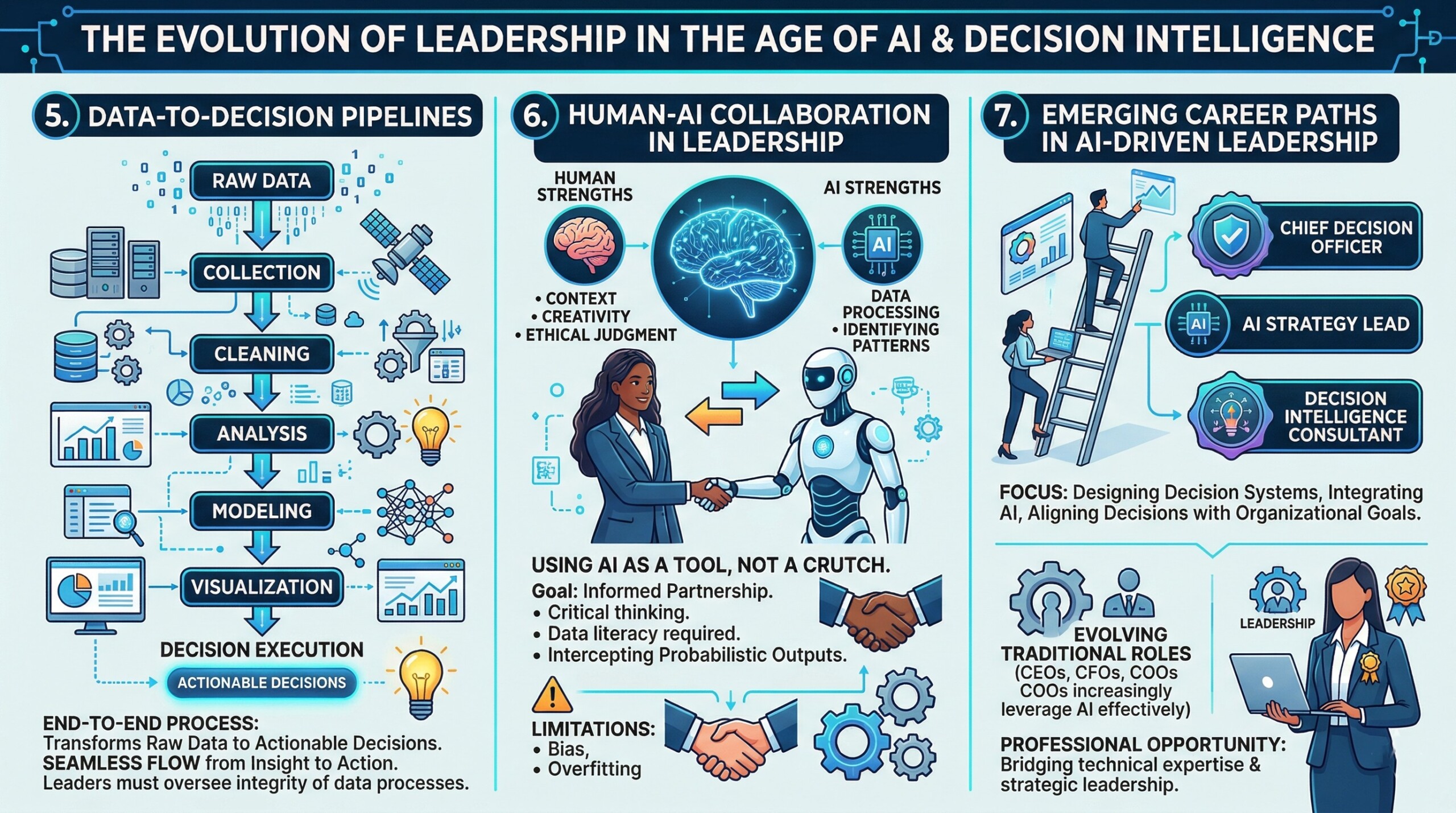
5. Data-to-Decision pipelines
A critical component of decision intelligence is the data-to-decision pipeline – the end-to-end process that transforms raw data into actionable decisions. This pipeline includes data collection, cleaning, analysis, modeling, visualization, and ultimately, decision execution.
Well-designed pipelines ensure that decisions are not delayed or distorted by poor data quality or fragmented systems. They create a seamless flow from insight to action. For leaders, understanding and overseeing these pipelines is essential, as the quality of decisions is directly tied to the integrity of the underlying data processes.
6. Human-AI collaboration in leadership
AI-driven leadership is fundamentally about collaboration between humans and machines. While AI excels at processing data and identifying patterns, humans bring context, creativity, and ethical judgment. Effective leaders learn to balance these strengths, using AI as a tool rather than a crutch.
This collaboration requires new skills, including data literacy, critical thinking, and the ability to interpret probabilistic outputs. Leaders must also be aware of the limitations of AI, such as bias and overfitting. The goal is not blind trust in algorithms but informed partnership. Subscribe to our free AI newsletter now.
7. Emerging career paths in AI-driven leadership
The rise of decision intelligence is creating new career roles at the intersection of technology and leadership. Positions such as Chief Decision Officer, AI Strategy Lead, and Decision Intelligence Consultant are becoming more common. These roles focus on designing decision systems, integrating AI into business processes, and ensuring that decisions align with organizational goals.
In addition, traditional leadership roles are evolving. CEOs, CFOs, and COOs are increasingly expected to understand AI capabilities and leverage them effectively. This shift is creating opportunities for professionals who can bridge the gap between technical expertise and strategic leadership.
Conclusion
Decision Intelligence represents a fundamental shift in how organizations approach decision-making. By combining AI, data, and human judgment, it enables leaders to move from intuition-driven choices to evidence-based, systematically optimized decisions. This not only improves outcomes but also enhances transparency, accountability, and adaptability.
As AI continues to evolve, leadership itself will be redefined. The leaders of the future will not just make decisions—they will design decision systems. They will harness AI to explore possibilities, anticipate risks, and drive strategic advantage. For professionals, this represents both a challenge and an opportunity: to develop the skills needed to thrive in an era where intelligence is not just artificial, but decisional. Upgrade your AI-readiness with our masterclass.
Share this with the world
Related Articles