Enterprise Knowledge AI & Organizational Intelligence Careers
Enterprise Knowledge AI & Organizational Intelligence Careers
Building AI systems over internal company knowledge; Retrieval-augmented generation and enterprise search;
Structuring and activating institutional intelligence
Introduction
very organization has a hidden intelligence system. It exists in strategy documents, project reports, customer conversations, emails, meeting notes, product manuals, sales decks, compliance files, HR policies, training material, and the lived experience of employees. But in most companies, this intelligence is scattered, underused, outdated, or locked inside departmental silos.
Enterprise Knowledge AI is the career field focused on solving this problem.
It brings together artificial intelligence, knowledge management, enterprise search, retrieval-augmented generation, data governance, organizational learning, and business transformation. The goal is not simply to build chatbots. The deeper goal is to help organizations remember better, search better, decide better, train better, and act faster.
As companies adopt AI, they will need professionals who can build systems that understand internal knowledge, retrieve the right information, connect it to business workflows, and convert institutional memory into usable intelligence. This makes Enterprise Knowledge AI and Organizational Intelligence one of the most important emerging career areas in the AI economy. An excellent collection of learning videos awaits you on our Youtube channel.
Let’s dive deep into this.
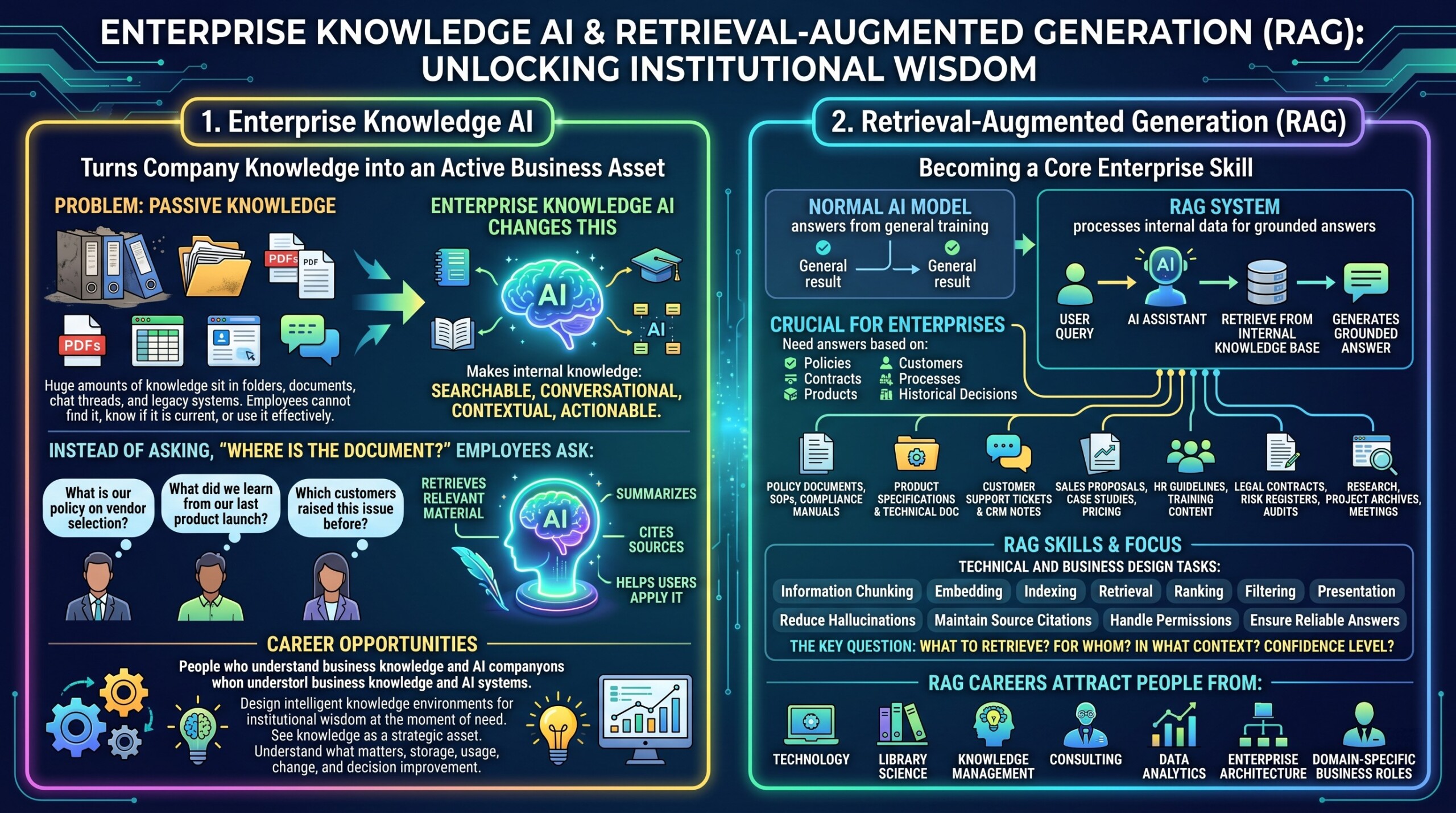
1. Enterprise Knowledge AI Turns Company Knowledge into an Active Business Asset
Most organizations already possess huge amounts of knowledge. The problem is that this knowledge is often passive. It sits in folders, PDFs, spreadsheets, intranet pages, chat threads, and legacy systems. Employees may not know where to find it, whether it is current, or how to use it effectively.
Enterprise Knowledge AI changes this by making internal knowledge searchable, conversational, contextual, and actionable.
Instead of asking, “Where is the document?” employees can ask, “What is our policy on vendor selection?” or “What did we learn from our last product launch?” or “Which customers raised this issue before?” AI can then retrieve relevant internal material, summarize it, cite sources, and help users apply it.
This creates career opportunities for people who can understand both business knowledge and AI systems. These professionals do not merely manage documents. They design intelligent knowledge environments where employees can access institutional wisdom at the moment of need.
A career in this area requires the ability to see knowledge as a strategic asset. The professional must understand what knowledge matters, where it is stored, who uses it, how it changes, and how it can improve decisions.
2. Retrieval-Augmented Generation Is Becoming a Core Enterprise Skill
Retrieval-augmented generation, or RAG, is one of the most important techniques in Enterprise Knowledge AI. A normal AI model answers from its general training. A RAG system first retrieves relevant information from a company’s internal knowledge base and then uses that retrieved material to generate a more grounded answer.
This is crucial for enterprises because companies cannot rely only on generic AI responses. They need answers based on their own policies, contracts, products, customers, processes, and historical decisions.
A RAG-based system may connect to internal sources such as:
- Policy documents, SOPs, and compliance manuals
- Product specifications and technical documentation
- Customer support tickets and CRM notes
- Sales proposals, case studies, and pricing documents
- HR guidelines, onboarding material, and training content
- Legal contracts, risk registers, and audit reports
- Research notes, project archives, and meeting summaries
Professionals in this field need to understand how information is chunked, embedded, indexed, retrieved, ranked, filtered, and presented to users. They must also know how to reduce hallucinations, maintain source citations, handle permissions, and ensure that users receive reliable answers.
RAG is not just a technical method. It is also a business design problem. The key question is: what should the AI retrieve, for whom, in what context, and with what level of confidence?
This is why RAG careers will attract people from technology, library science, knowledge management, consulting, data analytics, enterprise architecture, and domain-specific business roles. A constantly updated Whatsapp channel awaits your participation.
3. Enterprise Search Is Moving from Keyword Search to Intelligent Discovery
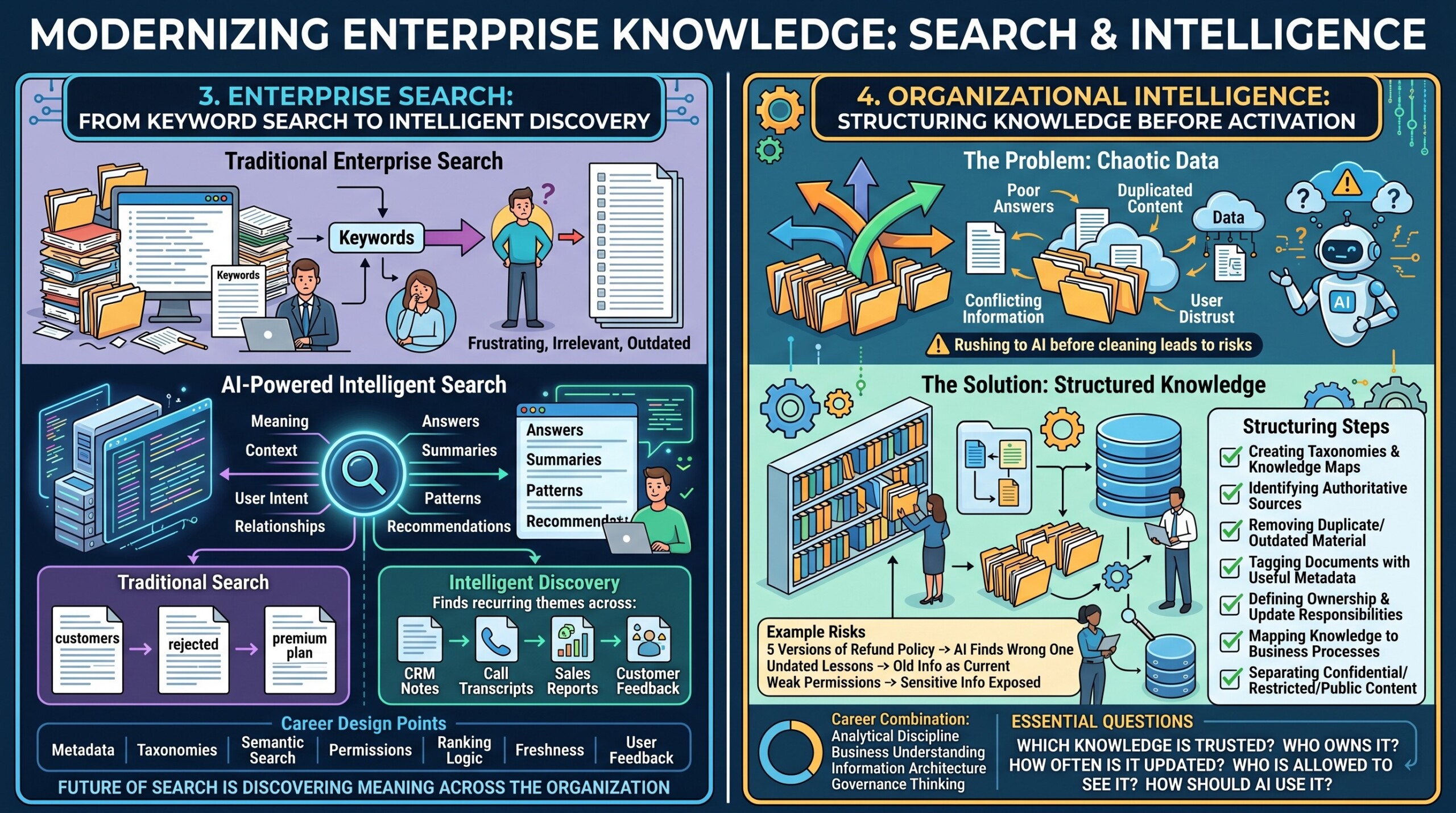
Traditional enterprise search is often frustrating. Employees type keywords and receive long lists of documents, many of which are irrelevant or outdated. They then spend time opening files, comparing versions, and interpreting information manually.
AI-powered enterprise search is different. It understands meaning, context, user intent, and relationships between concepts. It can retrieve not only documents but also answers, summaries, patterns, and recommendations.
For example, an employee may ask, “What are the main reasons customers rejected our premium plan last quarter?” A traditional search engine may return files containing the words “customers,” “rejected,” and “premium plan.” An intelligent enterprise search system can search across CRM notes, call transcripts, sales reports, and customer feedback to identify recurring themes.
This creates new career roles around designing search experiences that are useful, accurate, and trusted. Professionals must think about metadata, taxonomies, semantic search, permissions, ranking logic, freshness, and user feedback.
The future of enterprise search is not about finding documents. It is about discovering meaning across the organization.
4. Organizational Intelligence Requires Structuring Knowledge Before Activating It
AI cannot activate organizational knowledge effectively if that knowledge is chaotic. Many companies rush to build AI assistants before cleaning and structuring their internal information. This often leads to poor answers, duplicated content, conflicting information, and user distrust.
Organizational Intelligence careers require the ability to structure knowledge before applying AI to it.
This includes:
- Creating taxonomies and knowledge maps
- Identifying authoritative sources
- Removing duplicate or outdated material
- Tagging documents with useful metadata
- Defining ownership and update responsibilities
- Mapping knowledge to business processes
- Separating confidential, restricted, and public internal content
This work may not look glamorous, but it is foundational. A company cannot become intelligent if its knowledge base is messy.
For example, if five different departments have five versions of a customer refund policy, an AI system may retrieve the wrong one. If project lessons are stored without dates, owners, or context, the AI may treat old information as current. If access permissions are weak, sensitive information may be exposed to the wrong users.
Therefore, careers in this field require a combination of analytical discipline, business understanding, information architecture, and governance thinking.
The professional must ask: Which knowledge is trusted? Who owns it? How often is it updated? Who is allowed to see it? How should AI use it? Excellent individualised mentoring programmes available.
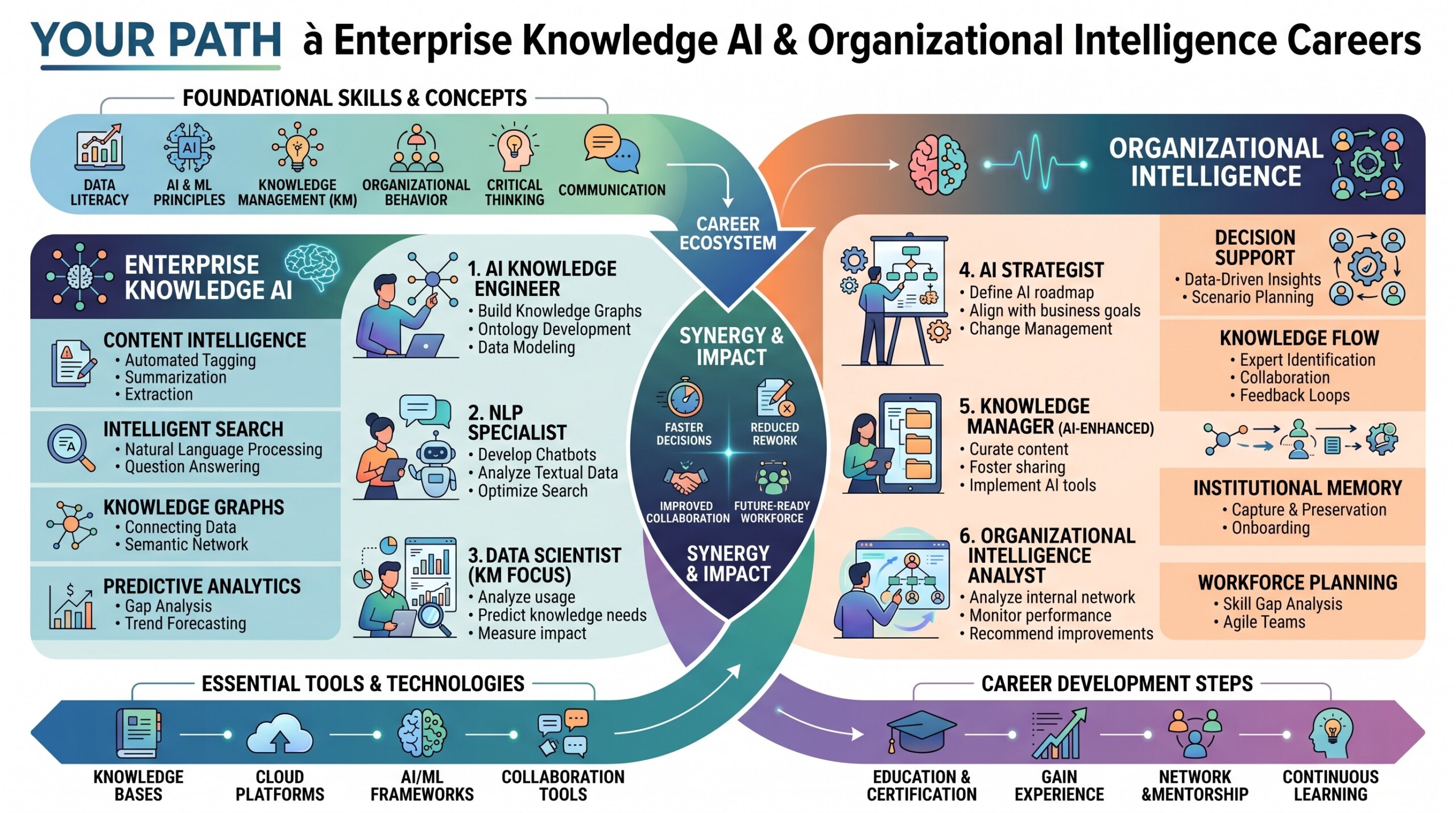
5. New Career Roles Are Emerging Around Enterprise Knowledge AI
As organizations adopt internal AI systems, several new roles will become important. Some will be technical, some will be managerial, and some will sit between business and technology.
Important career roles include:
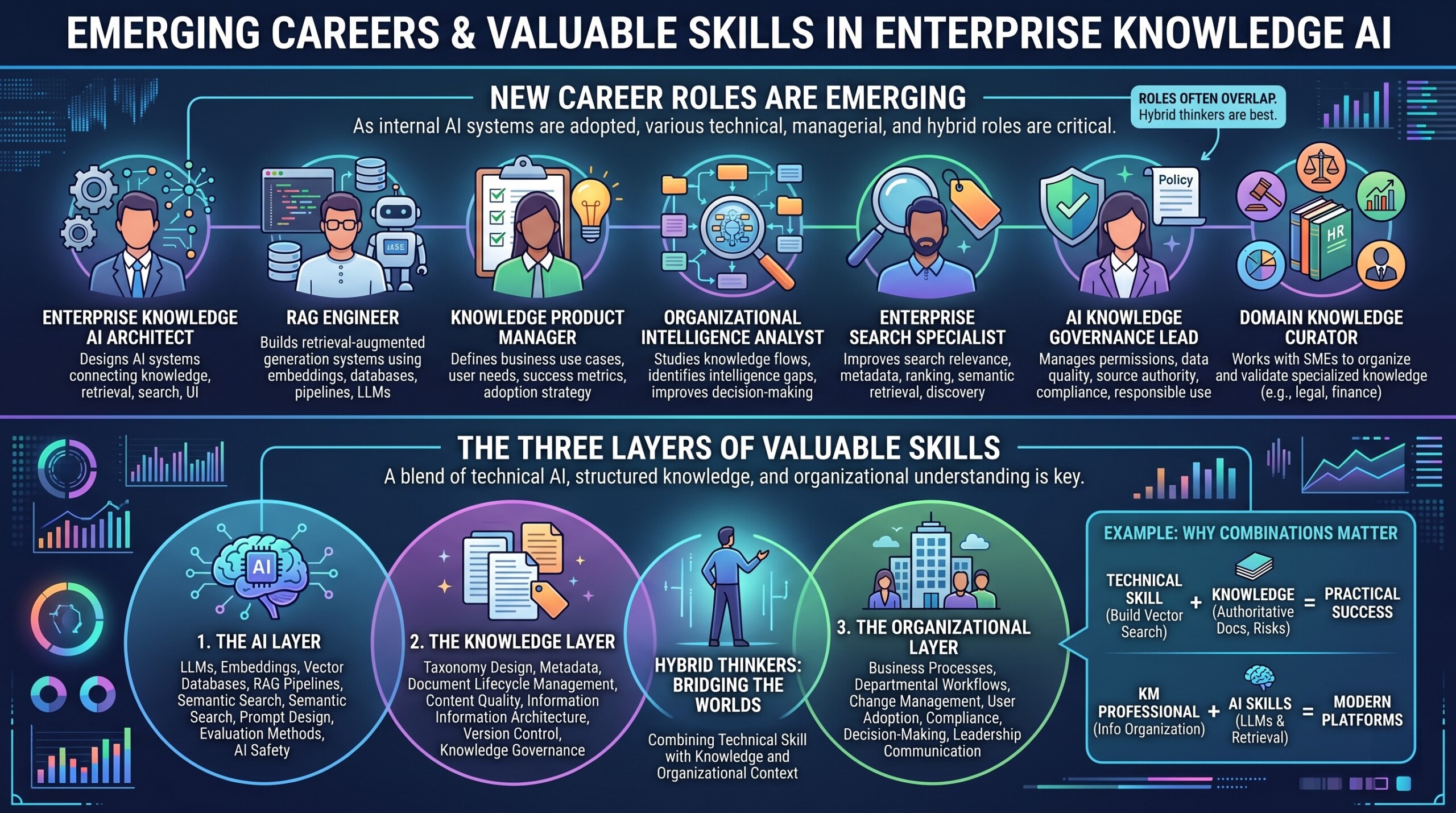
- Enterprise Knowledge AI Architect: Designs AI systems that connect internal knowledge sources, retrieval pipelines, search tools, and user interfaces.
- RAG Engineer: Builds retrieval-augmented generation systems using embeddings, vector databases, indexing pipelines, and LLMs.
- Knowledge Product Manager: Defines the business use cases, user needs, success metrics, and adoption strategy for knowledge AI tools.
- Organizational Intelligence Analyst: Studies company knowledge flows, identifies intelligence gaps, and recommends ways to improve decision-making.
- Enterprise Search Specialist: Improves search relevance, metadata quality, ranking, semantic retrieval, and user discovery experience.
- AI Knowledge Governance Lead: Manages permissions, data quality, source authority, compliance, auditability, and responsible AI use.
- Domain Knowledge Curator: Works with subject matter experts to organize and validate specialized knowledge in areas such as legal, finance, HR, engineering, or customer support.
These roles will often overlap. In smaller companies, one person may handle multiple responsibilities. In large enterprises, entire teams may be formed around internal AI knowledge platforms.
The best professionals in this field will be hybrid thinkers. They will understand AI, but they will also understand how organizations actually work.
6. The Most Valuable Skills Combine AI, Business, and Knowledge Management
Enterprise Knowledge AI careers are not limited to programmers. Technical skills matter, but business and knowledge skills are equally important.
A strong professional in this area should develop capabilities across three layers.
First, the AI layer. This includes understanding LLMs, embeddings, vector databases, RAG pipelines, semantic search, prompt design, evaluation methods, and AI safety.
Second, the knowledge layer. This includes taxonomy design, metadata, document lifecycle management, content quality, information architecture, version control, and knowledge governance.
Third, the organizational layer. This includes business processes, departmental workflows, change management, user adoption, compliance, decision-making, and leadership communication.
For example, a technically skilled person may know how to build a vector search system. But unless they understand which documents are authoritative, which users need which answers, and which risks must be controlled, the system may fail in practice.
Similarly, a knowledge management professional may understand how to organize information. But unless they learn AI retrieval systems and LLM behavior, they may not be able to design modern knowledge platforms.
The future belongs to professionals who can bridge these worlds. Subscribe to our free AI newsletter now.
7. Enterprise Knowledge AI Can Transform Decision-Making and Learning
The biggest promise of Enterprise Knowledge AI is not faster search. It is better organizational intelligence.
When internal knowledge becomes accessible and usable, employees can make better decisions. New employees can learn faster. Teams can avoid repeating past mistakes. Leaders can see patterns across departments. Customer-facing teams can respond with greater accuracy. Innovation teams can build on prior work instead of starting from zero.
Imagine a company where every project automatically contributes lessons to a living knowledge base. Every customer complaint becomes part of a pattern analysis system. Every policy update is reflected instantly in employee-facing AI assistants. Every sales team can learn from the best proposals. Every leader can ask, “What do we already know about this problem?” before making a decision.
This is organizational intelligence in action.
However, this transformation requires more than technology. It requires culture. People must be willing to document knowledge, share insights, maintain quality, and trust AI systems responsibly. Professionals in this career field will therefore need to work not only with machines but also with people, incentives, workflows, and organizational behavior.
Enterprise Knowledge AI succeeds when it becomes part of how the organization thinks.
Conclusion
Enterprise Knowledge AI and Organizational Intelligence careers will become increasingly important as companies move from experimenting with AI to embedding it into daily work. The next stage of enterprise AI will not be only about public models or generic chatbots. It will be about building intelligent systems over internal company knowledge.
Retrieval-augmented generation, enterprise search, knowledge structuring, metadata design, governance, and institutional intelligence will become core capabilities for modern organizations. Companies will need professionals who can connect scattered information, activate hidden knowledge, and create AI systems that help employees think, decide, and act more effectively.
This field is ideal for people who enjoy working at the intersection of AI, business, knowledge, systems, and strategy. It offers opportunities for engineers, analysts, consultants, knowledge managers, product leaders, and domain experts.
In the AI-powered enterprise, knowledge will no longer remain buried in files and forgotten folders. It will become a living, searchable, explainable, and actionable intelligence layer. The professionals who build that layer will shape how organizations learn, remember, and compete. Upgrade your AI-readiness with our masterclass.