
Green AI, Energy Optimization & Sustainable AI Careers
Green AI, Energy Optimization & Sustainable AI Careers
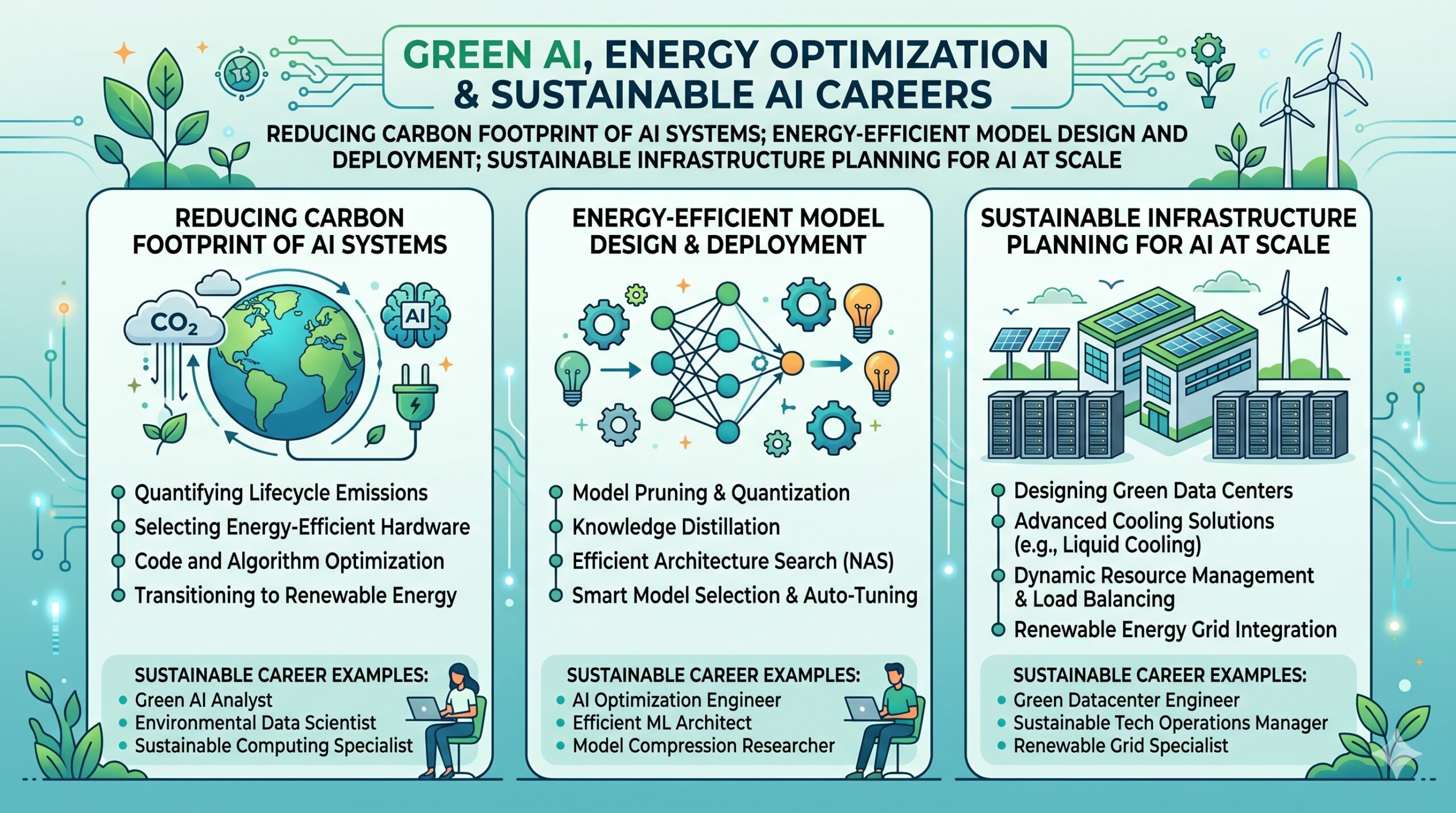
Reducing carbon footprint of AI systems; Energy-efficient model design and deployment; Sustainable infrastructure planning for AI at scale
Introduction
Artificial intelligence is becoming the operating layer of modern business. It is entering education, healthcare, finance, manufacturing, agriculture, logistics, media, governance, and scientific research. But as AI becomes more powerful and more widely deployed, its environmental footprint is also becoming harder to ignore.
Green AI is the discipline of designing, training, deploying, and governing AI systems in a way that reduces energy use, carbon emissions, water consumption, hardware waste, and infrastructure pressure. It is not anti-AI. It is pro-responsible AI. It asks a practical question: how can we get the benefits of AI without building wasteful, oversized, energy-hungry systems for every task?
This question is now urgent. The International Energy Agency projects that global electricity consumption from data centres could more than double to around 945 TWh by 2030, with AI as a major driver of growth. That is slightly more than Japan’s current total electricity consumption. Data centres may still account for a small share of global electricity use overall, but their growth is fast, concentrated, and locally significant. In the United States, data centres are expected to account for nearly half of electricity demand growth between now and 2030.
The challenge is not only electricity. AI also affects water use, cooling demand, grid planning, chip supply chains, and e-waste. MIT News notes that generative AI has environmental consequences including increased electricity demand and water consumption. The Environmental and Energy Study Institute reported in 2025 that some large data centres can consume up to 5 million gallons of water per day, comparable to the water use of a town of 10,000 to 50,000 people.
Green AI, therefore, is no longer a niche ethical topic. It is becoming a core engineering, infrastructure, policy, and career opportunity.
Let’s dive deep into this.
1. Green AI means useful intelligence with lower environmental cost
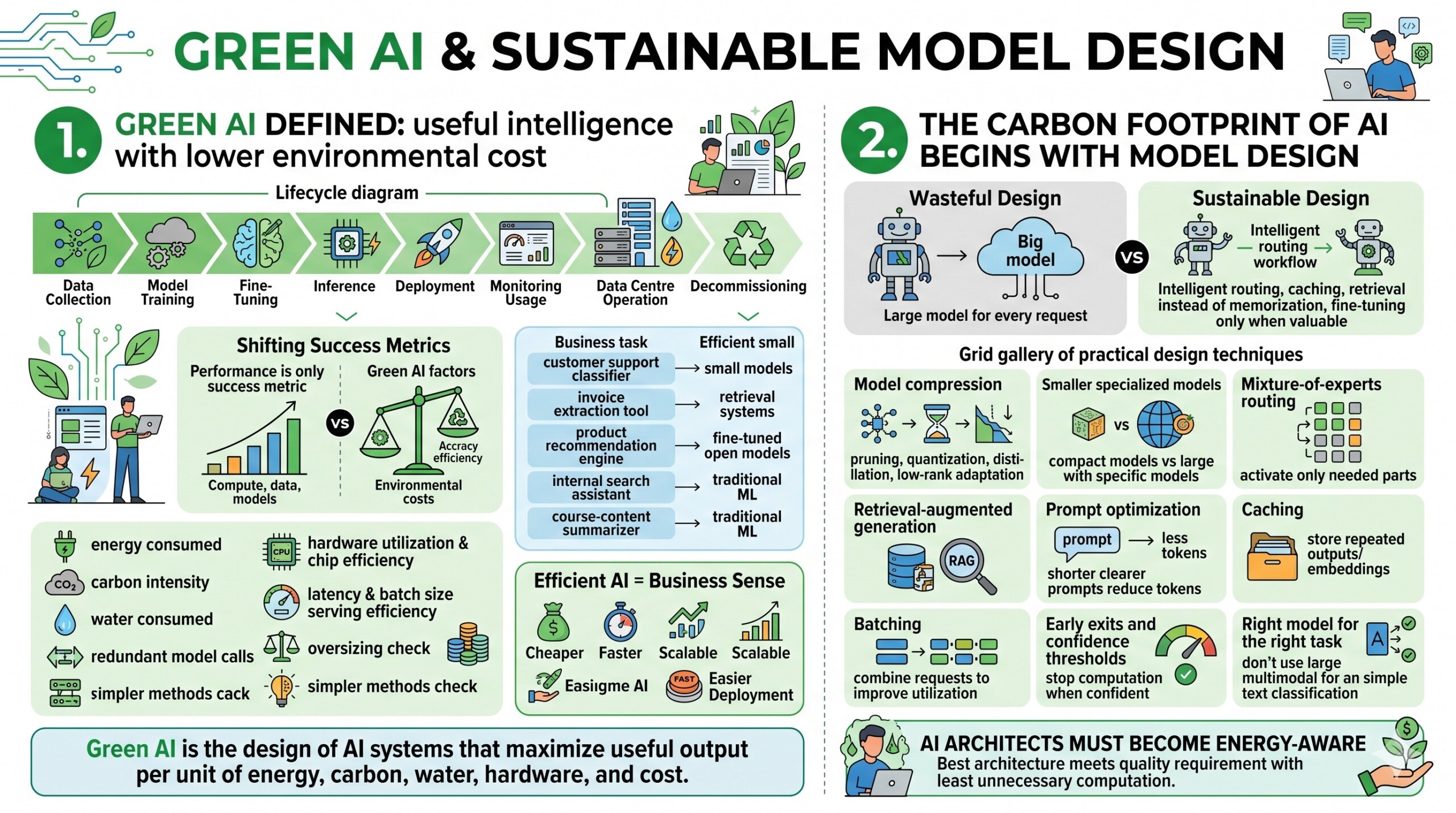
Green AI is about measuring and reducing the environmental cost of AI across the full lifecycle: data collection, model training, fine-tuning, inference, deployment, monitoring, hardware usage, data centre operation, and eventual decommissioning.
In the early phase of deep learning, performance was often treated as the only success metric. Bigger datasets, bigger models, more compute, and more parameters were considered signs of progress. That mindset still matters in frontier research, but it is not always appropriate for real-world deployment.
Most business AI tasks do not require the largest available model. A customer support classifier, invoice extraction tool, product recommendation engine, internal search assistant, or course-content summarizer may work well with a smaller model, a retrieval system, a fine-tuned open model, or even traditional machine learning.
Green AI asks builders to measure more than accuracy. It asks them to consider:
- Energy consumed during training and inference.
- Carbon intensity of the electricity used.
- Water consumed for cooling.
- Hardware utilization and chip efficiency.
- Number of redundant model calls.
- Latency, batch size, and serving efficiency.
- Whether the model is oversized for the task.
- Whether the same outcome can be achieved with simpler methods.
This is not merely environmental idealism. It is business sense. Efficient AI systems are usually cheaper, faster, more scalable, and easier to deploy.
A useful definition is this: Green AI is the design of AI systems that maximize useful output per unit of energy, carbon, water, hardware, and cost.
2. The carbon footprint of AI begins with model design
The carbon footprint of AI is not fixed. It depends heavily on model size, architecture, training method, hardware, location, energy mix, and deployment pattern. The same AI task can have very different emissions depending on how and where it is run.
A wasteful design might use a large frontier model for every request, even when a small classifier or retrieval query would work. A more sustainable design would route tasks intelligently. Simple queries go to smaller models. Complex reasoning goes to larger models. Frequently repeated answers are cached. Retrieval is used instead of forcing the model to memorize everything. Fine-tuning is used only when it creates clear value.
Practical model-design techniques for Green AI include:
- Model compression: Use pruning, quantization, distillation, and low-rank adaptation to reduce compute needs.
- Smaller specialized models: Use compact models trained or fine-tuned for specific tasks instead of one large general model for everything.
- Mixture-of-experts routing: Activate only the parts of a model needed for a task, when the architecture supports it.
- Retrieval-augmented generation: Retrieve relevant information from a database or document store instead of relying on larger model context every time.
- Prompt optimization: Shorter, clearer prompts reduce token usage and inference cost.
- Caching: Store repeated outputs, embeddings, search results, and intermediate computations.
- Batching: Combine requests where possible to improve hardware utilization.
- Early exits and confidence thresholds: Stop computation when the system is already confident enough.
- Right model for the right task: Do not use a large multimodal model for a simple text classification job.
This is where AI architects must become energy-aware. The best architecture is not always the most advanced one. It is the one that meets the quality requirement with the least unnecessary computation. An excellent collection of learning videos awaits you on our Youtube channel.
3. Inference is becoming as important as training
Early discussions about AI sustainability focused mainly on training large models. Training is expensive and energy-intensive, especially for frontier models. But as AI becomes embedded in millions or billions of daily interactions, inference can become the larger long-term cost.
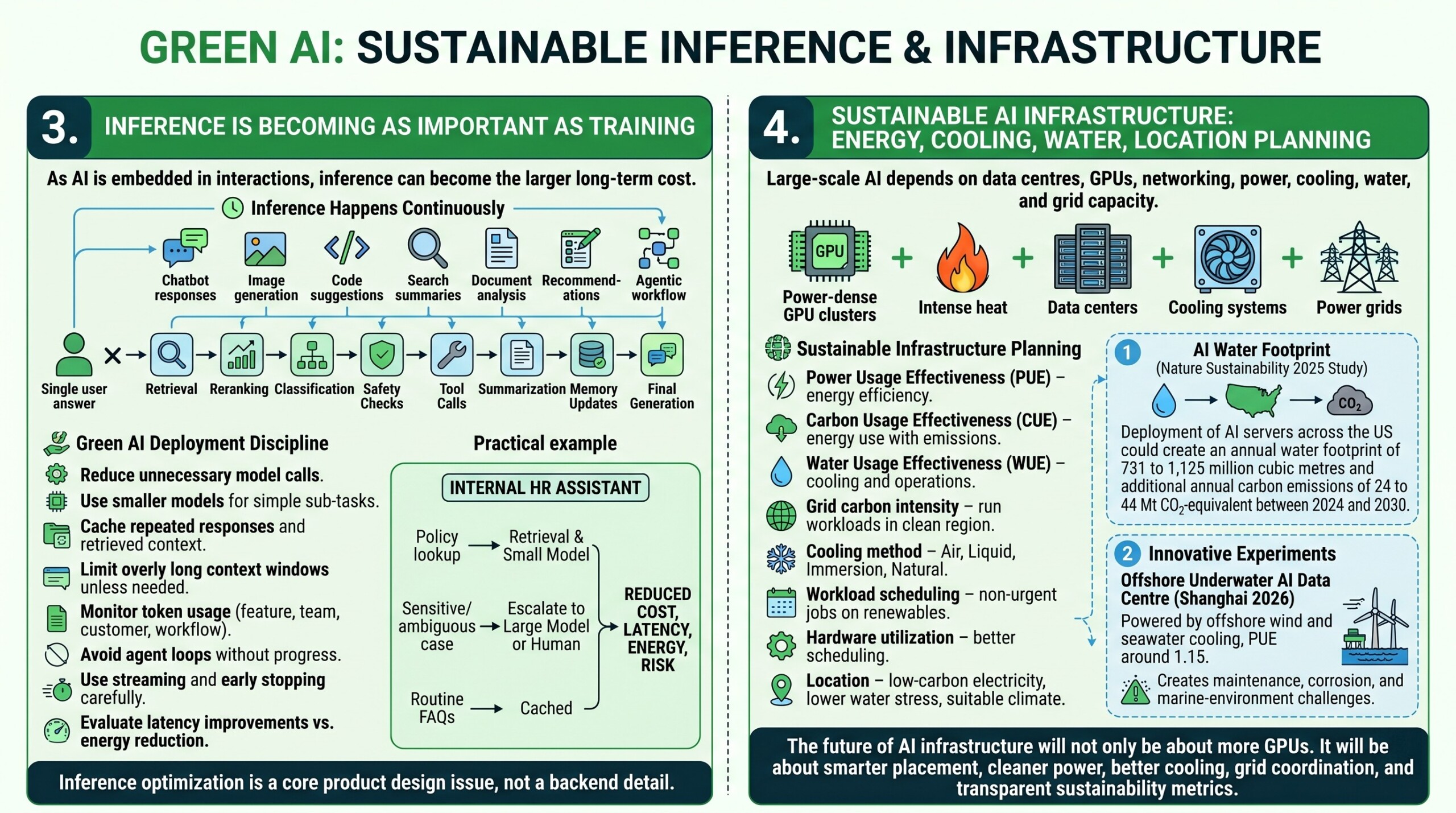
Inference means running the model after it has been trained. Every chatbot response, image generation, code suggestion, search summary, document analysis, recommendation, and agentic workflow step consumes compute. When AI is deployed at scale, inference happens continuously.
This matters because modern AI products often involve many hidden model calls. A single user-facing answer may include retrieval, reranking, classification, safety checks, tool calls, summarization, memory updates, and final generation. Agentic systems can multiply this further because they may plan, call tools, reflect, retry, and verify outputs.
Green AI deployment requires inference discipline:
- Reduce unnecessary model calls.
- Use smaller models for simple sub-tasks.
- Cache repeated responses and retrieved context.
- Limit overly long context windows unless needed.
- Monitor token usage by feature, team, customer, and workflow.
- Avoid agent loops that keep calling tools without progress.
- Use streaming and early stopping carefully.
- Evaluate whether latency improvements also reduce energy use.
A practical example: a company building an internal HR assistant may not need a large model for every query. Policy lookup can use retrieval and a small model. Sensitive or ambiguous cases can escalate to a larger model or a human. Routine FAQs can be cached. This reduces cost, latency, energy use, and risk at the same time.
In sustainable AI, inference optimization is not a backend detail. It is a core product design issue.
4. Sustainable AI infrastructure requires energy, cooling, water, and location planning
Green AI cannot be solved only at the model layer. Large-scale AI depends on data centres, GPUs, networking, power systems, cooling systems, backup power, water availability, and grid capacity.
The infrastructure question is becoming critical because AI workloads are power-dense. GPU clusters produce intense heat and require advanced cooling. Data centres may need large quantities of electricity and, depending on cooling method, significant water. This can create pressure on local grids and communities.
Sustainable infrastructure planning should consider:
- Power Usage Effectiveness: PUE measures how efficiently a data centre uses energy. A lower PUE means less overhead beyond IT equipment.
- Carbon Usage Effectiveness: CUE connects data centre energy use with emissions.
- Water Usage Effectiveness: WUE measures water used for cooling and facility operations.
- Grid carbon intensity: Running workloads in a region with cleaner electricity can reduce emissions.
- Cooling method: Air cooling, liquid cooling, immersion cooling, and natural cooling have different trade-offs.
- Workload scheduling: Non-urgent jobs can run when renewable energy availability is higher or grid carbon intensity is lower.
- Hardware utilization: Idle GPUs still consume power. Better scheduling improves sustainability and economics.
- Location: Regions with low-carbon electricity, lower water stress, and suitable climate can reduce environmental impact.
Research and reporting increasingly highlight water as a serious AI infrastructure issue. A 2025 Nature Sustainability study estimated that deployment of AI servers across the United States could create an annual water footprint of 731 to 1,125 million cubic metres and additional annual carbon emissions of 24 to 44 Mt CO₂-equivalent between 2024 and 2030, depending on expansion scale.
New infrastructure experiments are also emerging. Reports in 2026 described an offshore underwater AI data centre near Shanghai, powered by offshore wind and cooled using seawater, with a reported PUE of around 1.15. Such projects are not a universal solution because they create maintenance, corrosion, and marine-environment challenges, but they show that AI infrastructure design is becoming more innovative.
The future of AI infrastructure will not only be about more GPUs. It will be about smarter placement, cleaner power, better cooling, grid coordination, and transparent sustainability metrics. A constantly updated Whatsapp channel awaits your participation.
5. Energy optimization itself is a major AI opportunity
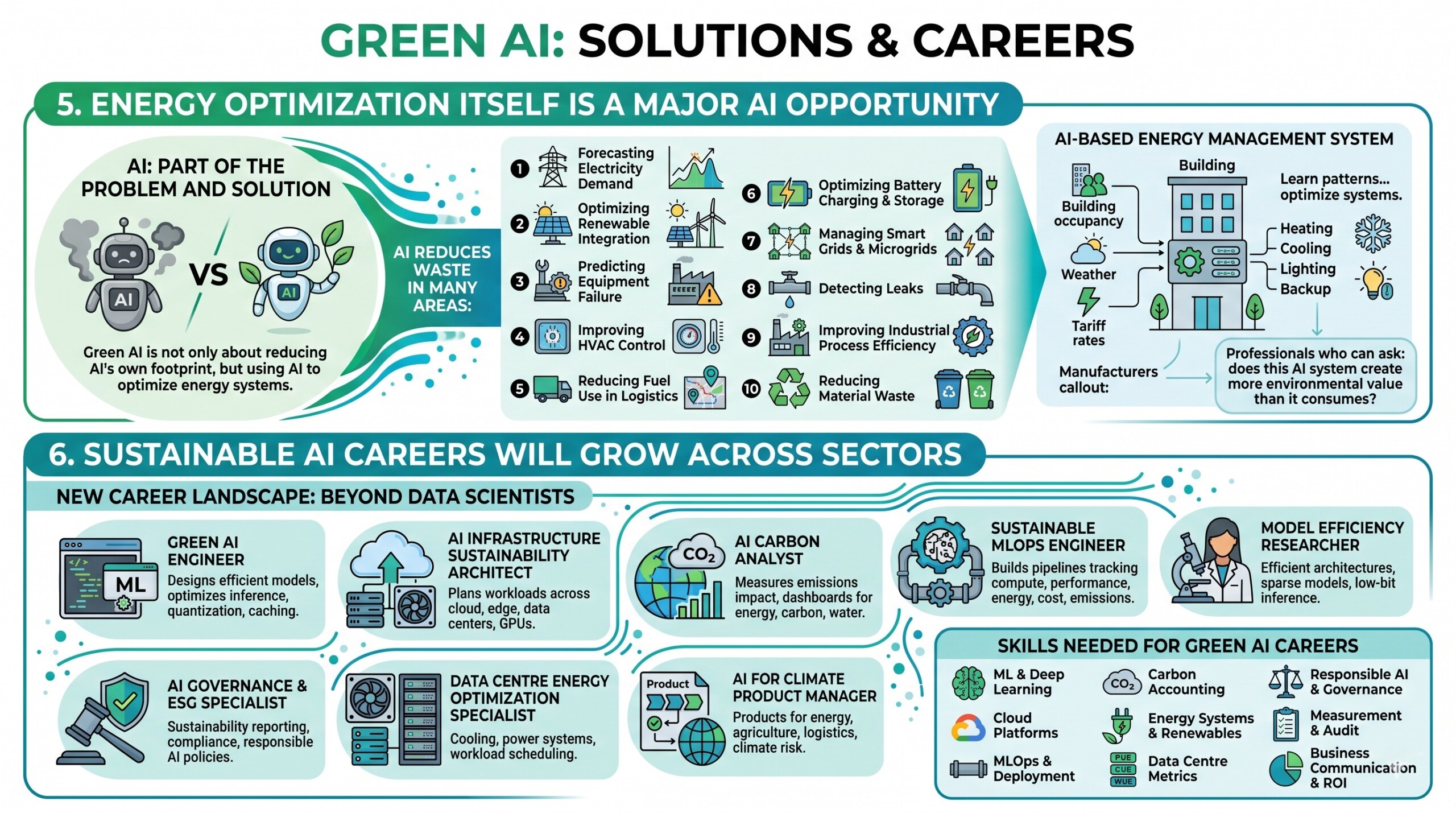
AI is part of the energy problem, but it can also be part of the solution. Green AI is not only about reducing AI’s own footprint. It is also about using AI to optimize energy systems, buildings, factories, logistics, transport, agriculture, and grids.
AI can help reduce waste in many areas:
- Forecasting electricity demand.
- Optimizing renewable energy integration.
- Predicting equipment failure in power plants and factories.
- Improving HVAC control in buildings.
- Reducing fuel use in logistics routes.
- Optimizing battery charging and storage.
- Managing smart grids and microgrids.
- Detecting leaks in water and gas systems.
- Improving industrial process efficiency.
- Reducing material waste in manufacturing.
For example, AI-based energy management systems can learn patterns of building occupancy, weather, equipment load, and tariff rates. They can then optimize heating, cooling, lighting, and backup systems. In manufacturing, AI can monitor energy-intensive processes and identify waste that human operators may miss.
This creates an important distinction. Wasteful AI is a problem. Sustainable AI applied to energy optimization is a solution. The goal is not to slow down AI adoption, but to deploy it where the net environmental and economic benefit is clear.
This is where careers will grow. Organizations will need people who understand both AI and energy systems. They will need professionals who can ask: does this AI system create more environmental value than it consumes?

6. Sustainable AI careers will grow across technology, infrastructure, policy, and business
Green AI will create a new career landscape. It will not be limited to data scientists. It will involve AI engineers, cloud architects, sustainability analysts, energy consultants, data centre planners, policy experts, ESG professionals, product managers, and auditors.
Important career paths include:
- Green AI Engineer: Designs efficient models, optimizes inference, uses quantization, caching, distillation, and efficient deployment.
- AI Infrastructure Sustainability Architect: Plans AI workloads across cloud, edge, data centres, GPUs, energy sources, and cooling systems.
- AI Carbon Analyst: Measures the emissions impact of AI systems and creates dashboards for energy, carbon, and water.
- Sustainable MLOps Engineer: Builds pipelines that track compute, model performance, energy use, cost, and emissions.
- AI Governance and ESG Specialist: Connects AI deployment with sustainability reporting, regulatory compliance, and responsible AI policies.
- Data Centre Energy Optimization Specialist: Works on cooling, power systems, workload scheduling, and energy efficiency.
- AI for Climate Product Manager: Builds AI products for energy, agriculture, logistics, climate risk, or environmental monitoring.
- Model Efficiency Researcher: Works on efficient architectures, sparse models, low-bit inference, hardware-aware training, and energy-aware benchmarking.
Skills needed for these careers include:
- Machine learning and deep learning fundamentals.
- Cloud platforms such as AWS, Azure, and Google Cloud.
- MLOps and model deployment.
- Model compression and inference optimization.
- Carbon accounting basics.
- Data centre metrics such as PUE, CUE, and WUE.
- Energy systems and renewable energy basics.
- Responsible AI and AI governance.
- Measurement, reporting, and audit practices.
- Business communication for sustainability ROI.
For students and professionals, this is a strong interdisciplinary opportunity. A person who understands AI and sustainability will be valuable because companies must now manage both innovation and environmental responsibility. Excellent individualised mentoring programmes available.
7. Green AI needs measurement, governance, and honest trade-off decisions
Green AI cannot rely on slogans. It needs measurement. Organizations should track the environmental impact of AI systems in the same way they track cost, uptime, accuracy, latency, and security.
A practical Green AI governance system should answer:
- Which models are used for which tasks?
- How much energy does each workload consume?
- What is the carbon intensity of the electricity used?
- How much water is used by the infrastructure?
- How much GPU time is idle or wasted?
- Which features create the most inference cost?
- Which AI tasks have clear business or social value?
- Which tasks are over-engineered?
- Which model calls can be cached, reduced, or replaced?
- What sustainability thresholds should trigger review?
This is especially important because sustainability can involve trade-offs. A model may be more accurate but much more expensive to run. A data centre may use less electricity for cooling but more water. A region may have cheap electricity but a high-carbon grid. A smaller model may be greener but less reliable for high-stakes work.
Good governance does not pretend these trade-offs disappear. It makes them visible and manageable.
Organizations should create AI sustainability scorecards that include:
- Model quality.
- Latency.
- Cost per task.
- Energy per task.
- Estimated carbon per task.
- Water impact where available.
- Hardware utilization.
- Business value.
- Risk level.
- Human review requirement.
This type of scorecard helps leaders move beyond the simplistic question: “Can we use AI here?” The better question is: “Can we use AI here efficiently, responsibly, and with measurable value?” Subscribe to our free AI newsletter now.
Conclusion
Green AI is becoming one of the most important themes in the next phase of artificial intelligence. As AI systems scale from experiments to everyday infrastructure, their environmental footprint will matter more. Electricity demand, water use, cooling needs, hardware pressure, and carbon emissions are now part of AI system design.
The practical path forward is not to reject AI. It is to build better AI. Use smaller models where possible. Route tasks intelligently. Optimize inference. Cache repeated work. Measure energy and emissions. Choose infrastructure carefully. Use cleaner power. Reduce water stress. Build governance systems that make sustainability visible.
At the same time, AI can help solve sustainability problems across buildings, grids, factories, transport, agriculture, and climate-risk planning. This dual role makes Green AI both a responsibility and an opportunity.
The future will belong to AI professionals who can combine intelligence with efficiency. Sustainable AI careers will grow because every serious organization will need people who understand how to build powerful AI systems without wasting energy, money, water, and trust.
Green AI is not a side topic. It is the discipline of making AI useful at scale without making it careless at scale. Upgrade your AI-readiness with our masterclass.