Guardrails, Policy Engines, and Safe AI Deployment
Guardrails, Policy Engines, and Safe AI Deployment
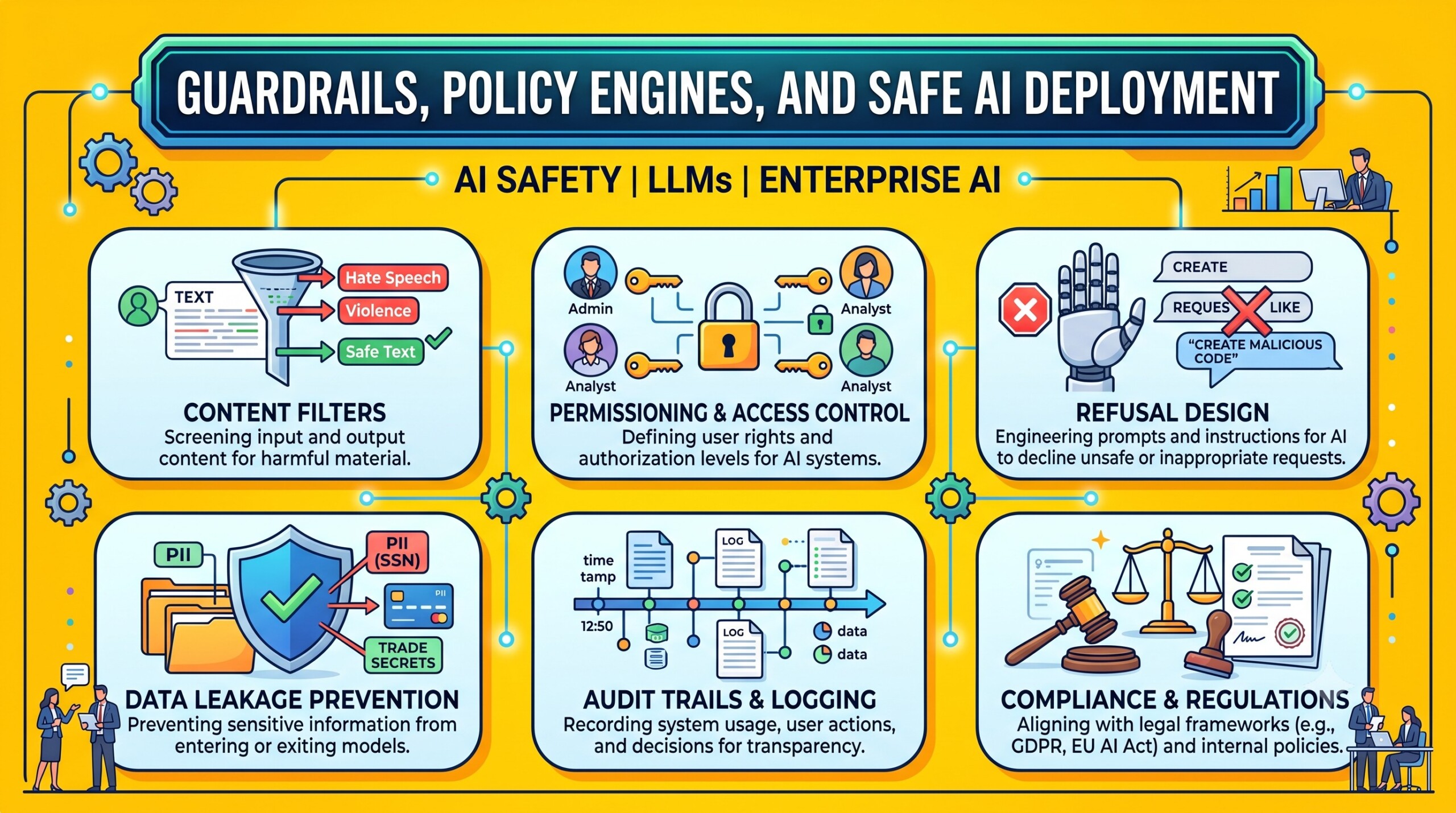
AI Safety, LLMs, Enterprise AI; Content filters, permissioning, refusal design, data leakage prevention, audit trails, and compliance.
Introduction
The first phase of enterprise generative AI focused on capability. Organizations wanted to know whether large language models could write reports, summarize documents, answer customer questions, generate code, analyse data, search corporate knowledge, and automate work. The next phase is increasingly about control.
As AI systems move from isolated chatbots into production environments connected to databases, email, customer records, financial systems, source code, enterprise applications, and external tools, mistakes can have much larger consequences. A hallucinated paragraph is inconvenient. An AI agent that can disclose confidential information, alter a database, send an email, execute code, or initiate a transaction introduces an entirely different level of risk.
Modern AI safety therefore cannot depend only on model alignment or content moderation. Safe deployment requires guardrails, identity controls, permissioning, policy enforcement, data protection, monitoring, human oversight, auditability, testing, and governance. NIST’s Generative AI Profile, ISO/IEC 42001, ISO/IEC 42005:2025, the OWASP GenAI LLM Top 10 2026, and the European Union’s AI Act all reflect this broader systems approach to AI risk.
The enterprise question is no longer simply, “Can the AI do this?” It is increasingly, “Should it be allowed to do this, with which data, under whose authority, using which tools, and with what oversight?”
Let’s dive deep into the topic now.
1. Guardrails must surround the model
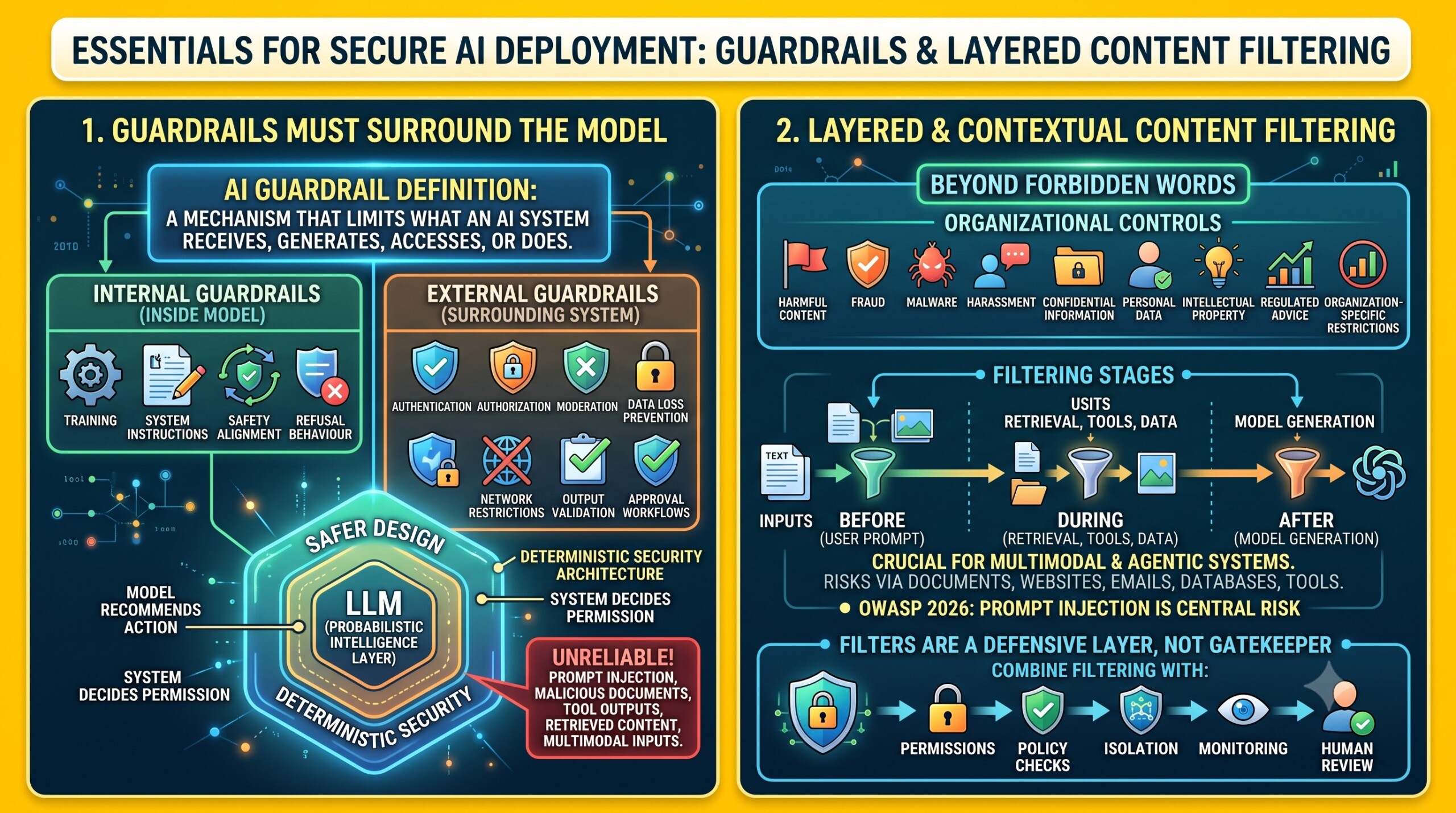
An AI guardrail is any mechanism that limits what an AI system can receive, generate, access, or do. Some guardrails operate inside the model through training, system instructions, safety alignment, and refusal behaviour. Others operate outside it through authentication, authorization, moderation, data loss prevention, network restrictions, output validation, and approval workflows.
Enterprise systems need both. A system prompt saying, “Never reveal confidential information,” is useful, but it is not a reliable security boundary. Prompt injection, malicious documents, tool outputs, retrieved content, multimodal inputs, and other adversarial techniques can influence model behaviour. The safer design assumes that the LLM is a probabilistic intelligence layer operating inside a more deterministic security architecture. The model may recommend an action, but the surrounding system decides whether that action is permitted.
2. Content filtering must become layered and contextual
Content filtering remains important, but enterprise filtering must go beyond lists of forbidden words. Organizations may need controls for harmful content, fraud, malware, harassment, confidential information, personal data, intellectual property, regulated advice, and organization-specific restrictions.
Filtering can occur before the model receives a prompt, while the system retrieves data or invokes tools, and after the model generates an answer. This becomes even more important for multimodal and agentic systems because malicious instructions may arrive through documents, websites, images, email, databases, or tool responses. OWASP’s 2026 guidance continues to treat prompt injection as a central LLM security risk.
Filters should therefore be treated as one defensive layer rather than an infallible gatekeeper. Safe deployment depends on combining filtering with permissions, policy checks, isolation, monitoring, and human review where appropriate.
3. Permissioning is one of the most important AI controls
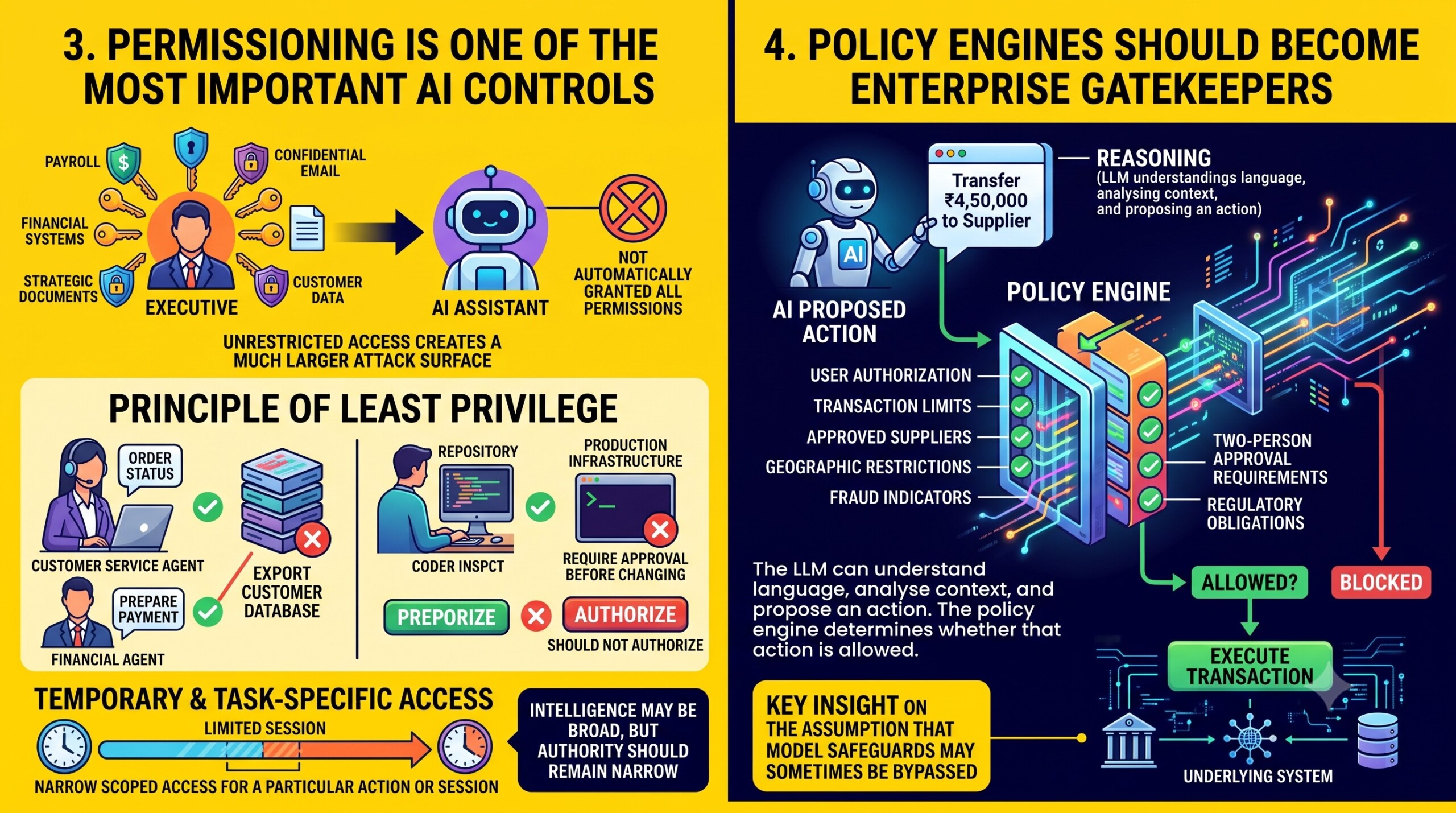
An AI assistant should not automatically receive every permission available to the employee using it. If an executive can access payroll, confidential email, financial systems, strategic documents, and customer data, giving an AI agent unrestricted access to all of those systems creates a much larger attack surface.
Enterprise AI should follow the principle of least privilege. A customer-service assistant may be allowed to read the status of one customer’s order but not export the customer database. A coding assistant may inspect a repository but require approval before changing production infrastructure. A financial agent may prepare a payment but should not necessarily be able to authorize it.
Permissions can also be temporary and task-specific. Instead of giving an agent permanent credentials, organizations can grant narrowly scoped access for a particular action or session. In safe agentic AI, intelligence may be broad, but authority should remain narrow.
4. Policy engines should become enterprise gatekeepers
A policy engine is a deterministic layer that evaluates whether an action proposed by an AI system should actually occur. Suppose an AI agent proposes transferring ₹4,50,000 to a supplier. The organization should not rely on the language model itself to determine whether the payment is permitted.
The request should be checked against rules such as user authorization, transaction limits, approved suppliers, geographic restrictions, fraud indicators, two-person approval requirements, and regulatory obligations. Only after those checks succeed should the underlying system execute the transaction.
This creates an important separation between reasoning and authority. The LLM can understand language, analyse context, and propose an action. The policy engine determines whether that action is allowed. This becomes especially important because current security guidance recommends designing systems on the assumption that model safeguards may sometimes be bypassed.


5. Refusal design should be intelligent
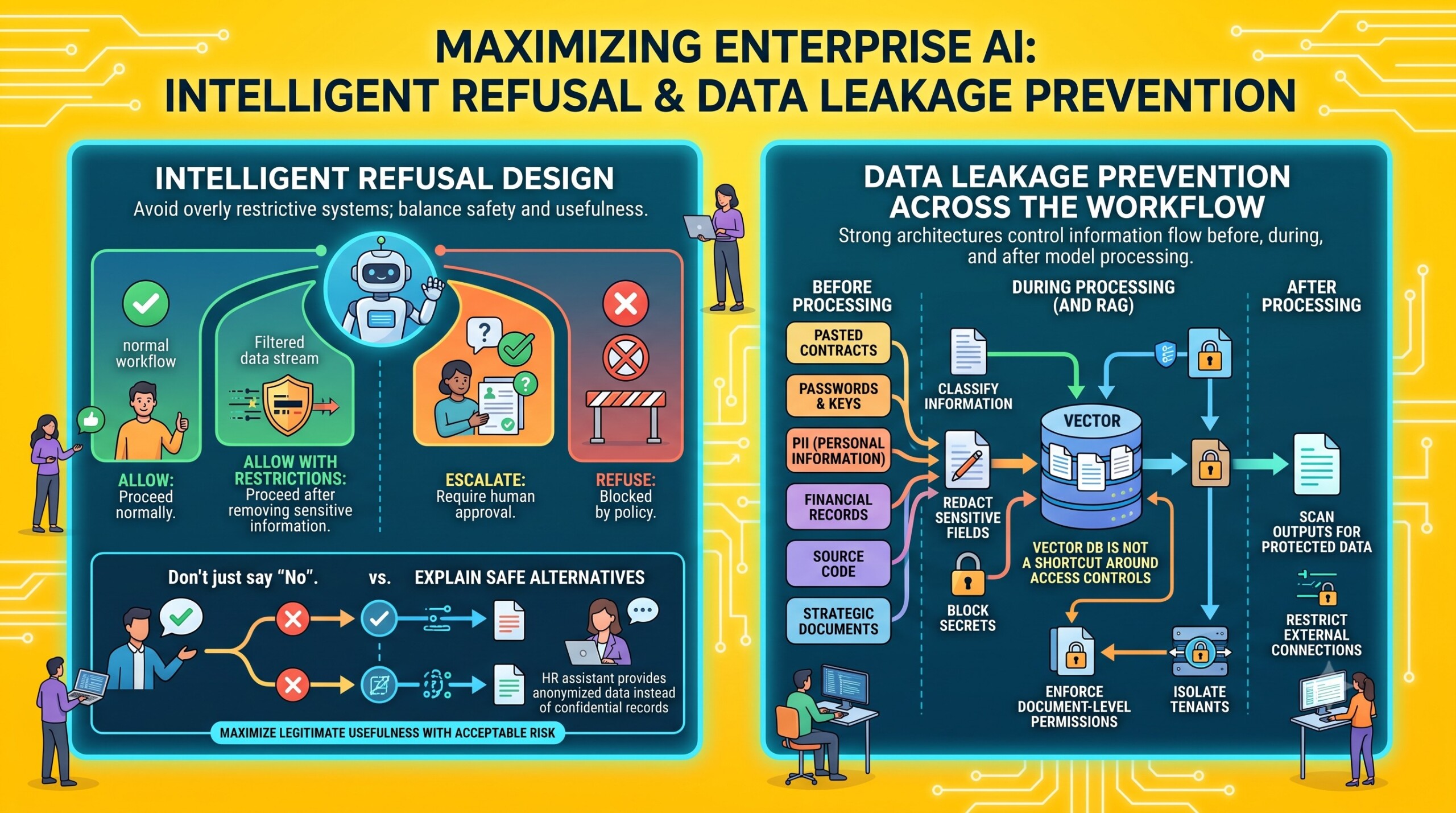
Safe AI must sometimes say no, but poor refusal design can make enterprise AI unnecessarily restrictive. A useful system should distinguish between different levels of risk rather than blocking everything uncertain.
A practical model is to support four outcomes: allow, allow with restrictions, escalate, or refuse. A task may proceed normally, proceed after sensitive information is removed, require human approval, or be blocked because it violates policy. Good refusal design should also explain what can safely be done instead.
For example, rather than simply refusing access to confidential employee records, an HR assistant might provide anonymized or aggregated information that meets privacy requirements. The objective is not maximum refusal. It is maximum legitimate usefulness within acceptable risk.
6. Data leakage prevention must cover the entire workflow
Sensitive information disclosure is one of the most serious enterprise AI risks. Employees may paste contracts, passwords, API keys, personal information, financial records, source code, or strategic documents into AI systems. Retrieval systems can also expose documents to users who should never have been able to access them.
Strong architectures therefore need controls before, during, and after model processing. Organizations can classify information, redact sensitive fields, block secrets, enforce document-level permissions, isolate tenants, restrict external connections, and scan outputs for protected data.
Retrieval-augmented generation requires particular care. A vector database should not become a shortcut around existing access controls. If an employee cannot normally open a confidential document, asking an AI assistant about that document should not reveal its contents. AI should never become a new route around existing information-security boundaries.
7. Prompt injection changes the security model
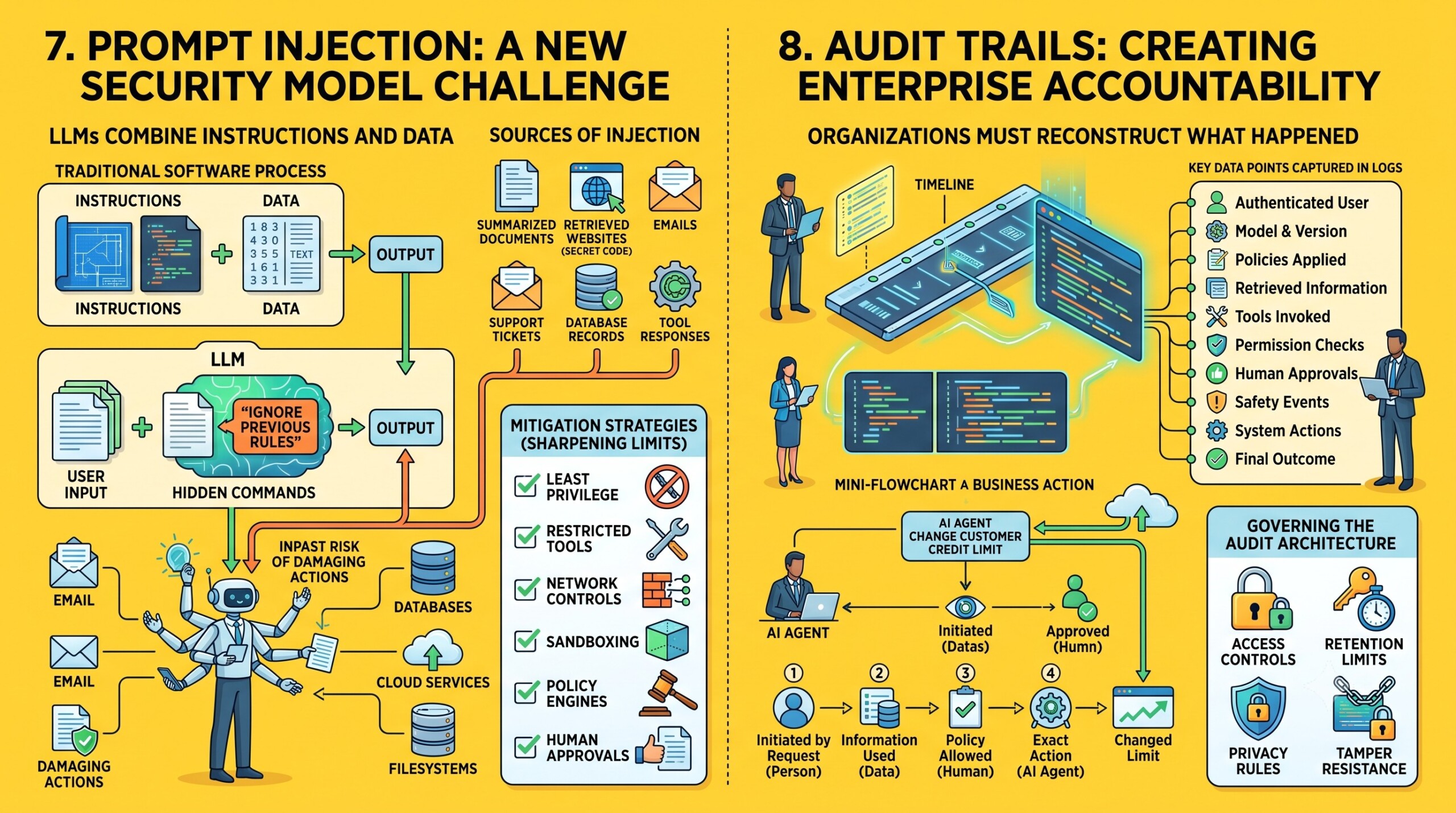
Traditional software usually separates instructions from data clearly. LLMs do not. A document being summarized may contain instructions telling the model to ignore earlier rules. A website retrieved by an agent may contain hidden commands. An email, support ticket, database record, or tool response may attempt to manipulate the model.
This is particularly dangerous when an AI system has access to untrusted information, sensitive information, and external tools at the same time. A manipulated chatbot may produce a poor answer. A manipulated agent with access to email, databases, cloud services, and files could potentially perform damaging actions.
Safe architecture should therefore assume that malicious instructions may eventually reach the model. The more important question is what the model can do if that happens. Least privilege, restricted tools, network controls, sandboxing, policy engines, and human approvals can sharply reduce the potential impact.
8. Audit trails create accountability
Organizations cannot govern AI systems if they cannot reconstruct what happened. Enterprise AI therefore needs meaningful audit trails. Depending on the use case, logs may capture the authenticated user, model and version, relevant policies, retrieved information, tools invoked, permission checks, human approvals, safety events, system actions, and final outcome.
This becomes particularly important when AI changes business systems. If an AI agent changes a customer’s credit limit, an auditor may later need to know who initiated the request, what information was used, which policy allowed the change, whether a person approved it, and exactly what action occurred.
Logging must also be governed carefully because logs themselves can contain confidential information. Access controls, encryption, retention limits, privacy rules, and tamper resistance are therefore part of the audit architecture. Auditability turns an opaque AI interaction into an accountable enterprise process.
9. High-impact actions require meaningful human oversight
“Human in the loop” is useful only when the human actually understands what is being approved. A simple approval button does not automatically create meaningful oversight.
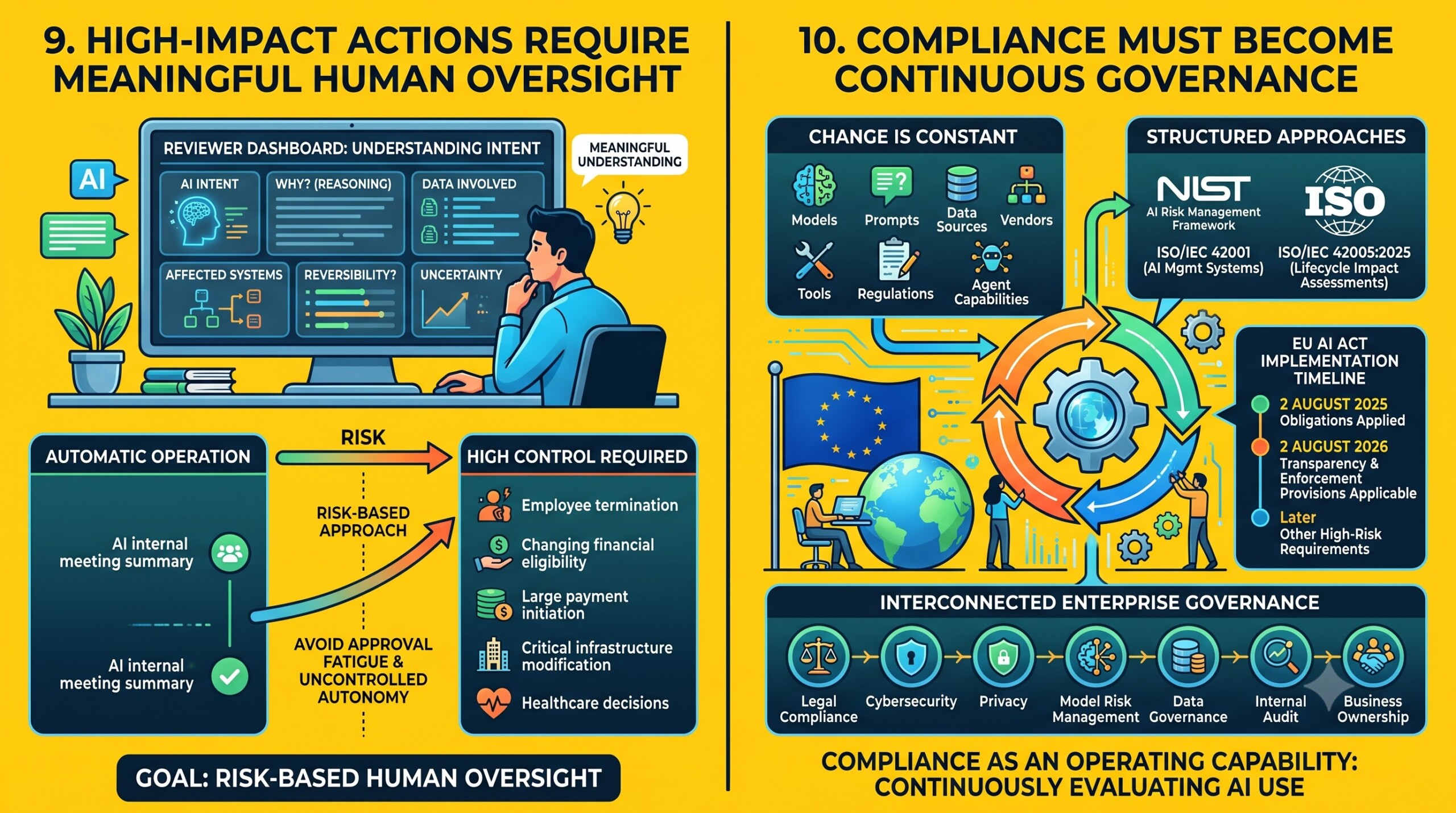
For consequential actions, reviewers should be able to see what the AI intends to do, why it recommends the action, what data is involved, what external systems will be affected, whether the action can be reversed, and where uncertainty remains. The required level of oversight should depend on risk.
An AI assistant preparing an internal meeting summary may operate automatically. A system recommending employee termination, altering a person’s financial eligibility, initiating a large payment, modifying critical infrastructure, or influencing healthcare decisions requires much stronger control. Too much approval creates fatigue, but too little creates uncontrolled autonomy. The goal is risk-based human oversight.
10. Compliance must become continuous governance
AI compliance can no longer be treated as a one-time policy exercise. Models change, prompts change, data sources change, vendors change, tools are added, regulations evolve, and agents acquire new capabilities.
NIST’s AI Risk Management Framework and its Generative AI Profile provide structured approaches to identifying and managing AI risks. ISO/IEC 42001 provides requirements for organizational AI management systems, while ISO/IEC 42005:2025 focuses on AI impact assessments across the lifecycle.
The European regulatory environment is also becoming operational. General-purpose AI obligations under the EU AI Act have applied since 2 August 2025. Important transparency and enforcement provisions became applicable from 2 August 2026, while additional requirements for certain high-risk systems follow later implementation dates. Enterprises operating internationally therefore need AI governance that connects legal compliance with cybersecurity, privacy, model risk management, data governance, internal audit, and business ownership.
Compliance should be treated as an operating capability that continuously evaluates how AI is being developed, connected, modified, and used.
Conclusion
The future of enterprise AI will not depend only on who has the most capable model. It will also depend on who can use powerful models without losing control of data, permissions, decisions, and accountability.
The strongest architecture treats an LLM as an intelligent but probabilistic component inside a governed system. The model can interpret language, analyse information, generate recommendations, and propose actions. Deterministic systems should control permissions, enforce policies, protect sensitive data, validate actions, and preserve evidence.
The model provides intelligence. Guardrails constrain behaviour. Identity establishes who is asking. Permissioning determines what can be accessed. Policy engines determine what can be done. Data controls determine what may enter or leave. Human oversight governs consequential actions. Audit trails create accountability. Compliance frameworks ensure that the whole system remains governable.
This becomes even more important as enterprises move from generative AI to agentic AI. A chatbot mainly produces information. An agent can increasingly act on the world by searching databases, sending messages, executing code, invoking APIs, and modifying business systems. At that point, AI safety becomes a question of controlling digital authority.
Give AI enough intelligence to be useful, enough access to perform the task, but never more authority than the task actually requires.