Prompt Engineering to Context Engineering
Prompt Engineering to Context Engineering
Moving beyond prompts into context design, memory, tools, retrieval, guardrails, and workflow architecture.
Introduction
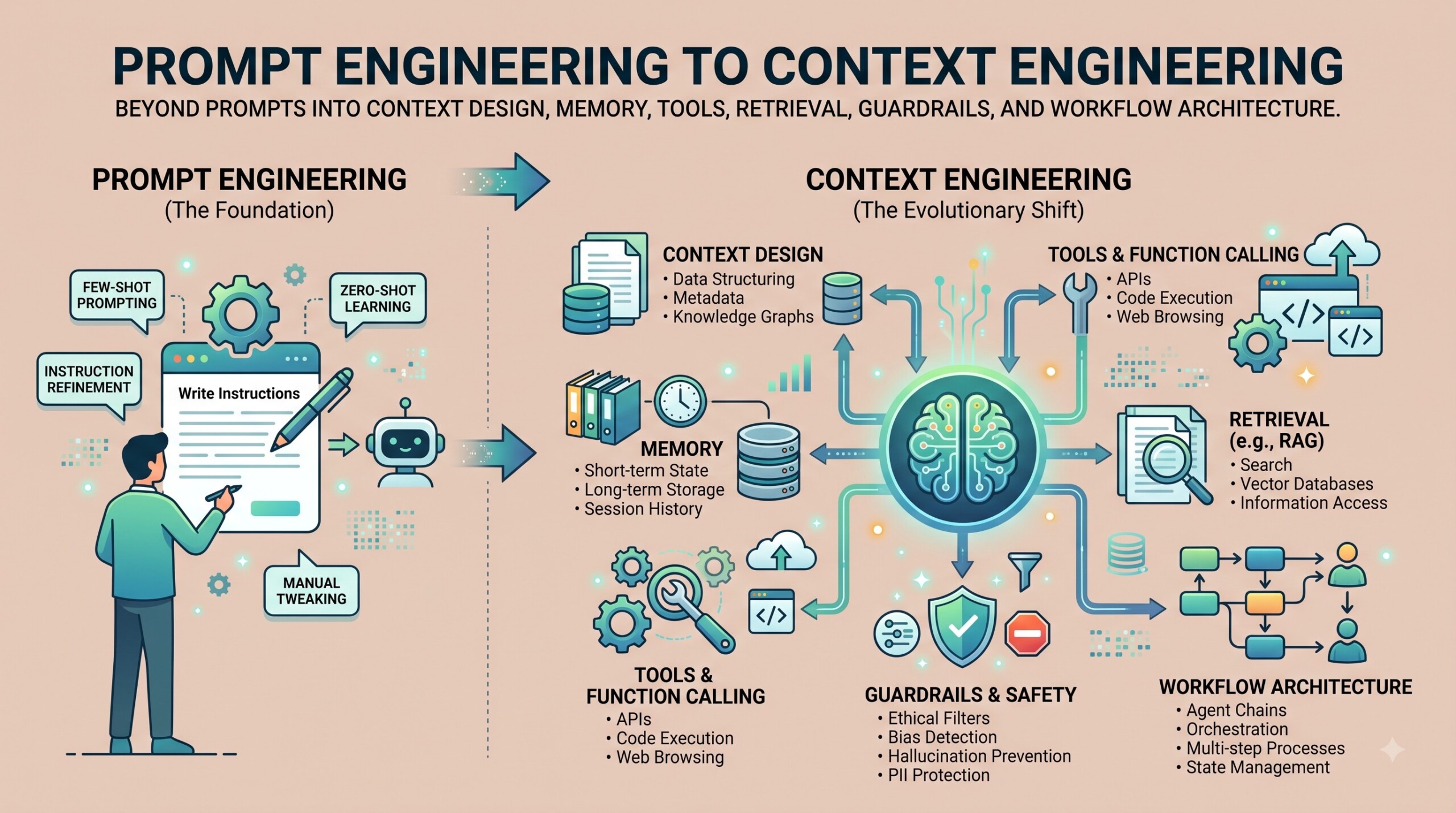
For the first phase of generative AI adoption, much of the attention went to prompt engineering: how to phrase a request, assign a role, provide examples, specify an output format, break a problem into steps, or ask a large language model to reason more carefully. Those skills still matter. A vague instruction can still produce a vague answer, while a well-structured instruction can materially improve results. But the centre of gravity has moved. As AI systems have evolved from chat interfaces into agents that search, retrieve documents, remember prior interactions, call software tools, execute code, collaborate with other agents, and operate across long-running workflows, the prompt has become only one component of a much larger system. Anthropic now explicitly describes effective agent design in terms of context engineering, while Google describes context as a first-class system with its own architecture, lifecycle and constraints. Modern agent frameworks from OpenAI similarly expose sessions, tools, handoffs, guardrails, tracing and persistent state as distinct building blocks.
This is the essential transition from prompt engineering to context engineering. Instead of asking only, “What should I tell the model?”, we now ask a larger set of questions: What information should the model see at this moment? What should it remember? What should it retrieve? Which tools should it be allowed to call? Which previous events should be compressed or discarded? What permissions should accompany each tool? When should another agent take over? When should a human approve an action? How do we know whether the system behaved correctly? In other words, context engineering is not a cleverer way of writing prompts. It is the discipline of designing the information, state, capabilities, constraints and workflow surrounding the model so that the right intelligence is available at the right time.
Let’s dive deep into the topic now.
1. The prompt is becoming one layer of the system
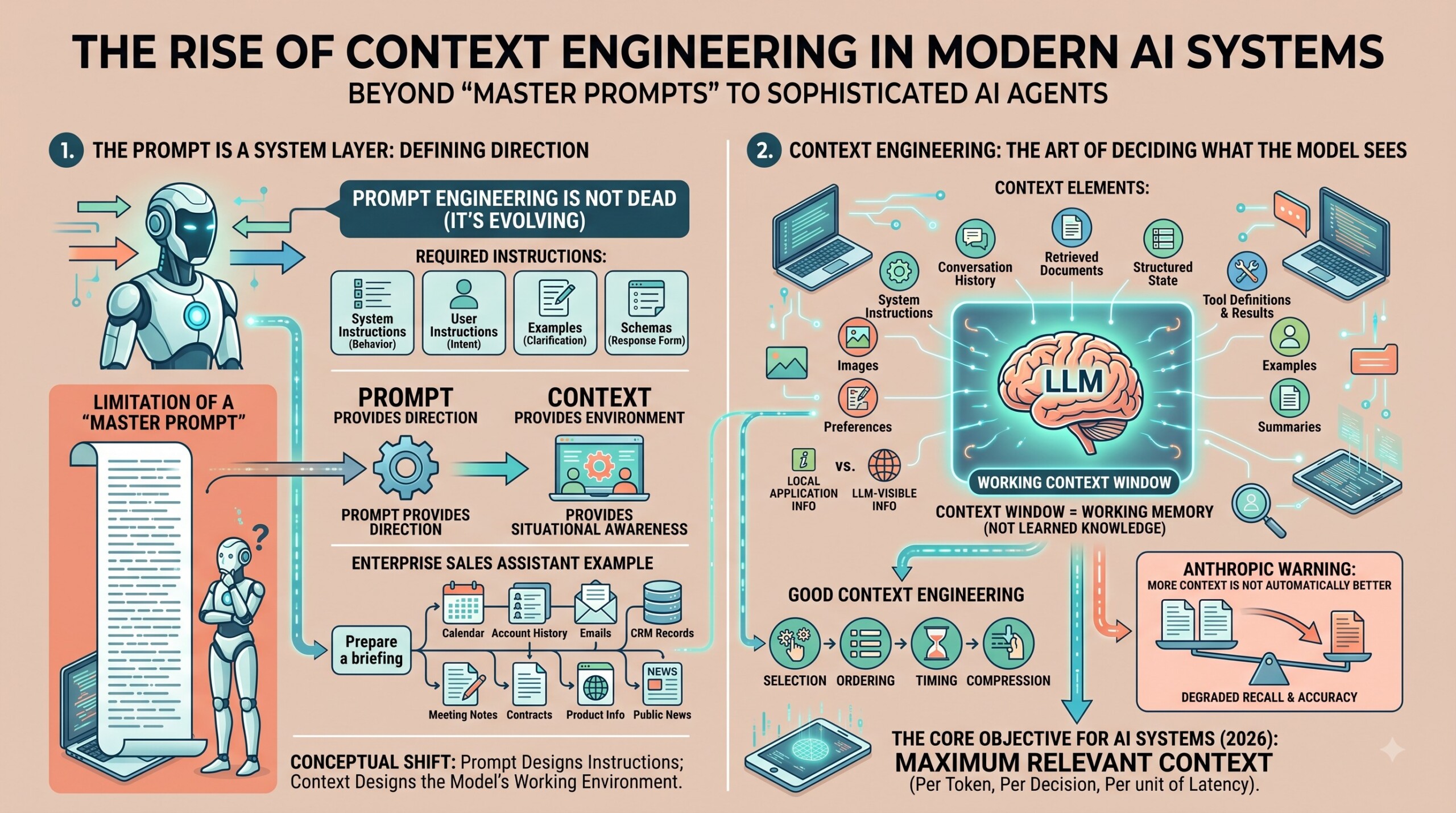
Prompt engineering is not disappearing. Claims that “prompt engineering is dead” are misleading because every serious AI application still requires instructions. System instructions establish behaviour, user instructions express intent, examples clarify ambiguous requirements, and schemas specify the form of an expected response. What has changed is the relative importance of the prompt. A sophisticated agent cannot be made reliable simply by writing a 5,000-word master prompt. If the agent receives the wrong documents, outdated customer information, inappropriate tools or corrupted memory, beautifully written instructions will not rescue it.
A useful way to think about modern AI architecture is that the prompt provides direction, while context provides situational awareness. Consider an enterprise sales assistant. The instruction might say, “Prepare a briefing for tomorrow’s meeting.” But producing a useful briefing may require calendar information, the customer’s account history, recent emails, CRM records, earlier meeting notes, relevant contracts, current product information and perhaps fresh public news. The quality of the answer therefore depends less on adding adjectives such as “comprehensive” or “professional” to the prompt and more on assembling the correct evidence around the task. That is the fundamental conceptual shift: prompt engineering designs instructions; context engineering designs the model’s working environment.
2. Context engineering is the art of deciding what the model sees
An LLM does not automatically know everything available to an organisation, application or user. At inference time it operates on the information made available inside its working context. That context can include system instructions, conversation history, retrieved documents, structured application state, tool definitions, tool results, images, user preferences, examples and summaries of previous work. OpenAI’s Agents SDK documentation makes an important distinction between information held locally by the application and information actually made visible to the LLM. Anthropic similarly describes the context window as the model’s working memory rather than its entire learned knowledge.
Good context engineering therefore involves selection, ordering, timing and compression. The challenge is not merely to put more information into the context window. Anthropic warns that more context is not automatically better and describes degradation in recall and accuracy as contexts become unnecessarily large. The system designer must decide what deserves to remain verbatim, what can be summarised, what should be fetched only when needed and what should never enter the model’s context at all. This leads to one of the most important principles for AI systems in 2026: the objective is not maximum context; it is maximum relevant context per token, per decision and per unit of latency. An excellent collection of learning videos awaits you on our Youtube channel.
3. Memory turns one-off conversations into continuing relationships
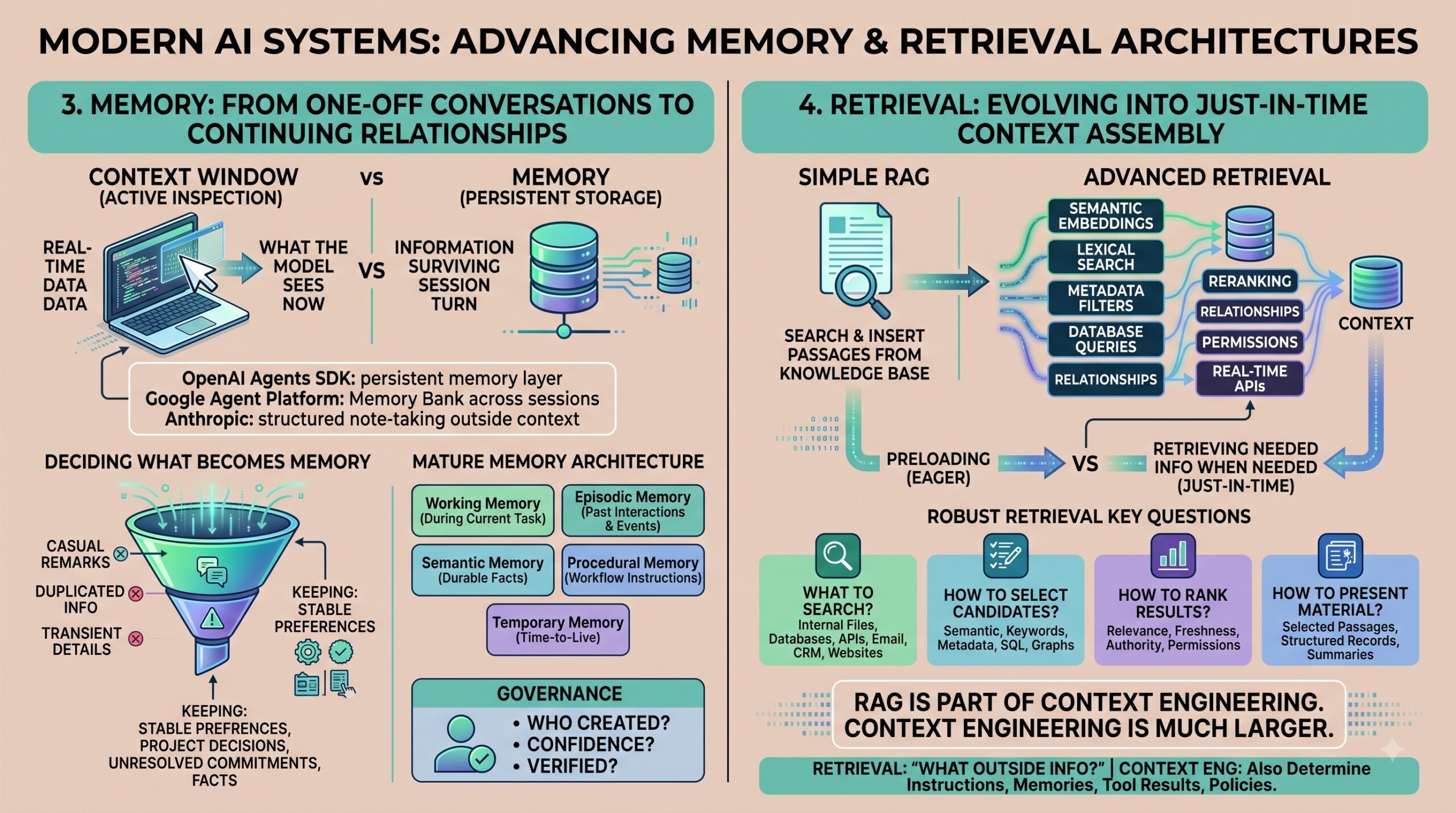
Context and memory should not be treated as synonyms. The context window is what the model can currently inspect. Memory is information that survives beyond the immediate turn or session and can later be selected for reintroduction into context. Modern frameworks increasingly formalise this distinction. OpenAI’s Agents SDK describes sessions as a persistent memory layer for maintaining working context, while Google’s Agent Platform Memory Bank provides persistent memories across multiple sessions. Anthropic’s context-engineering guidance discusses structured note-taking in which important information is written outside the active context and retrieved later when relevant.
The difficult part is not storing everything; it is deciding what deserves to become memory. A useful memory system may retain stable user preferences, project decisions, unresolved commitments, previously verified facts or important corrections while ignoring casual remarks, duplicated information and transient details.
A mature memory architecture can therefore distinguish between:
- Working memory: information needed during the current task or conversation.
- Episodic memory: records or summaries of previous interactions, events and decisions.
- Semantic memory: durable facts about users, organisations, products or projects.
- Procedural memory: learned instructions, conventions or recurring ways of completing tasks.
- Temporary memory: information with a defined expiry period or time-to-live.
Memory must also have governance. Designers should ask who created a memory, how confident the system is in it, when it was last verified, who may access it and when it should expire.
Kawal – add turbocharger promo here – link it to site
(add that strip image that you have at bottom here also)
Bottom wala bhi rahne dena delete mat karna
4. Retrieval is evolving from simple RAG into just-in-time context assembly
Retrieval-augmented generation, or RAG, was an early form of context engineering. Instead of relying exclusively on what a model learned during training, a system searches an external knowledge source and inserts relevant passages into the prompt. But modern retrieval architectures are becoming considerably more sophisticated. Effective systems may combine semantic embeddings, lexical search, metadata filters, structured database queries, reranking, document relationships, access permissions and real-time APIs.
The crucial change is from preloading everything to retrieving what is needed when it is needed. Anthropic describes just-in-time retrieval as an important component of context engineering, while
A robust retrieval layer should address at least four questions:
- What should be searched? Internal files, databases, APIs, email, CRM systems, websites or specialist knowledge bases.
- How should candidates be selected? Semantic search, keywords, metadata, SQL, graph relationships or combinations of these.
- How should results be ranked? Relevance, freshness, authority, permissions and task-specific importance should all matter.
- How should retrieved material be presented? Raw documents are often inferior to carefully selected passages, structured records or concise summaries.
The implication is important: RAG is part of context engineering, but context engineering is much larger than RAG. Retrieval answers the question “What outside information should we bring in?” Context engineering additionally determines what instructions, memories, tool results, policies and workflow state should accompany that retrieved evidence. A constantly updated Whatsapp channel awaits your participation.
5. Tools convert the model from a text generator into an actor
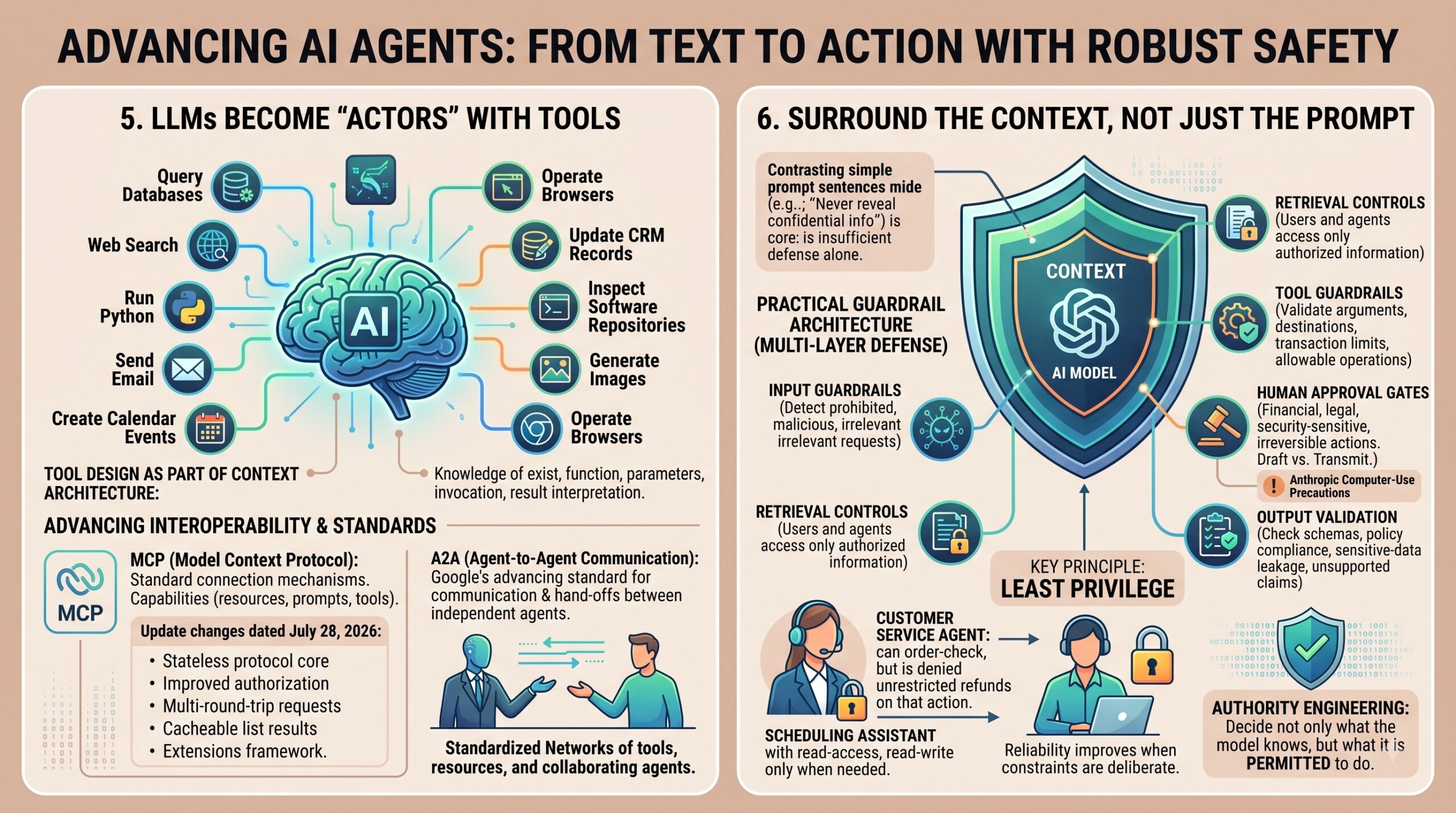
A language model on its own primarily predicts and generates content. Tools allow it to interact with the world. A tool may query a database, search the web, run Python, send an email, create a calendar event, update a CRM record, inspect a software repository, generate an image or operate a browser. Modern agent frameworks therefore treat tool design as part of context architecture. The model must know which tools exist, what each tool does, what parameters it accepts, when it is appropriate to invoke it and how to interpret the result.
Interoperability is also becoming more important. The Model Context Protocol, or MCP, provides a standard mechanism for connecting AI applications with external tools and data sources. The current MCP specification dated July 28, 2026 formalises capabilities including resources, prompts and tools, while the latest release introduces changes including a stateless protocol core, improved authorization, multi-round-trip requests, cacheable list results and an extensions framework. Google is also advancing Agent-to-Agent, or A2A, for communication and hand-offs between independent agents. These developments point toward an ecosystem in which AI applications do not merely contain isolated proprietary integrations; they increasingly participate in standardized networks of tools, resources and collaborating agents.
6. Guardrails must surround the context, not merely appear inside the prompt
One of the most dangerous mistakes in AI deployment is treating safety instructions as sentences inside the system prompt: “Never reveal confidential information,” “Do not perform dangerous actions,” or “Ask before making a payment.” Those instructions are useful, but they should not be the only defence. In an agentic system, safeguards need to exist at several layers—before model invocation, around retrieval, around each tool call, at the permission layer, during output validation and at high-impact workflow transitions.
This becomes especially important when agents can take consequential actions. An assistant that drafts a payment is fundamentally different from one that can authorize and transmit the payment. A research agent that reads public websites carries different risks from an agent with unrestricted access to internal systems. Anthropic’s computer-use documentation similarly emphasizes additional precautions when models can directly control browsers and desktop environments. Context engineering therefore includes authority engineering: deciding not only what the model knows, but what it is permitted to do.
A practical guardrail architecture may include:
- Input guardrails to detect prohibited, malicious or irrelevant requests.
- Retrieval controls so users and agents can only access information they are authorised to see.
- Tool guardrails validating arguments, destinations, transaction limits and allowable operations.
- Human approval gates before financial, legal, security-sensitive or irreversible actions.
- Output validation checking schemas, policy compliance, sensitive-data leakage and unsupported claims.
The key principle is least privilege. Give an agent only the information and capabilities required for the current task. A customer-service agent that merely checks an order should not automatically receive permission to issue unrestricted refunds. A scheduling assistant may need read access to an executive’s calendar before it receives write access. Reliability improves when context and capabilities are deliberately constrained rather than universally available. Excellent individualised mentoring programmes available.
7. Workflow architecture is replacing the idea of one giant intelligent prompt
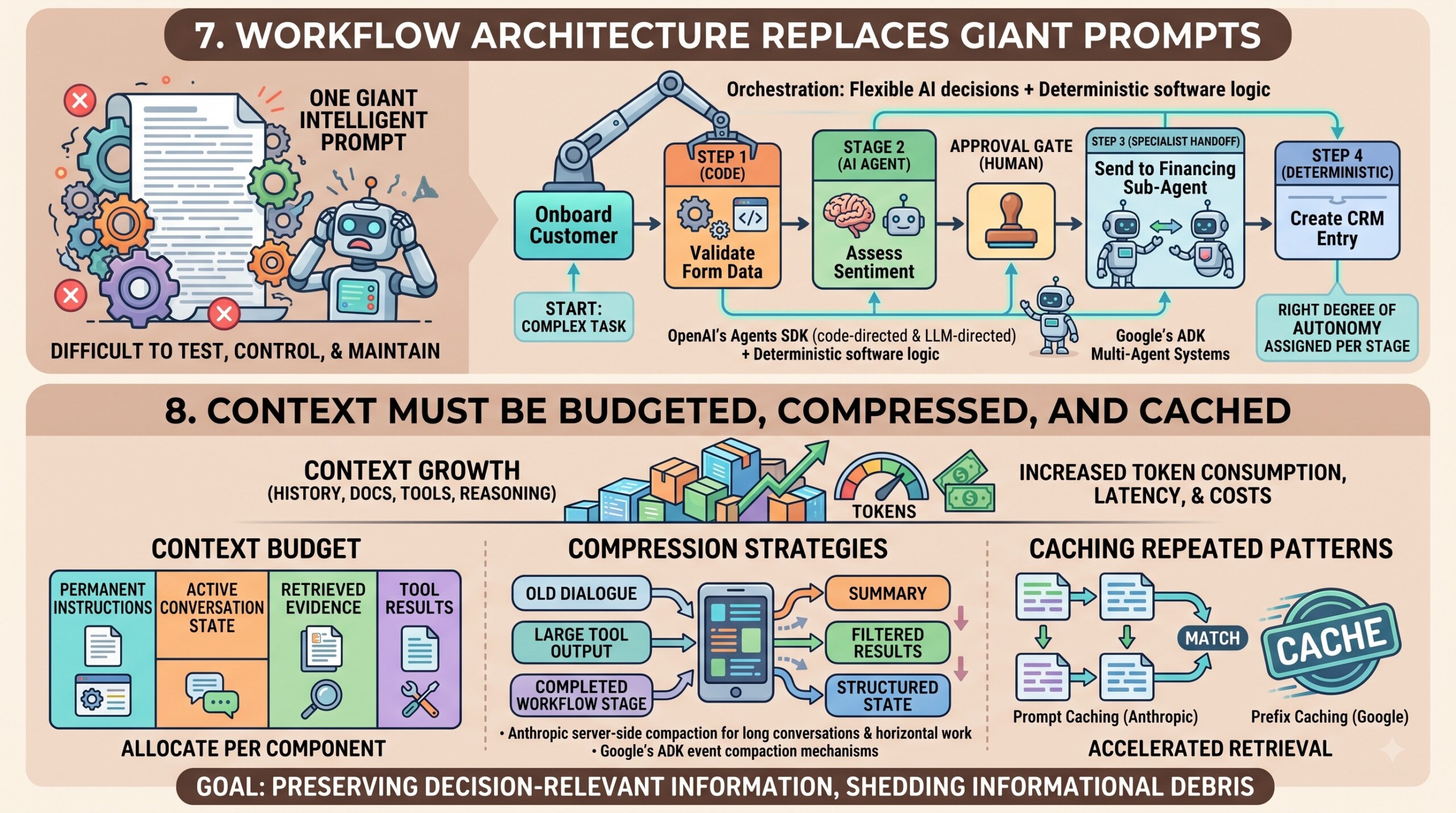
Many practical tasks are processes, not questions. “Onboard this customer”, “investigate this incident”, “prepare the quarterly business review” or “research a potential acquisition” can involve dozens of actions, decisions, dependencies and validations. Trying to encode the entire process inside one enormous prompt makes the system difficult to test, control and maintain. Modern frameworks increasingly separate model reasoning from application orchestration. OpenAI’s Agents SDK, for instance, supports both LLM-directed orchestration and code-directed orchestration, allowing developers to combine flexible AI decisions with deterministic software logic.
This leads to workflow architecture: breaking work into stages, defining state transitions, identifying deterministic steps, deciding when an LLM is required, selecting tools, inserting approval points and specifying recovery behaviour when something fails. Some stages may be conventional code; others may involve an agent; still others may call specialist sub-agents. OpenAI’s handoff mechanism allows one agent to transfer tasks to another specialist, while Google’s ADK work demonstrates architectures designed for context-aware multi-agent systems. The best systems are therefore not necessarily the most autonomous. They are the systems that assign the right degree of autonomy to each stage of the workflow.
8. Context must be budgeted, compressed and cached
A large context window can be valuable, but it should not become an excuse for poor architecture. Conversation history, retrieved documents, tool outputs and intermediate reasoning can accumulate rapidly in long-running agents. Eventually, the system pays for this in token consumption, latency and sometimes accuracy. Anthropic’s current documentation explicitly identifies server-side compaction as a primary strategy for long-running conversations approaching context limits, and its engineering guidance discusses compaction, structured memory and sub-agent architectures as complementary strategies for long-horizon work.
Context engineering therefore requires a context budget. Permanent instructions may deserve one allocation; active conversation state another; retrieved evidence another; tool results another. Old dialogue might be summarised after a task boundary. Large tool outputs can be filtered before being returned to the model. Completed workflow stages can be compressed into structured state. Repeated stable prefixes can be cached. Anthropic, for example, supports prompt caching for repeated context, while Google’s ADK has introduced event compaction mechanisms for controlling context growth. The design goal is not to make the model remember every token it has ever encountered. It is to preserve decision-relevant information while shedding informational debris. Subscribe to our free AI newsletter now.
9. Observability and evaluation become part of context engineering
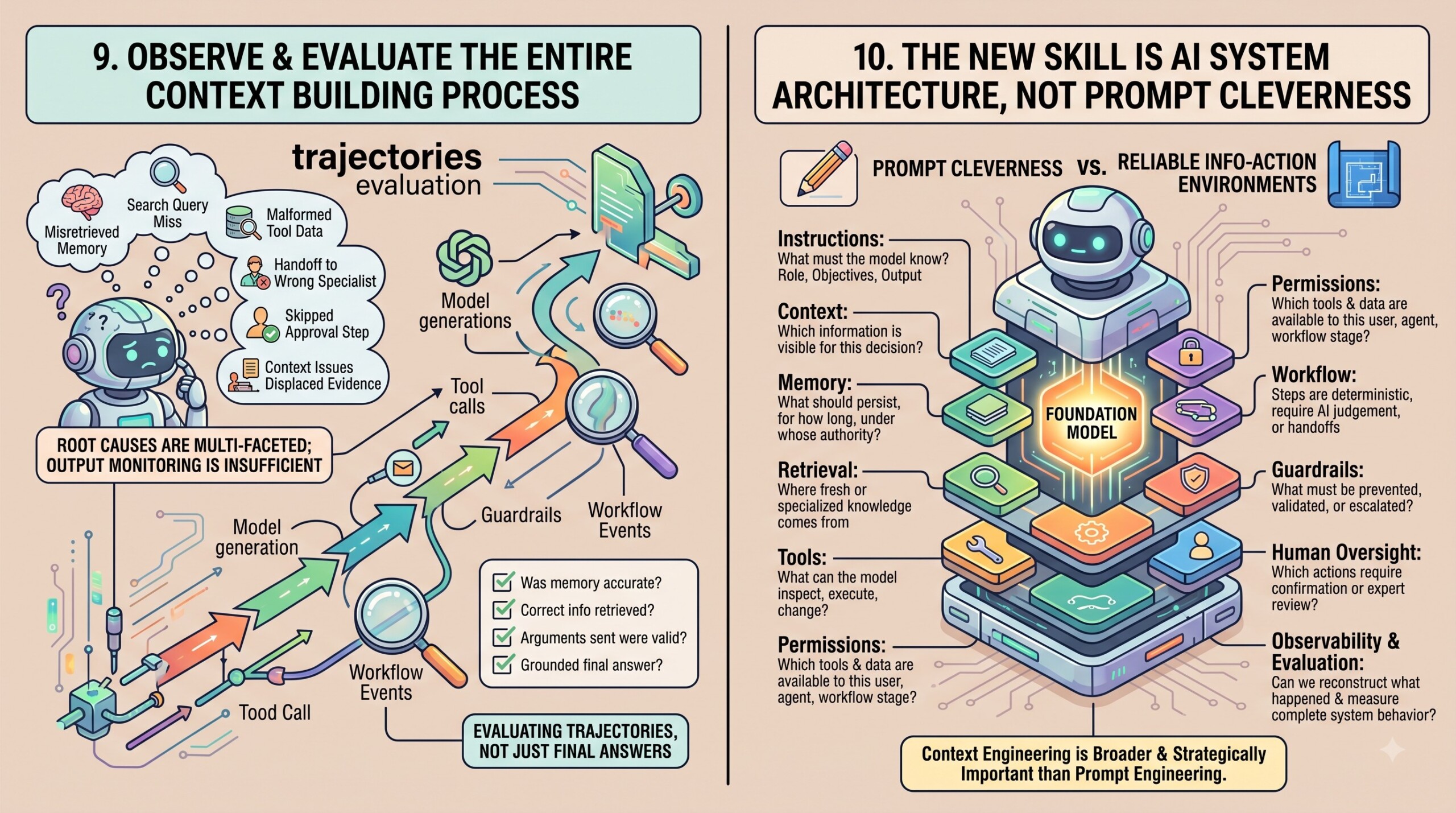
When an ordinary chatbot produces a poor answer, a developer might inspect the prompt. When an agent fails, the root cause can be anywhere: an incorrect memory may have been retrieved, a search query may have missed the right document, a tool may have returned malformed data, a handoff may have selected the wrong specialist, an approval step may have been skipped, or irrelevant context may have displaced important evidence. This is why production AI requires more than output monitoring. The entire context-building process needs to be observable.
OpenAI’s Agents SDK tracing system records model generations, tool calls, handoffs, guardrails and custom workflow events, making it possible to inspect how an agent reached an outcome. Evaluation should therefore expand beyond “Was the final answer good?” A mature evaluation framework asks whether the correct information was retrieved, whether memory was accurate, whether the correct tool was chosen, whether the arguments sent to that tool were valid, whether permissions were respected, whether context was unnecessarily large, whether the agent escalated appropriately and whether the final answer remained grounded in evidence. We are moving from evaluating prompts to evaluating trajectories.
10. The new skill is AI system architecture, not prompt cleverness
A useful mental model is to treat an AI application as a stack. At the centre sits the foundation model, but around it sit instructions, state, memory, retrieval, tools, permissions, orchestration, human oversight, observability and evaluation.
For practitioners, the consequence is significant. The high-value question is no longer “Who can write the cleverest prompt?” It is “Who can design the most reliable information-and-action environment around an intelligent model?” Context engineering draws on software architecture, information retrieval, data engineering, security, UX, knowledge management, workflow design and AI evaluation. That makes it both broader and more strategically important than traditional prompt engineering.
A useful context-engineering checklist for any serious AI application is:
- Instructions: What must the model know about its role, objective, constraints and expected output?
- Context: Which information deserves to be visible for this particular decision?
- Memory: What should persist, for how long, and under whose authority?
- Retrieval: Where should fresh or specialised knowledge come from, and how will relevance be measured?
- Tools: What can the model inspect, calculate, create, change or execute?
- Permissions: Which tools and data should be available to this user, agent and workflow stage?
- Workflow: Which steps are deterministic, which require AI judgement, and where are handoffs needed?
- Guardrails: What must be prevented, validated or escalated?
- Human oversight: Which actions require confirmation or expert review?
- Observability and evaluation: Can we reconstruct what happened and measure whether the complete system behaved correctly?
Once these questions are answered, prompt engineering fits naturally inside the architecture rather than carrying the impossible burden of controlling the entire system. The prompt remains important – but it becomes one carefully engineered source of context among many. Upgrade your AI-readiness with our masterclass.
Conclusion
The move from prompt engineering to context engineering represents a maturation of generative AI. Early experimentation taught us how to communicate with models; the next stage is teaching organisations how to surround those models with the right knowledge, memory, tools, permissions and processes. The winning AI systems will not simply have excellent prompts or the largest possible context windows. They will retrieve selectively, remember deliberately, use tools safely, compress intelligently, expose only necessary permissions, involve humans at consequential moments and maintain enough observability to understand why an agent behaved as it did. Prompt engineering asks, “What should I say to the AI?” Context engineering asks the more powerful question: “What should this AI know, remember, retrieve, see, use and be allowed to do at this precise moment in the workflow?” That is the architectural shift defining serious AI deployment in 2026.